Page 315 of 458

6-5
Fuels containing MMT can reduce the life of spark
plugs and the performance of the emission control
system may be affected. The malfunction indicator lamp
may turn on. If this occurs, return to your authorized
GM dealer for service.
To provide cleaner air, all gasolines in the United States
are now required to contain additives that will help
prevent engine and fuel system deposits from forming,
allowing your emission control system to work properly.
You should not have to add anything to your fuel.
Gasolines containing oxygenates, such as ethers and
ethanol, and reformulated gasolines may be available in
your area to contribute to clean air. General Motors
recommends that you use these gasolines, particularly if
they comply with the specifications described earlier.
NOTICE:
Your vehicle was not designed for fuel that
contains methanol. Don't use fuel containing
methanol. It can corrode metal parts in your fuel
system and also damage plastic and rubber parts.
That damage wouldn't be covered under your
warranty.
Fuel E-85 (85% Ethanol)
The 8th digit of your vehicle identification number
(VIN) shows the code letter or number that identifies
your engine. You will find the VIN at the top left of the
instrument panel. See ªVehicle Identification Numberº
in the Index.
If your vehicle has the 2200 L4 engine (VIN Code 5),
you may use either regular unleaded gasoline or ethanol
fuel containing up to 85% ethanol (E
-85); also see
ªFuel (Gasoline)º listed previously. If your vehicle has
the 4.3L V6 engine use only regular unleaded gasoline.
Only vehicles with the 2200 L4 engine (VIN Code 5)
may use 85% ethanol fuel (E
-85).
Many service stations will not have an 85% ethanol
fuel (E
-85) pump available. The U. S. Department
of Energy has an alternative fuels website
(http://afdcmap.nrel.gov/nrel/) that can help you find E
-85
fuel. Those stations that do have E
-85 should have a label
indicating ethanol content. Do not use the fuel if the
ethanol content is greater than 85%. Your vehicle may not
operate properly if the ethanol content is greater than 85%.
At a minimum, E
-85 should meet
ASTM Specification D 5798.
Page 316 of 458

6-6
To insure quick starts in the wintertime, the E-85 fuel
must be formulated properly for your climate according
to ASTM specification D 5798. If you have trouble
starting on E
-85, it may be because your E-85 fuel is
not properly formulated for your climate. If this
happens, switching to gasoline or adding gasoline to
your fuel tank may improve starting. Your vehicle is
designed to accommodate a mixture of gasoline and
E
-85 fuel. For good starting and heater efficiency below
32�F (0�C), the fuel mix in the fuel tank should contain
no more than 70% ethanol.
E
-85 has less energy per gallon than gasoline, so you'll
need to refill your fuel tank more often when using E
-85
than when you're using gasoline. Use regular gasoline
when pulling a trailer. For payload capacity with ethanol
fuel see ªLoading Your Vehicleº in the Index.
NOTICE:
Some additives are not compatible with E-85 fuel
and may harm your fuel system. Damage caused
by additives wouldn't be covered by your new
vehicle warranty. Don't use additives with
E
-85 fuel.
NOTICE:
Your vehicle was not designed for fuel that
contains methanol. It can corrode metal parts
in your fuel system and also damage plastic and
rubber parts. That damage wouldn't be covered
under your warranty. Don't use fuel containing
methanol.
Page 317 of 458
6-7
Fuels in Foreign Countries
If you plan on driving in another country outside the
United States or Canada, the proper fuel may be hard to
find. Never use leaded gasoline or any other fuel not
recommended in the previous text on fuel. Costly repairs
caused by use of improper fuel wouldn't be covered by
your warranty.
To check on fuel availability, ask an auto club, or
contact a major oil company that does business in the
country where you'll be driving.
Filling Your Tank
CAUTION:
Fuel vapor is highly flammable. It burns
violently, and that can cause very bad injuries.
Don't smoke if you're near fuel or refueling your
vehicle. Keep sparks, flames and smoking
materials away from fuel.
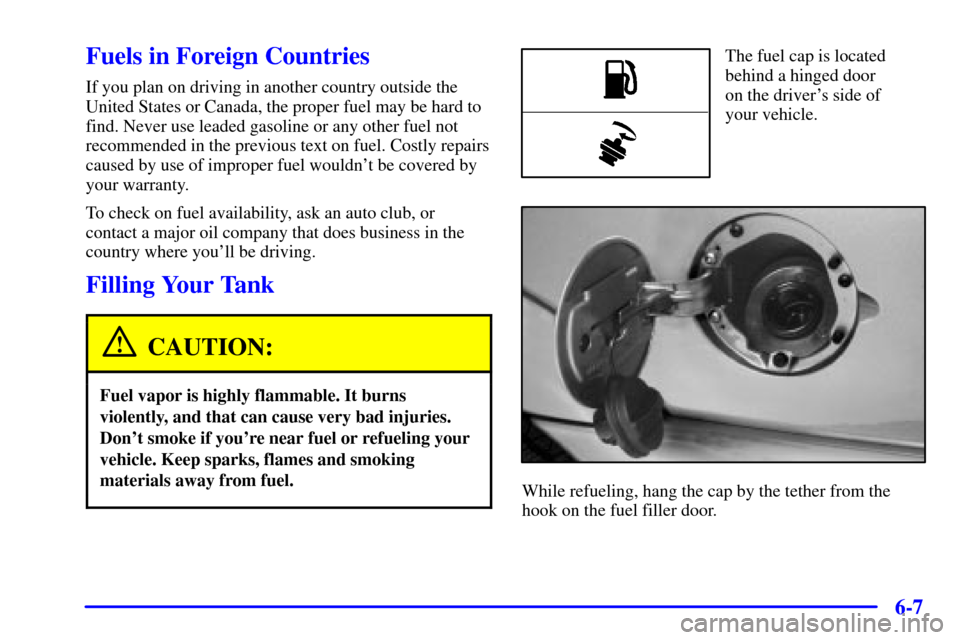
The fuel cap is located
behind a hinged door
on the driver's side of
your vehicle.
While refueling, hang the cap by the tether from the
hook on the fuel filler door.
Page 318 of 458

6-8
To remove the fuel cap, turn it slowly to the left
(counterclockwise). The fuel cap has a spring in it; if
you let go of the cap too soon, it will spring back to
the right.
CAUTION:
If you get fuel on yourself and then something
ignites it, you could be badly burned. Fuel can
spray out on you if you open the fuel cap too
quickly. This spray can happen if your tank is
nearly full, and is more likely in hot weather.
Open the fuel cap slowly and wait for any ªhissº
noise to stop. Then unscrew the cap all the way.
Be careful not to spill fuel. Clean fuel from painted
surfaces as soon as possible. See ªCleaning the Outside
of Your Vehicleº in the Index.When you put the fuel cap back on, turn it to the right
(clockwise) until you hear a clicking sound. Make sure
you fully install the cap. The diagnostic system can
determine if the fuel cap has been left off or improperly
installed. This would allow fuel to evaporate into the
atmosphere. See ªMalfunction Indicator Lampº in
the Index.
NOTICE:
If you need a new fuel cap, be sure to get the
right type. Your dealer can get one for you. If you
get the wrong type, it may not fit properly. This
may cause your malfunction indicator lamp to
light and may damage your fuel tank and
emissions system. See ªMalfunction Indicator
Lampº in the Index.
Page 319 of 458

6-9
Filling a Portable Fuel Container
CAUTION:
Never fill a portable fuel container while it is in
your vehicle. Static electricity discharge from the
container can ignite the gasoline vapor. You can
be badly burned and your vehicle damaged if this
occurs. To help avoid injury to you and others:
�Dispense gasoline only into approved
containers.
�Do not fill a container while it is inside a
vehicle, in a vehicle's trunk, pickup bed or
on any surface other than the ground.
�Bring the fill nozzle in contact with the
inside of the fill opening before operating
the nozzle. Contact should be maintained
until the filling is complete.
�Don't smoke while pumping gasoline.
Checking Things Under the Hood
CAUTION:
Things that burn can get on hot engine parts and
start a fire. These include liquids like fuel, oil,
coolant, brake fluid, windshield washer and other
fluids, and plastic or rubber. You or others could
be burned. Be careful not to drop or spill things
that will burn onto a hot engine.
Page 323 of 458
6-13
Engine Oil
Checking Engine Oil
It's a good idea to check your engine oil every time you
get fuel. In order to get an accurate reading, the oil must
be warm and the vehicle must be on level ground.
The engine oil dipstick
handle on the ªVORTECº
2200 L4 engine is under
the fill cap.
The engine oil dipstick
handle on theªVORTECº
4300 V6 engine is a
yellow ring.
See ªEngine Compartment Overviewº in the Index for
more information on location.
Turn off the engine and give the oil several minutes to
drain back into the oil pan. If you don't, the oil dipstick
might not show the actual level.
Page 326 of 458

6-16
As in the chart shown previously, SAE 5W-30 is best for
your vehicle. However, you can use SAE 10W
-30 if it's
going to be 0�F (
-18�C) or above. These numbers on an
oil container show its viscosity, or thickness. Do not use
other viscosity oils, such as SAE 20W
-50.
NOTICE:
Use only engine oil with the American
Petroleum Institute Certified For Gasoline
Engines starburst symbol. Failure to use the
recommended oil can result in engine damage
not covered by your warranty.
GM Goodwrench� oil meets all the requirements for
your vehicle.
If you are in an area where the temperature falls below
-20�F (-29�C), consider using either an SAE 5W-30
synthetic oil or an SAE 0W
-30 oil. Both will provide
easier cold starting and better protection for your engine
at extremely low temperatures.
Engine Oil Additives
Don't add anything to your oil. The recommended oils
with the starburst symbol are all you will need for good
performance and engine protection.
When to Change Engine Oil
If any one of these is true for you, use the short trip/city
maintenance schedule:
�Most trips are less than 5 miles (8 km). This is
particularly important when outside temperatures are
below freezing.
�Most trips include extensive idling (such as frequent
driving in stop
-and-go traffic).
�Your vehicle has a 2200 L4 (Code 5) flexible fuel
engine and you have used E
-85 ethanol fuel.
�You frequently tow a trailer.
�The vehicle is used for delivery service, police, taxi
or other commercial application.
Page 358 of 458

6-48 Inflation -- Tire Pressure
The Certification/Tire label, which is on the driver's
door edge, above the door latch, shows the correct
inflation pressures for your tires when they're cold.
ªColdº means your vehicle has been sitting for at least
three hours or driven no more than 1 mile (1.6 km).
NOTICE:
Don't let anyone tell you that underinflation or
overinflation is all right. It's not. If your tires
don't have enough air (underinflation), you can
get the following:
�Too much flexing
�Too much heat
�Tire overloading
�Bad wear
�Bad handling
�Bad fuel economy
NOTICE: (Continued)
NOTICE: (Continued)
If your tires have too much air (overinflation),
you can get the following:
�Unusual wear
�Bad handling
�Rough ride
�Needless damage from road hazards
When to Check
Check your tires once a month or more. Also, check the
tire pressure of the spare tire.
If you have a compact spare tire, it should be at
60 psi (420 kPa).
How to Check
Use a good quality pocket
-type gage to check tire
pressure. You can't tell if your tires are properly inflated
simply by looking at them. Radial tires may look
properly inflated even when they're underinflated.
Be sure to put the valve caps back on the valve stems.
They help prevent leaks by keeping out dirt and
moisture.