Page 224 of 341
5-23
CAUTION:
Getting under a vehicle when it is jacked up is
dangerous. If the vehicle slips off the jack, you
could be badly injured or killed. Never get under
a vehicle when it is supported only by a jack.
CAUTION:
Raising your vehicle with the jack improperly
positioned can damage the vehicle and even
make the vehicle fall. To help avoid personal
injury and vehicle damage, be sure to fit the jack
lift head into the proper location before raising
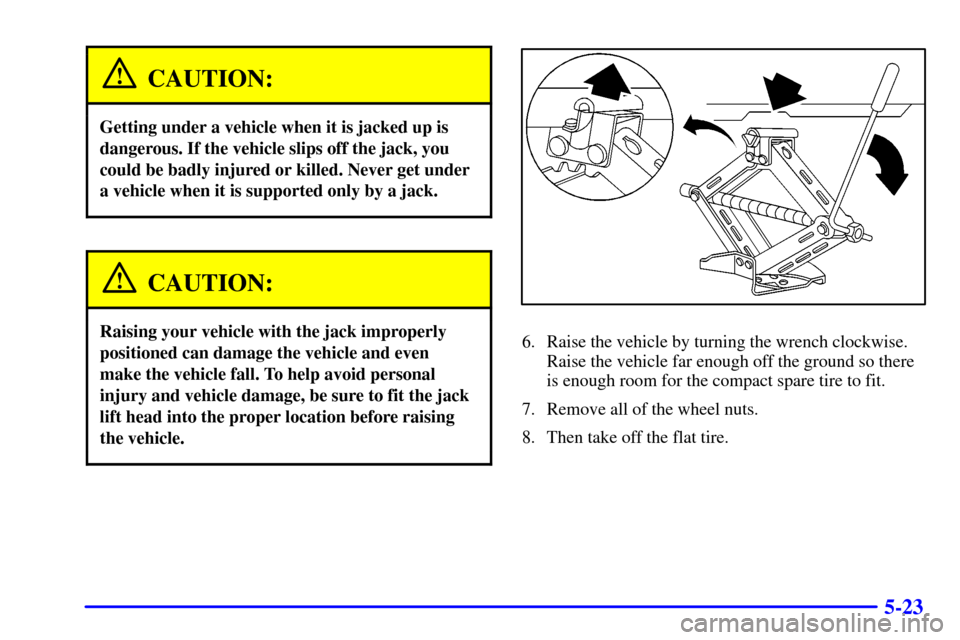
the vehicle.6. Raise the vehicle by turning the wrench clockwise.
Raise the vehicle far enough off the ground so there
is enough room for the compact spare tire to fit.
7. Remove all of the wheel nuts.
8. Then take off the flat tire.
Page 226 of 341
5-25
CAUTION:
Never use oil or grease on studs or nuts. If you
do, the nuts might come loose. Your wheel could
fall off, causing a serious accident.
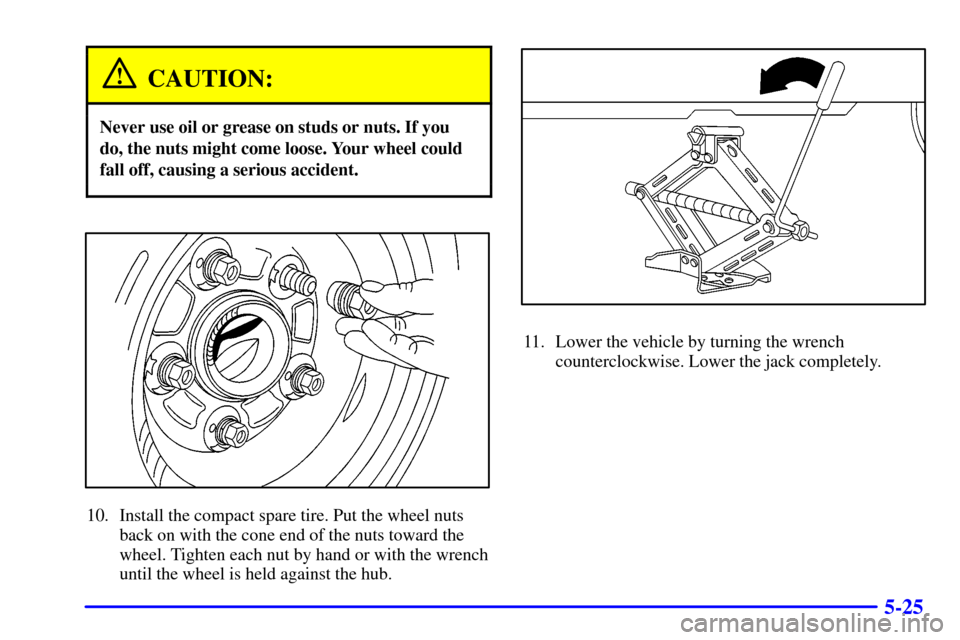
10. Install the compact spare tire. Put the wheel nuts
back on with the cone end of the nuts toward the
wheel. Tighten each nut by hand or with the wrench
until the wheel is held against the hub.
11. Lower the vehicle by turning the wrench
counterclockwise. Lower the jack completely.
Page 238 of 341
6-7
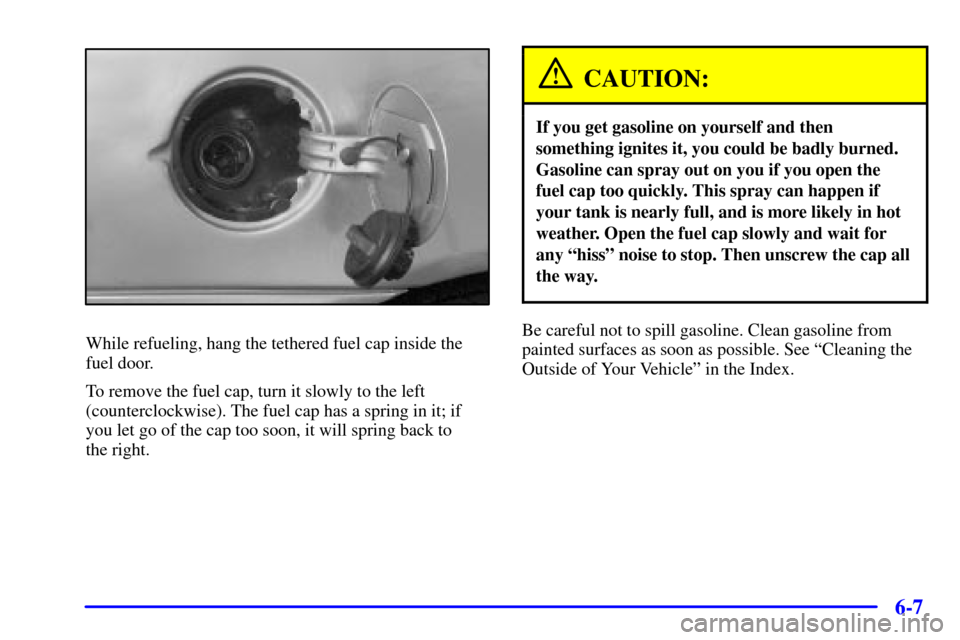
While refueling, hang the tethered fuel cap inside the
fuel door.
To remove the fuel cap, turn it slowly to the left
(counterclockwise). The fuel cap has a spring in it; if
you let go of the cap too soon, it will spring back to
the right.
CAUTION:
If you get gasoline on yourself and then
something ignites it, you could be badly burned.
Gasoline can spray out on you if you open the
fuel cap too quickly. This spray can happen if
your tank is nearly full, and is more likely in hot
weather. Open the fuel cap slowly and wait for
any ªhissº noise to stop. Then unscrew the cap all
the way.
Be careful not to spill gasoline. Clean gasoline from
painted surfaces as soon as possible. See ªCleaning the
Outside of Your Vehicleº in the Index.
Page 239 of 341
6-8
When you put the fuel cap back on, turn it to the right
(clockwise) until you hear a clicking sound. Make sure
you fully install the cap. The diagnostic system can
determine if the fuel cap has been left off or improperly
installed. This would allow fuel to evaporate into the
atmosphere. See ªMalfunction Indicator Lampº in
the Index.
NOTICE:
If you need a new fuel cap, be sure to get the
right type. Your dealer can get one for you. If you
get the wrong type, it may not fit properly. This
may cause your malfunction indicator lamp to
light and may damage your fuel tank and
emissions system. See ªMalfunction Indicator
Lampº in the Index.
Filling a Portable Fuel Container
CAUTION:
Never fill a portable fuel container while it is in
your vehicle. Static electricity discharge from the
container can ignite the gasoline vapor. You can
be badly burned and your vehicle damaged if this
occurs. To help avoid injury to you and others:
�Dispense gasoline only into
approved containers.
�Do not fill a container while it is inside a
vehicle, in a vehicle's trunk, pickup bed or
on any surface other than the ground.
�Bring the fill nozzle in contact with the
inside of the fill opening before operating
the nozzle. Contact should be maintained
until the filling is complete.
�Don't smoke while pumping gasoline.
Page 242 of 341
6-11 Engine Compartment Overview
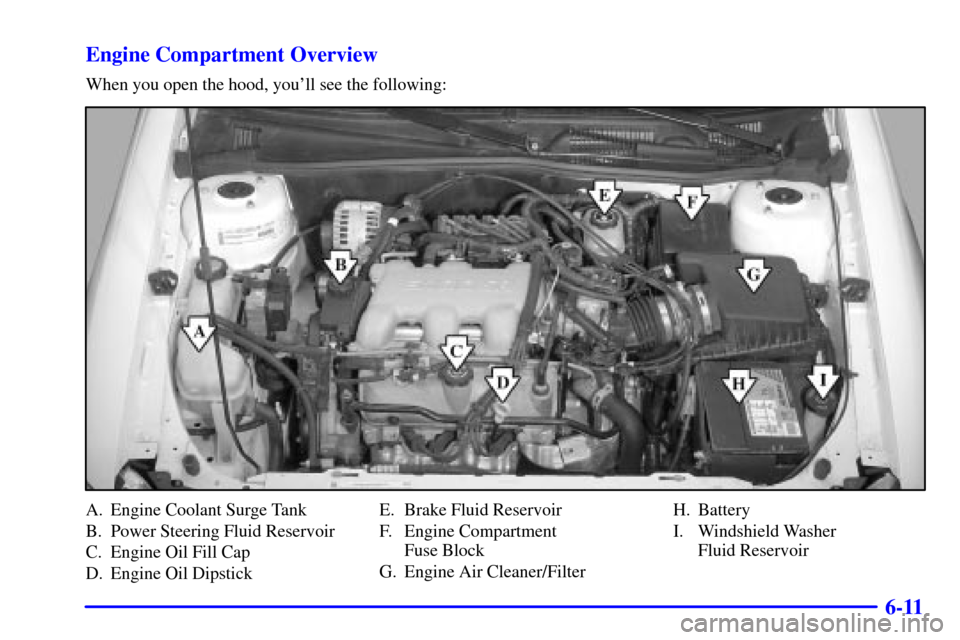
When you open the hood, you'll see the following:
A. Engine Coolant Surge Tank
B. Power Steering Fluid Reservoir
C. Engine Oil Fill Cap
D. Engine Oil DipstickE. Brake Fluid Reservoir
F. Engine Compartment
Fuse Block
G. Engine Air Cleaner/FilterH. Battery
I. Windshield Washer
Fluid Reservoir
Page 261 of 341
6-30
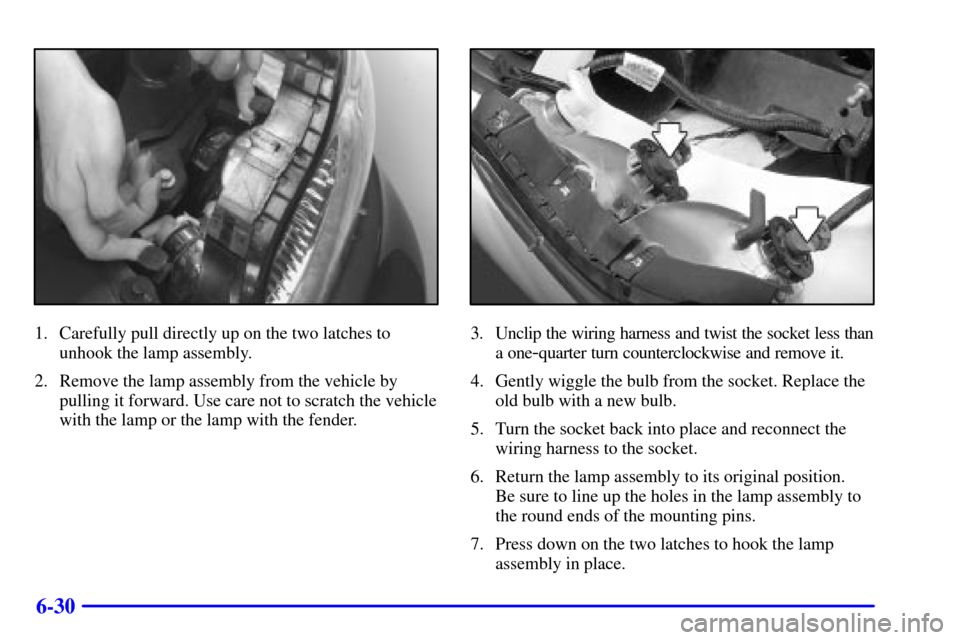
1. Carefully pull directly up on the two latches to
unhook the lamp assembly.
2. Remove the lamp assembly from the vehicle by
pulling it forward. Use care not to scratch the vehicle
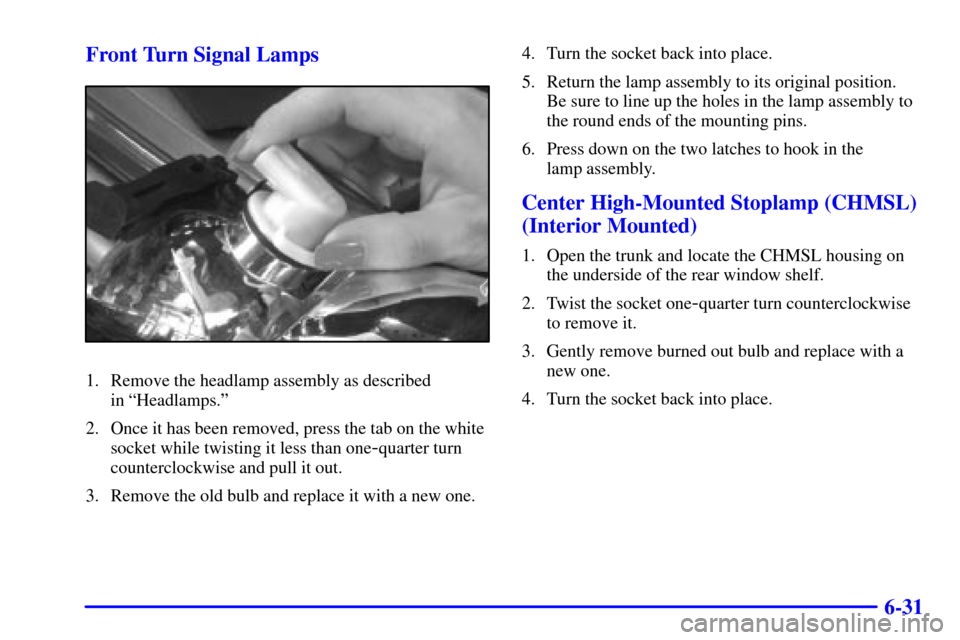
with the lamp or the lamp with the fender.3. Unclip the wiring harness and twist the socket less than
a one
-quarter turn counterclockwise and remove it.
4. Gently wiggle the bulb from the socket. Replace the
old bulb with a new bulb.
5. Turn the socket back into place and reconnect the
wiring harness to the socket.
6. Return the lamp assembly to its original position.
Be sure to line up the holes in the lamp assembly to
the round ends of the mounting pins.
7. Press down on the two latches to hook the lamp
assembly in place.
Page 262 of 341
6-31 Front Turn Signal Lamps
1. Remove the headlamp assembly as described
in ªHeadlamps.º
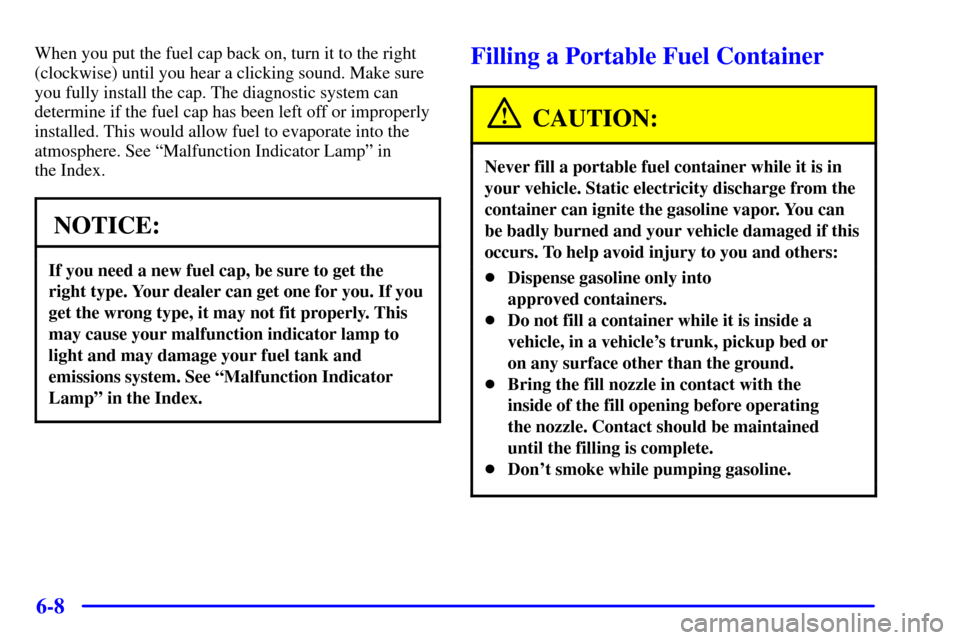
2. Once it has been removed, press the tab on the white
socket while twisting it less than one
-quarter turn
counterclockwise and pull it out.
3. Remove the old bulb and replace it with a new one.4. Turn the socket back into place.
5. Return the lamp assembly to its original position.
Be sure to line up the holes in the lamp assembly to
the round ends of the mounting pins.
6. Press down on the two latches to hook in the
lamp assembly.
Center High-Mounted Stoplamp (CHMSL)
(Interior Mounted)
1. Open the trunk and locate the CHMSL housing on
the underside of the rear window shelf.
2. Twist the socket one
-quarter turn counterclockwise
to remove it.
3. Gently remove burned out bulb and replace with a
new one.
4. Turn the socket back into place.
Page 284 of 341
6-53
Electrical System
Add-On Electrical Equipment
NOTICE:
Don't add anything electrical to your vehicle
unless you check with your dealer first. Some
electrical equipment can damage your vehicle
and the damage wouldn't be covered by your
warranty. Some add
-on electrical equipment
can keep other components from working as
they should.
Your vehicle has an air bag system. Before attempting to
add anything electrical to your vehicle, see ªServicing
Your Air Bag
-Equipped Vehicleº in the Index.
Headlamp Wiring
The headlamp wiring is protected by fuses, one for each
headlamp, in the fuse block. An electrical overload will
cause the lamps to turn off. If this happens, have your
headlamp wiring checked right away.
Windshield Wipers
The windshield wiper motor is protected by an internal
circuit breaker and a fuse. If the motor overheats due to
heavy snow, etc., the wiper will stop until the motor
cools. If the overload is caused by some electrical
problem and not snow, etc., be sure to get it fixed.
Power Windows and Other Power Options
Circuit breakers in the fuse block protect the power
windows and other power accessories. When the current
load is too heavy, the circuit breaker opens and closes,
protecting the circuit until the problem is fixed or
goes away.