Page 205 of 341
5-4
2. Get the vehicles close enough so the jumper cables
can reach, but be sure the vehicles aren't touching
each other. If they are, it could cause a ground
connection you don't want. You wouldn't be able to
start your vehicle, and the bad grounding could
damage the electrical systems.
To avoid the possibility of the vehicles rolling, set
the parking brake firmly on both vehicles involved in
the jump start procedure. Put an automatic transaxle
in PARK (P) or a manual transaxle in NEUTRAL
before setting the parking brake.
NOTICE:
If you leave your radio on, it could be badly
damaged. The repairs wouldn't be covered by
your warranty.
3. Turn off the ignition on both vehicles. Unplug
unnecessary accessories plugged into the cigarette
lighter or in the accessory power outlet. Turn off the
radio and all lamps that aren't needed. This will
avoid sparks and help save both batteries. And it
could save your radio!
4. Open the hoods and locate the batteries. Find the
positive (+) and negative (
-) terminal locations on
each vehicle. See ªEngine Compartment Overviewº
in the Index for more information on location.
CAUTION:
An electric fan can start up even when the engine
is not running and can injure you. Keep hands,
clothing and tools away from any underhood
electric fan.
Page 206 of 341
5-5
CAUTION:
Using a match near a battery can cause battery
gas to explode. People have been hurt doing this,
and some have been blinded. Use a flashlight if
you need more light.
Be sure the battery has enough water. You don't
need to add water to the ACDelco� battery
installed in every new GM vehicle. But if a
battery has filler caps, be sure the right amount
of fluid is there. If it is low, add water to take
care of that first. If you don't, explosive gas could
be present.
Battery fluid contains acid that can burn you.
Don't get it on you. If you accidentally get it in
your eyes or on your skin, flush the place with
water and get medical help immediately.
5. Check that the jumper cables don't have loose or
missing insulation. If they do, you could get a shock.
The vehicles could be damaged, too.
Before you connect the cables, here are some things
you should know. Positive (+) will go to positive (+)
or to a remote positive (+) terminal if the vehicle has
one. Negative (
-) will go to a heavy, unpainted metal
engine part or to a remote negative (
-) terminal if the
vehicle with the dead battery has one.
Don't connect positive (+) to negative (
-) or you'll
get a short that would damage the battery and maybe
other parts, too. And don't connect the negative (
-)
cable to the negative (
-) terminal on the dead battery
because this can cause sparks.
CAUTION:
Fans or other moving engine parts can injure you
badly. Keep your hands away from moving parts
once the engine is running.
Page 208 of 341
5-7
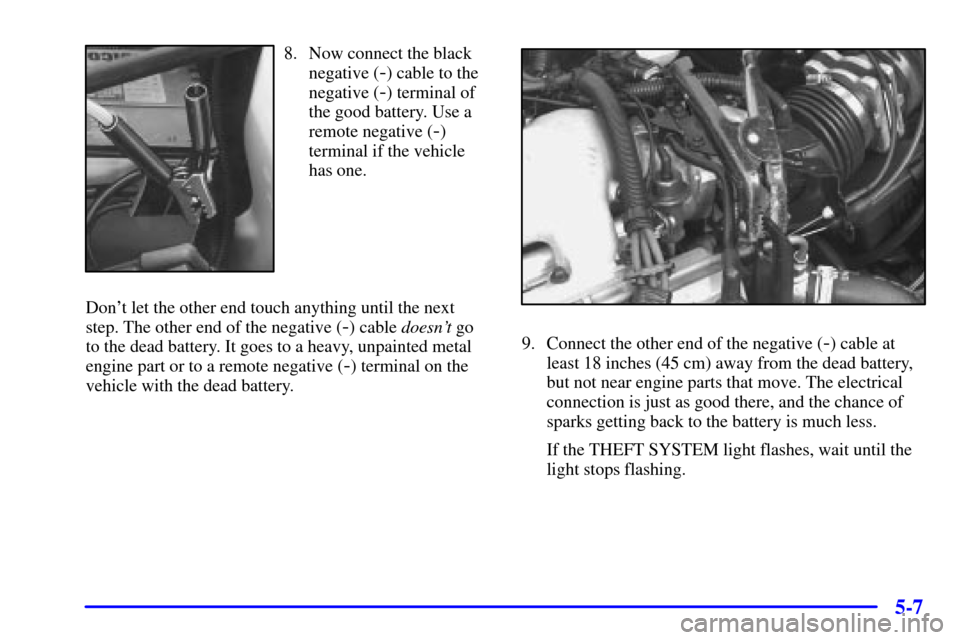
8. Now connect the black
negative (
-) cable to the
negative (
-) terminal of
the good battery. Use a
remote negative (
-)
terminal if the vehicle
has one.
Don't let the other end touch anything until the next
step. The other end of the negative (
-) cable doesn't go
to the dead battery. It goes to a heavy, unpainted metal
engine part or to a remote negative (
-) terminal on the
vehicle with the dead battery.
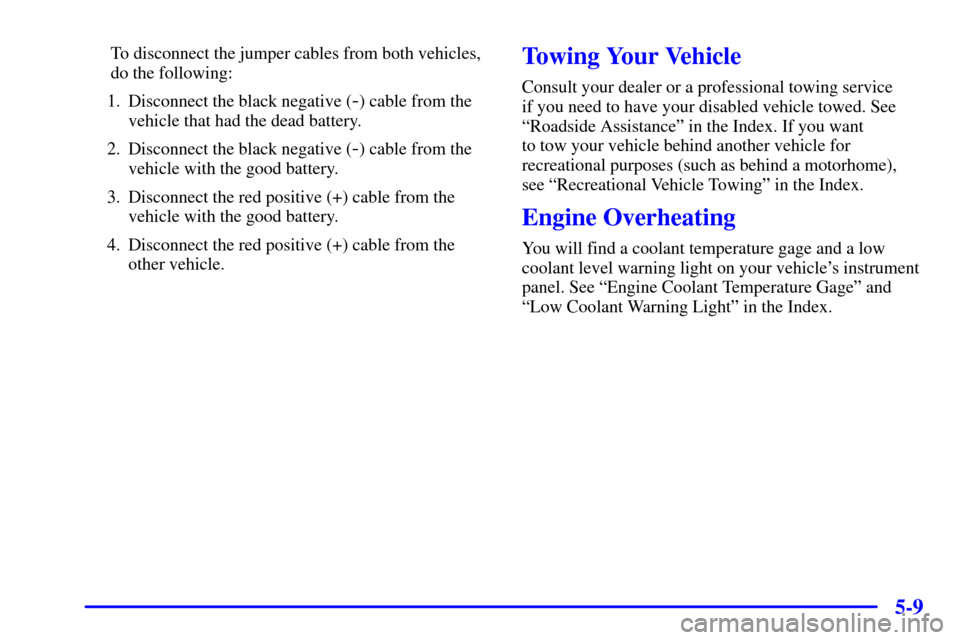
9. Connect the other end of the negative (-) cable at
least 18 inches (45 cm) away from the dead battery,
but not near engine parts that move. The electrical
connection is just as good there, and the chance of
sparks getting back to the battery is much less.
If the THEFT SYSTEM light flashes, wait until the
light stops flashing.
Page 210 of 341
5-9
To disconnect the jumper cables from both vehicles,
do the following:
1. Disconnect the black negative (
-) cable from the
vehicle that had the dead battery.
2. Disconnect the black negative (
-) cable from the
vehicle with the good battery.
3. Disconnect the red positive (+) cable from the
vehicle with the good battery.
4. Disconnect the red positive (+) cable from the
other vehicle.
Towing Your Vehicle
Consult your dealer or a professional towing service
if you need to have your disabled vehicle towed. See
ªRoadside Assistanceº in the Index. If you want
to tow your vehicle behind another vehicle for
recreational purposes (such as behind a motorhome),
see ªRecreational Vehicle Towingº in the Index.
Engine Overheating
You will find a coolant temperature gage and a low
coolant level warning light on your vehicle's instrument
panel. See ªEngine Coolant Temperature Gageº and
ªLow Coolant Warning Lightº in the Index.
Page 212 of 341
5-11 If No Steam Is Coming From Your Engine
An overheat warning, along with a low coolant light,
can indicate a serious problem. See ªLow Coolant
Lightº in the Index.
If you get an engine overheat warning with no low
coolant light, but see or hear no steam, the problem may
not be too serious. Sometimes the engine can get a little
too hot when you:
�Climb a long hill on a hot day.
�Stop after high
-speed driving.
�Idle for long periods in traffic.
�Tow a trailer.
If you get the overheat warning with no sign of steam,
try this for a minute or so:
1. If your air conditioner is on, turn it off.
2. Turn on your heater to full hot at the highest fan
speed and open the window as necessary.
3. If you're in a traffic jam, shift to NEUTRAL (N);
otherwise, shift to the highest gear while
driving
-- AUTOMATIC OVERDRIVE (D).If you no longer have the overheat warning, you can
drive. Just to be safe, drive slower for about 10 minutes.
If the warning doesn't come back on, you can
drive normally.
If the warning continues, pull over, stop, and park your
vehicle right away.
If there's still no sign of steam, idle the engine for three
minutes while you're parked. If you still have the
warning, turn off the engine and get everyone out of the
vehicle until it cools down.
You may decide not to lift the hood but to get service
help right away.
Page 215 of 341
5-14 How to Add Coolant to the Coolant
Surge Tank
NOTICE:
This vehicle has a specific coolant fill procedure.
Failure to follow this procedure could cause your
engine to overheat and be severely damaged.
If you haven't found a problem yet, check to see if
coolant is visible in the surge tank. If coolant is visible
but the coolant level isn't at the FULL COLD mark or
slightly higher, add a 50/50 mixture of clean, drinkable
water and DEX
-COOL� coolant at the coolant surge
tank, but be sure the cooling system, including the
coolant surge tank pressure cap, is cool before you do it.
See ªEngine Coolantº in the Index for more
information.
If no coolant is visible in the surge tank, add coolant
as follows:
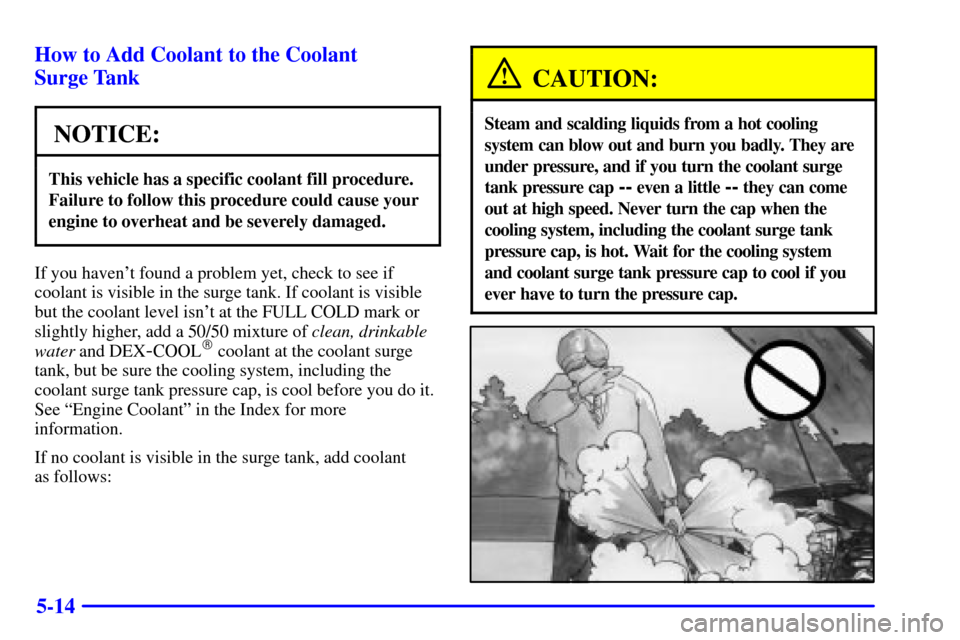
CAUTION:
Steam and scalding liquids from a hot cooling
system can blow out and burn you badly. They are
under pressure, and if you turn the coolant surge
tank pressure cap
-- even a little -- they can come
out at high speed. Never turn the cap when the
cooling system, including the coolant surge tank
pressure cap, is hot. Wait for the cooling system
and coolant surge tank pressure cap to cool if you
ever have to turn the pressure cap.
Page 231 of 341
5-30
If You're Stuck: In Sand, Mud,
Ice or Snow
In order to free your vehicle when it is stuck, you will
need to spin the wheels, but you don't want to spin
your wheels too fast. The method known as ªrockingº
can help you get out when you're stuck, but you must
use caution.
CAUTION:
If you let your tires spin at high speed, they can
explode, and you or others could be injured. And,
the transaxle or other parts of the vehicle can
overheat. That could cause an engine
compartment fire or other damage. When you're
stuck, spin the wheels as little as possible. Don't
spin the wheels above 35 mph (55 km/h) as shown
on the speedometer.
NOTICE:
Spinning your wheels can destroy parts of your
vehicle as well as the tires. If you spin the wheels
too fast while shifting your transaxle back and
forth, you can destroy your transaxle.
For information about using tire chains on your vehicle,
see ªTire Chainsº in the Index.
Rocking Your Vehicle To Get It Out
First, turn your steering wheel left and right. That will
clear the area around your front wheels. Then shift back
and forth between REVERSE (R) and a forward gear,
spinning the wheels as little as possible. Release the
accelerator pedal while you shift, and press lightly on
the accelerator pedal when the transaxle is in gear. By
slowly spinning your wheels in the forward and reverse
directions, you will cause a rocking motion that may
free your vehicle. If that doesn't get you out after a few
tries, you may need to be towed out. If you do need to
be towed out, see ªTowing Your Vehicleº in the Index.
Page 239 of 341
6-8
When you put the fuel cap back on, turn it to the right
(clockwise) until you hear a clicking sound. Make sure
you fully install the cap. The diagnostic system can
determine if the fuel cap has been left off or improperly
installed. This would allow fuel to evaporate into the
atmosphere. See ªMalfunction Indicator Lampº in
the Index.
NOTICE:
If you need a new fuel cap, be sure to get the
right type. Your dealer can get one for you. If you
get the wrong type, it may not fit properly. This
may cause your malfunction indicator lamp to
light and may damage your fuel tank and
emissions system. See ªMalfunction Indicator
Lampº in the Index.
Filling a Portable Fuel Container
CAUTION:
Never fill a portable fuel container while it is in
your vehicle. Static electricity discharge from the
container can ignite the gasoline vapor. You can
be badly burned and your vehicle damaged if this
occurs. To help avoid injury to you and others:
�Dispense gasoline only into
approved containers.
�Do not fill a container while it is inside a
vehicle, in a vehicle's trunk, pickup bed or
on any surface other than the ground.
�Bring the fill nozzle in contact with the
inside of the fill opening before operating
the nozzle. Contact should be maintained
until the filling is complete.
�Don't smoke while pumping gasoline.