Page 210 of 341
5-9
To disconnect the jumper cables from both vehicles,
do the following:
1. Disconnect the black negative (
-) cable from the
vehicle that had the dead battery.
2. Disconnect the black negative (
-) cable from the
vehicle with the good battery.
3. Disconnect the red positive (+) cable from the
vehicle with the good battery.
4. Disconnect the red positive (+) cable from the
other vehicle.
Towing Your Vehicle
Consult your dealer or a professional towing service
if you need to have your disabled vehicle towed. See
ªRoadside Assistanceº in the Index. If you want
to tow your vehicle behind another vehicle for
recreational purposes (such as behind a motorhome),
see ªRecreational Vehicle Towingº in the Index.
Engine Overheating
You will find a coolant temperature gage and a low
coolant level warning light on your vehicle's instrument
panel. See ªEngine Coolant Temperature Gageº and
ªLow Coolant Warning Lightº in the Index.
Page 277 of 341
6-46 Cleaning the Top of the Instrument Panel
Use only mild soap and water to clean the top surfaces
of the instrument panel. Sprays containing silicones or
waxes may cause annoying reflections in the windshield
and even make it difficult to see through the windshield
under certain conditions.
Cleaning Interior Plastic Components
Use only a mild soap and water solution on a soft
cloth or sponge. Commercial cleaners may affect the
surface finish.
Care of Safety Belts
Keep belts clean and dry.
CAUTION:
Do not bleach or dye safety belts. If you do, it
may severely weaken them. In a crash, they
might not be able to provide adequate protection.
Clean safety belts only with mild soap and
lukewarm water.
Cleaning Glass Surfaces
Glass should be cleaned often. GM Glass Cleaner or
a liquid household glass cleaner will remove normal
tobacco smoke and dust films on interior glass. See
ªAppearance Care and Materialsº in the Index.
NOTICE:
Don't use abrasive cleaners on glass, because they
may cause scratches. Avoid placing decals on the
inside rear window, since they may have to be
scraped off later. If abrasive cleaners are used on
the inside of the rear window, an electric
defogger element may be damaged. Any
temporary license should not be attached across
the defogger grid.
Page 283 of 341
6-52
Vehicle Identification Number (VIN)
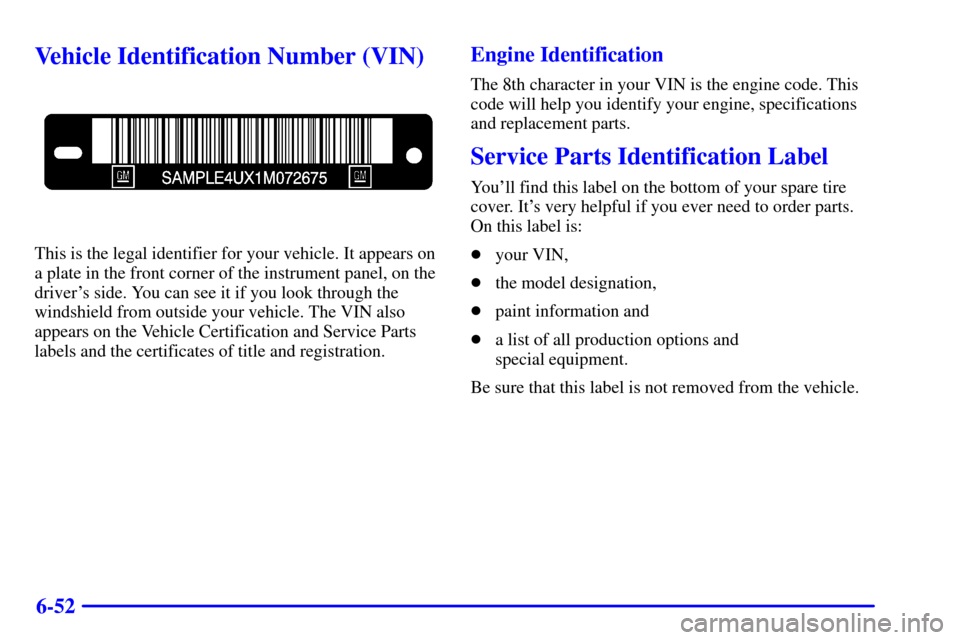
This is the legal identifier for your vehicle. It appears on
a plate in the front corner of the instrument panel, on the
driver's side. You can see it if you look through the
windshield from outside your vehicle. The VIN also
appears on the Vehicle Certification and Service Parts
labels and the certificates of title and registration.
Engine Identification
The 8th character in your VIN is the engine code. This
code will help you identify your engine, specifications
and replacement parts.
Service Parts Identification Label
You'll find this label on the bottom of your spare tire
cover. It's very helpful if you ever need to order parts.
On this label is:
�your VIN,
�the model designation,
�paint information and
�a list of all production options and
special equipment.
Be sure that this label is not removed from the vehicle.
Page 285 of 341
6-54 Fuses and Circuit Breakers
The wiring circuits in your vehicle are protected from
short circuits by a combination of fuses, circuit breakers
and fusible thermal links in the wiring itself.
Look at the silver
-colored band inside the fuse. If the
band is broken or melted, replace the fuse. Be sure you
replace a bad fuse with a new one of the identical size
and rating.
If you ever have a problem on the road and don't have a
spare fuse, you can borrow one that has the same
amperage. Just pick a feature of your vehicle that you
can get along without
-- like the radio or cigarette
lighter
-- and use its fuse, if it is the correct amperage.
Replace it as soon as you can.
There are three fuse blocks in your vehicle: two
instrument panel fuse blocks and the engine
compartment fuse block.
There is a fuse puller located on the engine compartment
fuse block. It can be used to easily remove fuses from
the fuse block.Instrument Panel Fuse Block
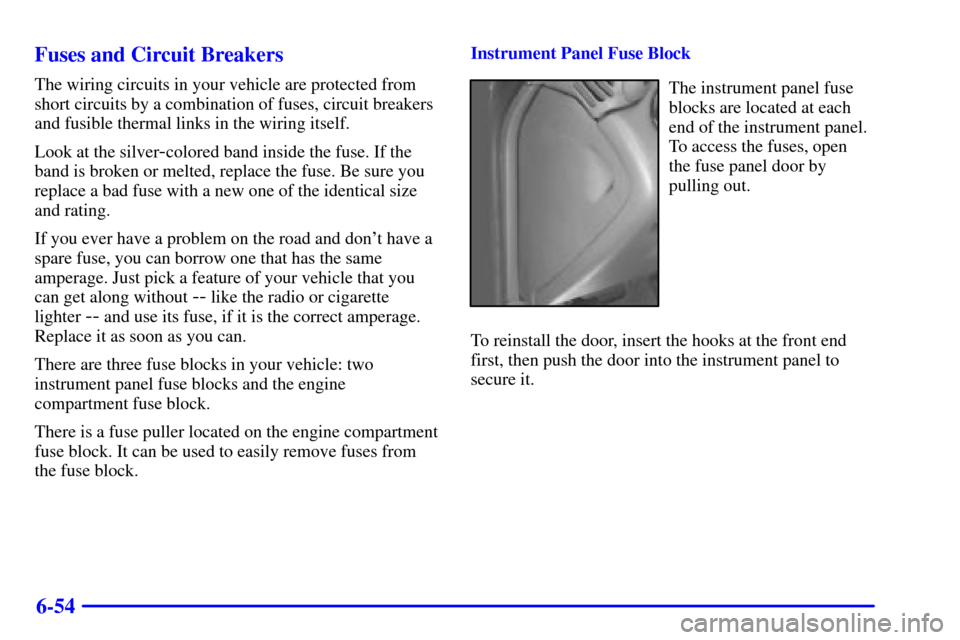
The instrument panel fuse
blocks are located at each
end of the instrument panel.
To access the fuses, open
the fuse panel door by
pulling out.
To reinstall the door, insert the hooks at the front end
first, then push the door into the instrument panel to
secure it.
Page 286 of 341
6-55
Instrument Panel Fuse Block -- Driver's Side
Fuse Usage
A Wipers
B Trunk Release and Remote
Keyless Entry
C Turn Signals
D Power Mirrors
E Air Bag
F Body Function Control ModuleFuse Usage
G Powertrain Control
Module (PCM)
H Door Locks
J Body Function Control
Module/Instrument Panel Cluster
MICRO RELAY
TRUNK RELRemote Trunk Release
CIRCUIT BRKR
PWR SEATSPower Seats
MICRO RELAY
DR UNLOCKDoor Locks
MICRO RELAY
DR LOCKDoor Locks
MICRO RELAY
DRIVERS
DR UNLOCKDoor Locks
STOP LPS Stoplamps
HAZARD LPS Hazard Lamps
IPC/HVAC
BATTCluster, Climate Control
Page 287 of 341
6-56
Instrument Panel Fuse Block -- Passenger's SideFuse Usage
A Instrument Panel Lights,
Brightness Control
B Cruise Control Switches
C Climate Control System
D Cruise Control
E Fog Lamps
F Interior Lamps, Body Function
Control Module
G Radio
H Sunroof
CIRCUIT BRKR
PWR WNDWSPower Windows
MICRO RELAY
FOG LPSFog Lamps
Page 332 of 341

8-3
STEP TWO -- If after contacting a member of
dealership management, it appears your concern cannot
be resolved by the dealership without further help,
contact the Chevrolet Customer Assistance Center by
calling 1-800-222-1020. In Canada, contact GM of Canada
Customer Communication Centre in Oshawa by calling
1-800-263-3777 (English) or 1-800-263-7854 (French).
We encourage you to call the toll-free number in order
to give your inquiry prompt attention. Please have the
following information available to give the Customer
Assistance Representative:
�Vehicle Identification Number (This is available
from the vehicle registration or title, or the plate
at the top left of the instrument panel and visible
through the windshield.)
�Dealership name and location
�Vehicle delivery date and present mileage
When contacting Chevrolet, please remember that
your concern will likely be resolved at a dealer's facility.
That is why we suggest you follow Step One first if
you have a concern.STEP THREE -- Both General Motors and your
dealer are committed to making sure you are
completely satisfied with your new vehicle. However,
if you continue to remain unsatisfied after following the
procedure outlined in Steps One and Two, you should
file with the GM/BBB Auto Line Program to enforce
any additional rights you may have. Canadian owners
refer to your Warranty and Owner Assistance
Information booklet for information on the Canadian
Motor Vehicle Arbitration Plan (CAMVAP).
The BBB Auto Line Program is an out of court program
administered by the Council of Better Business Bureaus
to settle automotive disputes regarding vehicle repairs or
the interpretation of the New Vehicle Limited Warranty.
Although you may be required to resort to this informal
dispute resolution program prior to filing a court action,
use of the program is free of charge and your case will
generally be heard within 40 days. If you do not agree
with the decision given in your case, you may reject it
and proceed with any other venue for relief available
to you.