Page 227 of 341
5-26
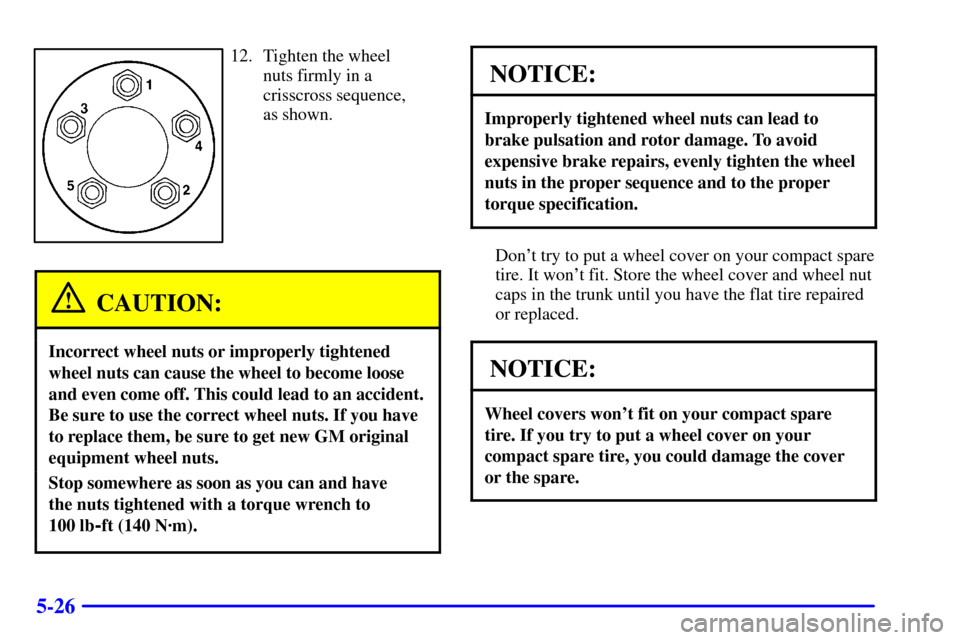
12. Tighten the wheel
nuts firmly in a
crisscross sequence,
as shown.
CAUTION:
Incorrect wheel nuts or improperly tightened
wheel nuts can cause the wheel to become loose
and even come off. This could lead to an accident.
Be sure to use the correct wheel nuts. If you have
to replace them, be sure to get new GM original
equipment wheel nuts.
Stop somewhere as soon as you can and have
the nuts tightened with a torque wrench to
100 lb
-ft (140 N´m).
NOTICE:
Improperly tightened wheel nuts can lead to
brake pulsation and rotor damage. To avoid
expensive brake repairs, evenly tighten the wheel
nuts in the proper sequence and to the proper
torque specification.
Don't try to put a wheel cover on your compact spare
tire. It won't fit. Store the wheel cover and wheel nut
caps in the trunk until you have the flat tire repaired
or replaced.
NOTICE:
Wheel covers won't fit on your compact spare
tire. If you try to put a wheel cover on your
compact spare tire, you could damage the cover
or the spare.
Page 239 of 341
6-8
When you put the fuel cap back on, turn it to the right
(clockwise) until you hear a clicking sound. Make sure
you fully install the cap. The diagnostic system can
determine if the fuel cap has been left off or improperly
installed. This would allow fuel to evaporate into the
atmosphere. See ªMalfunction Indicator Lampº in
the Index.
NOTICE:
If you need a new fuel cap, be sure to get the
right type. Your dealer can get one for you. If you
get the wrong type, it may not fit properly. This
may cause your malfunction indicator lamp to
light and may damage your fuel tank and
emissions system. See ªMalfunction Indicator
Lampº in the Index.
Filling a Portable Fuel Container
CAUTION:
Never fill a portable fuel container while it is in
your vehicle. Static electricity discharge from the
container can ignite the gasoline vapor. You can
be badly burned and your vehicle damaged if this
occurs. To help avoid injury to you and others:
�Dispense gasoline only into
approved containers.
�Do not fill a container while it is inside a
vehicle, in a vehicle's trunk, pickup bed or
on any surface other than the ground.
�Bring the fill nozzle in contact with the
inside of the fill opening before operating
the nozzle. Contact should be maintained
until the filling is complete.
�Don't smoke while pumping gasoline.
Page 262 of 341
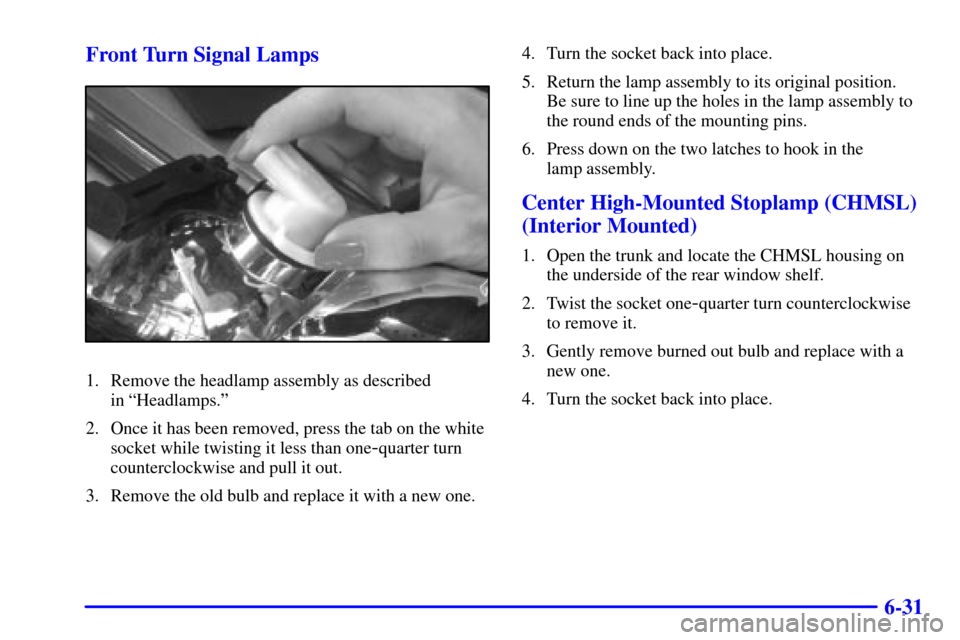
6-31 Front Turn Signal Lamps
1. Remove the headlamp assembly as described
in ªHeadlamps.º
2. Once it has been removed, press the tab on the white
socket while twisting it less than one
-quarter turn
counterclockwise and pull it out.
3. Remove the old bulb and replace it with a new one.4. Turn the socket back into place.
5. Return the lamp assembly to its original position.
Be sure to line up the holes in the lamp assembly to
the round ends of the mounting pins.
6. Press down on the two latches to hook in the
lamp assembly.
Center High-Mounted Stoplamp (CHMSL)
(Interior Mounted)
1. Open the trunk and locate the CHMSL housing on
the underside of the rear window shelf.
2. Twist the socket one
-quarter turn counterclockwise
to remove it.
3. Gently remove burned out bulb and replace with a
new one.
4. Turn the socket back into place.
Page 263 of 341
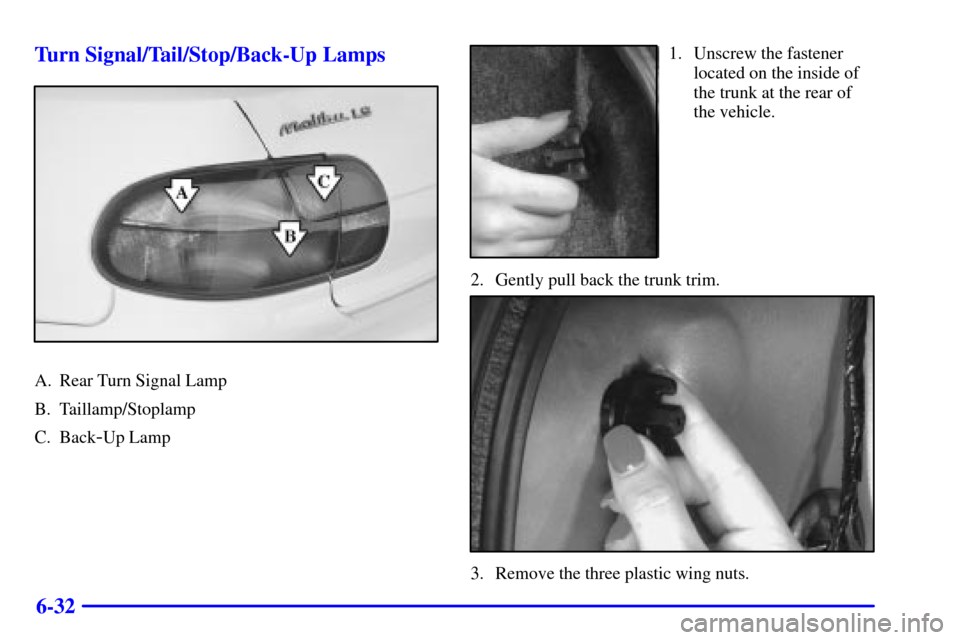
6-32 Turn Signal/Tail/Stop/Back-Up Lamps
A. Rear Turn Signal Lamp
B. Taillamp/Stoplamp
C. Back
-Up Lamp
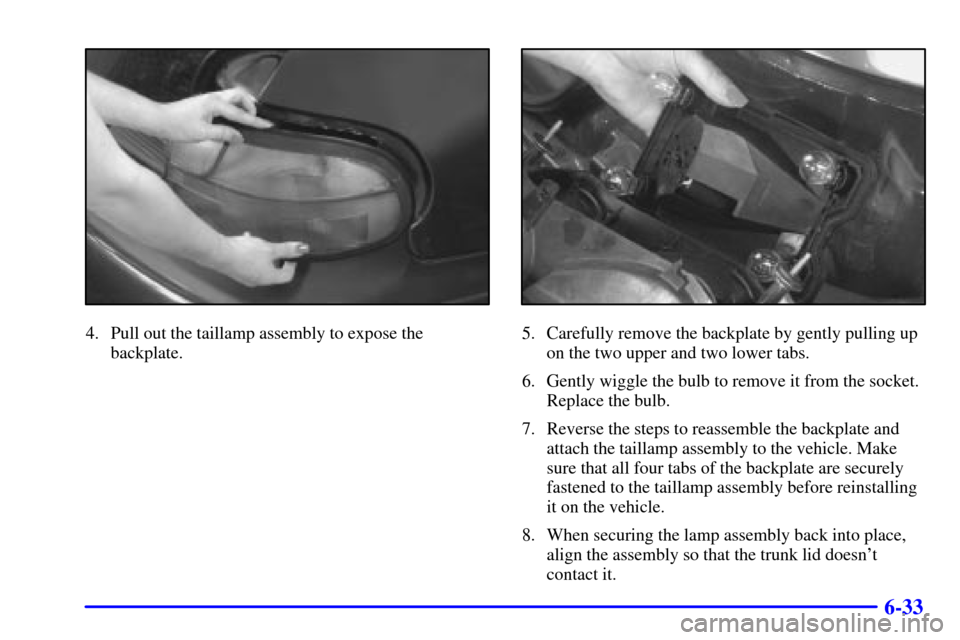
1. Unscrew the fastener
located on the inside of
the trunk at the rear of
the vehicle.
2. Gently pull back the trunk trim.
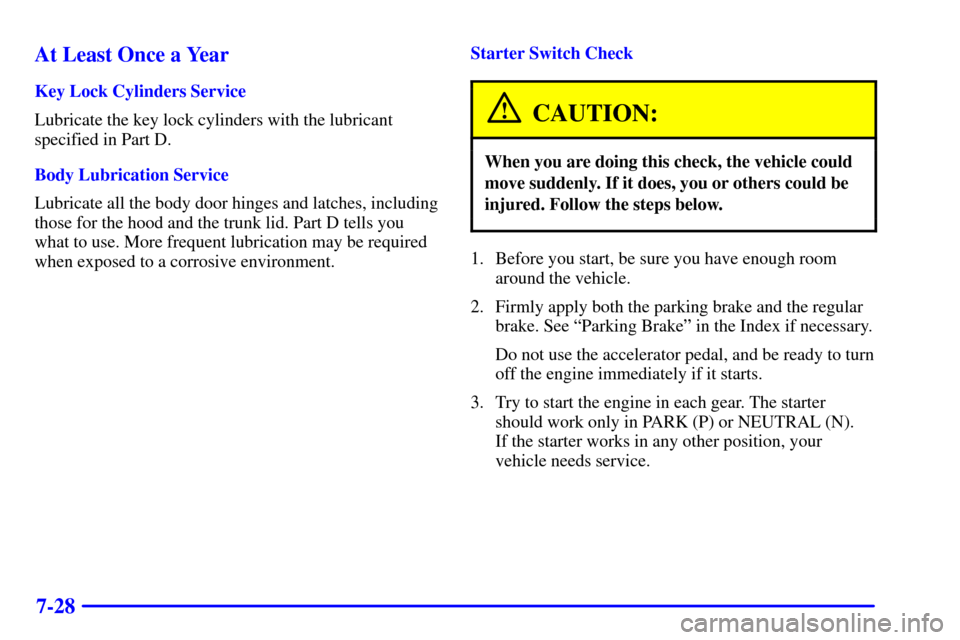
3. Remove the three plastic wing nuts.
Page 264 of 341
6-33
4. Pull out the taillamp assembly to expose the
backplate.5. Carefully remove the backplate by gently pulling up
on the two upper and two lower tabs.
6. Gently wiggle the bulb to remove it from the socket.
Replace the bulb.
7. Reverse the steps to reassemble the backplate and
attach the taillamp assembly to the vehicle. Make
sure that all four tabs of the backplate are securely
fastened to the taillamp assembly before reinstalling
it on the vehicle.
8. When securing the lamp assembly back into place,
align the assembly so that the trunk lid doesn't
contact it.
Page 286 of 341
6-55
Instrument Panel Fuse Block -- Driver's Side
Fuse Usage
A Wipers
B Trunk Release and Remote
Keyless Entry
C Turn Signals
D Power Mirrors
E Air Bag
F Body Function Control ModuleFuse Usage
G Powertrain Control
Module (PCM)
H Door Locks
J Body Function Control
Module/Instrument Panel Cluster
MICRO RELAY
TRUNK RELRemote Trunk Release
CIRCUIT BRKR
PWR SEATSPower Seats
MICRO RELAY
DR UNLOCKDoor Locks
MICRO RELAY
DR LOCKDoor Locks
MICRO RELAY
DRIVERS
DR UNLOCKDoor Locks
STOP LPS Stoplamps
HAZARD LPS Hazard Lamps
IPC/HVAC
BATTCluster, Climate Control
Page 288 of 341
6-57
Engine Compartment Fuse Block
The engine compartment fuse block is located on the
driver's side of the vehicle, near the engine air
cleaner/filter. See ªEngine Compartment Overviewº in
the Index for more information on location.
Maxifuse Usage
1 Ignition Switch
2 Right Electrical Center
-Fog Lamps,
Radio, Body Function Control Module,
Interior Lamps Maxifuse Usage
3 Left Electrical Center
-Stoplamps, Hazard
Lamps, Body Function Control Module,
Cluster, Climate Control System
4 Anti
-Lock Brakes
5 Ignition Switch
6 Not Used
7 Left Electrical Center
-Power Seats,
Power Mirrors, Door Locks, Trunk
Release and Remote Lock Control
8 Cooling Fan #1
Mini Relay Usage
9 Rear Defogger
10 Not Used
11 Not Used
12 Cooling Fan #1
13 HVAC Blower (Climate Control)
14 Cooling Fan #2
15 Cooling Fan
Page 319 of 341
7-28 At Least Once a Year
Key Lock Cylinders Service
Lubricate the key lock cylinders with the lubricant
specified in Part D.
Body Lubrication Service
Lubricate all the body door hinges and latches, including
those for the hood and the trunk lid. Part D tells you
what to use. More frequent lubrication may be required
when exposed to a corrosive environment.Starter Switch Check
CAUTION:
When you are doing this check, the vehicle could
move suddenly. If it does, you or others could be
injured. Follow the steps below.
1. Before you start, be sure you have enough room
around the vehicle.
2. Firmly apply both the parking brake and the regular
brake. See ªParking Brakeº in the Index if necessary.
Do not use the accelerator pedal, and be ready to turn
off the engine immediately if it starts.
3. Try to start the engine in each gear. The starter
should work only in PARK (P) or NEUTRAL (N).
If the starter works in any other position, your
vehicle needs service.
Page:
< prev 1-8 9-16 17-24