Page 100 of 397
2-34
3. If your engine still won't start (or starts but then
stops), it could be flooded with too much gasoline.
Try pushing your accelerator pedal all the way to the
floor and holding it there as you hold the key in
START for about three seconds. If the vehicle starts
briefly but then stops again, do the same thing.
This time keep the pedal down for five or
six seconds to clear the extra gasoline from the
engine. After waiting about 15 seconds, repeat the
normal starting procedure.
NOTICE:
Your engine is designed to work with the
electronics in your vehicle. If you add electrical
parts or accessories, you could change the way
the engine operates. Before adding electrical
equipment, check with your dealer. If you don't,
your engine might not perform properly.
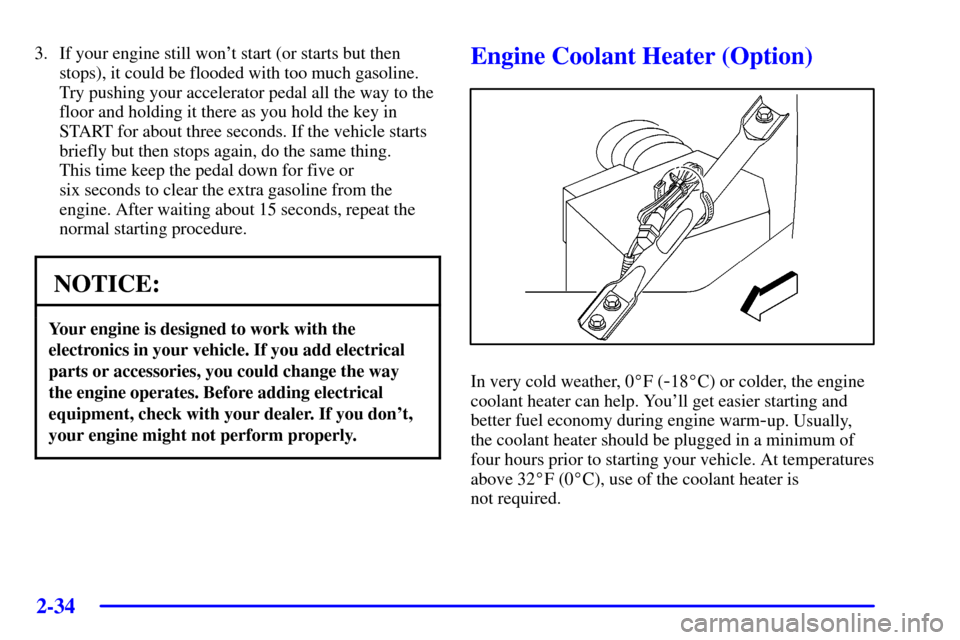
Engine Coolant Heater (Option)
In very cold weather, 0�F (-18�C) or colder, the engine
coolant heater can help. You'll get easier starting and
better fuel economy during engine warm
-up. Usually,
the coolant heater should be plugged in a minimum of
four hours prior to starting your vehicle. At temperatures
above 32�F (0�C), use of the coolant heater is
not required.
Page 101 of 397
2-35
To Use the Engine Coolant Heater
1. Turn off the engine.
2. Open the hood and unwrap the electrical cord. The
cord is attached to the underside of the diagonal
brace, which is located above the engine air
cleaner/filter assembly.
3. Plug it into a normal, grounded 110
-volt AC outlet.
CAUTION:
Plugging the cord into an ungrounded outlet
could cause an electrical shock. Also, the wrong
kind of extension cord could overheat and cause
a fire. You could be seriously injured. Plug the
cord into a properly grounded three
-prong
11 0
-volt AC outlet. If the cord won't reach, use a
heavy
-duty three-prong extension cord rated for
at least 15 amps.
4. Before starting the engine, be sure to unplug
and store the cord as it was before to keep it away
from moving engine parts. If you don't, it could
be damaged.
How long should you keep the coolant heater plugged
in? The answer depends on the outside temperature, the
kind of oil you have, and some other things. Instead of
trying to list everything here, we ask that you contact
your dealer in the area where you'll be parking your
vehicle. The dealer can give you the best advice for that
particular area.
Page 154 of 397
2-88 Engine Coolant Temperature Gage
United States-3400 V6
Engine ClusterUnited States-3800 V6
Engine Cluster
Canada-3400 V6
Engine ClusterCanada-3800 V6
Engine ClusterThis gage shows the engine coolant temperature.
It also provides an indicator of how hard your vehicle is
working. During the majority of the operation, the gage
will read 210�F (100�C) or less.
If you are pulling a load or going up hills, it is normal
for the temperature to fluctuate and approach the 250�F
(122�C) mark. When the gage reads greater than 250�F
(122�C), the HOT COOLANT TEMP light will be
illuminated in the message center and a chime will
sound continuously. If the gage reaches the 260�F
(125�C) mark, it indicates that the cooling system is
working beyond its capacity.
See ªEngine Overheatingº in the Index.
Page 162 of 397
2-96
Hot Coolant Temp
United States Canada
This message is displayed when the cooling system
temperature gets hot. A chime will sound
continuously, also.
Check the coolant temperature gage and the coolant
level. See ªEngine Coolant,º ªEngine Coolant
Temperature Gageº and ªEngine Overheatingº in the
Index for further information.Low Coolant LevelUnited States Canada
This message is displayed when the cooling system is
low on coolant. Four chimes will also sound.
The engine may overheat. See ªEngine Coolantº in the
Index and have your vehicle serviced as soon as you can.
Page 263 of 397
5-10
Towing Your Vehicle
Consult your dealer or a professional towing service
if you need to have your disabled vehicle towed.
See ªRoadside Assistanceº in the Index. If you
want to tow your vehicle behind another vehicle for
recreational purposes (such as behind a motorhome),
see ªRecreational Vehicle Towingº in the Index.
Engine Overheating
You will find a coolant temperature gage and a warning
message about a hot engine on your instrument panel
cluster. See ªEngine Coolant Temperature Gageº and
ªHot Coolant Temperature Messageº in the Index.
You also have a low coolant message on your instrument
panel cluster. See ªLow Coolant Level Messageº in
the Index.
Overheated Engine Protection
Operating Mode
This emergency operating mode allows your vehicle
to be driven to a safe place in an emergency situation.
If an overheated engine condition exists, an overheat
protection mode which alternates firing groups of
cylinders helps prevent engine damage. In this mode,
you will notice a significant loss in power and engine
performance. The low coolant light may come on and
the temperature gage will indicate an overheat condition
exists. Driving extended miles (km) and/or towing
a trailer in the overheat protection mode should
be avoided.
NOTICE:
After driving in the overheated engine protection
operating mode, to avoid engine damage, allow
the engine to cool before attempting any repair.
The engine oil will be severely degraded. Repair
the cause of coolant loss, change the oil and reset
the oil life system. See ªEngine Oilº in the Index.
Page 314 of 397
6-25
A 50/50 mixture of clean, drinkable water and
DEX
-COOL� coolant will:
�Give freezing protection down to
-34�F (-37�C).
�Give boiling protection up to 265�F (129�C).
�Protect against rust and corrosion.
�Help keep the proper engine temperature.
�Let the warning lights and gages work as
they should.
NOTICE:
When adding coolant, it is important that you
use only DEX
-COOL� (silicate-free) coolant.
If coolant other than DEX-COOL is added to
the system, premature engine, heater core or
radiator corrosion may result. In addition, the
engine coolant will require change sooner
-- at
30,000 miles (50 000 km) or 24 months,
whichever occurs first. Damage caused by the
use of coolant other than DEX
-COOL� is not
covered by your new vehicle warranty.
What to Use
Use a mixture of one-half clean, drinkable water and
one
-half DEX-COOL� coolant which won't damage
aluminum parts. If you use this coolant mixture, you
don't need to add anything else.
CAUTION:
Adding only plain water to your cooling system
can be dangerous. Plain water, or some other
liquid such as alcohol, can boil before the proper
coolant mixture will. Your vehicle's coolant
warning system is set for the proper coolant
mixture. With plain water or the wrong mixture,
your engine could get too hot but you wouldn't
get the overheat warning. Your engine could
catch fire and you or others could be burned.
Use a 50/50 mixture of clean, drinkable water
and DEX
-COOL� coolant.
Page 374 of 397

Scheduled Maintenance
7-15
100,000 Miles (166 000 km)
�Inspect spark plug wires.
An Emission Control Service.
�Replace spark plugs.
An Emission Control Service.
�Change automatic transaxle fluid and filter if the vehicle is mainly driven
under one or more of these conditions:
± In heavy city traffic where the outside temperature regularly
reaches 90�F (32�C) or higher.
± In hilly or mountainous terrain.
± When doing frequent trailer towing.
± Uses such as found in taxi, police or delivery service.
�If you haven't used your vehicle under severe service conditions listed
previously and, therefore, haven't changed your automatic transaxle fluid,
change both the fluid and filter.
150,000 Miles (240 000 km)
�Drain, flush and refill cooling system (or every 60 months since last service,
whichever occurs first). See ªEngine Coolantº in the Index for what to use.
Inspect hoses. Clean radiator, condenser, pressure cap and neck. Pressure test
the cooling system and pressure cap.
An Emission Control Service.
ACTUAL
SERVICED BY:MILEAGE
DATE
ACTUAL
SERVICED BY:MILEAGE
DATE