Page 161 of 397
2-95
Traction Active (If Equipped)
United States Canada
This message will appear when the traction control
system is limiting wheel spin.
The message will stay on a few seconds after the
traction system stops limiting wheel spin.Battery Life Indicator
When the vehicle is started
this message will be
displayed for three seconds.
If the message is displayed when the engine is running,
you may have a problem with your charging system. If
there is a problem with the charging system, four chimes
will sound when the message comes on. The battery
display will also stay on while the key is in ON until the
engine is started.
If the message stays on after starting the engine it
could indicate a problem with the generator drive belt,
or some other charging system problem. Have it
checked right away. Driving with this message on could
drain your battery.
If you must drive a short distance with this message
displayed, it helps to turn off all your accessories.
Page 215 of 397

4-3
Drunken Driving
Death and injury associated with drinking and driving
is a national tragedy. It's the number one contributor to
the highway death toll, claiming thousands of victims
every year.
Alcohol affects four things that anyone needs to drive
a vehicle:
�Judgment
�Muscular Coordination
�Vision
�Attentiveness.
Police records show that almost half of all motor
vehicle
-related deaths involve alcohol. In most cases,
these deaths are the result of someone who was drinking
and driving. In recent years, about 16,000 annual motor
vehicle
-related deaths have been associated with the use
of alcohol, with more than 300,000 people injured.
Many adults
-- by some estimates, nearly half the adult
population
-- choose never to drink alcohol, so they
never drive after drinking. For persons under 21, it's
against the law in every U.S. state to drink alcohol.
There are good medical, psychological and
developmental reasons for these laws.The obvious way to solve the leading highway safety
problem is for people never to drink alcohol and then
drive. But what if people do? How much is ªtoo muchº
if the driver plans to drive? It's a lot less than many
might think. Although it depends on each person
and situation, here is some general information on
the problem.
The Blood Alcohol Concentration (BAC) of someone
who is drinking depends upon four things:
�The amount of alcohol consumed
�The drinker's body weight
�The amount of food that is consumed before and
during drinking
�The length of time it has taken the drinker to
consume the alcohol.
According to the American Medical Association, a
180
-lb. (82 kg) person who drinks three 12-ounce
(355 ml) bottles of beer in an hour will end up with a
BAC of about 0.06 percent. The person would reach the
same BAC by drinking three 4
-ounce (120 ml) glasses
of wine or three mixed drinks if each had 1
-1/2 ounces
(45 ml) of a liquor like whiskey, gin or vodka.
Page 243 of 397
4-31 Dinghy Towing
NOTICE:
Towing your vehicle with all four wheels on the
ground will damage drivetrain components.
Your vehicle was not designed to be towed with all four
wheels on the ground. If your vehicle must be towed,
you should use a dolly. See ªDolly Towingº that follows
for more information.
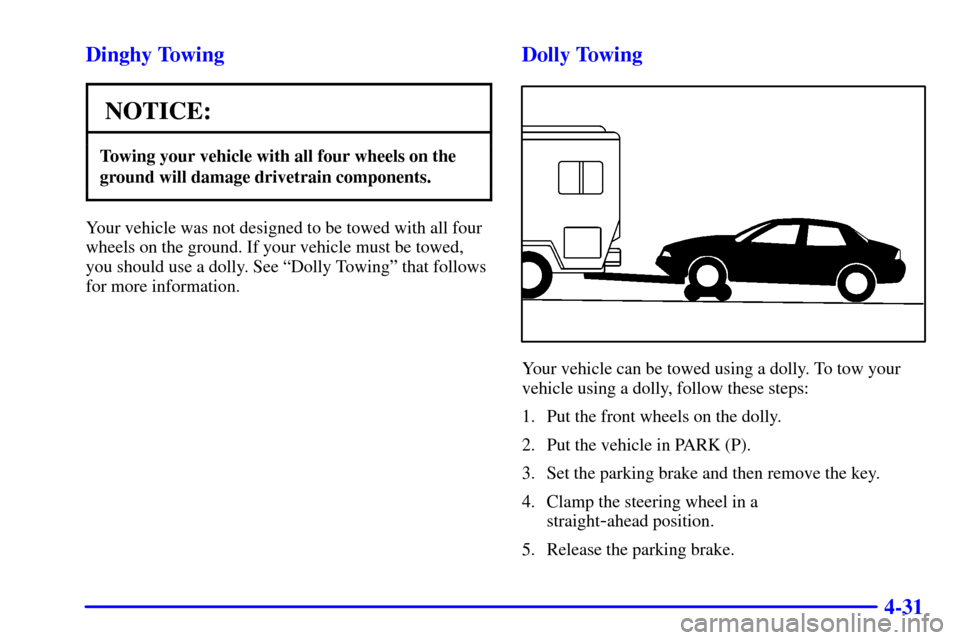
Dolly Towing
Your vehicle can be towed using a dolly. To tow your
vehicle using a dolly, follow these steps:
1. Put the front wheels on the dolly.
2. Put the vehicle in PARK (P).
3. Set the parking brake and then remove the key.
4. Clamp the steering wheel in a
straight
-ahead position.
5. Release the parking brake.
Page 255 of 397
5-2
Hazard Warning Flashers
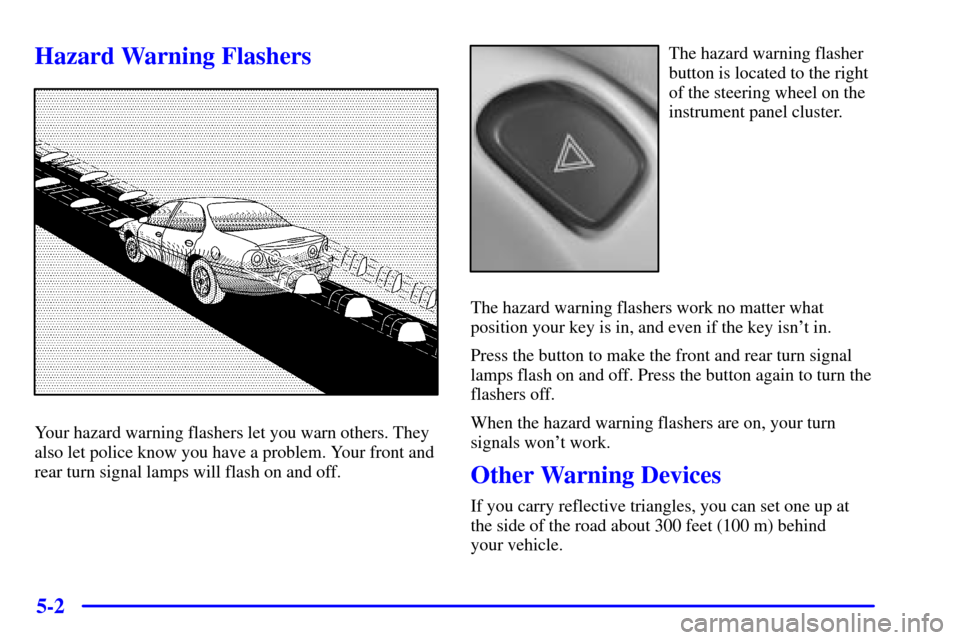
Your hazard warning flashers let you warn others. They
also let police know you have a problem. Your front and
rear turn signal lamps will flash on and off.
The hazard warning flasher
button is located to the right
of the steering wheel on the
instrument panel cluster.
The hazard warning flashers work no matter what
position your key is in, and even if the key isn't in.
Press the button to make the front and rear turn signal
lamps flash on and off. Press the button again to turn the
flashers off.
When the hazard warning flashers are on, your turn
signals won't work.
Other Warning Devices
If you carry reflective triangles, you can set one up at
the side of the road about 300 feet (100 m) behind
your vehicle.
Page 318 of 397
6-29 When to Check Power Steering Fluid
It is not necessary to regularly check power steering
fluid unless you suspect there is a leak in the system or
you hear an unusual noise. A fluid loss in this system
could indicate a problem. Have the system inspected and
repaired. See ªEngine Compartment Overviewº in the
Index for reservoir location.
How to Check Power Steering Fluid
Turn the key off, let the engine compartment cool down,
wipe the cap and the top of the reservoir clean, then
unscrew the cap and wipe the dipstick with a clean rag.
Replace the cap and completely tighten it. Then remove
the cap again and look at the fluid level on the dipstick.
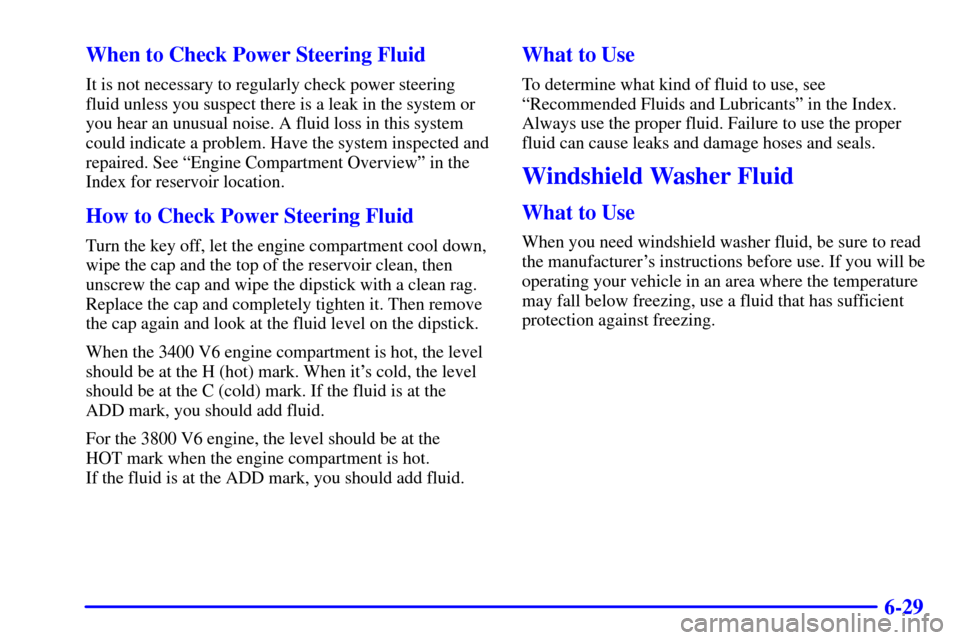
When the 3400 V6 engine compartment is hot, the level
should be at the H (hot) mark. When it's cold, the level
should be at the C (cold) mark. If the fluid is at the
ADD mark, you should add fluid.
For the 3800 V6 engine, the level should be at the
HOT mark when the engine compartment is hot.
If the fluid is at the ADD mark, you should add fluid.
What to Use
To determine what kind of fluid to use, see
ªRecommended Fluids and Lubricantsº in the Index.
Always use the proper fluid. Failure to use the proper
fluid can cause leaks and damage hoses and seals.
Windshield Washer Fluid
What to Use
When you need windshield washer fluid, be sure to read
the manufacturer's instructions before use. If you will be
operating your vehicle in an area where the temperature
may fall below freezing, use a fluid that has sufficient
protection against freezing.
Page 353 of 397
6-64
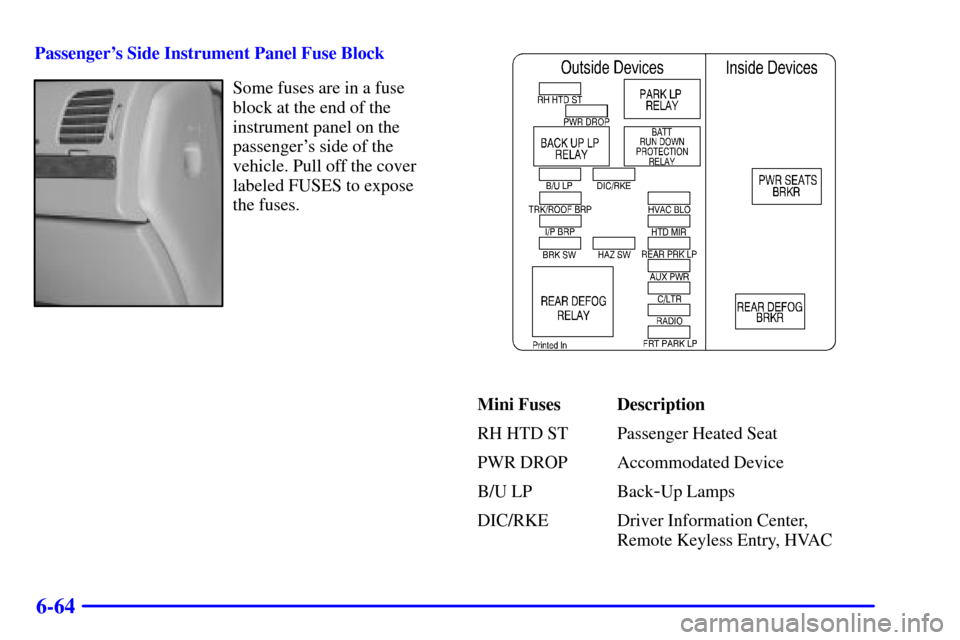
Passenger's Side Instrument Panel Fuse Block
Some fuses are in a fuse
block at the end of the
instrument panel on the
passenger's side of the
vehicle. Pull off the cover
labeled FUSES to expose
the fuses.
Mini Fuses Description
RH HTD ST Passenger Heated Seat
PWR DROP Accommodated Device
B/U LP Back
-Up Lamps
DIC/RKE Driver Information Center,
Remote Keyless Entry, HVAC
Page 376 of 397

7-17 At Least Twice a Year
Restraint System Check
Make sure the safety belt reminder light and all your
belts, buckles, latch plates, retractors and anchorages are
working properly. Look for any other loose or damaged
safety belt system parts. If you see anything that might
keep a safety belt system from doing its job, have it
repaired. Have any torn or frayed safety belts replaced.
Also look for any opened or broken air bag coverings,
and have them repaired or replaced. (The air bag system
does not need regular maintenance.)
Wiper Blade Check
Inspect wiper blades for wear or cracking. Replace blade
inserts that appear worn or damaged or that streak or
miss areas of the windshield. Also see ªWiper Blades,
Cleaningº in the Index.
Trunk Release Sensor Check
At least twice a year, check to see if the system is
working properly. Make sure the horn chirps and
the latch releases. Follow the disabling procedure.
See ªTrunk Release Sensorº in the Index.Weatherstrip Lubrication
Silicone grease on weatherstrips will make them last
longer, seal better, and not stick or squeak. Apply
silicone grease with a clean cloth. During very cold,
damp weather more frequent application may be
required. See ªRecommended Fluids and Lubricantsº
in the Index.
Automatic Transaxle Check
Check the transaxle fluid level; add if needed.
See ªAutomatic Transaxle Fluidº in the Index.
A fluid loss may indicate a problem. Check the
system and repair if needed.
At Least Once a Year
Key Lock Cylinders Service
Lubricate the key lock cylinders with the lubricant
specified in Part D.
Body Lubrication Service
Lubricate all hinges and latches, including those for
the body doors, hood, secondary latch, pivots, spring
anchor, release pawl, rear compartment, glove box door,
console door and any folding seat hardware. Part D tells
you what to use. More frequent lubrication may be
required when exposed to a corrosive environment.
Page 377 of 397
7-18
Starter Switch Check
CAUTION:
When you are doing this check, the vehicle could
move suddenly. If it does, you or others could be
injured. Follow the steps below.
1. Before you start, be sure you have enough room
around the vehicle.
2. Firmly apply both the parking brake and the regular
brake. See ªParking Brakeº in the Index if necessary.
Do not use the accelerator pedal, and be ready to turn
off the engine immediately if it starts.
3. Try to start the engine in each gear. The starter
should work only in PARK (P) or NEUTRAL (N).
If the starter works in any other position, your
vehicle needs service.Automatic Transaxle Shift Lock Control
System Check
CAUTION:
When you are doing this check, the vehicle could
move suddenly. If it does, you or others could be
injured. Follow the steps below.
1. Before you start, be sure you have enough room
around the vehicle. It should be parked on a
level surface.
2. Firmly apply the parking brake. See ªParking Brakeº
in the Index if necessary.
Be ready to apply the regular brake immediately
if the vehicle begins to move.
3. With the engine off, turn the key to the ON position,
but don't start the engine. Without applying the
regular brake, try to move the shift lever out of
PARK (P) with normal effort. If the shift lever
moves out of PARK (P), your vehicle needs service.