Page 115 of 397

2-49
Flash-to-Pass Feature
With the turn signal lever in the low-beam position, pull
the lever toward you momentarily to switch to
high
-beams (to signal that you are going to pass).
If you have the headlamps on, they will return to
low
-beams when you release the lever.
This feature operates even when the headlamps are off.
Windshield Wipers
The windshield wipers will operate with the ignition in
ACC or ON.
WIPER: To operate the windshield wipers, turn the
band labeled WIPER, located on the multifunction lever,
upward or downward.
OFF: To stop the wipers turn the band to OFF.
The five marks between OFF and LO are delay settings.
For a longer delay between wiping cycles, turn the band
downward. For a shorter delay between wiping cycles
turn the band upward.LO (Low Speed): Turn the band up to LO for a steady
wiping at a low speed.
HI (High Speed): Turn the band up to HI for a steady
wiping at a high speed.
MIST: Turn the band downward to MIST for a single
wiping cycle. Hold the band at this setting until the
windshield wipers start, then release it. The windshield
wipers will stop after one wipe. If additional cycles are
needed, hold the band on MIST longer.
Be sure to clear ice and snow from the wiper blades
before using them. Hold the band at this setting until the
windshield wipers start, then release it. The windshield
wipers will stop after one wipe. If additional cycles are
needed, hold the band on MIST longer.
Heavy snow or ice can overload your wipers. A circuit
breaker will stop them until the motor cools. Clear away
snow or ice to prevent an overload. If your blades
become damaged, get new blades or blade inserts.
Page 126 of 397
2-60 Inside Day/Night Rearview Mirror with
Map Lamps
To reduce glare from headlamps behind you, pull the
lever at the bottom of the mirror toward you (to the
night position). To return the mirror back to the day
position, push the lever away from you.
There are two map lamps located on the bottom of the
mirror. Each lamp is turned on and off by pressing the
button next to the lamp.
Inside Day/Night Rearview Mirror with
OnStar� and Map Lamps (Option)
This mirror has a lever located at the bottom of the
mirror between the two map lamps. This lever is used to
change the mirror from day to night position. To reduce
glare from headlamps behind you while driving at night,
turn the lever 90 degrees. To return to the mirror back to
the day position, return the lever to its original position.
There are two map lamps located on the bottom of the
mirror. Each lamp is turned on and off by pressing the
button next to the lamp.
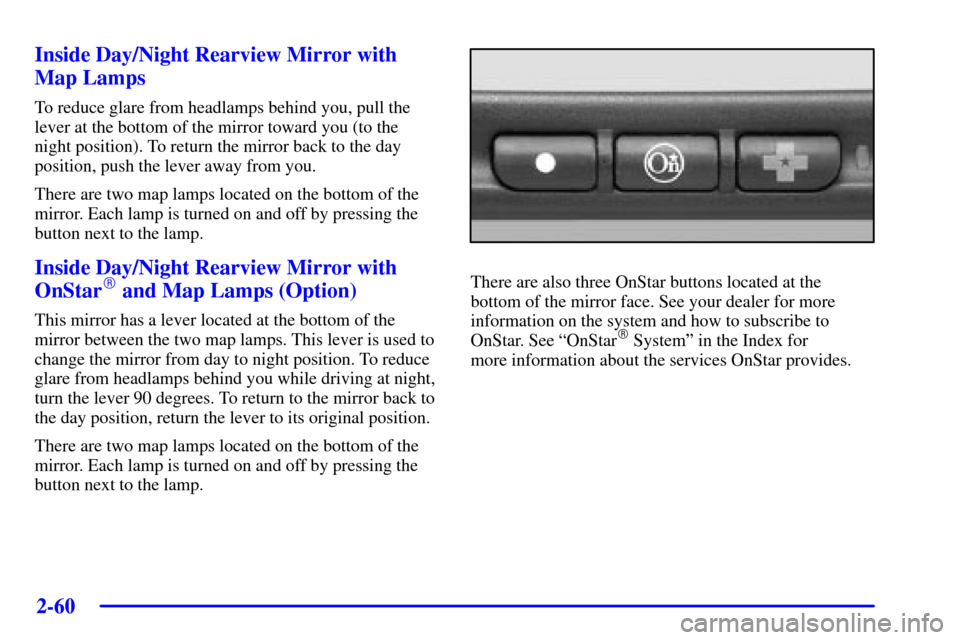
There are also three OnStar buttons located at the
bottom of the mirror face. See your dealer for more
information on the system and how to subscribe to
OnStar. See ªOnStar
� Systemº in the Index for
more information about the services OnStar provides.
Page 130 of 397

2-64
Storage Compartments
Glove Box
Use the key to lock and unlock the glove box. To open,
lift the latch.
Front Armrest (If Equipped)
If your vehicle has the split bench front seat, there is an
armrest located in the center of the seat. Dual cupholders
are located in front of the armrest.
Center Console (If Equipped)
The console has cupholders, a cassette tape and CD
storage area and a coinholder. To open the console's
storage area, pull up on the latch located in the front of
the console lid.
Rear Seat Armrest and Cupholder
(If Equipped)
If your vehicle has the split folding rear seat, there will
be two cupholders in the rear seat armrest. To access
them, pull down on the cloth strap located toward the
top of your center back seat cushion.
Trunk Convenience Net (If Equipped)
Your vehicle may have a convenience net. You'll see it
on the back wall of the trunk.
Put small loads, like grocery bags, behind or inside the
net. It can help keep them from falling over during sharp
turns or quick starts and stops.
The net isn't for larger, heavier loads. Store those in the
trunk as far forward as you can.
You can unhook the net so that it will lie flat when
you're not using it.
Page 152 of 397
2-86 Brake System Warning Light
Your vehicle's hydraulic brake system is divided into
two parts. If one part isn't working, the other part can
still work and stop you. For good braking, though, you
need both parts working well.
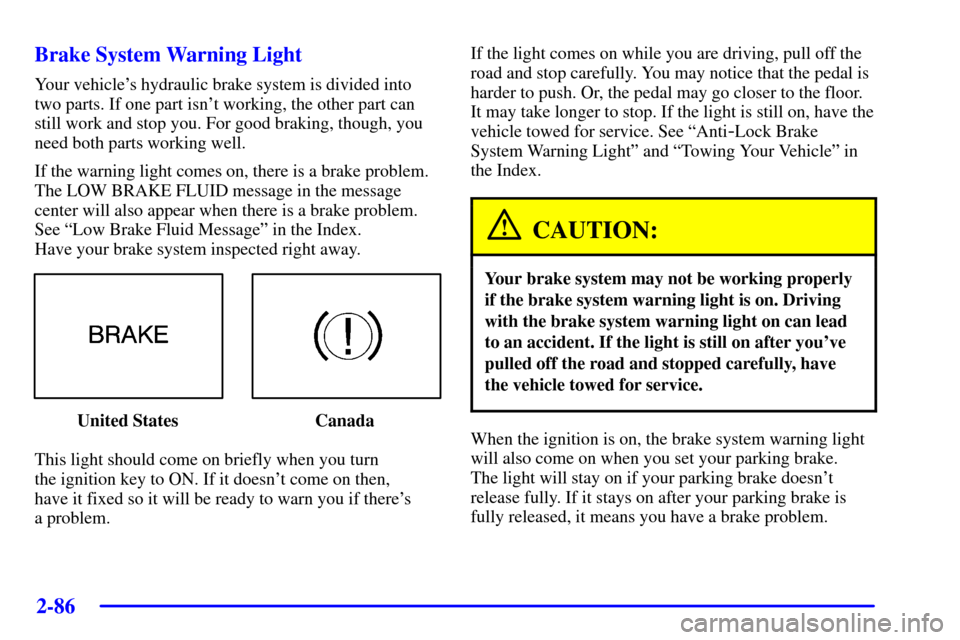
If the warning light comes on, there is a brake problem.
The LOW BRAKE FLUID message in the message
center will also appear when there is a brake problem.
See ªLow Brake Fluid Messageº in the Index.
Have your brake system inspected right away.
United States Canada
This light should come on briefly when you turn
the ignition key to ON. If it doesn't come on then,
have it fixed so it will be ready to warn you if there's
a problem.If the light comes on while you are driving, pull off the
road and stop carefully. You may notice that the pedal is
harder to push. Or, the pedal may go closer to the floor.
It may take longer to stop. If the light is still on, have the
vehicle towed for service. See ªAnti
-Lock Brake
System Warning Lightº and ªTowing Your Vehicleº in
the Index.
CAUTION:
Your brake system may not be working properly
if the brake system warning light is on. Driving
with the brake system warning light on can lead
to an accident. If the light is still on after you've
pulled off the road and stopped carefully, have
the vehicle towed for service.
When the ignition is on, the brake system warning light
will also come on when you set your parking brake.
The light will stay on if your parking brake doesn't
release fully. If it stays on after your parking brake is
fully released, it means you have a brake problem.
Page 156 of 397

2-90
This light should come on, as a check to show you it is
working, when the ignition is on and the engine is not
running. If the light doesn't come on, have it repaired.
This light will also come on during a malfunction in one
of two ways:
�Light Flashing
-- A misfire condition has been
detected. A misfire increases vehicle emissions and
may damage the emission control system on your
vehicle. Dealer or qualified service center diagnosis
and service may be required.
�Light On Steady
-- An emission control system
malfunction has been detected on your vehicle.
Dealer or qualified service center diagnosis and
service may be required.
If the Light Is Flashing
The following may prevent more serious damage to
your vehicle:
�Reducing vehicle speed.
�Avoiding hard accelerations.
�Avoiding steep uphill grades.
�If you are towing a trailer, reduce the amount of
cargo being hauled as soon as it is possible.If the light stops flashing and remains on steady,
see ªIf the Light Is On Steadyº following.
If the light continues to flash, when it is safe to do so,
stop the vehicle. Find a safe place to park your vehicle.
Turn the key off, wait at least 10 seconds and restart the
engine. If the light remains on steady, see ªIf the Light
Is On Steadyº following. If the light is still flashing,
follow the previous steps, and drive the vehicle to your
dealer or qualified service center for service.
If the Light Is On Steady
You may be able to correct the emission system
malfunction by considering the following:
Did you recently put fuel into your vehicle?
If so, reinstall the fuel cap, making sure to fully install
the cap. See ªFilling Your Tankº in the Index. The
diagnostic system can determine if the fuel cap has been
left off or improperly installed. A loose or missing fuel
cap will allow fuel to evaporate into the atmosphere.
A few driving trips with the cap properly installed
should turn the light off.
Did you just drive through a deep puddle of water?
If so, your electrical system may be wet. The condition
will usually be corrected when the electrical system
dries out. A few driving trips should turn the light off.
Page 213 of 397
4-
4-1
Section 4 Your Driving and the Road
Here you'll find information about driving on different kinds of roads and in varying weather conditions. We've also
included many other useful tips on driving.
4
-2 Defensive Driving
4
-3 Drunken Driving
4
-6 Control of a Vehicle
4
-6 Braking
4
-9 Traction Control System (3800 V6 Engine)
4
-11 Steering
4
-13 Off-Road Recovery
4
-14 Passing
4
-15 Loss of Control
4
-16 Driving at Night4
-18 Driving in Rain and on Wet Roads
4
-21 City Driving
4
-22 Freeway Driving
4
-23 Before Leaving on a Long Trip
4
-24 Highway Hypnosis
4
-24 Hill and Mountain Roads
4
-26 Winter Driving
4
-30 Recreational Vehicle Towing
4
-32 Loading Your Vehicle
4
-34 Towing a Trailer
Page 242 of 397

4-30
Run your engine only as long as you must. This saves
fuel. When you run the engine, make it go a little faster
than just idle. That is, push the accelerator slightly. This
uses less fuel for the heat that you get and it keeps the
battery charged. You will need a well
-charged battery to
restart the vehicle, and possibly for signaling later on
with your headlamps. Let the heater run for a while.
Then, shut the engine off and close the window almost
all the way to preserve the heat. Start the engine again
and repeat this only when you feel really uncomfortable
from the cold. But do it as little as possible. Preserve the
fuel as long as you can. To help keep warm, you can get
out of the vehicle and do some fairly vigorous exercises
every half hour or so until help comes.
Recreational Vehicle Towing
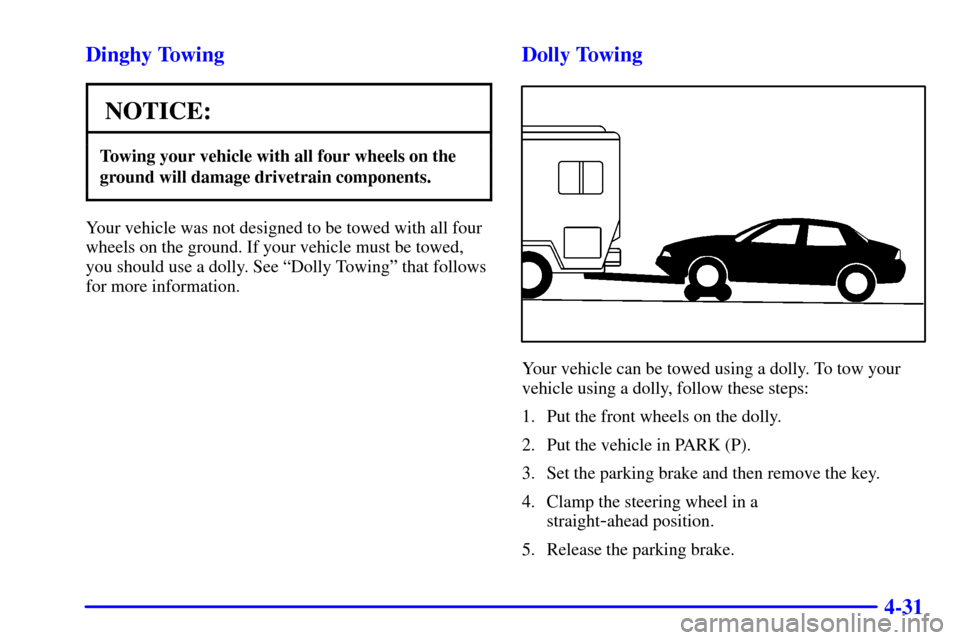
Recreational vehicle towing means towing your vehicle
behind another vehicle
-- such as behind a motorhome.
The two most common types of recreational vehicle
towing are known as ªdinghy towingº (towing your
vehicle with all four wheels on the ground) and ªdolly
towingº (towing your vehicle with two wheels on the
ground and two wheels up on a device known as
a ªdollyº).With the proper preparation and equipment, many
vehicles can be towed in these ways. See ªDinghy
Towingº and ªDolly Towing,º following.
Here are some important things to consider before
you do recreational vehicle towing:
�What's the towing capacity of the towing
vehicle? Be sure you read the tow vehicle
manufacturer's recommendations.
�How far will you tow? Some vehicles have
restrictions on how far and how long they can tow.
�Do you have the proper towing equipment? See your
dealer or trailering professional for additional advice
and equipment recommendations.
�Is your vehicle ready to be towed? Just as you would
prepare your vehicle for a long trip, you'll want to
make sure your vehicle is prepared to be towed.
See ªBefore Leaving on a Long Tripº in the Index.
Page 243 of 397
4-31 Dinghy Towing
NOTICE:
Towing your vehicle with all four wheels on the
ground will damage drivetrain components.
Your vehicle was not designed to be towed with all four
wheels on the ground. If your vehicle must be towed,
you should use a dolly. See ªDolly Towingº that follows
for more information.
Dolly Towing
Your vehicle can be towed using a dolly. To tow your
vehicle using a dolly, follow these steps:
1. Put the front wheels on the dolly.
2. Put the vehicle in PARK (P).
3. Set the parking brake and then remove the key.
4. Clamp the steering wheel in a
straight
-ahead position.
5. Release the parking brake.