Page 59 of 397
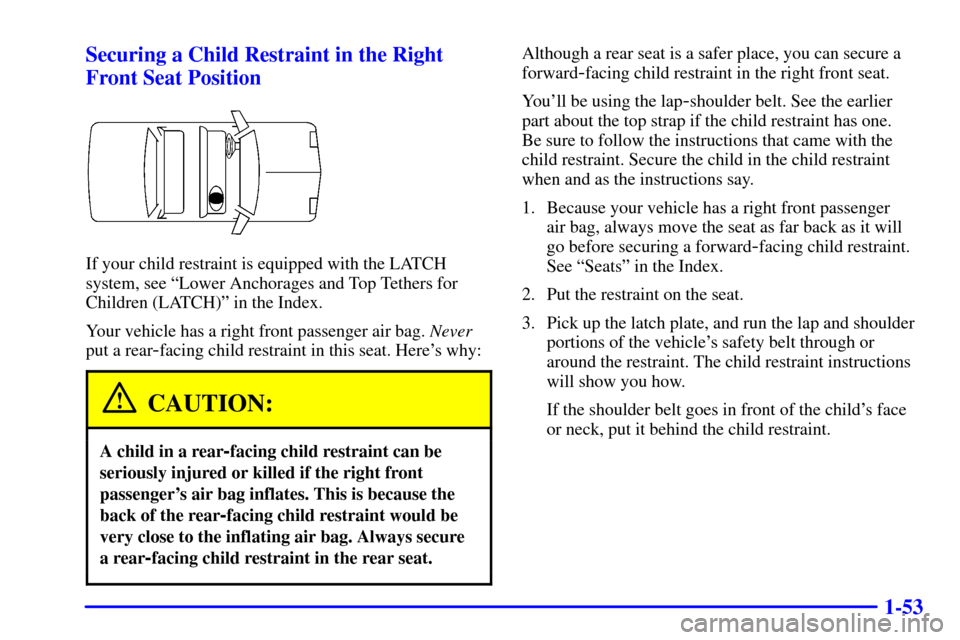
1-53 Securing a Child Restraint in the Right
Front Seat Position
If your child restraint is equipped with the LATCH
system, see ªLower Anchorages and Top Tethers for
Children (LATCH)º in the Index.
Your vehicle has a right front passenger air bag. Never
put a rear
-facing child restraint in this seat. Here's why:
CAUTION:
A child in a rear-facing child restraint can be
seriously injured or killed if the right front
passenger's air bag inflates. This is because the
back of the rear
-facing child restraint would be
very close to the inflating air bag. Always secure
a rear
-facing child restraint in the rear seat.
Although a rear seat is a safer place, you can secure a
forward
-facing child restraint in the right front seat.
You'll be using the lap
-shoulder belt. See the earlier
part about the top strap if the child restraint has one.
Be sure to follow the instructions that came with the
child restraint. Secure the child in the child restraint
when and as the instructions say.
1. Because your vehicle has a right front passenger
air bag, always move the seat as far back as it will
go before securing a forward
-facing child restraint.
See ªSeatsº in the Index.
2. Put the restraint on the seat.
3. Pick up the latch plate, and run the lap and shoulder
portions of the vehicle's safety belt through or
around the restraint. The child restraint instructions
will show you how.
If the shoulder belt goes in front of the child's face
or neck, put it behind the child restraint.
Page 62 of 397
1-56
Older Children
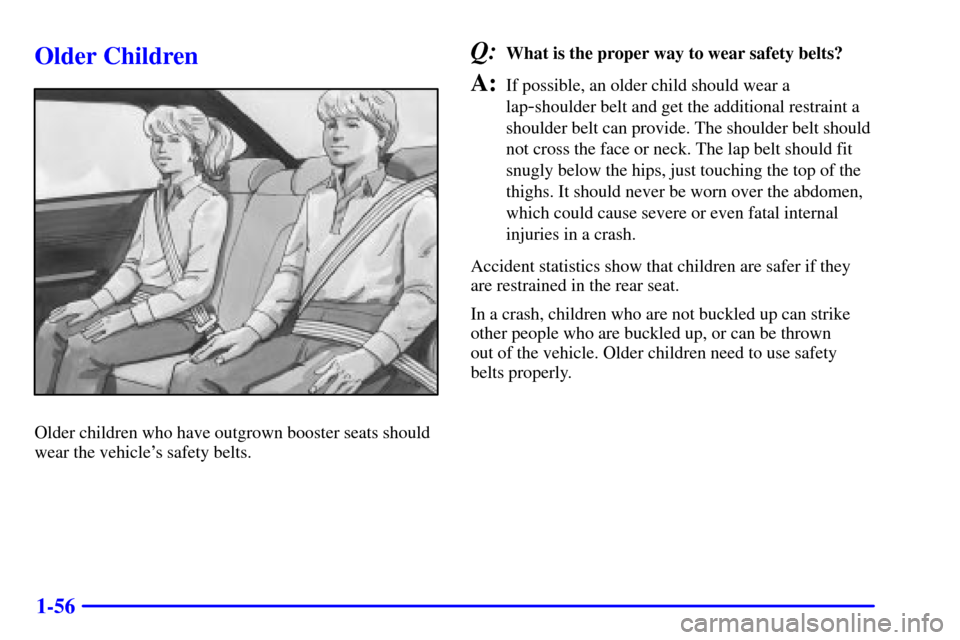
Older children who have outgrown booster seats should
wear the vehicle's safety belts.
Q:What is the proper way to wear safety belts?
A:If possible, an older child should wear a
lap
-shoulder belt and get the additional restraint a
shoulder belt can provide. The shoulder belt should
not cross the face or neck. The lap belt should fit
snugly below the hips, just touching the top of the
thighs. It should never be worn over the abdomen,
which could cause severe or even fatal internal
injuries in a crash.
Accident statistics show that children are safer if they
are restrained in the rear seat.
In a crash, children who are not buckled up can strike
other people who are buckled up, or can be thrown
out of the vehicle. Older children need to use safety
belts properly.
Page 102 of 397
2-36
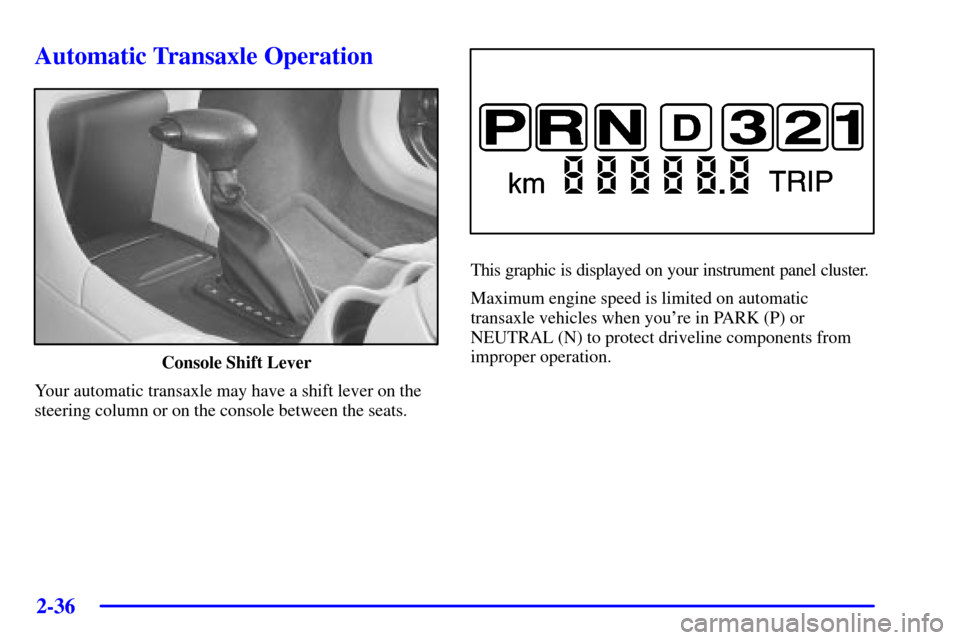
Automatic Transaxle Operation
Console Shift Lever
Your automatic transaxle may have a shift lever on the
steering column or on the console between the seats.
This graphic is displayed on your instrument panel cluster.
Maximum engine speed is limited on automatic
transaxle vehicles when you're in PARK (P) or
NEUTRAL (N) to protect driveline components from
improper operation.
Page 178 of 397
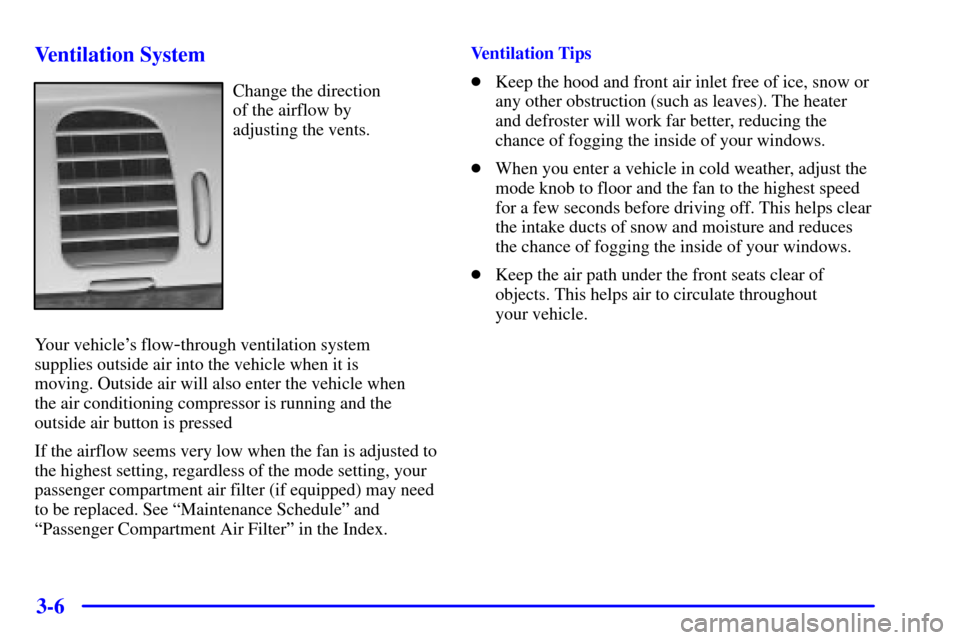
3-6 Ventilation System
Change the direction
of the airflow by
adjusting the vents.
Your vehicle's flow
-through ventilation system
supplies outside air into the vehicle when it is
moving. Outside air will also enter the vehicle when
the air conditioning compressor is running and the
outside air button is pressed
If the airflow seems very low when the fan is adjusted to
the highest setting, regardless of the mode setting, your
passenger compartment air filter (if equipped) may need
to be replaced. See ªMaintenance Scheduleº and
ªPassenger Compartment Air Filterº in the Index.Ventilation Tips
�Keep the hood and front air inlet free of ice, snow or
any other obstruction (such as leaves). The heater
and defroster will work far better, reducing the
chance of fogging the inside of your windows.
�When you enter a vehicle in cold weather, adjust the
mode knob to floor and the fan to the highest speed
for a few seconds before driving off. This helps clear
the intake ducts of snow and moisture and reduces
the chance of fogging the inside of your windows.
�Keep the air path under the front seats clear of
objects. This helps air to circulate throughout
your vehicle.
Page 245 of 397
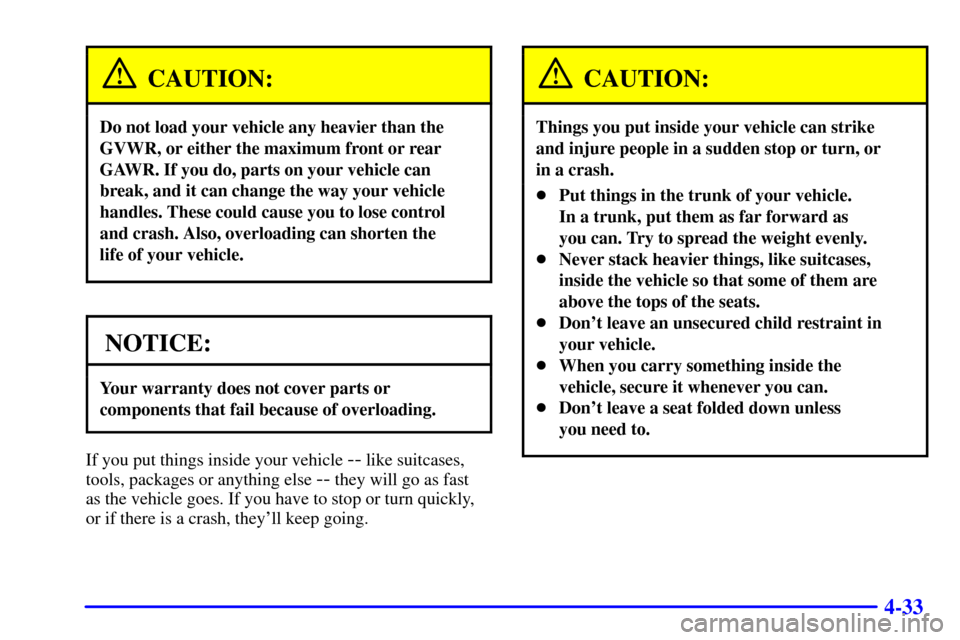
4-33
CAUTION:
Do not load your vehicle any heavier than the
GVWR, or either the maximum front or rear
GAWR. If you do, parts on your vehicle can
break, and it can change the way your vehicle
handles. These could cause you to lose control
and crash. Also, overloading can shorten the
life of your vehicle.
NOTICE:
Your warranty does not cover parts or
components that fail because of overloading.
If you put things inside your vehicle -- like suitcases,
tools, packages or anything else
-- they will go as fast
as the vehicle goes. If you have to stop or turn quickly,
or if there is a crash, they'll keep going.
CAUTION:
Things you put inside your vehicle can strike
and injure people in a sudden stop or turn, or
in a crash.
�Put things in the trunk of your vehicle.
In a trunk, put them as far forward as
you can. Try to spread the weight evenly.
�Never stack heavier things, like suitcases,
inside the vehicle so that some of them are
above the tops of the seats.
�Don't leave an unsecured child restraint in
your vehicle.
�When you carry something inside the
vehicle, secure it whenever you can.
�Don't leave a seat folded down unless
you need to.
Page 354 of 397
6-65
Mini Fuses Description
TRK/
ROOF BRPTrunk Lamps, Headliner Lamps
HVAC BLO HVAC Blower Relay
I/P BRP Instrument Panel Footwell Lamps,
Glovebox Lamps
HTD MIR Heated Mirrors
BRK SW Brake Switch
HAZ SW Hazard Switch
REAR PRK LP Rear Parking Lamps
AUX PWR Accessory Power Outlet (Battery)
C/LTR Cigarette Lighter
RADIO Radio, Radio Amplifier
FRT PARK LP Front Parking Lamps,
Instrumentation Lighting Circuit Relay Description
PARK
LP RELAYParking Lamp Relay
BACK UP
LP RELAYBack
-up Lamps Relay
BATT RUN
DOWN
PROTECTION
RELAYBattery Run Down
Protection Relay
REAR
DEFOG RELAYRear Defogger Relay,
Heated Mirror Relay
Circuit Breaker Description
POWER
SEATS BRKRPower Seat Circuit Breaker
REAR
DEFOG BRKRRear Defogger Breaker