Page 265 of 384
5-20
Z06 models do not have Extended Mobility Tires.
If a Z06 model tire goes flat, avoid further tire and
wheel damage by driving slowly to a level place and
stopping. Then do this:
1. Turn on the hazard warning flashers.
2. Set the parking brake firmly.
3. Put the shift lever (manual transmission)
in REVERSE (R).
4. Turn off the engine.
5. Inspect the flat tire.
If the tire has been separated from the wheel or has
damaged sidewalls or large tears that allow rapid air
loss, call a tire repair facility. See ªRoadside Assistanceº
in the Index.
If the flat tire is due to a slow leak caused by a nail or
other similar road hazard, the tire inflator kit may be
used to repair the damaged tire temporarily. The kit uses
a liquid tire sealant to seal small punctures in the tread
area of the tire. The flat tire is then inflated to at least 26 psi (179 kPa)
and driven to evenly distribute the tire sealant. The tire
pressure is checked after driving for a maximum of
10 minutes to see if the slow leak has been stopped.
If the tire pressure is 19 psi (131 kPa) or more, inflate
the tire up to the standard operating pressure as shown
on the Tire Pressure Label found on the rear edge of the
driver's door. See ªTires, Pressureº in the Index.
You should have the damaged tire repaired as soon
as possible. The tire sealant is a temporary repair only.
For more information regarding the tire inflator kit see
ªTire Inflator Kitº following this section.
NOTICE:
If the tire pressure has dropped below 19 psi
(131 kPa), the vehicle should not be driven
further. Damage to the tire may be severe
and the sealant will not be effective. Contact
Roadside Assistance. See ªRoadside Assistanceº
in the Index.
Page 266 of 384
5-21
Tire Inflator Kit (Z06 Models Only)
Every Z06 model with P295/35ZR18 and P265/40ZR17
tires, when new, was equipped with a tire inflator kit.
The repair kit contains a detailed instruction card that
outlines step by step the temporary repair procedure.
Be sure to read and follow all the tire inflator kit
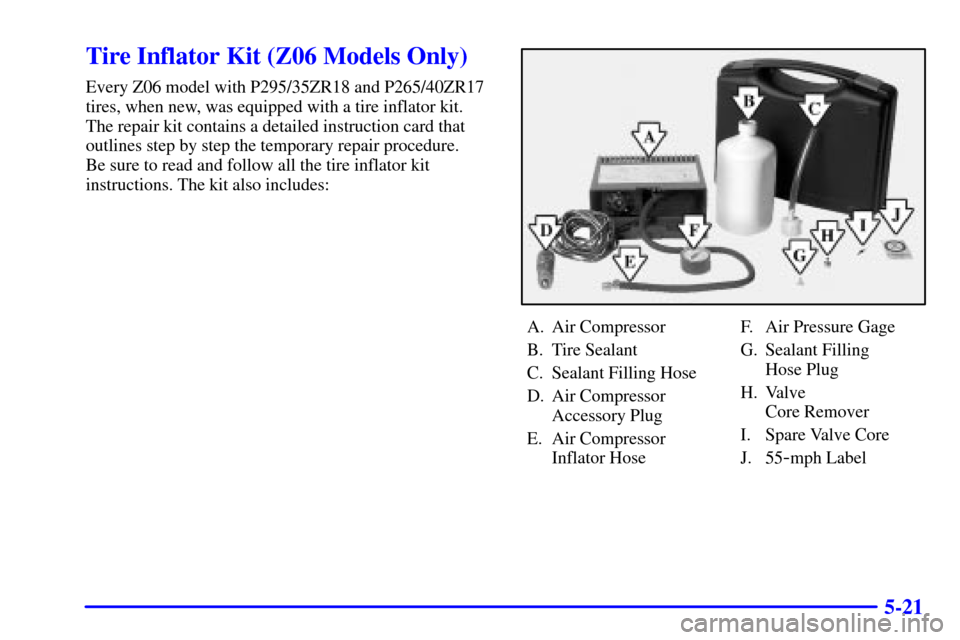
instructions. The kit also includes:
A. Air Compressor
B. Tire Sealant
C. Sealant Filling Hose
D. Air Compressor
Accessory Plug
E. Air Compressor
Inflator HoseF. Air Pressure Gage
G. Sealant Filling
Hose Plug
H. Valve
Core Remover
I. Spare Valve Core
J. 55
-mph Label
Page 267 of 384

5-22 Tire Sealant
The kit contains a liquid sealant that when injected into
a flat tire, may temporarily repair nail holes or cuts in
the tread area of the tire. The tire sealant cannot repair
tire damage caused while driving on a flat tire or a tire
that has had a ªblow outº or a tire that has punctures in
the sidewall areas. The tire sealant solution is a one
-time
use application for one tire only. Check the tire sealant
expiration date; the sealant may not be as effective
beyond the expiration date. The tire sealant can be
peeled off easily after drying.
NOTICE:
Do not use a tire sealant if your vehicle is
equipped with Extended Mobility Tires or tire
pressure monitors. The tire sealant can damage
tire pressure monitor sensors. See ªExtended
Mobility Tiresº in the Index.
Air Compressor
The air compressor included in the tire inflator kit, was
designed exclusively for the Z06 Model equipped with
P295/35ZR18 and P265/40ZR17 tires. After the sealant
has been injected into the flat tire, use the air compressor
to inflate the tire to at least 26 psi (179 kPa). Instructions
for connecting and using the air compressor are located
on the air compressor.
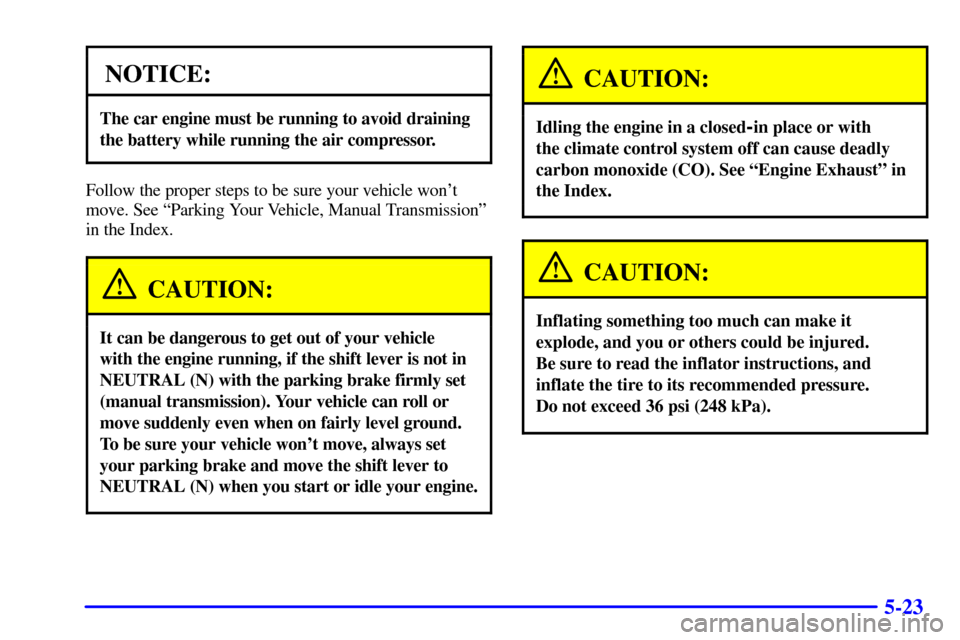
A. Inflating Hose
B. Air Pressure GageC. ON/OFF Switch
D. Air Compressor Plug
Page 268 of 384
5-23
NOTICE:
The car engine must be running to avoid draining
the battery while running the air compressor.
Follow the proper steps to be sure your vehicle won't
move. See ªParking Your Vehicle, Manual Transmissionº
in the Index.
CAUTION:
It can be dangerous to get out of your vehicle
with the engine running, if the shift lever is not in
NEUTRAL (N) with the parking brake firmly set
(manual transmission). Your vehicle can roll or
move suddenly even when on fairly level ground.
To be sure your vehicle won't move, always set
your parking brake and move the shift lever to
NEUTRAL (N) when you start or idle your engine.
CAUTION:
Idling the engine in a closed-in place or with
the climate control system off can cause deadly
carbon monoxide (CO). See ªEngine Exhaustº in
the Index.
CAUTION:
Inflating something too much can make it
explode, and you or others could be injured.
Be sure to read the inflator instructions, and
inflate the tire to its recommended pressure.
Do not exceed 36 psi (248 kPa).
Page 269 of 384
5-24
NOTICE:
Do not allow the air compressor to operate
continuously for more than six minutes to help
prevent damage from overheating.
NOTICE:
If 26 psi (179 kPa) tire pressure cannot be
reached after six minutes, the vehicle should not
be driven further. Damage to the tire is severe
and the sealant will not be effective. Remove the
air compressor plug from the accessory power
outlet and unscrew the inflating hose from
the tire valve. See ªRoadside Assistanceº in
the Index.
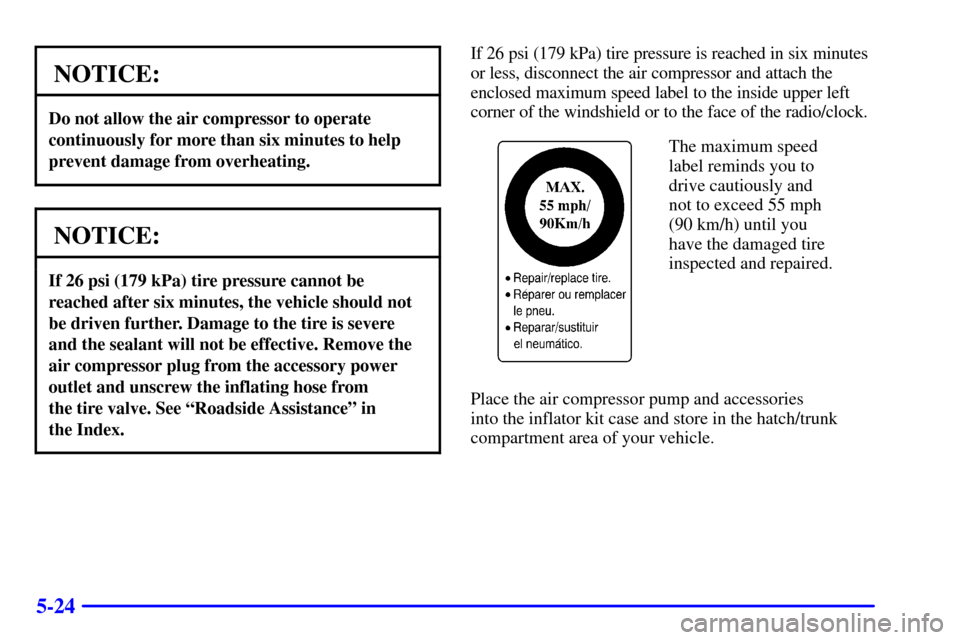
If 26 psi (179 kPa) tire pressure is reached in six minutes
or less, disconnect the air compressor and attach the
enclosed maximum speed label to the inside upper left
corner of the windshield or to the face of the radio/clock.
The maximum speed
label reminds you to
drive cautiously and
not to exceed 55 mph
(90 km/h) until you
have the damaged tire
inspected and repaired.
Place the air compressor pump and accessories
into the inflator kit case and store in the hatch/trunk
compartment area of your vehicle.
Page 270 of 384
5-25 Tire Inflator Kit Storage
The tire inflator kit is stored in the rear hatch/trunk area
of your vehicle.
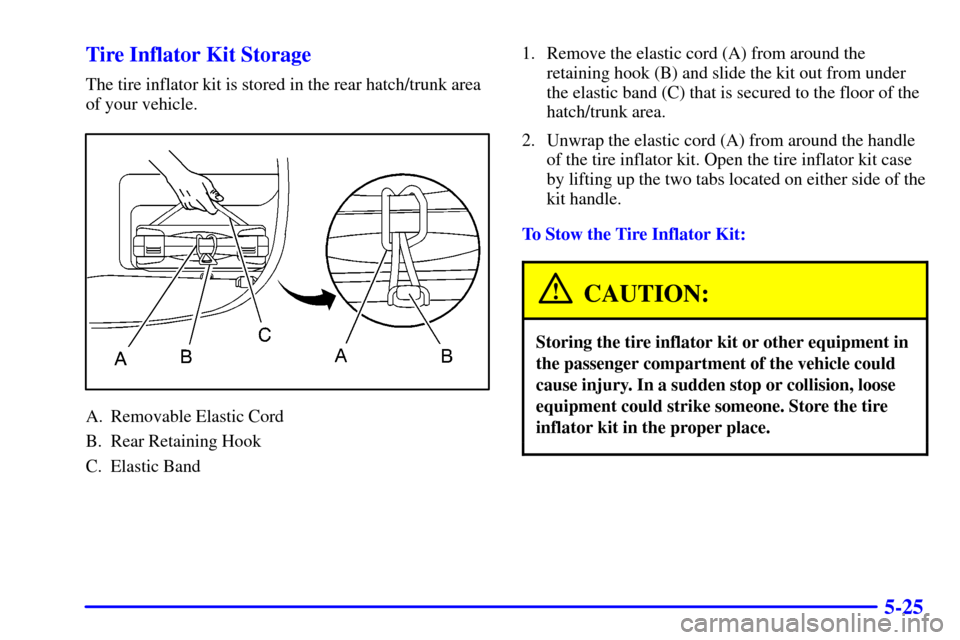
A. Removable Elastic Cord
B. Rear Retaining Hook
C. Elastic Band1. Remove the elastic cord (A) from around the
retaining hook (B) and slide the kit out from under
the elastic band (C) that is secured to the floor of the
hatch/trunk area.
2. Unwrap the elastic cord (A) from around the handle
of the tire inflator kit. Open the tire inflator kit case
by lifting up the two tabs located on either side of the
kit handle.
To Stow the Tire Inflator Kit:
CAUTION:
Storing the tire inflator kit or other equipment in
the passenger compartment of the vehicle could
cause injury. In a sudden stop or collision, loose
equipment could strike someone. Store the tire
inflator kit in the proper place.
Page 271 of 384
5-26
A. Removable Elastic Cord
B. Tire Inflator Kit
1. Loop the elastic cord (A) around the handle of the
tire inflator kit.A. Removable Elastic Cord
B. Rear Retaining Hook
C. Elastic Band
2. Insert the tire inflator kit under the elastic band (C)
that is secured to the floor of the hatch/trunk area
of your vehicle.
3. Wrap the elastic cord (A) around the retaining hook (B).
Page 312 of 384

6-40
Tires
Your new vehicle comes with high-quality tires made by
a leading tire manufacturer. If you ever have questions
about your tire warranty and where to obtain service,
see your Chevrolet Warranty booklet for details.
CAUTION:
Poorly maintained and improperly used tires
are dangerous.
�Overloading your tires can cause
overheating as a result of too much friction.
You could have an air
-out and a serious
accident. See ªLoading Your Vehicleº in
the Index.
CAUTION: (Continued)
CAUTION: (Continued)
�Underinflated tires pose the same danger
as overloaded tires. The resulting accident
could cause serious injury. Check all tires
frequently to maintain the recommended
pressure. Tire pressure should be checked
when your tires are cold.
�Overinflated tires are more likely to be
cut, punctured or broken by a sudden
impact
-- such as when you hit a pothole.
Keep tires at the recommended pressure.
�Worn, old tires can cause accidents. If your
tread is badly worn, or if your tires have
been damaged, replace them.