Page 188 of 360
4-23
Once you are moving on the freeway, make certain you
allow a reasonable following distance. Expect to move
slightly slower at night.
When you want to leave the freeway, move to the
proper lane well in advance. If you miss your exit,
do not, under any circumstances, stop and back up.
Drive on to the next exit.
The exit ramp can be curved, sometimes quite sharply.
The exit speed is usually posted.
Reduce your speed according to your speedometer, not
to your sense of motion. After driving for any distance
at higher speeds, you may tend to think you are going
slower than you actually are.
Before Leaving on a Long Trip
Make sure you're ready. Try to be well rested. If you
must start when you're not fresh
-- such as after a
day's work
-- don't plan to make too many miles that
first part of the journey. Wear comfortable clothing and
shoes you can easily drive in.Is your vehicle ready for a long trip? If you keep it
serviced and maintained, it's ready to go. If it needs
service, have it done before starting out. Of course,
you'll find experienced and able service experts in
Chevrolet dealerships all across North America.
They'll be ready and willing to help if you need it.
Here are some things you can check before a trip:
�Windshield Washer Fluid: Is the reservoir full?
Are all windows clean inside and outside?
�Wiper Blades: Are they in good shape?
�Fuel, Engine Oil, Other Fluids: Have you checked
all levels?
�Lamps: Are they all working? Are the lenses clean?
�Tires: They are vitally important to a safe,
trouble
-free trip. Is the tread good enough for
long
-distance driving? Are the tires all inflated
to the recommended pressure?
�Weather Forecasts: What's the weather outlook
along your route? Should you delay your trip a
short time to avoid a major storm system?
�Maps: Do you have up
-to-date maps?
Page 221 of 360
5-14
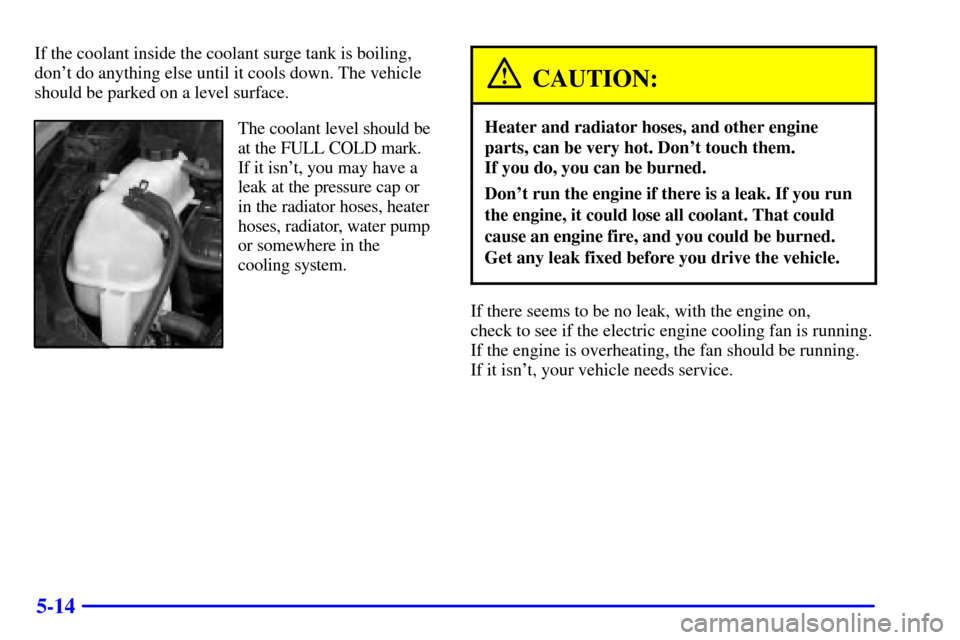
If the coolant inside the coolant surge tank is boiling,
don't do anything else until it cools down. The vehicle
should be parked on a level surface.
The coolant level should be
at the FULL COLD mark.
If it isn't, you may have a
leak at the pressure cap or
in the radiator hoses, heater
hoses, radiator, water pump
or somewhere in the
cooling system.
CAUTION:
Heater and radiator hoses, and other engine
parts, can be very hot. Don't touch them.
If you do, you can be burned.
Don't run the engine if there is a leak. If you run
the engine, it could lose all coolant. That could
cause an engine fire, and you could be burned.
Get any leak fixed before you drive the vehicle.
If there seems to be no leak, with the engine on,
check to see if the electric engine cooling fan is running.
If the engine is overheating, the fan should be running.
If it isn't, your vehicle needs service.
Page 240 of 360

6-
6-1
Section 6 Service and Appearance Care
Here you will find information about the care of your vehicle. This section begins with service and fuel information,
and then it shows how to check important fluid and lubricant levels. There is also technical information about your
vehicle, and a part devoted to its appearance care.
6
-2 Service
6
-3 Fuel
6
-5 Fuels in Foreign Countries
6
-6 Filling Your Tank
6
-8 Filling a Portable Fuel Container
6
-9 Checking Things Under the Hood
6
-14 Engine Oil
6
-21 Engine Air Cleaner/Filter
6
-23 Automatic Transaxle Fluid
6
-24 Manual Transaxle Fluid
6
-24 Hydraulic Clutch
6
-25 Engine Coolant
6
-28 Surge Tank Pressure Cap
6
-29 Power Steering Fluid6
-29 Windshield Washer Fluid
6
-31 Brakes
6
-35 Battery
6
-36 Bulb Replacement
6
-43 Tires
6
-51 Appearance Care
6
-52 Cleaning the Inside of Your Vehicle
6
-54 Care of Safety Belts
6
-55 Cleaning the Outside of Your Vehicle
6
-60 Vehicle Identification Number (VIN)
6
-61 Electrical System
6
-66 Replacement Bulbs
6
-66 Capacities and Specifications
6
-67 Normal Maintenance Replacement Parts
Page 253 of 360
6-14
Engine Oil
If the oil pressure light
appears on the instrument
cluster, it means you need
to check your engine oil
level right away.
For more information, see ªOil Pressure Lightº in
the Index.
You should check your engine oil level regularly; this is
an added reminder.
Checking Engine Oil
It's a good idea to check your engine oil every time you
get fuel. In order to get an accurate reading, the oil must
be warm and the vehicle must be on level ground.
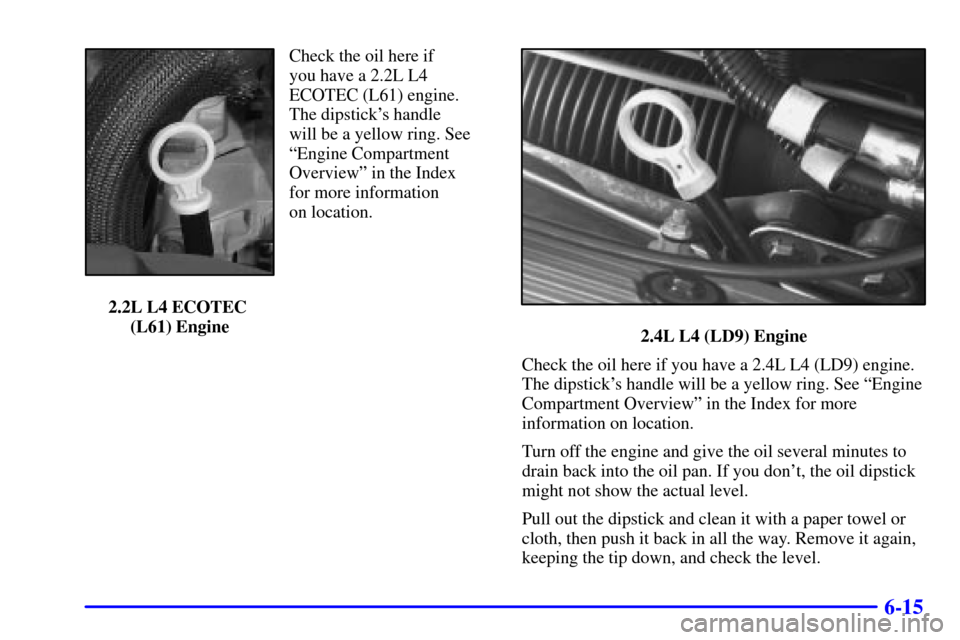
Check the oil here if you
have a 2.2L L4 (LN2)
engine. See ªEngine
Compartment Overviewº in
the Index for more
information on location.
2.2L L4 (LN2) Engine
Page 254 of 360
6-15
Check the oil here if
you have a 2.2L L4
ECOTEC (L61) engine.
The dipstick's handle
will be a yellow ring. See
ªEngine Compartment
Overviewº in the Index
for more information
on location.
2.2L L4 ECOTEC
(L61) Engine
2.4L L4 (LD9) Engine
Check the oil here if you have a 2.4L L4 (LD9) engine.
The dipstick's handle will be a yellow ring. See ªEngine
Compartment Overviewº in the Index for more
information on location.
Turn off the engine and give the oil several minutes to
drain back into the oil pan. If you don't, the oil dipstick
might not show the actual level.
Pull out the dipstick and clean it with a paper towel or
cloth, then push it back in all the way. Remove it again,
keeping the tip down, and check the level.
Page 256 of 360
6-17 When to Add Engine Oil
If the oil is at or below the ADD mark for a 2.2L
L4 (LN2) or 2.4L L4 (LD9) engine, or at or below the
MIN mark for a 2.2L L4 ECOTEC (L61) engine, then
you'll need to add at least one quart of oil. But you must
use the right kind. This part explains what kind of oil to
use. For engine oil crankcase capacity, see ªCapacities
and Specificationsº in the Index.
NOTICE:
Don't add too much oil. If your engine has so
much oil that the oil level gets above the upper
mark that shows the proper operating range,
your engine could be damaged.
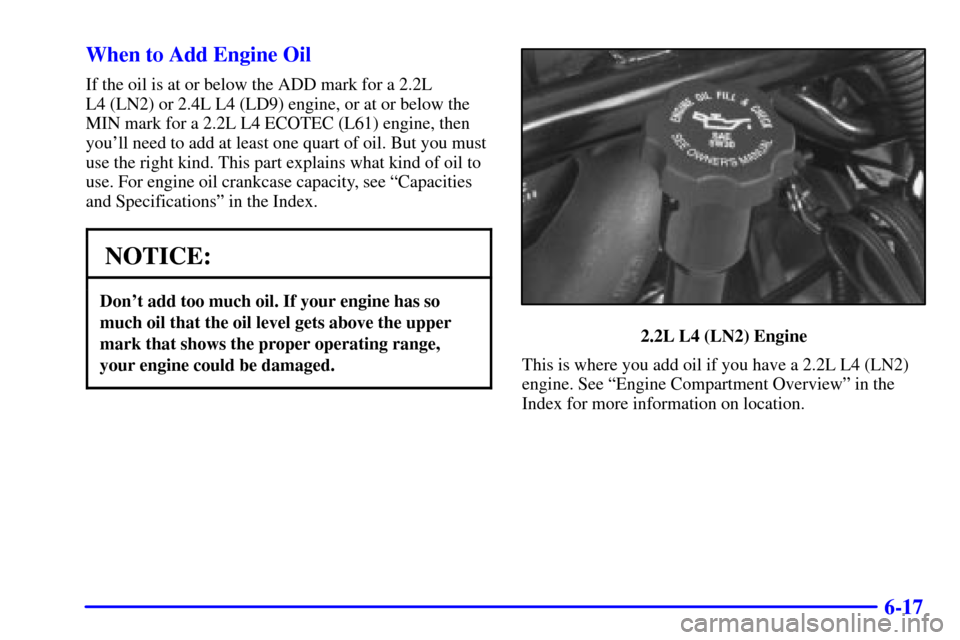
2.2L L4 (LN2) Engine
This is where you add oil if you have a 2.2L L4 (LN2)
engine. See ªEngine Compartment Overviewº in the
Index for more information on location.
Page 257 of 360
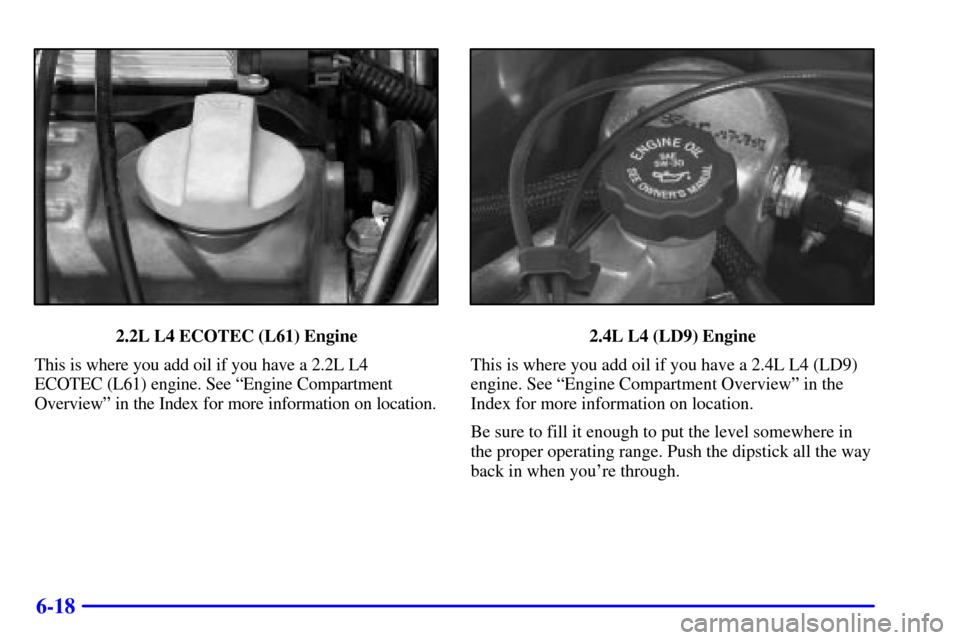
6-18
2.2L L4 ECOTEC (L61) Engine
This is where you add oil if you have a 2.2L L4
ECOTEC (L61) engine. See ªEngine Compartment
Overviewº in the Index for more information on location.2.4L L4 (LD9) Engine
This is where you add oil if you have a 2.4L L4 (LD9)
engine. See ªEngine Compartment Overviewº in the
Index for more information on location.
Be sure to fill it enough to put the level somewhere in
the proper operating range. Push the dipstick all the way
back in when you're through.
Page 262 of 360
6-23
Automatic Transaxle Fluid
It is not necessary to check the transaxle fluid level. A
transaxle fluid leak is the only reason for fluid loss. If a
leak occurs, take the vehicle to the dealership service
department and have it repaired as soon as possible. You
may also have your fluid level checked by your dealer
or service center when you have your oil changed.
Change both the fluid and filter every 50,000 miles
(83 000 km) if the vehicle is mainly driven under one or
more of these conditions:
�In heavy city traffic where the outside temperature
regularly reaches 90�F (32�C) or higher.
�In hilly or mountainous terrain.�When doing frequent trailer towing.
�Uses such as found in taxi, police or delivery service.
If you do not use your vehicle under any of these
conditions, the fluid and filter do not require changing.
NOTICE:
We recommend you use only fluid labeled
DEXRON�-III, because fluid with that label is
made especially for your automatic transaxle.
Damage caused by fluid other than
DEXRON
�-III is not covered by your new
vehicle warranty.