Page 250 of 360
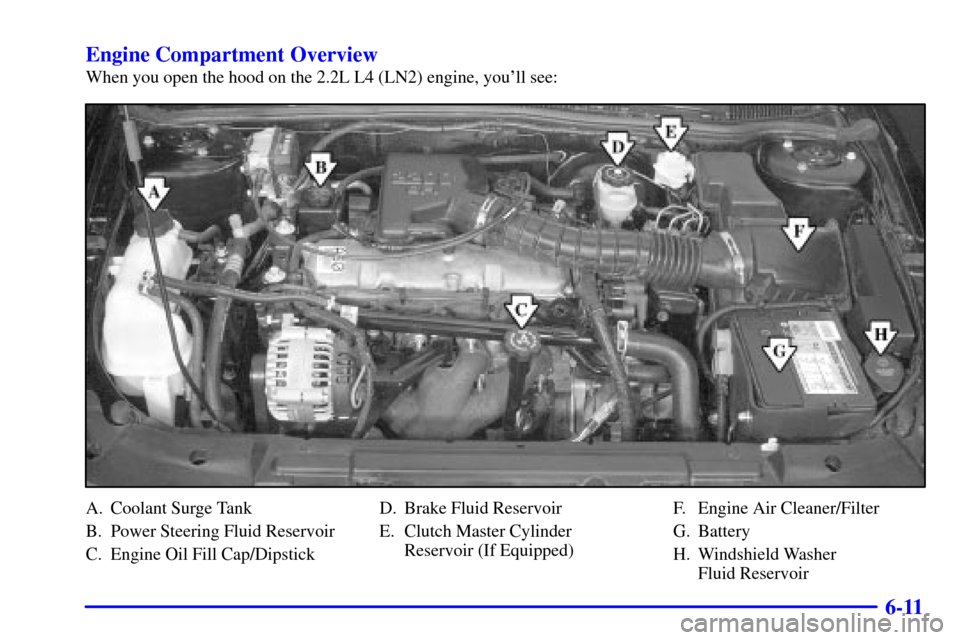
6-11 Engine Compartment Overview
When you open the hood on the 2.2L L4 (LN2) engine, you'll see:
A. Coolant Surge Tank
B. Power Steering Fluid Reservoir
C. Engine Oil Fill Cap/DipstickD. Brake Fluid Reservoir
E. Clutch Master Cylinder
Reservoir (If Equipped)F. Engine Air Cleaner/Filter
G. Battery
H. Windshield Washer
Fluid Reservoir
Page 251 of 360
6-12
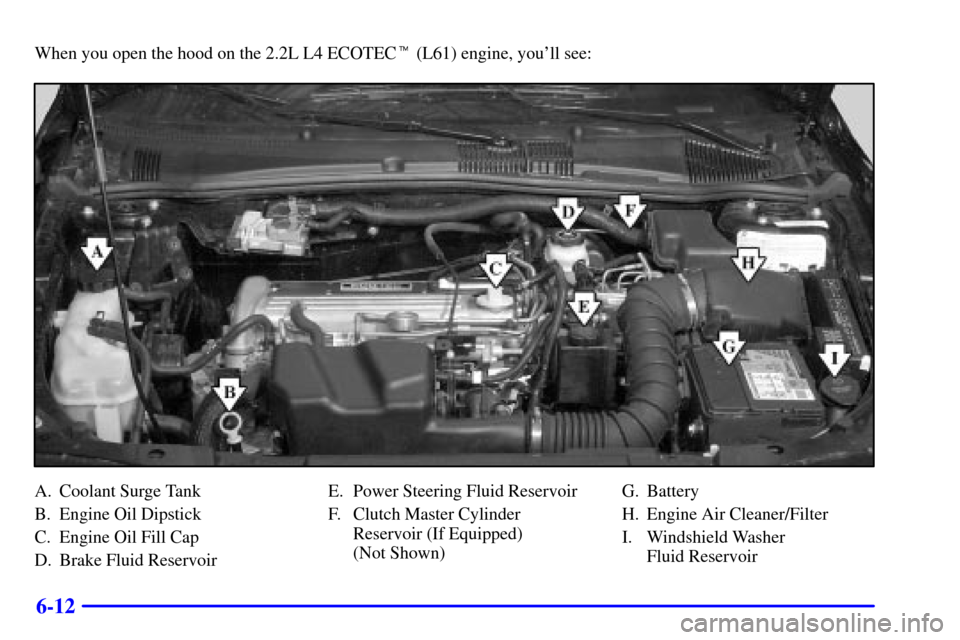
When you open the hood on the 2.2L L4 ECOTEC� (L61) engine, you'll see:
A. Coolant Surge Tank
B. Engine Oil Dipstick
C. Engine Oil Fill Cap
D. Brake Fluid ReservoirE. Power Steering Fluid Reservoir
F. Clutch Master Cylinder
Reservoir (If Equipped)
(Not Shown)G. Battery
H. Engine Air Cleaner/Filter
I. Windshield Washer
Fluid Reservoir
Page 252 of 360
6-13
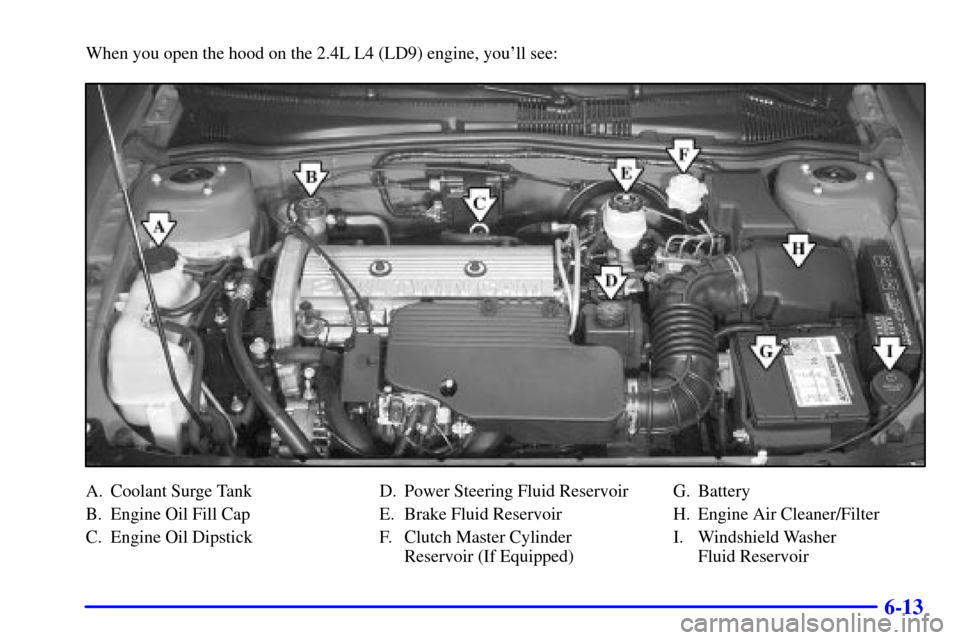
When you open the hood on the 2.4L L4 (LD9) engine, you'll see:
A. Coolant Surge Tank
B. Engine Oil Fill Cap
C. Engine Oil DipstickD. Power Steering Fluid Reservoir
E. Brake Fluid Reservoir
F. Clutch Master Cylinder
Reservoir (If Equipped)G. Battery
H. Engine Air Cleaner/Filter
I. Windshield Washer
Fluid Reservoir
Page 268 of 360
6-29
Power Steering Fluid
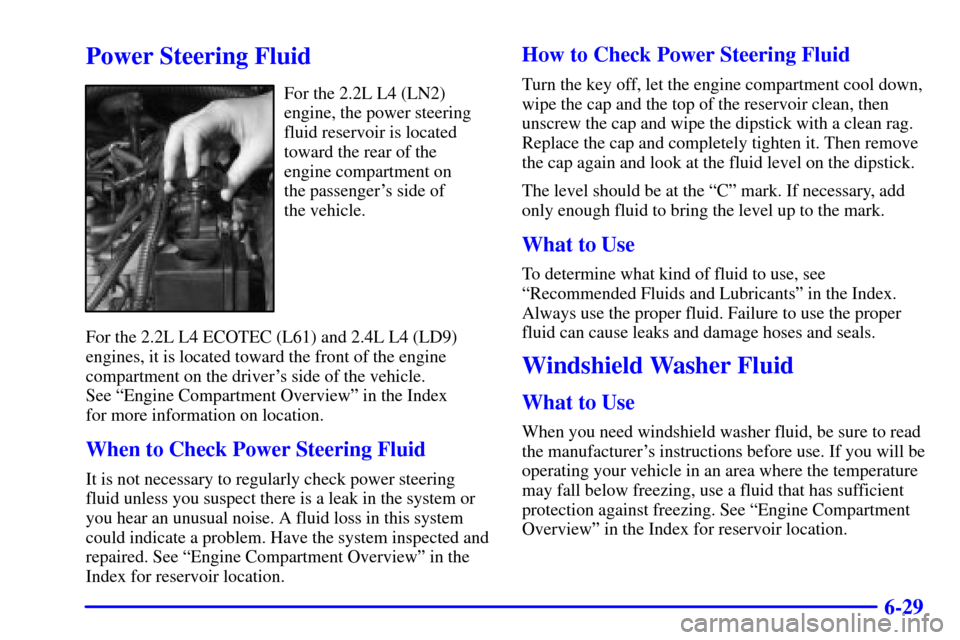
For the 2.2L L4 (LN2)
engine, the power steering
fluid reservoir is located
toward the rear of the
engine compartment on
the passenger's side of
the vehicle.
For the 2.2L L4 ECOTEC (L61) and 2.4L L4 (LD9)
engines, it is located toward the front of the engine
compartment on the driver's side of the vehicle.
See ªEngine Compartment Overviewº in the Index
for more information on location.
When to Check Power Steering Fluid
It is not necessary to regularly check power steering
fluid unless you suspect there is a leak in the system or
you hear an unusual noise. A fluid loss in this system
could indicate a problem. Have the system inspected and
repaired. See ªEngine Compartment Overviewº in the
Index for reservoir location.
How to Check Power Steering Fluid
Turn the key off, let the engine compartment cool down,
wipe the cap and the top of the reservoir clean, then
unscrew the cap and wipe the dipstick with a clean rag.
Replace the cap and completely tighten it. Then remove
the cap again and look at the fluid level on the dipstick.
The level should be at the ªCº mark. If necessary, add
only enough fluid to bring the level up to the mark.
What to Use
To determine what kind of fluid to use, see
ªRecommended Fluids and Lubricantsº in the Index.
Always use the proper fluid. Failure to use the proper
fluid can cause leaks and damage hoses and seals.
Windshield Washer Fluid
What to Use
When you need windshield washer fluid, be sure to read
the manufacturer's instructions before use. If you will be
operating your vehicle in an area where the temperature
may fall below freezing, use a fluid that has sufficient
protection against freezing. See ªEngine Compartment
Overviewº in the Index for reservoir location.
Page 313 of 360
Short Trip/City Scheduled Maintenance
7-7
The services shown in this schedule up to 100,000 miles
(166 000 km) should be repeated after 100,000 miles
(166 000 km) at the same intervals for the life of
this vehicle. The services shown at 150,000 miles
(240 000 km) should be repeated at the same interval
after 150,000 miles (240 000 km) for the life of
this vehicle.
See ªOwner Checks and Servicesº and ªPeriodic
Maintenance Inspectionsº following.
Footnotes
� The U.S. Environmental Protection Agency or the
California Air Resources Board has determined that
the failure to perform this maintenance item will not
nullify the emission warranty or limit recall liability
prior to the completion of the vehicle's useful life.
We, however, urge that all recommended maintenance
services be performed at the indicated intervals and the
maintenance be recorded.# Lubricate the suspension, steering linkage and the
transaxle shift linkage.
+ A good time to check your brakes is during tire
rotation. See ªBrake System Inspectionº under
ªPeriodic Maintenance Inspectionsº in Part C of
this schedule.
++ If you drive in a highly corrosive environment,
your brake calipers may require additional
inspection and service, at every other tire rotation.
See ªCaliper/Knuckle Maintenance Inspectionº
under ªPeriodic Maintenance Inspectionsº in
Part C of this schedule.
Page 327 of 360

Long Trip/Highway Scheduled Maintenance
7-21
The services shown in this schedule up to 100,000 miles
(166 000 km) should be repeated after 100,000 miles
(166 000 km) at the same intervals for the life of
this vehicle. The services shown at 150,000 miles
(240 000 km) should be repeated at the same
interval after 150,000 miles (240 000 km) for the
life of this vehicle.
See ªOwner Checks and Servicesº and ªPeriodic
Maintenance Inspectionsº following.
Footnotes
� The U.S. Environmental Protection Agency or the
California Air Resources Board has determined that
the failure to perform this maintenance item will not
nullify the emission warranty or limit recall liability
prior to the completion of the vehicle's useful life.
We, however, urge that all recommended maintenance
services be performed at the indicated intervals and the
maintenance be recorded.# Lubricate the suspension, steering linkage and the
transaxle shift linkage.
+ A good time to check your brakes is during tire
rotation. See ªBrake System Inspectionº under
ªPeriodic Maintenance Inspectionsº in Part C of
this schedule.
++ If you drive in a highly corrosive environment,
your brake calipers may require additional
inspection and service, at every other tire rotation.
See ªCaliper/Knuckle Maintenance Inspectionº
under ªPeriodic Maintenance Inspectionsº in
Part C of this schedule.
Page 339 of 360

7-33
Automatic Transaxle Shift Lock Control System Check
CAUTION:
When you are doing this check, the vehicle could
move suddenly. If it does, you or others could be
injured. Follow the steps below.
1. Before you start, be sure you have enough room
around the vehicle. It should be parked on a
level surface.
2. Firmly apply the parking brake. See ªParking Brakeº
in the Index if necessary.
Be ready to apply the regular brake immediately if
the vehicle begins to move.
3. With the engine off, turn the key to the RUN position,
but don't start the engine. Without applying the
regular brake, try to move the shift lever out of
PARK (P) with normal effort. If the shift lever moves
out of PARK (P), your vehicle needs service.Ignition Transaxle Lock Check
While parked, and with the parking brake set, try to turn
the ignition key to LOCK in each shift lever position.
�With an automatic transaxle, the key should turn to
LOCK only when the shift lever is in PARK (P).
�With a manual transaxle, the key should turn to
LOCK only when you press the key release button.
On all vehicles, the key should come out only in LOCK.
Turn the steering wheel to the left and to the right.
It should only lock when turned to the right.
Page 341 of 360
7-35
Part C: Periodic
Maintenance Inspections
Listed in this part are inspections and services which
should be performed at least twice a year (for instance,
each spring and fall). You should let your dealer's
service department or other qualified service center
do these jobs. Make sure any necessary repairs are
completed at once.
Proper procedures to perform these services may be
found in a service manual. See ªService and Owner
Publicationsº in the Index.
Steering, Suspension and Front Drive
Axle Boot and Seal Inspection
Inspect the front and rear suspension and steering
system for damaged, loose or missing parts, signs of
wear or lack of lubrication. Inspect the power steering
lines and hoses for proper hook
-up, binding, leaks,
cracks, chafing, etc. Clean and then inspect the
drive axle boot seals for damage, tears or leakage.
Replace seals if necessary.
Exhaust System Inspection
Inspect the complete exhaust system. Inspect the body
near the exhaust system. Look for broken, damaged,
missing or out
-of-position parts as well as open seams,
holes, loose connections or other conditions which could
cause a heat build
-up in the floor pan or could let exhaust
fumes into the vehicle. See ªEngine Exhaustº in the Index.
Fuel System Inspection
Inspect the complete fuel system for damage or leaks.
Engine Cooling System Inspection
Inspect the hoses and have them replaced if they are
cracked, swollen or deteriorated. Inspect all pipes, fittings
and clamps; replace as needed. Clean the outside of the
radiator and air conditioning condenser. To help ensure
proper operation, a pressure test of the cooling system
and pressure cap is recommended at least once a year.
Throttle System Inspection
Inspect the throttle system for interference or binding,
and for damaged or missing parts. Replace parts as
needed. Replace any components that have high effort
or excessive wear. Do not lubricate accelerator and
cruise control cables.