Page 265 of 360
6-26 What to Use
Use a mixture of one-half clean, drinkable water and
one
-half DEX-COOL� coolant which won't damage
aluminum parts. If you use this coolant mixture, you
don't need to add anything else.
CAUTION:
Adding only plain water to your cooling system
can be dangerous. Plain water, or some other
liquid such as alcohol, can boil before the proper
coolant mixture will. Your vehicle's coolant
warning system is set for the proper coolant
mixture. With plain water or the wrong mixture,
your engine could get too hot but you wouldn't
get the overheat warning. Your engine could
catch fire and you or others could be burned.
Use a 50/50 mixture of clean, drinkable water
and DEX
-COOL� coolant.
NOTICE:
If you use an improper coolant mixture, your
engine could overheat and be badly damaged.
The repair cost wouldn't be covered by your
warranty. Too much water in the mixture can
freeze and crack the engine, radiator, heater core
and other parts.
If you have to add coolant more than four times a year,
have your dealer check your cooling system.
NOTICE:
If you use the proper coolant, you don't have to
add extra inhibitors or additives which claim to
improve the system. These can be harmful.
Page 271 of 360
6-32
What to Add
When you do need brake fluid, use only DOT
-3 brake
fluid. Use new brake fluid from a sealed container only.
See ªRecommended Fluids and Lubricantsº in
the Index.
Always clean the brake fluid reservoir cap and the area
around the cap before removing it. This will help keep
dirt from entering the reservoir.
CAUTION:
With the wrong kind of fluid in your brake
system, your brakes may not work well, or they
may not even work at all. This could cause a
crash. Always use the proper brake fluid.
NOTICE:
�Using the wrong fluid can badly damage
brake system parts. For example, just a few
drops of mineral
-based oil, such as engine
oil, in your brake system can damage brake
system parts so badly that they'll have to be
replaced. Don't let someone put in the
wrong kind of fluid.
�If you spill brake fluid on your vehicle's
painted surfaces, the paint finish can be
damaged. Be careful not to spill brake fluid
on your vehicle. If you do, wash it off
immediately. See ªAppearance Careº in
the Index.
Page 292 of 360
6-53 Special Fabric Cleaning Problems
Stains caused by such things as catsup, coffee (black),
egg, fruit, fruit juice, milk, soft drinks, vomit, urine and
blood can be removed as follows:
1. Carefully scrape off excess stain, then sponge the
soiled area with cool water.
2. If a stain remains, follow the cleaner instructions
described earlier.
3. If an odor lingers after cleaning vomit or urine,
treat the area with a water/baking soda solution:
1 teaspoon (5 ml) of baking soda to 1 cup (250 ml)
of lukewarm water.
4. Let dry.
Stains caused by candy, ice cream, mayonnaise, chili
sauce and unknown stains can be removed as follows:
1. Carefully scrape off excess stain.
2. First, clean with cool water and allow to
dry completely.
3. If a stain remains, follow the cleaner instructions
described earlier.
Cleaning Vinyl
Use warm water and a clean cloth.
�Rub with a clean, damp cloth to remove dirt.
You may have to do it more than once.
�Things like tar, asphalt and shoe polish will stain
if you don't get them off quickly. Use a clean cloth
and a vinyl/leather cleaner. See your dealer for
this product.
Cleaning the Top of the Instrument Panel
Use only mild soap and water to clean the top surfaces
of the instrument panel. Sprays containing silicones or
waxes may cause annoying reflections in the windshield
and even make it difficult to see through the windshield
under certain conditions.
Cleaning Interior Plastic Components
Use only a mild soap and water solution on a soft
cloth or sponge. Commercial cleaners may affect the
surface finish.
Page 295 of 360
6-56 Cleaning Exterior Lamps/Lenses
Use only lukewarm or cold water, a soft cloth and a car
washing soap to clean exterior lamps and lenses. Follow
instructions under ªWashing Your Vehicle.º
Finish Care
Occasional waxing or mild polishing of your vehicle by
hand may be necessary to remove residue from the paint
finish. You can get GM
-approved cleaning products
from your dealer. See ªAppearance Care and Materialsº
in the Index.
Your vehicle has a ªbasecoat/clearcoatº paint finish.
The clearcoat gives more depth and gloss to the colored
basecoat. Always use waxes and polishes that are
non
-abrasive and made for a basecoat/clearcoat
paint finish.
NOTICE:
Machine compounding or aggressive polishing on
a basecoat/clearcoat paint finish may dull the
finish or leave swirl marks.
Foreign materials such as calcium chloride and other
salts, ice melting agents, road oil and tar, tree sap, bird
droppings, chemicals from industrial chimneys, etc., can
damage your vehicle's finish if they remain on painted
surfaces. Wash the vehicle as soon as possible. If
necessary, use non
-abrasive cleaners that are marked
safe for painted surfaces to remove foreign matter.
Exterior painted surfaces are subject to aging, weather
and chemical fallout that can take their toll over a period
of years. You can help to keep the paint finish looking
new by keeping your vehicle garaged or covered
whenever possible.
Page 305 of 360
6-66
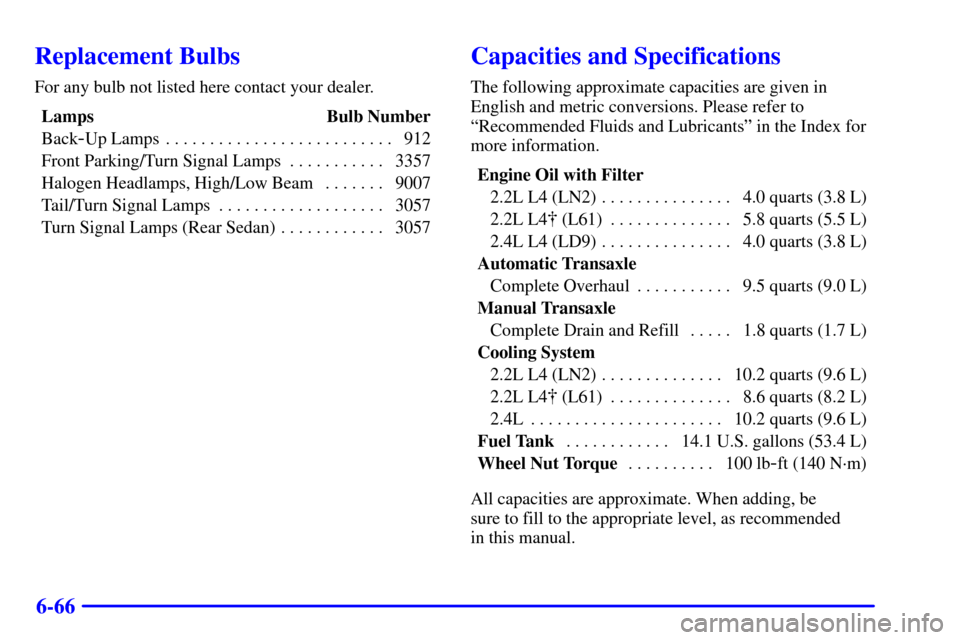
Replacement Bulbs
For any bulb not listed here contact your dealer.
Lamps Bulb Number
Back
-Up Lamps 912. . . . . . . . . . . . . . . . . . . . . . . . . .
Front Parking/Turn Signal Lamps 3357. . . . . . . . . . .
Halogen Headlamps, High/Low Beam 9007. . . . . . .
Tail/Turn Signal Lamps 3057. . . . . . . . . . . . . . . . . . .
Turn Signal Lamps (Rear Sedan) 3057. . . . . . . . . . . .
Capacities and Specifications
The following approximate capacities are given in
English and metric conversions. Please refer to
ªRecommended Fluids and Lubricantsº in the Index for
more information.
Engine Oil with Filter
2.2L L4 (LN2) 4.0 quarts (3.8 L). . . . . . . . . . . . . . .
2.2L L4� (L61) 5.8 quarts (5.5 L). . . . . . . . . . . . . .
2.4L L4 (LD9) 4.0 quarts (3.8 L). . . . . . . . . . . . . . .
Automatic Transaxle
Complete Overhaul 9.5 quarts (9.0 L). . . . . . . . . . .
Manual Transaxle
Complete Drain and Refill 1.8 quarts (1.7 L). . . . .
Cooling System
2.2L L4 (LN2) 10.2 quarts (9.6 L). . . . . . . . . . . . . .
2.2L L4� (L61) 8.6 quarts (8.2 L). . . . . . . . . . . . . .
2.4L 10.2 quarts (9.6 L). . . . . . . . . . . . . . . . . . . . . .
Fuel Tank14.1 U.S. gallons (53.4 L) . . . . . . . . . . . .
Wheel Nut Torque100 lb
-ft (140 N´m) . . . . . . . . . .
All capacities are approximate. When adding, be
sure to fill to the appropriate level, as recommended
in this manual.
Page 306 of 360

6-67 Engine Specifications
2.2L L4 (LN2) VIN Engine Code 4. . . . . . . . . . . . . .
2.2L L4� (L61) VIN Engine Code F. . . . . . . . . . . . .
2.4L L4 (LD9) VIN Engine Code T. . . . . . . . . . . . . .
Air Conditioning
Refrigerant Capacity
If you do your own service work, you'll need the proper
service manual. See ªDoing Your Own Service Workº in
the Index for additional information. It is recommended
that service work on your air conditioning system be
performed by a qualified technician.
Air Conditioning
Refrigerant R
-134a1.5 lbs. (.68 kg) . . . . . . . . . . . .
Use Refrigerant Oil, R134a Systems
Normal Maintenance
Replacement Parts
Engine Air Cleaner/Filter
2.2L L4 (LN2) A
-1172C* . . . . . . . . . . . . . . . . . . . . .
2.2L L4� (L61) A
-1172C* . . . . . . . . . . . . . . . . . . . .
2.4L L4 (LD9) A
-1172C* . . . . . . . . . . . . . . . . . . . . .
Engine Oil Filter
2.2L L4 (LN2) PF
-47* . . . . . . . . . . . . . . . . . . . . . . .
2.2L L4� (L61) PF2244G*. . . . . . . . . . . . . . . . . . . .
2.4L L4 (LD9) PF
-44* . . . . . . . . . . . . . . . . . . . . . . .
Spark Plugs
2.2L L4 (LN2) 41
-928* . . . . . . . . . . . . . . . . . . . . . . .
Gap: 0.040 inch (1.02 mm)
2.2L L4� (L61) 41
-981* . . . . . . . . . . . . . . . . . . . . . .
Gap: 0.042 inch (1.06 mm)
2.4L L4 (LD9) 41
-963* . . . . . . . . . . . . . . . . . . . . . . .
Gap: 0.050 inch (1.27 mm)
Windshield Wiper Blade (Shepherd's Hook Type)
Left Side 22 inches (56 cm). . . . . . . . . . . . . . . . . . .
Right Side 17 inches (43 cm). . . . . . . . . . . . . . . . . .
* ACDelco
� part number.
� ECOTEC�
Page 311 of 360
Scheduled Maintenance
7-5
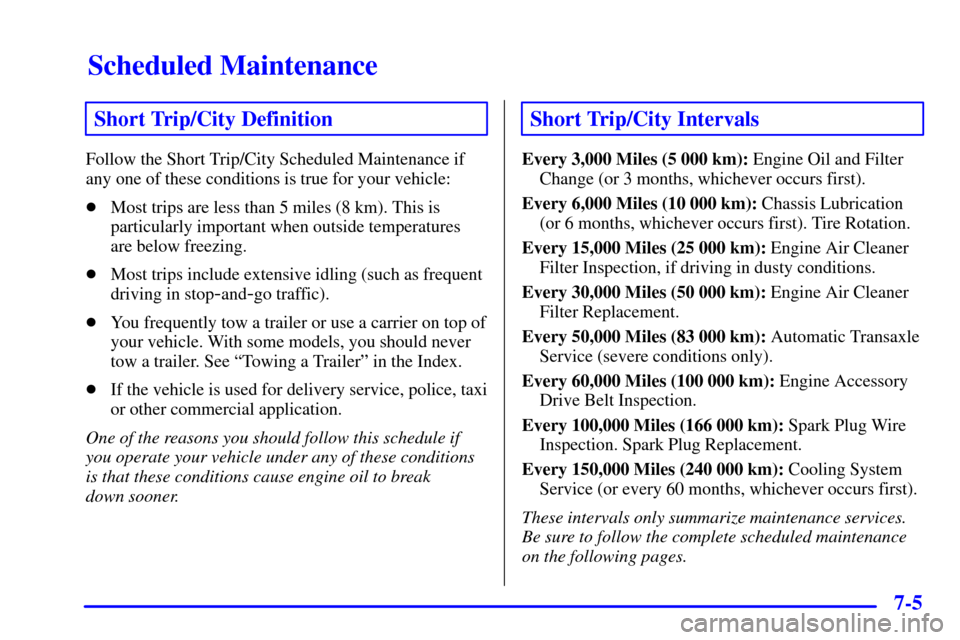
Short Trip/City Definition
Follow the Short Trip/City Scheduled Maintenance if
any one of these conditions is true for your vehicle:
�Most trips are less than 5 miles (8 km). This is
particularly important when outside temperatures
are below freezing.
�Most trips include extensive idling (such as frequent
driving in stop
-and-go traffic).
�You frequently tow a trailer or use a carrier on top of
your vehicle. With some models, you should never
tow a trailer. See ªTowing a Trailerº in the Index.
�If the vehicle is used for delivery service, police, taxi
or other commercial application.
One of the reasons you should follow this schedule if
you operate your vehicle under any of these conditions
is that these conditions cause engine oil to break
down sooner.
Short Trip/City Intervals
Every 3,000 Miles (5 000 km): Engine Oil and Filter
Change (or 3 months, whichever occurs first).
Every 6,000 Miles (10 000 km): Chassis Lubrication
(or 6 months, whichever occurs first). Tire Rotation.
Every 15,000 Miles (25 000 km): Engine Air Cleaner
Filter Inspection, if driving in dusty conditions.
Every 30,000 Miles (50 000 km): Engine Air Cleaner
Filter Replacement.
Every 50,000 Miles (83 000 km): Automatic Transaxle
Service (severe conditions only).
Every 60,000 Miles (100 000 km): Engine Accessory
Drive Belt Inspection.
Every 100,000 Miles (166 000 km): Spark Plug Wire
Inspection. Spark Plug Replacement.
Every 150,000 Miles (240 000 km): Cooling System
Service (or every 60 months, whichever occurs first).
These intervals only summarize maintenance services.
Be sure to follow the complete scheduled maintenance
on the following pages.
Page 312 of 360
Scheduled Maintenance
7-6
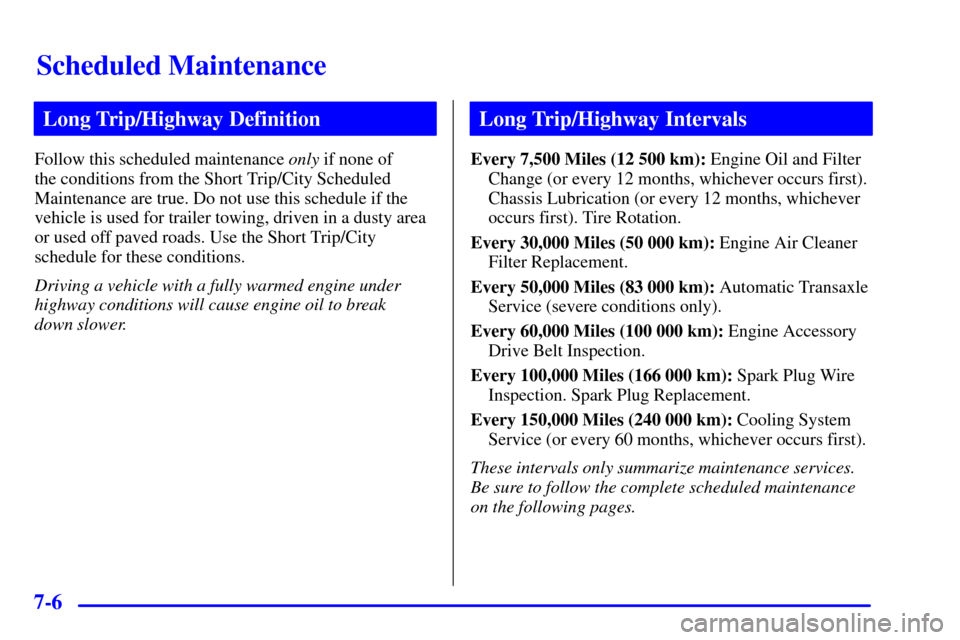
Long Trip/Highway Definition
Follow this scheduled maintenance only if none of
the conditions from the Short Trip/City Scheduled
Maintenance are true. Do not use this schedule if the
vehicle is used for trailer towing, driven in a dusty area
or used off paved roads. Use the Short Trip/City
schedule for these conditions.
Driving a vehicle with a fully warmed engine under
highway conditions will cause engine oil to break
down slower.
Long Trip/Highway Intervals
Every 7,500 Miles (12 500 km): Engine Oil and Filter
Change (or every 12 months, whichever occurs first).
Chassis Lubrication (or every 12 months, whichever
occurs first). Tire Rotation.
Every 30,000 Miles (50 000 km): Engine Air Cleaner
Filter Replacement.
Every 50,000 Miles (83 000 km): Automatic Transaxle
Service (severe conditions only).
Every 60,000 Miles (100 000 km): Engine Accessory
Drive Belt Inspection.
Every 100,000 Miles (166 000 km): Spark Plug Wire
Inspection. Spark Plug Replacement.
Every 150,000 Miles (240 000 km): Cooling System
Service (or every 60 months, whichever occurs first).
These intervals only summarize maintenance services.
Be sure to follow the complete scheduled maintenance
on the following pages.