Page 133 of 360

2-72 Service Vehicle Soon Light
This light will come on
briefly when you turn
on the ignition.
It will stay on or come on if it detects a problem on the
vehicle. If this happens, see your dealer's service
department as soon as possible.
Passlock� Warning Light
United States Canada
This light will come on briefly when you turn the key
to START.
If the light flashes, the Passlock system has entered a
tamper mode. If the vehicle fails to start, see ªPasslockº
in the Index.
On vehicles equipped with the remote keyless entry system,
when the ignition is off and the security system is armed, the
light will flash to indicate that the security system is active.
If the light comes on continuously while driving and
stays on, there may be a problem with the Passlock
system. Your vehicle will not be protected by Passlock,
and you should see your dealer.
On vehicles equipped with remote keyless entry, the
Passlock warning light will flash to indicate that the
security system is active when the ignition is OFF and
the security system is armed.
Page 191 of 360
4-26
Winter Driving
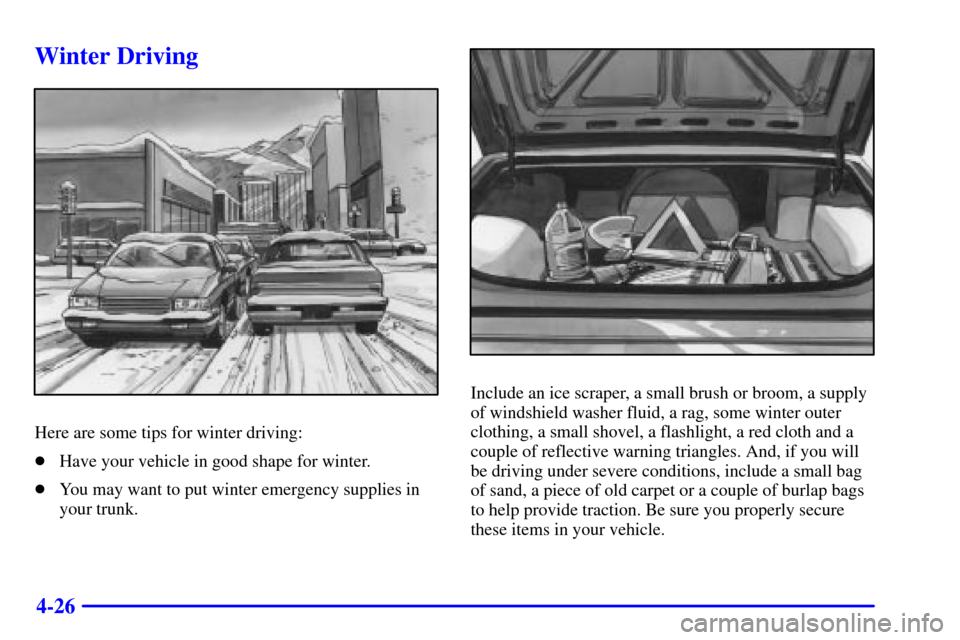
Here are some tips for winter driving:
�Have your vehicle in good shape for winter.
�You may want to put winter emergency supplies in
your trunk.
Include an ice scraper, a small brush or broom, a supply
of windshield washer fluid, a rag, some winter outer
clothing, a small shovel, a flashlight, a red cloth and a
couple of reflective warning triangles. And, if you will
be driving under severe conditions, include a small bag
of sand, a piece of old carpet or a couple of burlap bags
to help provide traction. Be sure you properly secure
these items in your vehicle.
Page 199 of 360

4-34
And, if you do have a heavy load, you should spread
it out. Don't carry more than 132 lbs. (60 kg) in
your trunk.
CAUTION:
Do not load your vehicle any heavier than the
GVWR, or either the maximum front or rear
GAWR. If you do, parts on your vehicle can
break, and it can change the way your vehicle
handles. These could cause you to lose control
and crash. Also, overloading can shorten the life
of your vehicle.
If you put things inside your vehicle -- like suitcases,
tools, packages, or anything else
-- they will go as fast
as the vehicle goes. If you have to stop or turn quickly,
or if there is a crash, they'll keep going.
CAUTION:
Things you put inside your vehicle can strike
and injure people in a sudden stop or turn,
or in a crash.
�Put things in the trunk or rear area of your
vehicle. In a trunk, put them as far forward
as you can. Try to spread the weight evenly.
If you have fold
-down rear seats, you'll find
four anchors on the back wall of your trunk.
You can use these anchors to tie down lighter
loads. They're not strong enough for heavy
things, however, so put them as far forward
as you can in the trunk or rear area.
�Never stack heavier things, like suitcases,
inside the vehicle so that some of them are
above the tops of the seats.
�Don't leave an unsecured child restraint in
your vehicle.
�When you carry something inside the
vehicle, secure it whenever you can.
�Don't leave a seat folded down unless you
need to.
Page 204 of 360
4-39 Driving with a Trailer
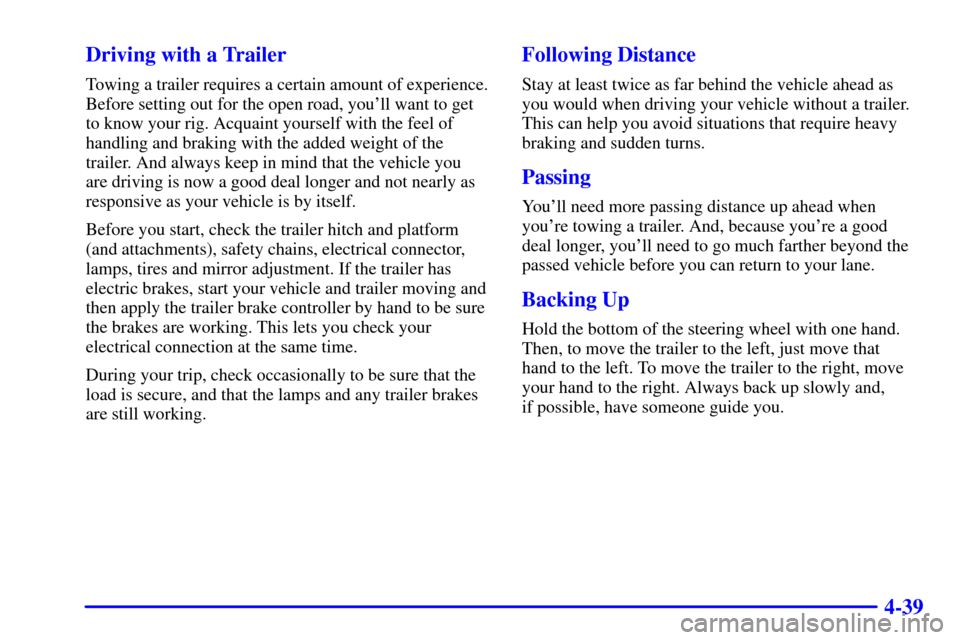
Towing a trailer requires a certain amount of experience.
Before setting out for the open road, you'll want to get
to know your rig. Acquaint yourself with the feel of
handling and braking with the added weight of the
trailer. And always keep in mind that the vehicle you
are driving is now a good deal longer and not nearly as
responsive as your vehicle is by itself.
Before you start, check the trailer hitch and platform
(and attachments), safety chains, electrical connector,
lamps, tires and mirror adjustment. If the trailer has
electric brakes, start your vehicle and trailer moving and
then apply the trailer brake controller by hand to be sure
the brakes are working. This lets you check your
electrical connection at the same time.
During your trip, check occasionally to be sure that the
load is secure, and that the lamps and any trailer brakes
are still working.
Following Distance
Stay at least twice as far behind the vehicle ahead as
you would when driving your vehicle without a trailer.
This can help you avoid situations that require heavy
braking and sudden turns.
Passing
You'll need more passing distance up ahead when
you're towing a trailer. And, because you're a good
deal longer, you'll need to go much farther beyond the
passed vehicle before you can return to your lane.
Backing Up
Hold the bottom of the steering wheel with one hand.
Then, to move the trailer to the left, just move that
hand to the left. To move the trailer to the right, move
your hand to the right. Always back up slowly and,
if possible, have someone guide you.
Page 236 of 360
5-29 Storing the Flat Tire and Tools
CAUTION:
Storing a jack, a tire or other equipment in the
passenger compartment of the vehicle could
cause injury. In a sudden stop or collision, loose
equipment could strike someone. Store all these
in the proper place.
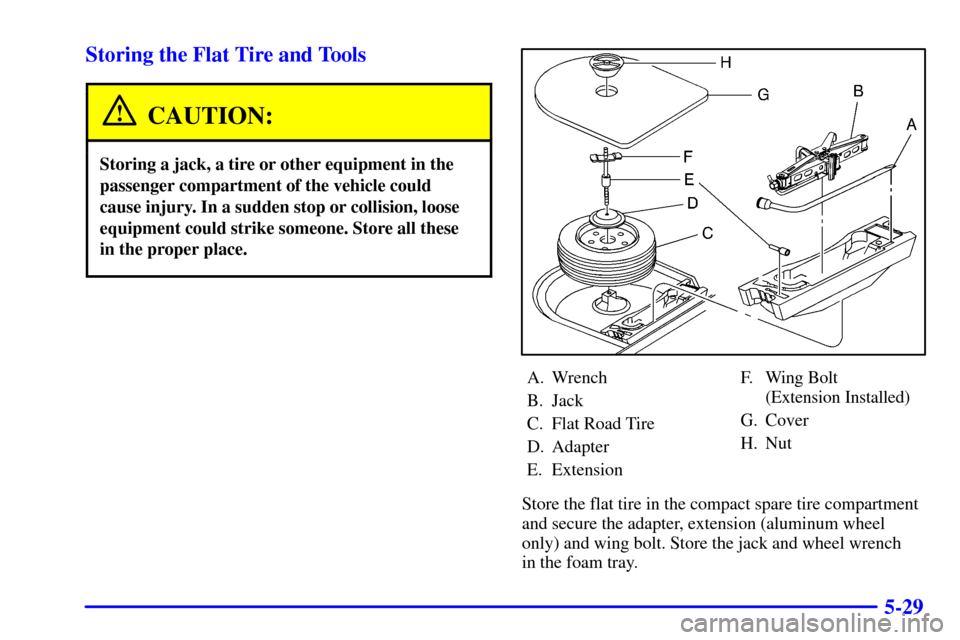
A. Wrench
B. Jack
C. Flat Road Tire
D. Adapter
E. ExtensionF. Wing Bolt
(Extension Installed)
G. Cover
H. Nut
Store the flat tire in the compact spare tire compartment
and secure the adapter, extension (aluminum wheel
only) and wing bolt. Store the jack and wheel wrench
in the foam tray.
Page 290 of 360

6-51
NOTICE:
If your vehicle has a tire size other than
P195/65R15 or P205/55R16 size tires, use tire
chains only where legal and only when you must.
Use only SAE Class ªSº type chains that are the
proper size for your tires. Install them on the
front tires and tighten them as tightly as possible
with the ends securely fastened. Drive slowly and
follow the chain manufacturer's instructions. If
you can hear the chains contacting your vehicle,
stop and retighten them. If the contact continues,
slow down until it stops. Driving too fast or
spinning the wheels with chains on will damage
your vehicle.
Appearance Care
Remember, cleaning products can be hazardous. Some
are toxic. Others can burst into flame if you strike a
match or get them on a hot part of the vehicle. Some are
dangerous if you breathe their fumes in a closed space.
When you use anything from a container to clean your
vehicle, be sure to follow the manufacturer's warnings
and instructions. And always open your doors or
windows when you're cleaning the inside.
Never use these to clean your vehicle:
�Gasoline
�Benzene
�Naphtha
�Carbon Tetrachloride
�Acetone
�Paint Thinner
�Turpentine
�Lacquer Thinner
�Nail Polish Remover
They can all be hazardous
-- some more than
others
-- and they can all damage your vehicle, too.