Page 250 of 360
6-11 Engine Compartment Overview
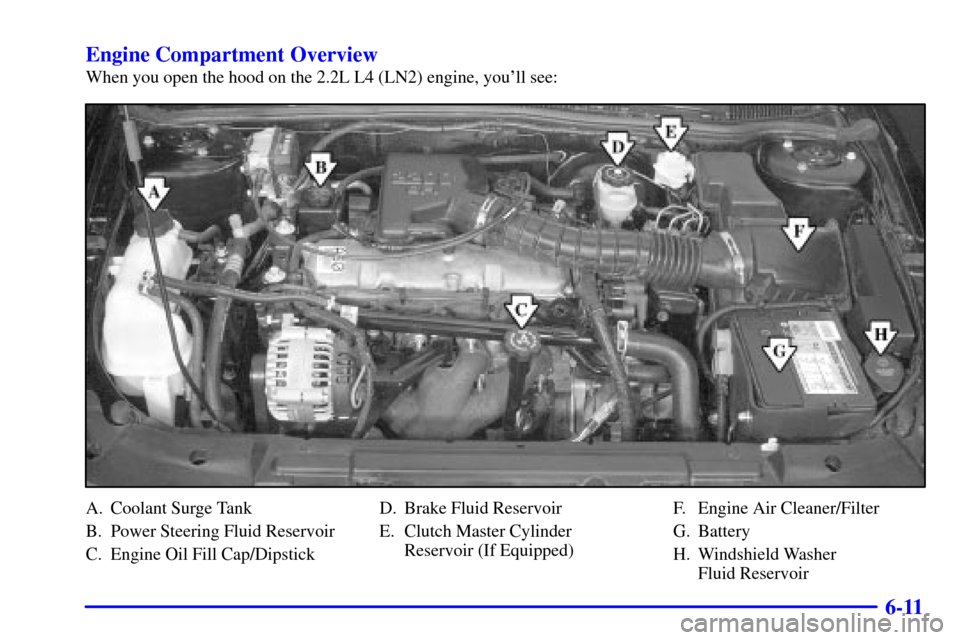
When you open the hood on the 2.2L L4 (LN2) engine, you'll see:
A. Coolant Surge Tank
B. Power Steering Fluid Reservoir
C. Engine Oil Fill Cap/DipstickD. Brake Fluid Reservoir
E. Clutch Master Cylinder
Reservoir (If Equipped)F. Engine Air Cleaner/Filter
G. Battery
H. Windshield Washer
Fluid Reservoir
Page 251 of 360
6-12
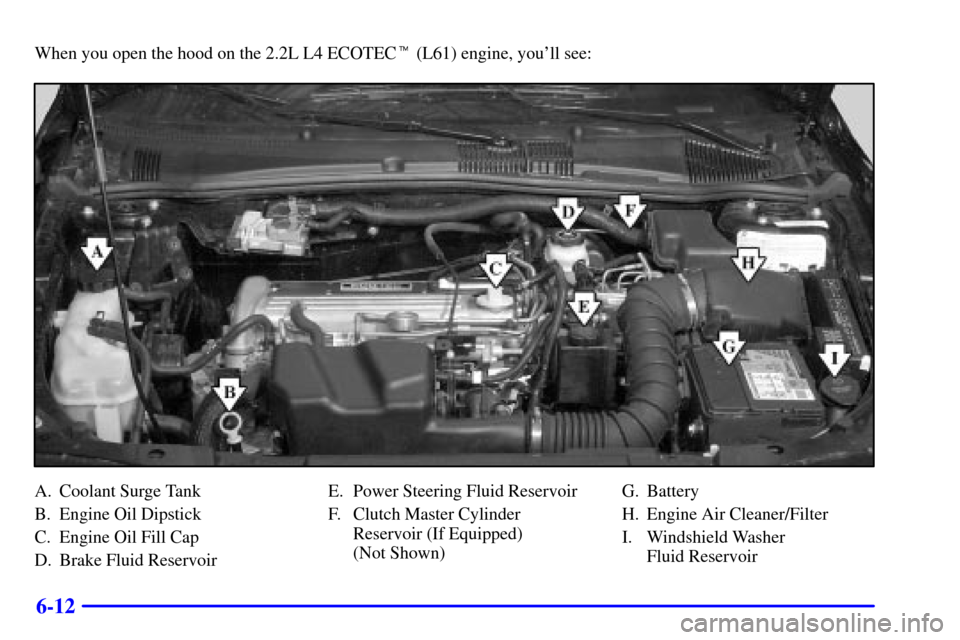
When you open the hood on the 2.2L L4 ECOTEC� (L61) engine, you'll see:
A. Coolant Surge Tank
B. Engine Oil Dipstick
C. Engine Oil Fill Cap
D. Brake Fluid ReservoirE. Power Steering Fluid Reservoir
F. Clutch Master Cylinder
Reservoir (If Equipped)
(Not Shown)G. Battery
H. Engine Air Cleaner/Filter
I. Windshield Washer
Fluid Reservoir
Page 252 of 360
6-13
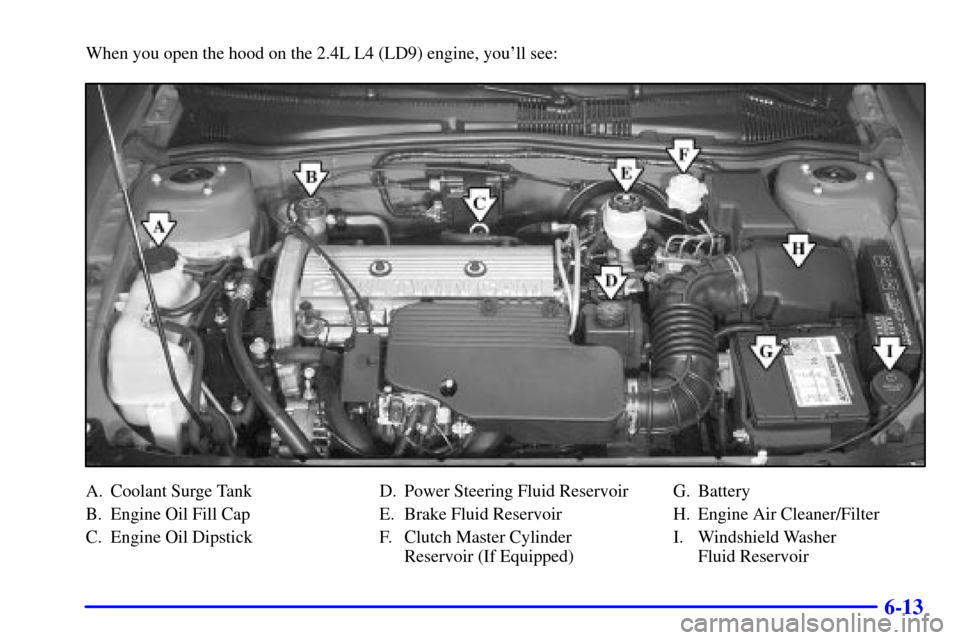
When you open the hood on the 2.4L L4 (LD9) engine, you'll see:
A. Coolant Surge Tank
B. Engine Oil Fill Cap
C. Engine Oil DipstickD. Power Steering Fluid Reservoir
E. Brake Fluid Reservoir
F. Clutch Master Cylinder
Reservoir (If Equipped)G. Battery
H. Engine Air Cleaner/Filter
I. Windshield Washer
Fluid Reservoir
Page 263 of 360

6-24
Manual Transaxle Fluid
It is not necessary to check the transaxle fluid level. A
transaxle fluid leak is the only reason for fluid loss. If a
leak occurs, take the vehicle to the dealership service
department and have it repaired as soon as possible. You
may also have your fluid level checked by your dealer
or service center when you have your oil changed. See
ªRecommended Fluids and Lubricantsº in the Index for
the proper fluid to use.
Hydraulic Clutch
The hydraulic clutch linkage in your vehicle is
self
-adjusting. The clutch master cylinder reservoir is
filled with hydraulic clutch fluid.
It is not necessary to regularly check clutch fluid unless
you suspect there is a leak in the system. Adding fluid
won't correct a leak.
A fluid loss in this system could indicate a problem.
Have the system inspected and repaired.
When to Check and What to Use
Refer to the Maintenance
Schedule to determine how
often you should check the
fluid level in your clutch
master cylinder reservoir
and for the proper fluid. See
ªOwner Checks and
Servicesº and
ªRecommended Fluids and
Lubricantsº in the Index.
How to Check and Add Fluid
You do not need to check the fluid level unless you
suspect a clutch problem. To check the fluid level, take
the cap off. If the fluid reaches the step inside the
reservoir, the fluid level is correct. See ªEngine
Compartment Overviewº in the Index for more
information on location.
Page 337 of 360
7-31 At Least Twice a Year
Restraint System Check
Make sure the safety belt reminder light and all your
belts, buckles, latch plates, retractors and anchorages are
working properly. Look for any other loose or damaged
safety belt system parts. If you see anything that might
keep a safety belt system from doing its job, have it
repaired. Have any torn or frayed safety belts replaced.
Also look for any opened or broken air bag coverings,
and have them repaired or replaced. (The air bag system
does not need regular maintenance.)
Wiper Blade Check
Inspect wiper blades for wear or cracking. Replace blade
inserts that appear worn or damaged or that streak or
miss areas of the windshield. Also see ªWiper Blades,
Cleaningº in the Index.Weatherstrip Lubrication
Silicone grease on weatherstrips will make them last
longer, seal better, and not stick or squeak. Apply
silicone grease with a clean cloth. During very cold,
damp weather more frequent application may be
required. See ªRecommended Fluids and Lubricantsº
in the Index.
Manual Transaxle Check
It is not necessary to check the transaxle fluid level.
Check for leaks. A fluid leak is the only reason for fluid
loss. Have the system inspected and repaired if needed.
Automatic Transaxle Inspection
It is not necessary to check the transaxle fluid level.
A transaxle fluid leak is the only reason for fluid loss.
Check for leaks. If a leak occurs, take the vehicle to
your dealer and have it repaired as soon as possible.
Hydraulic Clutch System Check
Check the fluid level in the clutch reservoir. See ªHydraulic
Clutch Fluidº in the Index. A fluid loss in this system
could indicate a problem. Have the system inspected and
repaired at once.
Page 338 of 360
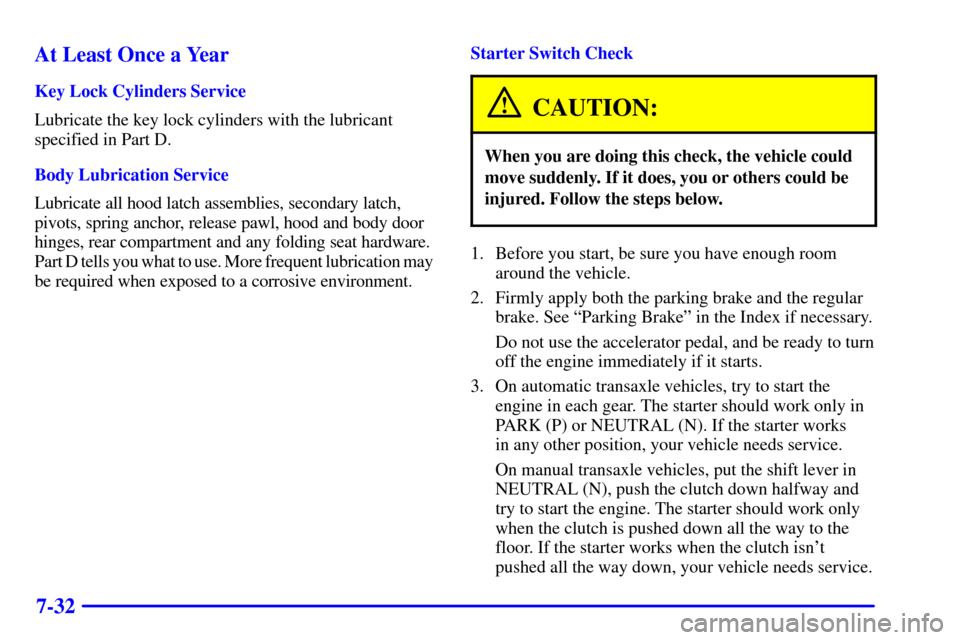
7-32 At Least Once a Year
Key Lock Cylinders Service
Lubricate the key lock cylinders with the lubricant
specified in Part D.
Body Lubrication Service
Lubricate all hood latch assemblies, secondary latch,
pivots, spring anchor, release pawl, hood and body door
hinges, rear compartment and any folding seat hardware.
Part D tells you what to use. More frequent lubrication may
be required when exposed to a corrosive environment.Starter Switch Check
CAUTION:
When you are doing this check, the vehicle could
move suddenly. If it does, you or others could be
injured. Follow the steps below.
1. Before you start, be sure you have enough room
around the vehicle.
2. Firmly apply both the parking brake and the regular
brake. See ªParking Brakeº in the Index if necessary.
Do not use the accelerator pedal, and be ready to turn
off the engine immediately if it starts.
3. On automatic transaxle vehicles, try to start the
engine in each gear. The starter should work only in
PARK (P) or NEUTRAL (N). If the starter works
in any other position, your vehicle needs service.
On manual transaxle vehicles, put the shift lever in
NEUTRAL (N), push the clutch down halfway and
try to start the engine. The starter should work only
when the clutch is pushed down all the way to the
floor. If the starter works when the clutch isn't
pushed all the way down, your vehicle needs service.
Page 343 of 360
7-37
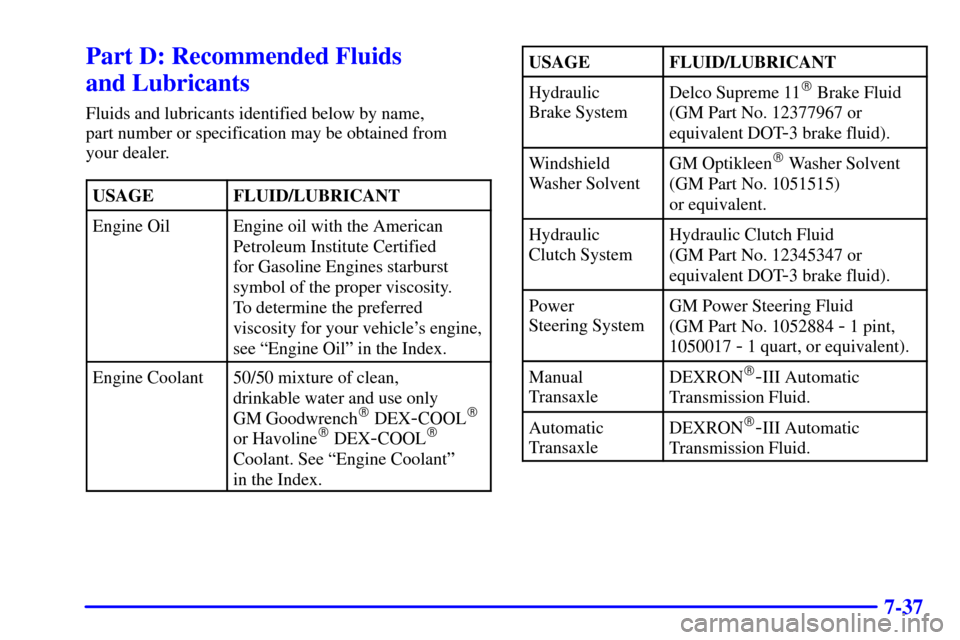
Part D: Recommended Fluids
and Lubricants
Fluids and lubricants identified below by name,
part number or specification may be obtained from
your dealer.
USAGE
FLUID/LUBRICANT
Engine OilEngine oil with the American
Petroleum Institute Certified
for Gasoline Engines starburst
symbol of the proper viscosity.
To determine the preferred
viscosity for your vehicle's engine,
see ªEngine Oilº in the Index.
Engine Coolant50/50 mixture of clean,
drinkable water and use only
GM Goodwrench
� DEX-COOL�
or Havoline� DEX-COOL�
Coolant. See ªEngine Coolantº
in the Index.
USAGEFLUID/LUBRICANT
Hydraulic
Brake SystemDelco Supreme 11� Brake Fluid
(GM Part No. 12377967 or
equivalent DOT
-3 brake fluid).
Windshield
Washer SolventGM Optikleen� Washer Solvent
(GM Part No. 1051515)
or equivalent.
Hydraulic
Clutch SystemHydraulic Clutch Fluid
(GM Part No. 12345347 or
equivalent DOT
-3 brake fluid).
Power
Steering SystemGM Power Steering Fluid
(GM Part No. 1052884
- 1 pint,
1050017
- 1 quart, or equivalent).
Manual
TransaxleDEXRON�-III Automatic
Transmission Fluid.
Automatic
TransaxleDEXRON�-III Automatic
Transmission Fluid.
Page 344 of 360
7-38
USAGEFLUID/LUBRICANT
Key Lock
CylindersMulti-Purpose Lubricant,
Superlube� (GM Part
No. 12346241 or equivalent).
Manual Transaxle
Shift LinkageChassis Lubricant (GM Part
No. 12377985 or equivalent) or
lubricant meeting requirements
of NLGI # 2, Category LB
or GC
-LB.
Clutch Linkage
Pivot PointsEngine oil.
Chassis
LubricationChassis Lubricant (GM Part
No. 12377985 or equivalent) or
lubricant meeting requirements
of NLGI # 2, Category LB
or GC
-LB.
USAGEFLUID/LUBRICANT
Hood Latch
Assembly,
Secondary Latch,
Pivots, Spring
Anchor and
Release PawlLubriplate� Lubricant Aerosol
(GM Part No. 12346293 or
equivalent) or lubricant meeting
requirements of NLGI # 2,
Category LB or GC
-LB.
Hood and
Door HingesMulti-Purpose Lubricant,
Superlube� (GM Part
No. 12346241 or equivalent).
Weatherstrip
ConditioningDielectric Silicone Grease
(GM Part No. 12345579
or equivalent).