Page 107 of 356
2-54 Windshield Washer
There is a paddle with the word PUSH on it at the top
of the turn signal/multifunction lever. To spray washer
fluid on the windshield, push the paddle. The washer
will continue to spray until you release the paddle. The
wipers will clear the window and wipe a few more times
before stopping or returning to the previous setting.
See ªWindshield Washer Fluidº in the Index.
CAUTION:
In freezing weather, don't use your washer until
the windshield is warmed. Otherwise the washer
fluid can form ice on the windshield, blocking
your vision.
Cruise Control (Option)
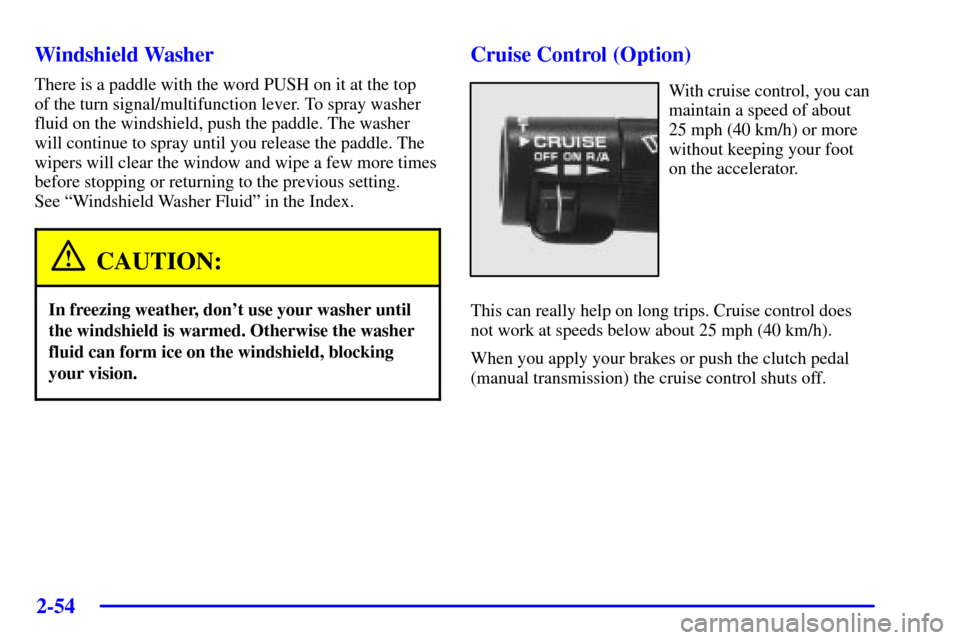
With cruise control, you can
maintain a speed of about
25 mph (40 km/h) or more
without keeping your foot
on the accelerator.
This can really help on long trips. Cruise control does
not work at speeds below about 25 mph (40 km/h).
When you apply your brakes or push the clutch pedal
(manual transmission) the cruise control shuts off.
Page 189 of 356
4-18
The heavier the rain, the harder it is to see. Even if your
windshield wiper blades are in good shape, a heavy rain
can make it harder to see road signs and traffic signals,
pavement markings, the edge of the road and even
people walking.
It's wise to keep your windshield wiping equipment
in good shape and keep your windshield washer tank
filled with washer fluid. Replace your windshield wiper
inserts when they show signs of streaking or missing
areas on the windshield, or when strips of rubber start to
separate from the inserts.
Driving too fast through large water puddles or even
going through some car washes can cause problems, too.
The water may affect your brakes. Try to avoid puddles.
But if you can't, try to slow down before you hit them.
Page 194 of 356

4-23
Here are some things you can check before a trip:
�Windshield Washer Fluid: Is the reservoir full?
Are all windows clean inside and outside?
�Wiper Blades: Are they in good shape?
�Fuel, Engine Oil, Other Fluids: Have you checked
all levels?
�Lamps: Are they all working? Are the lenses clean?
�Tires: They are vitally important to a safe,
trouble
-free trip. Is the tread good enough for
long
-distance driving? Are the tires all inflated to
the recommended pressure?
�Weather Forecasts: What's the weather outlook
along your route? Should you delay your trip a
short time to avoid a major storm system?
�Maps: Do you have up
-to-date maps?
Highway Hypnosis
Is there actually such a condition as ªhighway hypnosisº?
Or is it just plain falling asleep at the wheel? Call it
highway hypnosis, lack of awareness, or whatever.
There is something about an easy stretch of road with
the same scenery, along with the hum of the tires on the
road, the drone of the engine, and the rush of the wind
against the vehicle that can make you sleepy. Don't let it
happen to you! If it does, your vehicle can leave the
road in less than a second, and you could crash and
be injured.
What can you do about highway hypnosis?
First, be aware that it can happen.
Then here are some tips:
�Make sure your vehicle is well ventilated,
with a comfortably cool interior.
�Keep your eyes moving. Scan the road ahead
and to the sides. Check your rearview mirrors
and your instruments frequently.
�If you get sleepy, pull off the road into a rest,
service or parking area and take a nap, get some
exercise, or both. For safety, treat drowsiness on
the highway as an emergency.
Page 303 of 356

6-57
Cleaning the Outside of the
Windshield and Wiper Blades
If the windshield is not clear after using the windshield
washer, or if the wiper blade chatters when running,
wax, sap or other material may be on the blade
or windshield.
Clean the outside of the windshield with a full
-strength
glass cleaning liquid. The windshield is clean if beads
do not form when you rinse it with water.
Grime from the windshield will stick to the wiper blades
and affect their performance. Clean the blade by wiping
vigorously with a cloth soaked in full
-strength
windshield washer solvent. Then rinse the blade
with water.
Check the wiper blades and clean them as necessary;
replace blades that look worn.
Weatherstrips
Silicone grease on weatherstrips will make them last
longer, seal better, and not stick or squeak. Apply
silicone grease with a clean cloth at least every six
months. During very cold, damp weather more frequent
application may be required. See ªRecommended Fluids
and Lubricantsº in the Index.
Cleaning a Removable Roof Panel
Special care is necessary when cleaning, removing
and/or storing the roof panel.
�Flush with water to remove dust and dirt, then dry
the panel.
�Clean the panel with GM Glass Cleaner. Leave the
cleaner on the panel for one minute, then wipe the
panel with a soft, lint
-free cloth.
�Don't use abrasive cleaning materials.
Page 336 of 356

7-18
Wiper Blade Check
Inspect wiper blades for wear or cracking. Replace blade
inserts that appear worn or damaged or that streak or
miss areas of the windshield. Also see ªWiper Blades,
Cleaningº in the Index.
Weatherstrip Lubrication
Silicone grease on weatherstrips will make them last
longer, seal better, and not stick or squeak. Apply
silicone grease with a clean cloth. During very cold,
damp weather more frequent application may be
required. See ªRecommended Fluids and Lubricantsº
in the Index.
Manual Transmission Check
Check the transmission fluid level; add if needed. See
ªManual Transmission Fluidº in the Index. Check for
leaks. A fluid leak is the only reason for fluid loss. Have
the system inspected and repaired if needed.Automatic Transmission Check
Check the transmission fluid level; add if needed. See
ªAutomatic Transmission Fluidº in the Index. A fluid
loss may indicate a problem. Check the system and
repair if needed.
Hydraulic Clutch System Check
Check the fluid level in the clutch reservoir. See
ªHydraulic Clutch Fluidº in the Index. A fluid loss in
this system could indicate a problem. Have the system
inspected and repaired at once.
At Least Once a Year
Key Lock Cylinders Service
Lubricate the key lock cylinders with the lubricant
specified in Part D.
Body Lubrication Service
Lubricate all hinges and latches, including those for the
hood, rear compartment, console doors and any folding
seat hardware. Part D tells you what to use. More
frequent lubrication may be required when exposed to a
corrosive environment.