Page 149 of 356

2-96 Low Oil Light
This warning light should
come on briefly while you
are starting your engine.
If the light doesn't come on,
have it repaired.
If the light stays on after starting your engine, your
engine oil level may be too low. You may need to add
oil. See ªEngine Oilº in the Index.
NOTICE:
The oil level monitoring system only checks
the oil level when you are starting your engine.
It does not keep monitoring the level once the
engine is running. Also, the oil level check only
works when the engine has been turned off long
enough for the oil to drain back into the oil pan.
Oil Change Light
This OIL CHANGE light
should come on briefly as a
bulb check when you start
the engine. If the OIL
CHANGE light doesn't
come on, have it serviced.
If the OIL CHANGE light comes on and stays on
for 60 seconds after you start the engine, have the
oil changed.
For additional information, see ªEngine Oil, When to
Changeº in the Index. After changing the engine oil, the
system must be reset. See ªHow to Reset the Oil Change
Lightº in the Index.
Page 150 of 356
2-97
Service Vehicle Light
This warning light should
come on in your instrument
panel cluster for a
three
-second bulb check
when you first start your
vehicle. If the light doesn't
come on, have it serviced.
This light will stay on steady if you have certain
non
-emission related vehicle problems. These problems
may not be obvious and may affect vehicle performance
or durability. Consult a qualified dealer for necessary
repairs to maintain top vehicle performance.
Check Gages Light
This warning light will
come on briefly when
you start the engine.
If the light comes on and stays on while you are driving,
check your gages to see if they are in the warning areas.
Hatch Ajar Light
This warning light should
come on in your instrument
panel cluster for a
three
-second bulb check
when you first start your
vehicle. If the light doesn't
come on, have it serviced.
This light will stay on steady if your hatch is open or
ajar and the ignition key is in RUN.
Page 152 of 356
2-99
Low Fuel Light
If your fuel is low, your vehicle's CHECK GAGES light
on your instrument panel cluster will come on. See
ªCheck Gages Lightº in the Index.
Reduced Engine Power Light
(V6 Engine Only)
The REDUCED ENG PWR
warning light should come
on in your instrument panel
cluster for a three
-second
bulb check when you first
start your vehicle.If the light doesn't come on, have it serviced.
If the REDUCED ENG PWR warning light comes on,
a noticeable reduction in the vehicle's performance may
occur. The vehicle may be driven at a reduced speed
while the REDUCED ENG PWR light is on, but
acceleration and speed may be reduced. Anytime this
warning light stays on, the vehicle should be taken to
an authorized Chevrolet dealer as soon as possible for
diagnosis and repair.
Page 178 of 356

4-7
Avoid needless heavy braking. Some people drive
in spurts
-- heavy acceleration followed by heavy
braking
-- rather than keeping pace with traffic.
This is a mistake. Your brakes may not have time to
cool between hard stops. Your brakes will wear out
much faster if you do a lot of heavy braking. If you
keep pace with the traffic and allow realistic following
distances, you will eliminate a lot of unnecessary
braking. That means better braking and longer
brake life.
If your engine ever stops while you're driving,
brake normally but don't pump your brakes.
If you do, the pedal may get harder to push down.
If your engine stops, you will still have some power
brake assist. But you will use it when you brake.
Once the power assist is used up, it may take longer
to stop and the brake pedal will be harder to push.
Anti-Lock Brake System (ABS)
Your vehicle has anti-lock brakes. ABS is an
advanced electronic braking system that will help
prevent a braking skid.
When you start your engine, or when you begin to
drive away, your anti
-lock brake system will check
itself. You may hear a momentary motor or clicking
noise while this test is going on, and you may even
notice that your brake pedal moves or pulses a little.
This is normal.
United States Canada
If there's a problem with the anti
-lock brake system,
this warning light will stay on. See ªAnti
-Lock Brake
System Warning Lightº in the Index.
Page 181 of 356

4-10
If your vehicle is in cruise control when the ASR system
begins to limit wheel spin, the cruise control will
automatically disengage. When road conditions allow
you to safely use it again, you may re
-engage the cruise
control. See ªCruise Controlº in the Index.
When the system is on,
this warning light will
come on to let you know if
there's a problem with your
ASR system. See ªASR
System Warning Lightº in
the Index.
When this warning light is on, the system will not limit
wheel spin. Adjust your driving accordingly.
The ASR system automatically comes on whenever
you start your vehicle. To limit wheel spin, especially
in slippery road conditions, you should always leave
the system on. But you can turn the ASR system off
if you ever need to. You should turn the system off if
your vehicle ever gets stuck in sand, mud or snow and
rocking the vehicle is required. See ªRocking Your
Vehicleº in the Index.
To turn the system off, press
the ASR button located on
the instrument panel.
The ASR system warning light will come on and stay
on. If the ASR system is limiting wheel spin when you
press the button, the warning light will come on
-- but
the system won't turn off right away. It will wait until
there's no longer a current need to limit wheel spin.
You can turn the system back on at any time by
pressing the button again. The ASR system warning
light should go off.
Page 192 of 356
4-21
Here are ways to increase your safety in city driving:
�Know the best way to get to where you are
going. Get a city map and plan your trip into an
unknown part of the city just as you would for a
cross
-country trip.
�Try to use the freeways that rim and crisscross
most large cities. You'll save time and energy.
See the next part, ªFreeway Driving.º
�Treat a green light as a warning signal. A traffic light
is there because the corner is busy enough to need it.
When a light turns green, and just before you start
to move, check both ways for vehicles that have
not cleared the intersection or may be running the
red light.
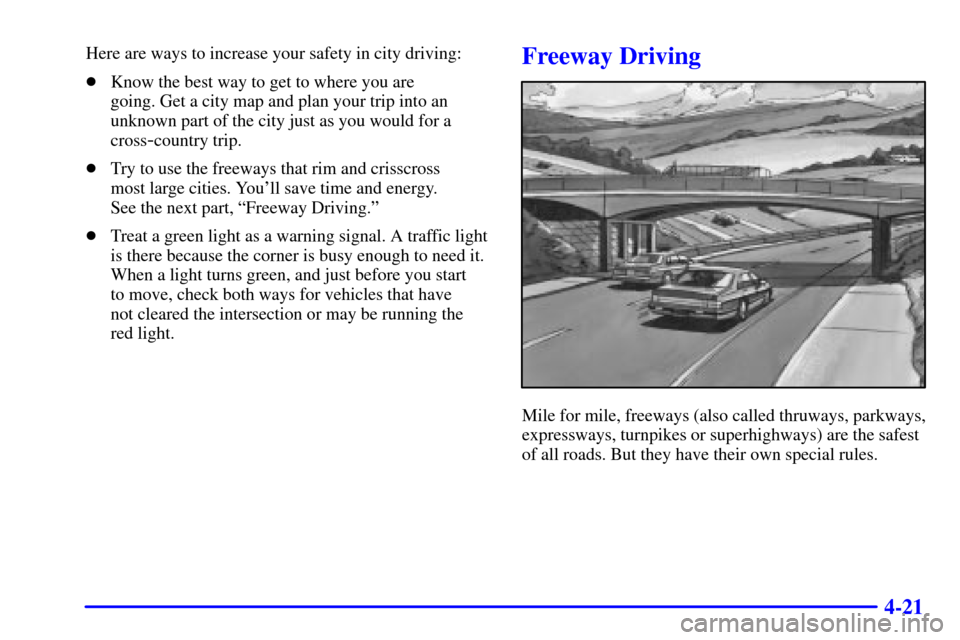
Freeway Driving
Mile for mile, freeways (also called thruways, parkways,
expressways, turnpikes or superhighways) are the safest
of all roads. But they have their own special rules.
Page 197 of 356
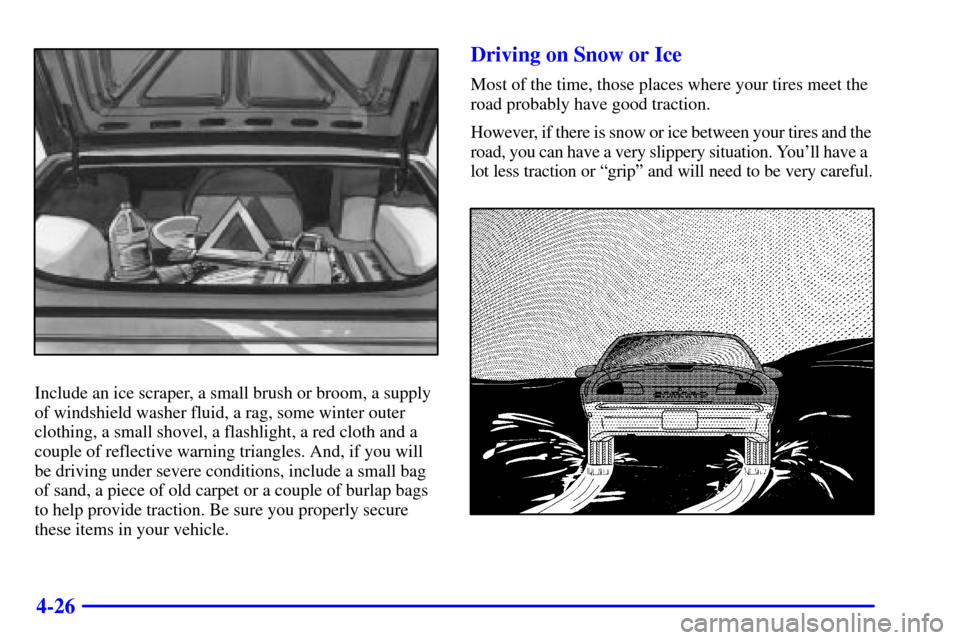
4-26
Include an ice scraper, a small brush or broom, a supply
of windshield washer fluid, a rag, some winter outer
clothing, a small shovel, a flashlight, a red cloth and a
couple of reflective warning triangles. And, if you will
be driving under severe conditions, include a small bag
of sand, a piece of old carpet or a couple of burlap bags
to help provide traction. Be sure you properly secure
these items in your vehicle.
Driving on Snow or Ice
Most of the time, those places where your tires meet the
road probably have good traction.
However, if there is snow or ice between your tires and the
road, you can have a very slippery situation. You'll have a
lot less traction or ªgripº and will need to be very careful.
Page 213 of 356
5-3
Other Warning Devices
If you carry reflective triangles, you can set one up at
the side of the road about 300 feet (100 m) behind
your vehicle.
Jump Starting
If your battery has run down, you may want to use
another vehicle and some jumper cables to start your
vehicle. Be sure to follow the steps below to do it safely.
CAUTION:
Batteries can hurt you. They can be
dangerous because:
�They contain acid that can burn you.
�They contain gas that can explode or ignite.
�They contain enough electricity to burn you.
If you don't follow these steps exactly, some or
all of these things can hurt you.
NOTICE:
Ignoring these steps could result in costly
damage to your vehicle that wouldn't be
covered by your warranty.
The ACDelco� battery in your vehicle has a
built
-in hydrometer. Do not charge, test or
jump start the battery if the hydrometer looks
clear or light yellow. Replace the battery when
there is a clear or light yellow hydrometer and a
cranking complaint.
Trying to start your vehicle by pushing or pulling
it won't work, and it could damage your vehicle.
1. Check the other vehicle. It must have a 12-volt
battery with a negative ground system.
NOTICE:
If the other system isn't a 12-volt system with a
negative ground, both vehicles can be damaged.