Page 256 of 356
6-10 Engine Compartment Overview
When you open the hood of the 3800 V6 engine, you'll see:
A. Engine Coolant Reservoir
B. Battery
C. Radiator Pressure Cap
D. Engine Oil Fill CapE. Automatic Transmission Fluid
Dipstick (If Equipped)
F. Windshield Washer Fluid Reservoir
G. Engine Cooling Fans
H. Engine Air Cleaner/FilterI. Power Steering Fluid Reservoir
J. Engine Oil Dipstick
K. Brake Fluid Reservoir
L. Clutch Master Cylinder
Reservoir (If Equipped)
Page 257 of 356
6-11
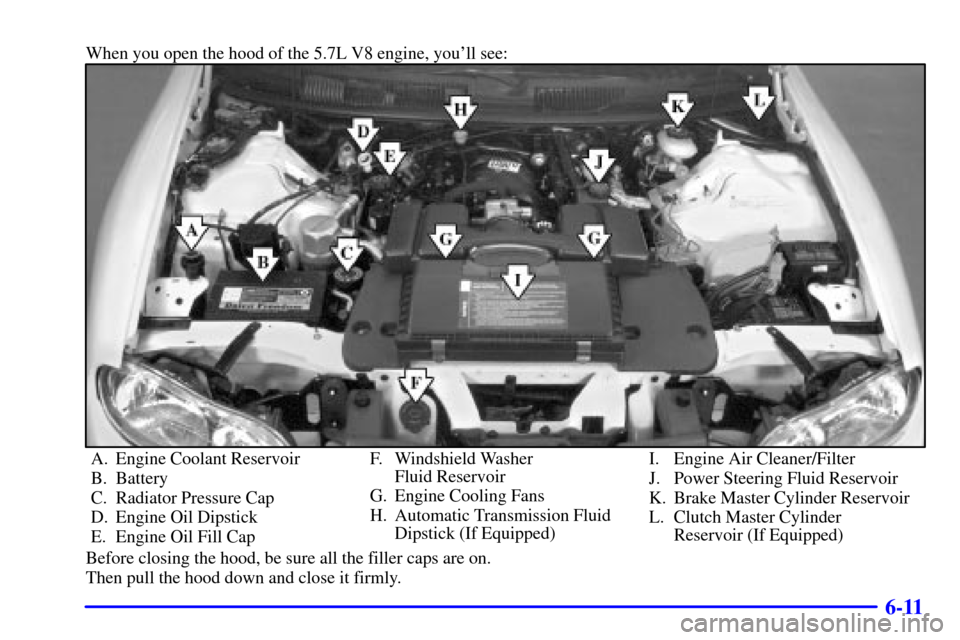
When you open the hood of the 5.7L V8 engine, you'll see:
A. Engine Coolant Reservoir
B. Battery
C. Radiator Pressure Cap
D. Engine Oil Dipstick
E. Engine Oil Fill CapF. Windshield Washer
Fluid Reservoir
G. Engine Cooling Fans
H. Automatic Transmission Fluid
Dipstick (If Equipped)I. Engine Air Cleaner/Filter
J. Power Steering Fluid Reservoir
K. Brake Master Cylinder Reservoir
L. Clutch Master Cylinder
Reservoir (If Equipped)
Before closing the hood, be sure all the filler caps are on.
Then pull the hood down and close it firmly.
Page 275 of 356

6-29 Checking Coolant
See ªEngine Compartment Overviewº in the Index for
information on location.
The vehicle must be on a level surface. When your engine
is cold, check the dipstick on the cap of the coolant
recovery tank. The coolant level should be at COLD, or a
little higher. When your engine is warm, the level on the
dipstick should be up to HOT, or a little higher.
Adding Coolant to the Recovery Tank
If you need more coolant, add the proper DEX
-COOL�
coolant mixture at the coolant recovery tank, but only
when your engine is cool. If the tank is very low or
empty, also add coolant to the radiator. See ªEngine
Overheatingº in the Index for information.
CAUTION:
Turning the radiator pressure cap when the
engine and radiator are hot can allow steam
and scalding liquids to blow out and burn you
badly. Never turn the pressure cap
-- even a
little
-- when the engine and radiator are hot.
Add coolant mixture at the recovery tank, but be careful
not to spill it.
CAUTION:
You can be burned if you spill coolant on hot
engine parts. Coolant contains ethylene glycol,
and it will burn if the engine parts are hot
enough. Don't spill coolant on a hot engine.
Occasionally check the coolant level in the radiator. For
information on how to add coolant to the radiator, see
ªCooling Systemº in the Index.
Page 276 of 356
6-30
Radiator Pressure Cap
The radiator pressure cap is located toward the front of
the engine compartment near the battery. See ªEngine
Compartment Overviewº in the Index for more
information on location.
NOTICE:
Your radiator cap is an 18 psi (124 kPa)
pressure
-type cap and must be tightly installed to
prevent coolant loss and possible engine damage
from overheating. Be sure the arrows on the cap
line up with the overflow tube on the radiator
filler neck. See ªEngine Compartment Overviewº
in the Index for more information on location.
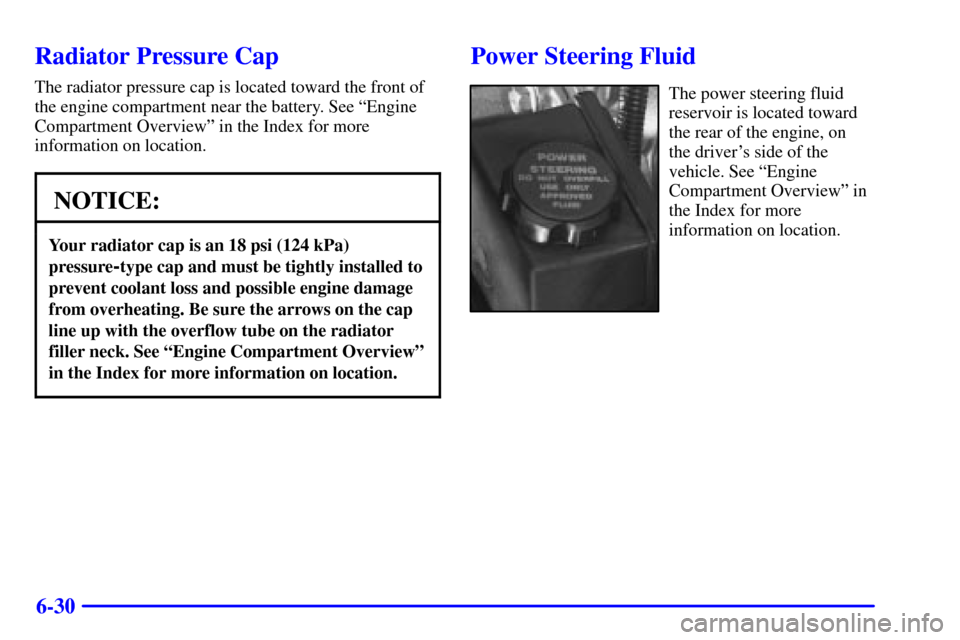
Power Steering Fluid
The power steering fluid
reservoir is located toward
the rear of the engine, on
the driver's side of the
vehicle. See ªEngine
Compartment Overviewº in
the Index for more
information on location.
Page 334 of 356
Scheduled Maintenance
7-16
100,000 Miles (166 000 km)
�Inspect spark plug wires.
An Emission Control Service.
�Replace spark plugs.
An Emission Control Service.
�If you haven't used your vehicle under severe service conditions listed
previously and, therefore, haven't changed your automatic transmission
fluid, change both the fluid and filter. Manual transmission fluid doesn't
require change.
150,000 Miles (240 000 km)
�Drain, flush and refill cooling system (or every 60 months since last service,
whichever occurs first). See ªEngine Coolantº in the Index for what to use.
Inspect hoses. Clean radiator, condenser, pressure cap and neck.
Pressure test the cooling system and pressure cap.
An Emission Control Service.
ACTUAL
SERVICED BY:MILEAGE
DATE
ACTUAL
SERVICED BY:MILEAGE
DATE
Page 340 of 356

7-22 Engine Cooling System Inspection
Inspect the hoses and have them replaced if they are
cracked, swollen or deteriorated. Inspect all pipes,
fittings and clamps; replace as needed. Clean the outside
of the radiator and air conditioning condenser. To help
ensure proper operation, a pressure test of the cooling
system and pressure cap is recommended at least once
a year.
Throttle System Inspection
(Except 3800 Series V6 Engine)
Inspect the throttle system for interference or binding,
and for damaged or missing parts. Replace parts as
needed. Replace any components that have high effort
or excessive wear. Do not lubricate accelerator and
cruise control cables.
Rear Axle Service
Check the gear lubricant level in the rear axle and add
if needed. See ªRear Axleº in the Index. A fluid loss
may indicate a problem. Check the axle and repair it
if needed.
Brake System Inspection
Inspect the complete system. Inspect brake lines and
hoses for proper hook
-up, binding, leaks, cracks,
chafing, etc. Inspect disc brake pads for wear and rotors
for surface condition. Inspect other brake parts,
including calipers, parking brake, etc. Check parking
brake adjustment. You may need to have your brakes
inspected more often if your driving habits or conditions
result in frequent braking.