Page 99 of 356
2-46
Shifting Into PARK (P)
(Automatic Transmission Only)
CAUTION:
It can be dangerous to get out of your vehicle if
the shift lever is not fully in PARK (P) with the
parking brake firmly set. Your vehicle can roll.
If you have left the engine running, the vehicle
can move suddenly. You or others could be
injured. To be sure your vehicle won't move, even
when you're on fairly level ground, use the steps
that follow. If you're pulling a trailer, see
ªTowing a Trailerº in the Index.
1. Hold the brake pedal down with your right foot and
set the parking brake.
2. Move the shift lever into PARK (P) by holding in the
button on the lever and pushing the lever all the way
toward the front of your vehicle.
3. Turn the ignition key to LOCK.
4. Remove the key and take it with you. If you can
leave your vehicle with the key in your hand, your
vehicle is in PARK (P).
Page 100 of 356
2-47
Leaving Your Vehicle With the Engine
Running (Automatic Transmission Only)
CAUTION:
It can be dangerous to leave your vehicle with
the engine running. Your vehicle could move
suddenly if the shift lever is not fully in PARK (P)
with the parking brake firmly set. And, if you
leave the vehicle with the engine running, it could
overheat and even catch fire. You or others could
be injured. Don't leave your vehicle with the
engine running unless you have to.
If you have to leave your vehicle with the engine
running, be sure your vehicle is in PARK (P) and your
parking brake is firmly set before you leave it. After
you've moved the shift lever into PARK (P), hold the
regular brake pedal down. See if you can move the shift
lever away from PARK (P) without first pushing in the
button. If you can, it means that the shift lever wasn't
fully locked into PARK (P).
Torque Lock (Automatic Transmission)
If you are parking on a hill and you don't shift your
transmission into PARK (P) properly, the weight of the
vehicle may put too much force on the parking pawl in
the transmission. You may find it difficult to pull the
shift lever out of PARK (P). This is called ªtorque lock.º
To prevent torque lock, set the parking brake and then
shift into PARK (P) properly before you leave the
driver's seat. To find out how, see ªShifting Into
PARK (P)º in the Index.
When you are ready to drive, move the shift lever out of
PARK (P) before you release the parking brake.
If torque lock does occur, you may need to have another
vehicle push yours a little uphill to take some of the
pressure from the parking pawl in the transmission,
so you can pull the shift lever out of PARK (P).
Page 101 of 356

2-48
Shifting Out of PARK (P)
(Automatic Transmission Only)
Your vehicle has an automatic transmission shift lock
control system. You have to fully apply your regular
brake before you can shift from PARK (P) when the
ignition is in RUN. See ªAutomatic Transmission
Operationº in the Index.
If you cannot shift out of PARK (P), ease pressure on
the shift lever
-- push the shift lever all the way into
PARK (P) and release the shift lever button as you
maintain brake application. Then press the shift lever
button and move the shift lever into the gear you wish.
If you ever hold the brake pedal down but still can't
shift out of PARK (P), try this:
1. Turn the ignition key to OFF.
2. Apply and hold the brake until the end of Step 4.
3. Shift to NEUTRAL (N).
4. Start the engine and then shift to the drive gear
you want.
5. Have the vehicle fixed as soon as you can.
Parking Your Vehicle
(Manual Transmission Models Only)
Before you get out of your vehicle, move the shift lever
into REVERSE (R) and firmly apply the parking brake.
Once the shift lever has been placed into REVERSE (R)
with the clutch pedal pressed in, you can turn the
ignition key to OFF, remove the key and release
the clutch.
If your vehicle is equipped to tow a trailer, see ªTowing
a Trailerº in the Index.
Page 103 of 356
2-50
Running Your Engine While You're
Parked (Automatic Transmission)
It's better not to park with the engine running. But if you
ever have to, here are some things to know.
CAUTION:
Idling the engine with the climate control
system off could allow dangerous exhaust into
your vehicle. See the earlier Caution under
ªEngine Exhaust.º
Also, idling in a closed-in place can let deadly
carbon monoxide (CO) into your vehicle even
if the fan is at the highest setting. One place
this can happen is a garage. Exhaust
-- with
CO
-- can come in easily. NEVER park in a
garage with the engine running.
Another closed-in place can be a blizzard.
See ªBlizzardº in the Index.
CAUTION:
It can be dangerous to get out of your vehicle if
the shift lever is not fully in PARK (P) with the
parking brake firmly set. Your vehicle can roll.
Don't leave your vehicle when the engine is
running unless you have to. If you've left the
engine running, the vehicle can move suddenly.
You or others could be injured. To be sure your
vehicle won't move, even when you're on fairly
level ground, always set your parking brake and
move the shift lever to PARK (P).
Follow the proper steps to be sure your vehicle won't
move. See ªShifting Into PARK (P)º in the Index.
If you are parking on a hill and if you're pulling a
trailer, also see ªTowing a Trailerº in the Index.
Page 112 of 356

2-59
Daytime Running Lamps / Automatic
Headlamp Control
Daytime Running Lamps (DRL) can make it easier for
others to see the front of your vehicle during the day.
DRL can be helpful in many different driving
conditions, but they can be especially helpful in the
short periods after dawn and before sunset. Fully
functional daytime running lamps are required on all
vehicles first sold in Canada.
A light sensor on top of the instrument panel
automatically turns the headlamps on, so be sure it
isn't covered.
The DRL system will not activate if the parking brake is
engaged prior to turning the ignition on.The DRL system will make your front turn signal lamps
come on when the following conditions are met:
�The ignition is on,
�the exterior lamp control is off,
�the parking brake is released, and
�it is bright enough outside.
When the DRL are on, only your front turn signal lamps
will be on. The taillamps, sidemarker and other lamps
won't be on. Your instrument panel won't be lit up
either. When you use your turn signals, the front turn
signal and the taillamp on the desired side will flash.
When it's dark enough outside, your front turn signal
lamps will go out and your headlamps will come on.
The other lamps will also come on.
When it's bright enough outside, the regular lamps will
go off, and your front turn signal lamps will come on.
As with any vehicle, you should turn on the regular
headlamp system when you need it.
Page 120 of 356
2-67
Accessory Power Outlet
The accessory power outlet can be used to connect
electrical equipment such as a cellular phone or
CB radio.
The accessory power outlet is located behind a closed
cover in front of the parking brake on the console.
NOTICE:
When using the accessory power outlet:
�The maximum load of any electrical
equipment should not exceed three amps.
�Be sure to turn off any electrical equipment
when not in use. Leaving electrical
equipment on for extended periods can
drain your battery.
Certain electrical accessories may not be compatible
with the accessory power outlet and could result in
blown vehicle or adapter fuses. If you experience a
problem, see your dealer for additional information on
the accessory power outlet.
NOTICE:
Adding some electrical equipment to your vehicle
can damage it or keep other things from working
as they should. This wouldn't be covered by
your warranty.
When adding electrical equipment, be sure to follow the
installation instructions included with the equipment.
We recommend that you see a qualified technician or
your dealer for the proper installation of your equipment.
NOTICE:
Power outlets are designed for accessory plugs
only. Do not hang any type of accessory or
accessory bracket from the plug. Improper use of
the power outlet can cause damage not covered
by your warranty.
Page 128 of 356
2-75
Convertible Top (If Equipped)
The following procedures explain the proper operation
of your convertible top.
Lowering Your Convertible Top
NOTICE:
Don't leave your convertible out with the top
down for any long periods of time. The sun and
the rain can damage your seat material and other
things inside your vehicle.
1. It is recommended that you park on a level surface.
Set the parking brake firmly. Shift an automatic
transmission into PARK (P) or a manual
transmission into REVERSE (R).
2. Turn the ignition to ACCESSORY or RUN.
3. Lower both sun visors.
NOTICE:
Raising or lowering the top while the vehicle
is in motion can cause damage to the top or
top mechanism.
NOTICE:
Don't lower the top if it is damp or wet. When
the top is down, trapped water can cause stains,
mildew and damage to the inside of your vehicle.
Be sure to dry off the top before you lower it.
Page 133 of 356
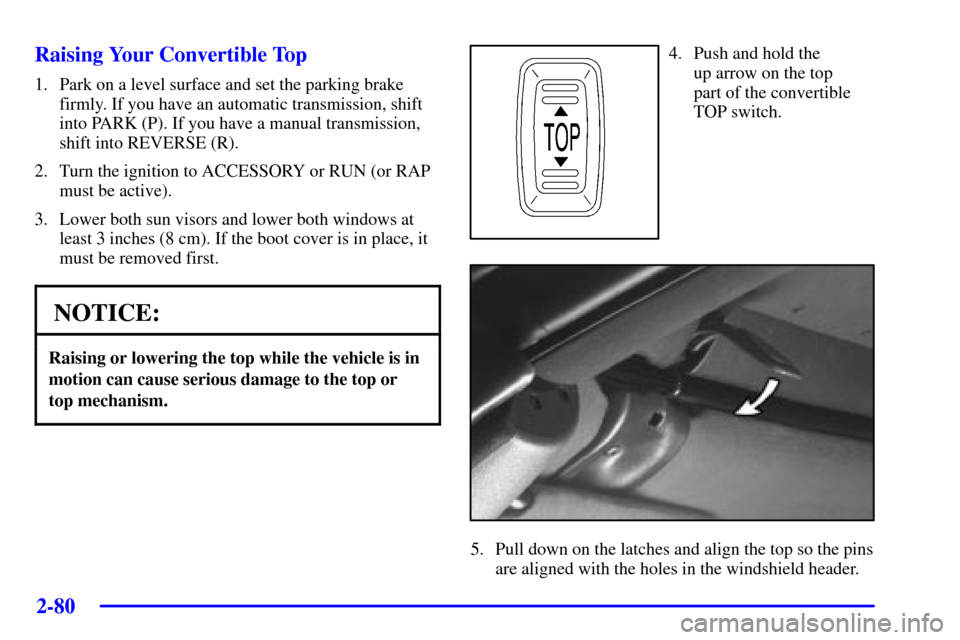
2-80 Raising Your Convertible Top
1. Park on a level surface and set the parking brake
firmly. If you have an automatic transmission, shift
into PARK (P). If you have a manual transmission,
shift into REVERSE (R).
2. Turn the ignition to ACCESSORY or RUN (or RAP
must be active).
3. Lower both sun visors and lower both windows at
least 3 inches (8 cm). If the boot cover is in place, it
must be removed first.
NOTICE:
Raising or lowering the top while the vehicle is in
motion can cause serious damage to the top or
top mechanism.
4. Push and hold the
up arrow on the top
part of the convertible
TOP switch.
5. Pull down on the latches and align the top so the pins
are aligned with the holes in the windshield header.