Page 221 of 331
6-26 Checking Coolant
If your vehicle has a diesel engine, see ªChecking
Coolantº in the Diesel Engine Supplement.
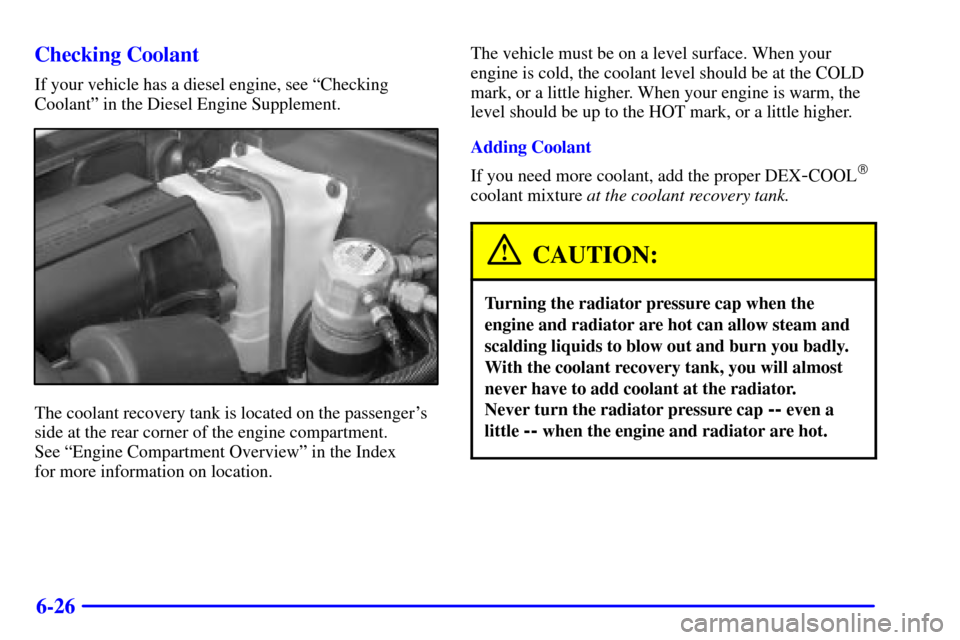
The coolant recovery tank is located on the passenger's
side at the rear corner of the engine compartment.
See ªEngine Compartment Overviewº in the Index
for more information on location.The vehicle must be on a level surface. When your
engine is cold, the coolant level should be at the COLD
mark, or a little higher. When your engine is warm, the
level should be up to the HOT mark, or a little higher.
Adding Coolant
If you need more coolant, add the proper DEX
-COOL�
coolant mixture at the coolant recovery tank.
CAUTION:
Turning the radiator pressure cap when the
engine and radiator are hot can allow steam and
scalding liquids to blow out and burn you badly.
With the coolant recovery tank, you will almost
never have to add coolant at the radiator.
Never turn the radiator pressure cap
-- even a
little
-- when the engine and radiator are hot.
Page 222 of 331
6-27
Add coolant mixture at the recovery tank, but be careful
not to spill it.
CAUTION:
You can be burned if you spill coolant on hot
engine parts. Coolant contains ethylene glycol,
and it will burn if the engine parts are hot
enough. Don't spill coolant on a hot engine.
Occasionally check the coolant level in the radiator.
For information on how to add coolant to the radiator,
see ªCooling Systemº in the Index.
Radiator Pressure Cap
(Gasoline Engine)
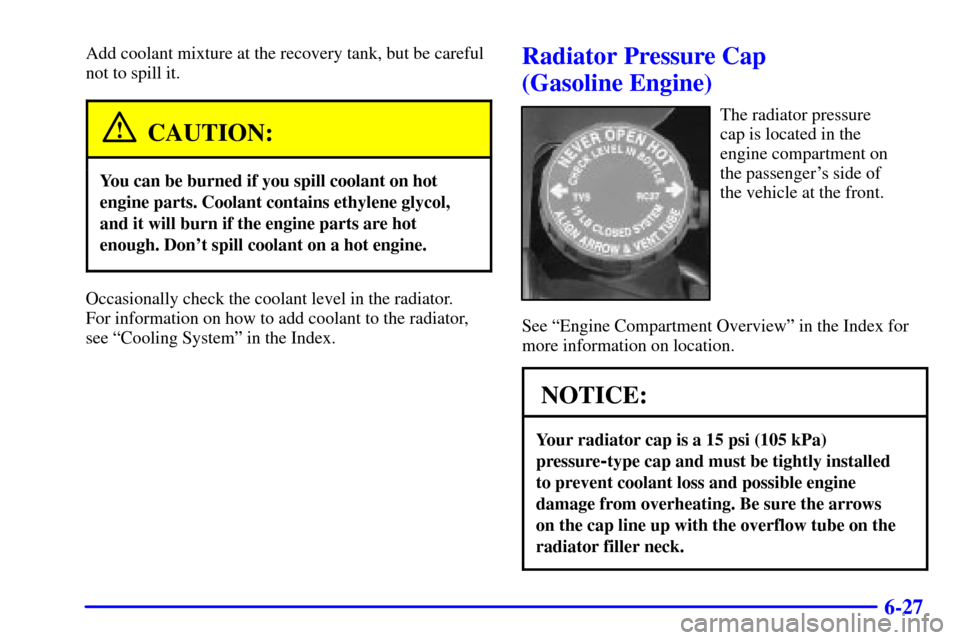
The radiator pressure
cap is located in the
engine compartment on
the passenger's side of
the vehicle at the front.
See ªEngine Compartment Overviewº in the Index for
more information on location.
NOTICE:
Your radiator cap is a 15 psi (105 kPa)
pressure
-type cap and must be tightly installed
to prevent coolant loss and possible engine
damage from overheating. Be sure the arrows
on the cap line up with the overflow tube on the
radiator filler neck.
Page 223 of 331

6-28
Power Steering Fluid
The power steering fluid
reservoir cap is located
at the front of the engine
compartment on the
driver's side of the vehicle.
When to Check Power Steering Fluid
It is not necessary to regularly check power steering
fluid unless you suspect there is a leak in the system or
you hear an unusual noise. A fluid loss in this system
could indicate a problem. Have the system inspected and
repaired. See ªEngine Compartment Overviewº in the
Index for reservoir location.
How to Check Power Steering Fluid
Turn the key off, let the engine compartment cool down,
wipe the cap and the top of the reservoir clean, then
unscrew the cap and wipe the dipstick with a clean rag.
Replace the cap and completely tighten it. Then remove
the cap again and look at the fluid level on the dipstick.
The level should be at the FULL COLD mark.
If necessary, add only enough fluid to bring the
level up to the mark.
What to Use
To determine what kind of fluid to use, see ªRecommended
Fluids and Lubricantsº in the Index. Always use the proper
fluid. Failure to use the proper fluid can cause leaks and
damage hoses and seals.
Page 226 of 331
6-31
CAUTION:
If you have too much brake fluid, it can spill on
the engine. The fluid will burn if the engine is hot
enough. You or others could be burned, and your
vehicle could be damaged. Add brake fluid only
when work is done on the brake hydraulic system.
See ªChecking Brake Fluidº in this section.
Refer to the Maintenance Schedule to determine when
to check your brake fluid. See ªPeriodic Maintenance
Inspectionsº in the Index.Checking Brake Fluid
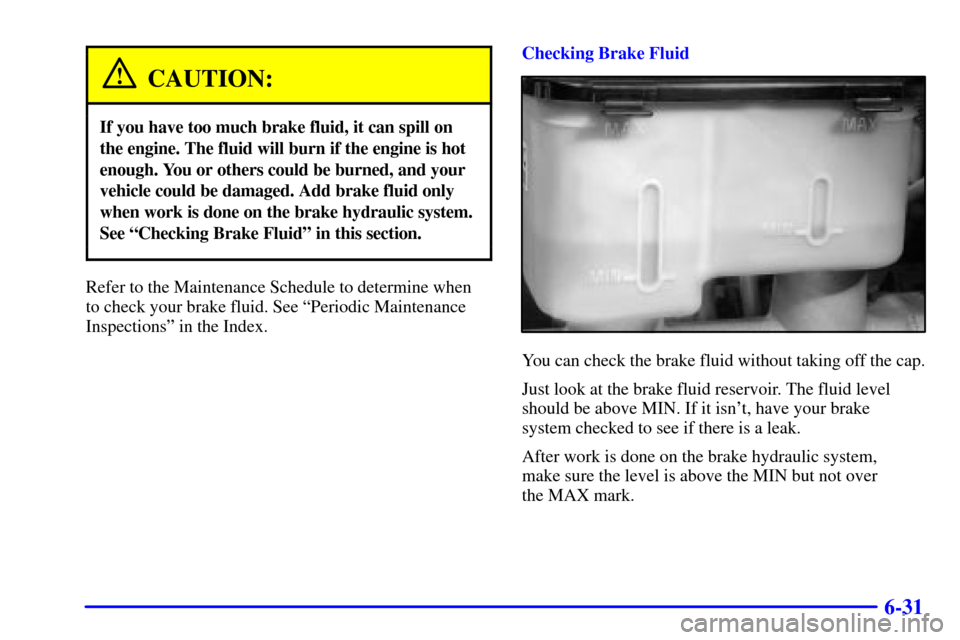
You can check the brake fluid without taking off the cap.
Just look at the brake fluid reservoir. The fluid level
should be above MIN. If it isn't, have your brake
system checked to see if there is a leak.
After work is done on the brake hydraulic system,
make sure the level is above the MIN but not over
the MAX mark.
Page 258 of 331
6-63
Fuse/Circuit
BreakerUsage
9 License Lamp, Parking Lamps,
Taillamps, Roof Marker
Lamps, Front Sidemarkers,
Door Switch Illumination,
Headlamp Switch Illumination
10 Not Used
11 Wiper Motor, Washer Pump
12 A/C, A/C Blower,
High Blower Relay
13 Power Amp, Cigarette Lighter,
Door Lock Relay
14 Cluster, Comfort Controls,
Instrument Switches, Radio
Illumination, Chime Module
15 DRL Relay
16 Front and Rear Turn Signals,
Back
-Up LampsFuse/Circuit
BreakerUsage
17 Radio (Ignition)
18 4WAL/VCM, Antilock Braking
System, Cruise Control
19 Radio (Battery)
20 PRNDL, Automatic Transmission,
Speedometer, Check Gages
Warning Light
21 Security/Steering
22 Not Used
23 Not Used
24 TP2 Relay (Gasoline Engine)
A Power Door Lock, Keyless
Entry Module
B Power Windows
Page 262 of 331
6-67 Capacities
After refill, the level must be rechecked. See ªCooling
Systemº in the Index.
Engine VIN Quantity
ªVORTECº 8100 G 28.5 quarts (27.0 L)
Engine Oil with Filter
After refill, the level must be rechecked. Add enough
engine oil so that the fluid is within the proper operating
range. See ªEngine Oilº in the Index.
Engine VIN Quantity
ªVORTECº 8100 G 6.6 quarts (6.3 L)
Fuel Tank Capacity
Type Quantity
Front Tank 22.0 U.S. gallons (79 L)
Rear Tank 18.0 U.S. gallons (68 L)
Air Conditioning
Refrigerant Capacity
If you do your own service work, you'll need the proper
service manual. See ªDoing Your Own Service Workº in
the Index for additional information. It is recommended
that service work on your air conditioning system be
performed by a qualified technician.
Air Conditioning
Refrigerant R
-134a 2.0 lbs (0.91kg). . . . . . . . . . . . .
Use Refrigerant Oil, R134a Systems
Page 268 of 331
Scheduled Maintenance
7-5
Short Trip/City Definition
Follow the Short Trip/City Scheduled Maintenance if
any one of these conditions is true for your vehicle:
�Most trips are less than 5 miles (8 km). This is
particularly important when outside temperatures
are below freezing.
�Most trips include extensive idling (such as frequent
driving in stop
-and-go traffic).
�You frequently tow a trailer.
�If the vehicle is used for delivery service, police, taxi
or other commercial application.
One of the reasons you should follow this schedule if
you operate your vehicle under any of these conditions
is that these conditions cause engine oil to break
down sooner.
Short Trip/City Intervals
Every 3,000 Miles (5 000 km): Engine Oil and Filter
Change (or 3 months, whichever occurs first). Chassis
Lubrication (or 3 months, whichever occurs first).
Rear Axle Fluid Check.
Every 6,000 Miles (10 000 km): Tire Rotation.
Every 15,000 Miles (25 000 km): Shields and
Underhood Insulation Inspection. Diesel Engine
Only: Thermostatically Controlled Engine Cooling
Fan Check (or every 12 months, whichever occurs
first). Diesel Engine Only: Air Intake System
Inspection. Front Wheel Bearing Repack (or at each
brake relining, whichever occurs first).
Every 24,000 Miles (40 000 km): Diesel Engine Only:
Fuel Cap Replacement, if driving in dusty conditions.
Every 30,000 Miles (50 000 km): Rear Axle Fluid
Change with Extreme Overload, Trailer Towing or
High Speed Use. Fuel Filter Replacement.
(Continued)
Page 269 of 331
Scheduled Maintenance
7-6
Short Trip/City Intervals
Every 50,000 Miles (83 000 km): Automatic
Transmission Service.
Every 60,000 Miles (100 000 km): Engine Accessory
Drive Belt Inspection. Evaporative Control System
Inspection. Diesel Engine Only: Crankcase
Depression Regulator Valve (CDRV) System Check.
Every 100,000 Miles (166 000 km): Gasoline Engine
Only: Spark Plug Wire Inspection. Gasoline Engine
Only: Spark Plug Replacement. Gasoline Engine
Only: Automatic Transmission Service (normal
conditions).
Every 150,000 Miles (240 000 km): Cooling System
Service (or every 60 months, whichever occurs first).
These intervals only summarize maintenance services.
Be sure to follow the complete scheduled maintenance
on the following pages.
Long Trip/Highway Definition
Follow this scheduled maintenance only if none of the
conditions from the Short Trip/City Scheduled
Maintenance are true. Do not use this schedule if the
vehicle is used for trailer towing, driven in a dusty area
or used off paved roads. Use the Short Trip/City
schedule for these conditions.
Driving a vehicle with a fully warmed engine under
highway conditions will cause engine oil to break
down slower.