Page 239 of 331

6-44
When It's Time for New Tires
One way to tell when it's
time for new tires is to
check the treadwear
indicators, which will
appear when your tires have
only 1/16 inch (1.6 mm) or
less of tread remaining.
Some commercial truck
tires may not have
treadwear indicators.
You need a new tire if any of the following statements
are true:
�You can see the indicators at three or more places
around the tire.
�You can see cord or fabric showing through the
tire's rubber.
�The tread or sidewall is cracked, cut or snagged
deep enough to show cord or fabric.
�The tire has a bump, bulge or split.
�The tire has a puncture, cut or other damage that
can't be repaired well because of the size or location
of the damage.
Dual Tire Operation
When the vehicle is new, or whenever a wheel, wheel
bolt or wheel nut is replaced, check the wheel nut
torque after 100, 1,000 and 6,000 miles (160, 1 600 and
10 000 km) of driving. For proper torque, see ªWheel
Nut Torqueº in the Index.
The outer tire on a dual wheel setup generally wears
faster than the inner tire. Your tires will wear more
evenly and last longer if you rotate the tires periodically.
If you're going to be doing a lot of driving on
high
-crown roads, you can reduce tire wear by adding
5 psi (35 kPa) to the tire pressure in the outer tires.
Be sure to return to the recommended pressures when
no longer driving under those conditions. See ªTiresº
and ªInflation
- Tire Pressureª in the Index for more
information on proper tire inflation.
CAUTION:
If you operate your vehicle with a tire that is
badly underinflated, the tire can overheat. An
overheated tire can lose air suddenly or catch fire.
You or others could be injured. Be sure all tires
(including the spare, if any) are properly inflated.
Page 243 of 331
6-48 Wheel Alignment and Tire Balance
The wheels on your vehicle were aligned and balanced
carefully at the factory to give you the longest tire life
and best overall performance.
Scheduled wheel alignment and wheel balancing are
not needed. However, if you notice unusual tire wear or
your vehicle pulling one way or the other, the alignment
may need to be reset. If you notice your vehicle
vibrating when driving on a smooth road, your wheels
may need to be rebalanced.
Wheel Replacement
Replace any wheel that is bent, cracked, or badly rusted
or corroded. If wheel nuts keep coming loose, the wheel,
wheel bolts and wheel nuts should be replaced. If the
wheel leaks air, replace it (except some aluminum
wheels, which can sometimes be repaired). See your
dealer if any of these conditions exist.
Your dealer will know the kind of wheel you need.Each new wheel should have the same load
-carrying
capacity, diameter, width, offset and be mounted the
same way as the one it replaces.
If you need to replace any of your wheels, wheel bolts
or wheel nuts, replace them only with new GM original
equipment parts. This way, you will be sure to have the
right wheel, wheel bolts and wheel nuts for your vehicle.
CAUTION:
Using the wrong replacement wheels, wheel bolts
or wheel nuts on your vehicle can be dangerous.
It could affect the braking and handling of your
vehicle, make your tires lose air and make you
lose control. You could have a collision in which
you or others could be injured. Always use the
correct wheel, wheel bolts and wheel nuts
for replacement.
Page 252 of 331

6-57
Underbody Maintenance
Chemicals used for ice and snow removal and dust
control can collect on the underbody. If these are
not removed, accelerated corrosion (rust) can occur
on the underbody parts such as fuel lines, frame,
floor pan and exhaust system even though they have
corrosion protection.
At least every spring, flush these materials from the
underbody with plain water. Clean any areas where mud
and other debris can collect. Dirt packed in closed areas
of the frame should be loosened before being flushed.
Your dealer or an underbody car washing system can
do this for you.
Chemical Paint Spotting
Some weather and atmospheric conditions can create
a chemical fallout. Airborne pollutants can fall upon
and attack painted surfaces on your vehicle. This
damage can take two forms: blotchy, ringlet
-shaped
discolorations, and small irregular dark spots etched into
the paint surface.
Although no defect in the paint job causes this, GM
will repair, at no charge to the owner, the surfaces of
new vehicles damaged by this fallout condition within
12 months or 12,000 miles (20 000 km) of purchase,
whichever occurs first.
Page 259 of 331
6-64
Underhood Fuse Block
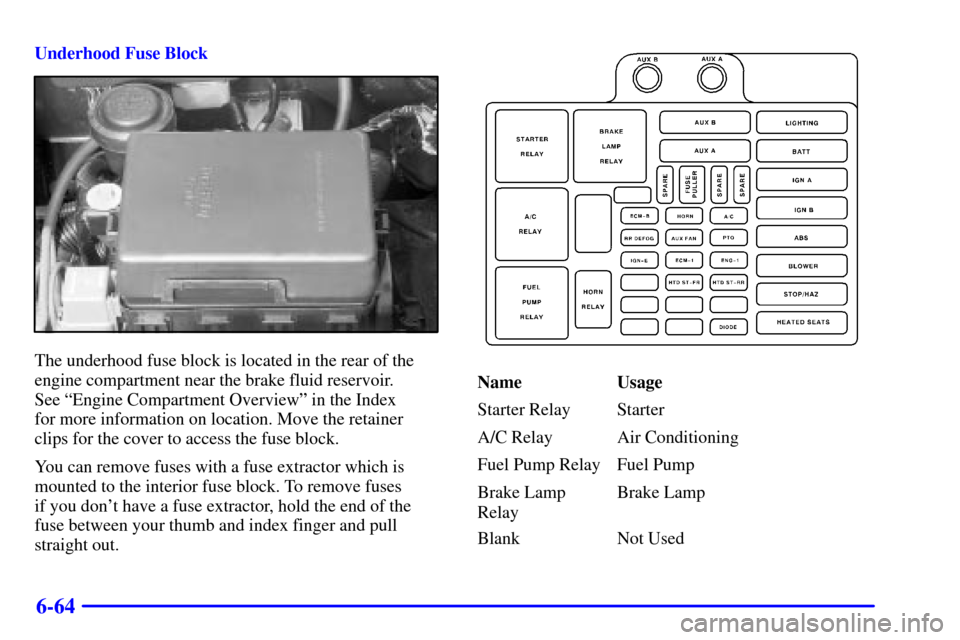
The underhood fuse block is located in the rear of the
engine compartment near the brake fluid reservoir.
See ªEngine Compartment Overviewº in the Index
for more information on location. Move the retainer
clips for the cover to access the fuse block.
You can remove fuses with a fuse extractor which is
mounted to the interior fuse block. To remove fuses
if you don't have a fuse extractor, hold the end of the
fuse between your thumb and index finger and pull
straight out.
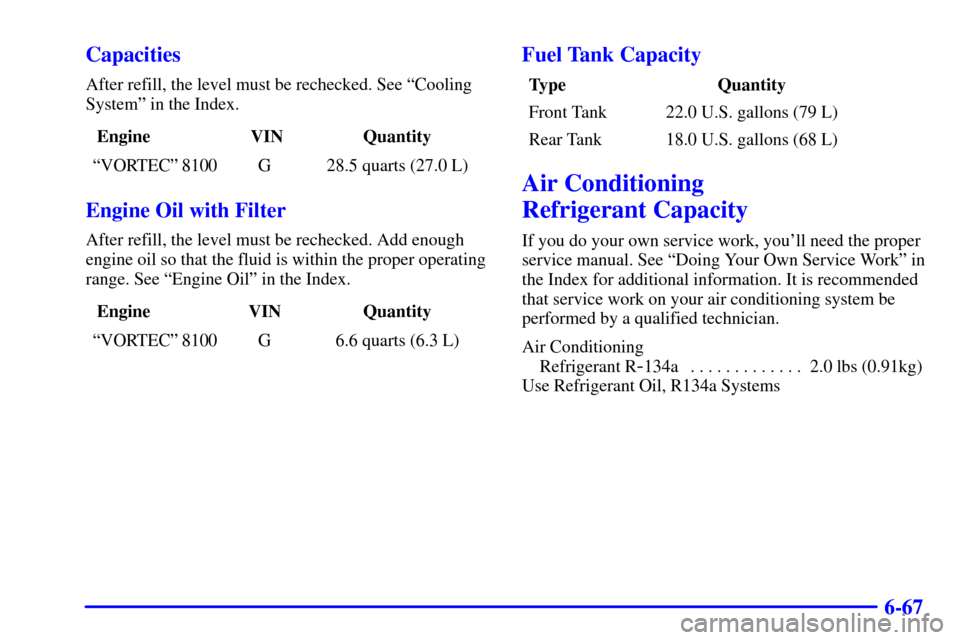
Name Usage
Starter Relay Starter
A/C Relay Air Conditioning
Fuel Pump Relay Fuel Pump
Brake Lamp
RelayBrake Lamp
Blank Not Used
Page 260 of 331
6-65
Name Usage
Horn Relay Horn
ECM
-B Fuel Pump, PCM/VCM
RR DEFOG Not Used
IGN
-E A/C Compressor Relay,
Dual Tanks
Blank Not Used
Blank Not Used
Blank Not Used
HORN Horn, Underhood Lamps
AUX FAN Not Used
ECM
-1 Injectors, PCM/VCM, Fuel
Solenoid (Diesel Engine) Fuel
Control Module (Diesel Engine)
HTD ST
-FR Not Used
Blank Not Used
Blank Not Used
A/C Air Conditioning
PTO PTO RelayName Usage
ENG
-1 Ignition Switch, Exhaust Gas
Recirculation, Canister Purge,
EVRV Idle Coast Solenoid, MAF,
Heated O
2, Fuel Heater (Diesel
Engine), Water Sensor (Diesel
Engine), Boost Solenoid (Diesel
Engine), EPR (Diesel Engine)
HTD ST
-RR Not Used
Blank Not Used
Diode Not Used
LIGHTING Headlamp and Panel Dimmer
Switch, Fog and Courtesy Fuses
BATT Battery, Fuse Block Busbar
IGN A Ignition Switch
IGN B Ignition Switch
ABS Anti
-Lock Brake Module
BLOWER High Blower Relay
STOP/HAZ Stoplamps
HEATED
SEATSNot Used
Page 262 of 331
6-67 Capacities
After refill, the level must be rechecked. See ªCooling
Systemº in the Index.
Engine VIN Quantity
ªVORTECº 8100 G 28.5 quarts (27.0 L)
Engine Oil with Filter
After refill, the level must be rechecked. Add enough
engine oil so that the fluid is within the proper operating
range. See ªEngine Oilº in the Index.
Engine VIN Quantity
ªVORTECº 8100 G 6.6 quarts (6.3 L)
Fuel Tank Capacity
Type Quantity
Front Tank 22.0 U.S. gallons (79 L)
Rear Tank 18.0 U.S. gallons (68 L)
Air Conditioning
Refrigerant Capacity
If you do your own service work, you'll need the proper
service manual. See ªDoing Your Own Service Workº in
the Index for additional information. It is recommended
that service work on your air conditioning system be
performed by a qualified technician.
Air Conditioning
Refrigerant R
-134a 2.0 lbs (0.91kg). . . . . . . . . . . . .
Use Refrigerant Oil, R134a Systems
Page 265 of 331
7-2
Have you purchased the GM Protection Plan? The Plan
supplements your new vehicle warranties. See your
Warranty and Owner Assistance booklet or your dealer
for details.
Introduction
Your Vehicle and the Environment
Proper vehicle maintenance not only helps to keep your
vehicle in good working condition, but also helps the
environment. All recommended maintenance procedures
are important. Improper vehicle maintenance can even
affect the quality of the air we breathe. Improper fluid
levels or the wrong tire inflation can increase the level
of emissions from your vehicle. To help protect our
environment, and to keep your vehicle in good
condition, please maintain your vehicle properly.
Maintenance Requirements
Maintenance intervals, checks, inspections and
recommended fluids and lubricants as prescribed in this
manual are necessary to keep your vehicle in good
working condition. Any damage caused by failure to
follow recommended maintenance may not be covered
by warranty.
Page 266 of 331
7-3 How This Section is Organized
This maintenance schedule is divided into five parts:
ªPart A: Scheduled Maintenance Servicesº explains
what to have done and how often. Some of these
services can be complex, so unless you are technically
qualified and have the necessary equipment, you should
let your dealer's service department or another qualified
service center do these jobs.
CAUTION:
Performing maintenance work on a vehicle can
be dangerous. In trying to do some jobs, you can
be seriously injured. Do your own maintenance
work only if you have the required know
-how
and the proper tools and equipment for the job.
If you have any doubt, have a qualified
technician do the work.
If you want to get the service information, see ªService
and Owner Publicationsº in the Index.ªPart B: Owner Checks and Servicesº tells you
what should be checked and when. It also explains what
you can easily do to help keep your vehicle in good
condition.
ªPart C: Periodic Maintenance Inspectionsº explains
important inspections that your dealer's service
department or another qualified service center
should perform.
ªPart D: Recommended Fluids and Lubricantsº lists
some recommended products necessary to help keep
your vehicle properly maintained. These products, or
their equivalents, should be used whether you do the
work yourself or have it done.
ªPart E: Maintenance Recordº is a place for
you to record and keep track of the maintenance
performed on your vehicle. Keep your maintenance
receipts. They may be needed to qualify your vehicle
for warranty repairs.