Page 160 of 331
4-28
Loading Your Vehicle
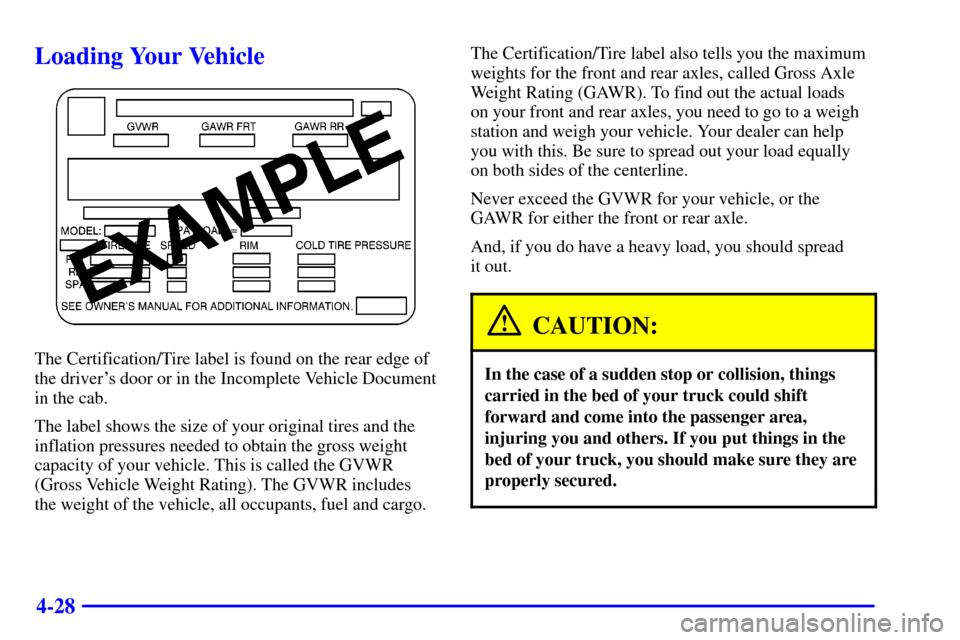
The Certification/Tire label is found on the rear edge of
the driver's door or in the Incomplete Vehicle Document
in the cab.
The label shows the size of your original tires and the
inflation pressures needed to obtain the gross weight
capacity of your vehicle. This is called the GVWR
(Gross Vehicle Weight Rating). The GVWR includes
the weight of the vehicle, all occupants, fuel and cargo.The Certification/Tire label also tells you the maximum
weights for the front and rear axles, called Gross Axle
Weight Rating (GAWR). To find out the actual loads
on your front and rear axles, you need to go to a weigh
station and weigh your vehicle. Your dealer can help
you with this. Be sure to spread out your load equally
on both sides of the centerline.
Never exceed the GVWR for your vehicle, or the
GAWR for either the front or rear axle.
And, if you do have a heavy load, you should spread
it out.
CAUTION:
In the case of a sudden stop or collision, things
carried in the bed of your truck could shift
forward and come into the passenger area,
injuring you and others. If you put things in the
bed of your truck, you should make sure they are
properly secured.
Page 161 of 331
4-29
Using heavier suspension components to get added
durability might not change your weight ratings. Ask
your dealer to help you load your vehicle the right way.
CAUTION:
Do not load your vehicle any heavier than the
GVWR, or either the maximum front or rear
GAWR. If you do, parts on your vehicle can
break, and it can change the way your vehicle
handles. These could cause you to lose control
and crash. Also, overloading can shorten the life
of your vehicle.
NOTICE:
Your warranty does not cover parts or
components that fail because of overloading.
If you put things inside your vehicle -- like suitcases,
tools, packages, or anything else
-- they go as fast as
the vehicle goes. If you have to stop or turn quickly,
or if there is a crash, they'll keep going.
CAUTION:
Things you put inside your vehicle can strike
and injure people in a sudden stop or turn,
or in a crash.
�Put things in the cargo area of your vehicle.
Try to spread the weight evenly.
�Never stack heavier things, like suitcases,
inside the vehicle so that some of them are
above the tops of the seats.
�Don't leave an unsecured child restraint
in your vehicle.
�When you carry something inside the
vehicle, secure it whenever you can.
�Don't leave a seat folded down unless
you need to.
Page 166 of 331

4-34 Trailer Brakes
If your trailer weighs more than 1,000 lbs. (450 kg)
loaded, then it needs its own brakes
-- and they must be
adequate. Be sure to read and follow the instructions for
the trailer brakes so you'll be able to install, adjust and
maintain them properly.
Your trailer brake system can tap into the vehicle's
hydraulic brake system only if:
�The trailer parts can withstand 3,000 psi
(20 650 kPa) of pressure.
�The trailer's brake system will use less than
0.02 cubic inch (0.3 cc) of fluid from your
vehicle's master cylinder. Otherwise, both braking
systems won't work well. You could even lose
your brakes.
If everything checks out this far, make the brake tap at
the port on the master cylinder that sends the fluid to
the rear brakes. But don't use copper tubing for this.
If you do, it will bend and finally break off. Use steel
brake tubing.
Driving with a Trailer
Towing a trailer requires a certain amount of experience.
Before setting out for the open road, you'll want to
get to know your rig. Acquaint yourself with the feel of
handling and braking with the added weight of the trailer.
And always keep in mind that the vehicle you are driving
is now a good deal longer and not nearly as responsive as
your vehicle is by itself.
Before you start, check the trailer hitch and platform
(and attachments), safety chains, electrical connector,
lamps, tires and mirror adjustment. If the trailer has
electric brakes, start your vehicle and trailer moving
and then apply the trailer brake controller by hand to
be sure the brakes are working. This lets you check
your electrical connection at the same time.
During your trip, check occasionally to be sure that the
load is secure, and that the lamps and any trailer brakes
are still working.
Following Distance
Stay at least twice as far behind the vehicle ahead as
you would when driving your vehicle without a trailer.
This can help you avoid situations that require heavy
braking and sudden turns.
Page 258 of 331
6-63
Fuse/Circuit
BreakerUsage
9 License Lamp, Parking Lamps,
Taillamps, Roof Marker
Lamps, Front Sidemarkers,
Door Switch Illumination,
Headlamp Switch Illumination
10 Not Used
11 Wiper Motor, Washer Pump
12 A/C, A/C Blower,
High Blower Relay
13 Power Amp, Cigarette Lighter,
Door Lock Relay
14 Cluster, Comfort Controls,
Instrument Switches, Radio
Illumination, Chime Module
15 DRL Relay
16 Front and Rear Turn Signals,
Back
-Up LampsFuse/Circuit
BreakerUsage
17 Radio (Ignition)
18 4WAL/VCM, Antilock Braking
System, Cruise Control
19 Radio (Battery)
20 PRNDL, Automatic Transmission,
Speedometer, Check Gages
Warning Light
21 Security/Steering
22 Not Used
23 Not Used
24 TP2 Relay (Gasoline Engine)
A Power Door Lock, Keyless
Entry Module
B Power Windows
Page 308 of 331

7-45
Cassette Deck Service
Clean cassette deck. Cleaning should be done every
50 hours of tape play. See ªAudio Systemsº in the
Index for further details.
At Least Twice a Year
Restraint System Check
Make sure the safety belt reminder light and all your
belts, buckles, latch plates, retractors and anchorages are
working properly. Look for any other loose or damaged
safety belt system parts. If you see anything that might
keep a safety belt system from doing its job, have it
repaired. Have any torn or frayed safety belts replaced.
Wiper Blade Check
Inspect wiper blades for wear or cracking. Replace blade
inserts that appear worn or damaged or that streak or
miss areas of the windshield. Also see ªWiper Blades,
Cleaningº in the Index.
Spare Tire Check
At least twice a year, after the monthly inflation check
of the spare tire determines that the spare is inflated to
the correct tire inflation pressure, make sure that the
spare tire is stored securely.Engine Air Cleaner Filter Restriction
Indicator Check
Your vehicle has an indicator located on the air cleaner
in the engine compartment that lets you know when the
air cleaner filter is dirty and needs to be changed. Check
indicator at least twice a year or when your engine oil is
changed, whichever occurs first. See ªAir Cleanerº in
the Index for more information. Inspect your air cleaner
filter restriction indicator more often if the vehicle is
used in dusty areas or under off road conditions.
Weatherstrip Lubrication
Silicone grease on weatherstrips will make them last
longer, seal better, and not stick or squeak. Apply
silicone grease with a clean cloth. During very cold,
damp weather more frequent application may be
required. See ªRecommended Fluids and Lubricantsº
in the Index.
Manual Transmission Check
Check the transmission fluid level; add if needed. See
ªManual Transmission Fluidº in the Index. Check for
leaks. A fluid leak is the only reason for fluid loss. Have
the system inspected and repaired if needed.
Page:
< prev 1-8 9-16 17-24