Page 162 of 331
4-30
Towing a Trailer
CAUTION:
If you don't use the correct equipment and drive
properly, you can lose control when you pull a
trailer. For example, if the trailer is too heavy,
the brakes may not work well
-- or even at all.
You and your passengers could be seriously
injured. Pull a trailer only if you have followed
all the steps in this section. Ask your dealer for
advice and information about towing a trailer
with your vehicle.
NOTICE:
Pulling a trailer improperly can damage your
vehicle and result in costly repairs not covered
by your warranty.
NOTICE: (Continued)
NOTICE: (Continued)
To pull a trailer correctly, follow the advice in
this part, and see your dealer for important
information about towing a trailer with your
vehicle. Additional rear axle maintenance is
required for a vehicle used to tow a trailer.
See ªScheduled Maintenance Servicesº in
the Index.
To identify what the vehicle trailering capacity is for
your vehicle, you should read the information in
ªWeight of the Trailerº that appears later in this section.
Trailering is different than just driving your vehicle by
itself. Trailering means changes in handling, durability
and fuel economy. Successful, safe trailering takes
correct equipment, and it has to be used properly.
That's the reason for this part. In it are many
time
-tested, important trailering tips and safety rules.
Many of these are important for your safety and that
of your passengers. So please read this section carefully
before you pull a trailer.
Page 212 of 331
6-17
Refer to the Maintenance Schedule to determine when to
replace the engine air cleaner/filter. See ªOwner Checks
and Servicesº in the Index.
CAUTION:
Operating the engine with the air cleaner/filter
off can cause you or others to be burned. The air
cleaner not only cleans the air, it stops flame if
the engine backfires. If it isn't there, and the
engine backfires, you could be burned. Don't
drive with it off, and be careful working on the
engine with the air cleaner/filter off.
NOTICE:
If the air cleaner/filter is off, a backfire can
cause a damaging engine fire. And, dirt can
easily get into your engine, which will damage it.
Always have the air cleaner/filter in place when
you're driving.
Automatic Transmission Fluid
If your vehicle has a diesel engine, see ªAutomatic
Transmission Fluidº in the Diesel Supplement.
When to Check and Change
A good time to check your automatic transmission
fluid level is when the engine oil is changed.
Change both the fluid and filter every
50,000 miles (83 000 km).
See ªScheduled Maintenance Servicesº in the Index.
How to Check
Because this operation can be a little difficult,
you may choose to have this done at the dealership
service department.
If you do it yourself, be sure to follow all the
instructions here, or you could get a false reading
on the dipstick.
Page 215 of 331
6-20 How to Add Fluid
Refer to the Maintenance Schedule to determine what
kind of transmission fluid to use. See ªRecommended
Fluids and Lubricantsº in the Index.
Add fluid only after checking the transmission fluid
while it is hot. (A cold check is used only as a
reference.) If the fluid level is low, add only enough of
the proper fluid to bring the level up to the HOT area'
for a hot check. It doesn't take much fluid, generally
less than one pint (0.5 L). Don't overfill.
NOTICE:
We recommend you use only fluid labeled
DEXRON�-III, because fluid with that label is
made especially for your automatic transmission.
Damage caused by fluid other than DEXRON
�-III
is not covered by your new vehicle warranty.
�After adding fluid, recheck the fluid level as
described under ªHow to Check.º
�When the correct fluid level is obtained, push the
dipstick back in all the way; then flip the handle
down to lock the dipstick in place.
Manual Transmission Fluid
When to Check
A good time to have it checked is when the engine
oil is changed. However, the fluid in your manual
transmission doesn't require changing.
How to Check
Because this operation can be a little difficult, you
may choose to have this done at your GM dealership
service department.
If you do it yourself, be sure to follow all the
instructions here, or you could get a false reading.
NOTICE:
Too much or too little fluid can damage your
transmission. Too much can mean that some of
the fluid could come out and fall on hot engine
parts or exhaust system parts, starting a fire.
Too little fluid could cause the transmission to
overheat. Be sure to get an accurate reading if
you check your transmission fluid.
Page 218 of 331
6-23
Rear Axle
When to Check and Change Lubricant
Refer to the Maintenance Schedule to determine how
often to check the lubricant and when to change it.
See ªScheduled Maintenance Servicesº in the Index.
Additional rear axle scheduled maintenance is required
when the vehicle is driven under the following conditions:
�Extreme loading (at or near GVWR) or trailer
towing, and:
�Operation above 45 mph (70 km/h) for extended
periods of time
Vehicles used in any of these conditions require the
rear axle lubricant be changed every 30,000 miles
(50 000 km). Fluid capacity is 4.12 quarts (3.9 L).
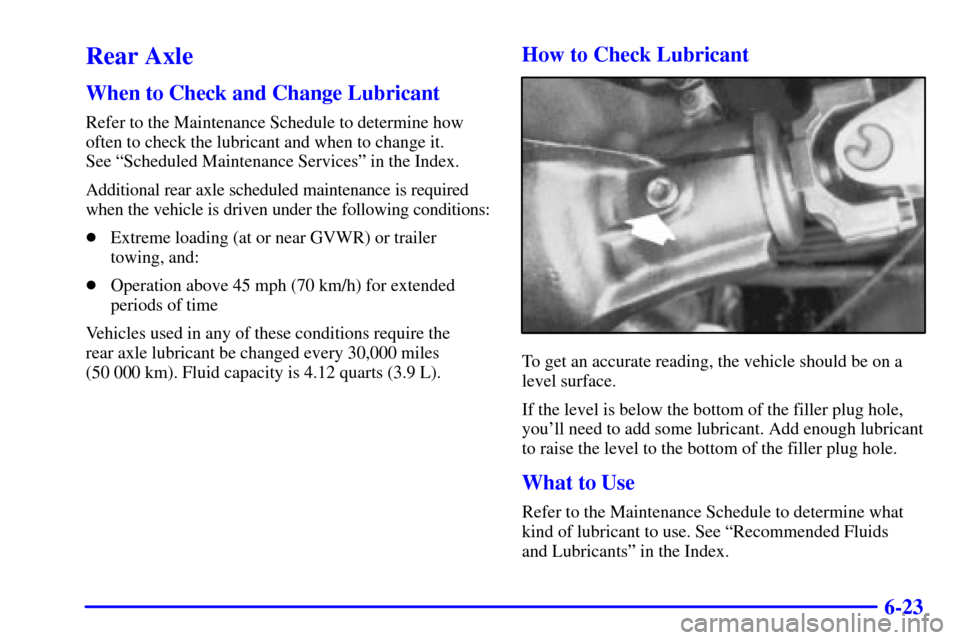
How to Check Lubricant
To get an accurate reading, the vehicle should be on a
level surface.
If the level is below the bottom of the filler plug hole,
you'll need to add some lubricant. Add enough lubricant
to raise the level to the bottom of the filler plug hole.
What to Use
Refer to the Maintenance Schedule to determine what
kind of lubricant to use. See ªRecommended Fluids
and Lubricantsº in the Index.
Page 229 of 331

6-34 Replacing Brake System Parts
The braking system on a vehicle is complex.
Its many parts have to be of top quality and work
well together if the vehicle is to have really good
braking. Your vehicle was designed and tested with
top
-quality GM brake parts. When you replace
parts of your braking system
-- for example, when
your brake linings wear down and you need new ones
put in
-- be sure you get new approved GM replacement
parts. If you don't, your brakes may no longer work
properly. For example, if someone puts in brake linings
that are wrong for your vehicle, the balance between
your front and rear brakes can change
-- for the worse.
The braking performance you've come to expect can
change in many other ways if someone puts in the
wrong replacement brake parts.
Battery
Your new vehicle comes with a maintenance free
ACDelco� battery. When it's time for a new battery,
get one that has the replacement number shown on the
original battery's label. We recommend an ACDelco
battery. See ªEngine Compartment Overviewº in the
Index for battery location.
WARNING: Battery posts, terminals and related
accessories contain lead and lead compounds, chemicals
known to the State of California to cause cancer and
reproductive harm. Wash hands after handling.
Page 238 of 331
6-43
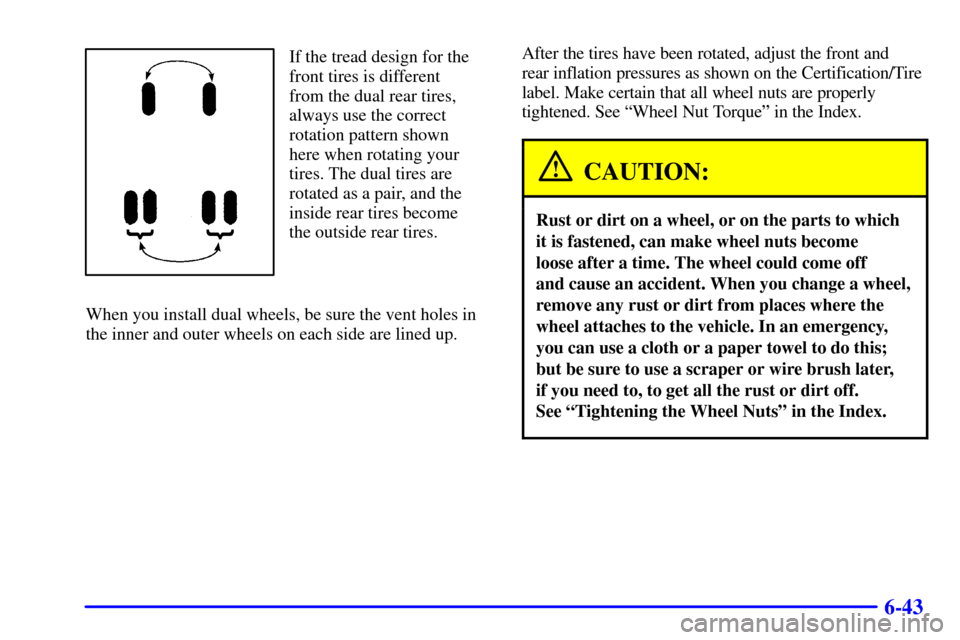
If the tread design for the
front tires is different
from the dual rear tires,
always use the correct
rotation pattern shown
here when rotating your
tires. The dual tires are
rotated as a pair, and the
inside rear tires become
the outside rear tires.
When you install dual wheels, be sure the vent holes in
the inner and outer wheels on each side are lined up.After the tires have been rotated, adjust the front and
rear inflation pressures as shown on the Certification/Tire
label. Make certain that all wheel nuts are properly
tightened. See ªWheel Nut Torqueº in the Index.
CAUTION:
Rust or dirt on a wheel, or on the parts to which
it is fastened, can make wheel nuts become
loose after a time. The wheel could come off
and cause an accident. When you change a wheel,
remove any rust or dirt from places where the
wheel attaches to the vehicle. In an emergency,
you can use a cloth or a paper towel to do this;
but be sure to use a scraper or wire brush later,
if you need to, to get all the rust or dirt off.
See ªTightening the Wheel Nutsº in the Index.
Page 241 of 331
6-46
CAUTION:
Rust or dirt on a wheel, or on the parts to which
it is fastened, can make the wheel nuts become
loose after a time. The wheel could come off and
cause a crash. When you change a wheel, remove
any rust or dirt from the places where the wheel
attaches to the vehicle. In an emergency, you can
use a cloth or a paper towel to do this; but be
sure to use a scraper or wire brush later, if you
need to, to get all the rust or dirt off.
CAUTION:
Never use oil or grease on studs or nuts.
If you do, the wheel nuts might come loose
and the wheel could fall off, causing a crash.
NOTICE:
Improperly tightened wheel nuts can lead to
brake pulsation and rotor damage. To avoid
expensive brake repairs, evenly tighten the wheel
nuts in the proper sequence and to the proper
torque specifications.
Page 263 of 331

6-68
Normal Maintenance
Replacement Parts
Replacement part numbers listed in this section are
based on the latest information available at the time of
printing, and are subject to change. If a part listed in
this manual is not the same as the part used in your
vehicle when it was built, or if you have any questions,
please contact your GM truck dealer.
These specifications are for information only. If you
have any questions, see the service manual for the
chassis or refer to the body manufacturer's publications.VIN Code G. . . . . . . . . . . . . . . . . . . . . . . . . . . .
Oil Filter* PF454. . . . . . . . . . . . . . . . . . . . . . . .
Engine Air Cleaner Filter* A1300C�� . . . . . . . .
Spark Plugs*** TJ14R-P15 . . . . . . . . . . . . . . .
Fuel Filter* GF626. . . . . . . . . . . . . . . . . . . . . . .
Wiper Blades** 22154886. . . . . . . . . . . . . . . . .
Wiper Blade Type Trico. . . . . . . . . . . . . . . . . .
Wiper Blade Length 18 inches (45.0 cm). . . . . .
*ACDelco
� part number
**GM part number
***Denso part number
��A1301C high
-capacity air cleaner filter.