Page 289 of 488

4-44
Here are some important things to consider before you
do recreational vehicle towing:
�What's the towing capacity of the towing
vehicle? Be sure you read the tow vehicle
manufacturer's recommendations.
�How far will you tow? Some vehicles have
restrictions on how far and how long they can tow.
�Do you have the proper towing equipment? See your
dealer or trailering professional for additional advice
and equipment recommendations.
�Is your vehicle ready to be towed? Just as you would
prepare your vehicle for a long trip, you'll want to
make sure your vehicle is prepared to be towed. See
ªBefore Leaving on a Long Tripº in the Index.Dinghy Towing (Two-Wheel Drive
Models Only)
Your vehicle should not be towed with all four wheels
on the ground. Your transmission has no provision for
internal lubrication while being towed. To properly tow
your vehicle, it should be placed on a platform trailer
with all four wheels off the ground. Towing with all four
wheels on the ground should be avoided.
Page 292 of 488
4-47
Be sure to use the proper towing equipment designed for
recreational vehicle towing. Follow the instructions for
the towing equipment.
CAUTION:
Shifting a four-wheel-drive vehicle's transfer
case into NEUTRAL can cause your vehicle to
roll even if the transmission is in PARK (P), for
an automatic transmission, or if your vehicle is in
gear, for a manual transmission. You or others
could be injured. Make sure the parking brake
is firmly set before you shift the transfer case
into NEUTRAL.
If your vehicle has four-wheel-drive it cannot be dolly
towed. A four
-wheel-drive vehicle must be towed
by flatbed.
Loading Your Vehicle
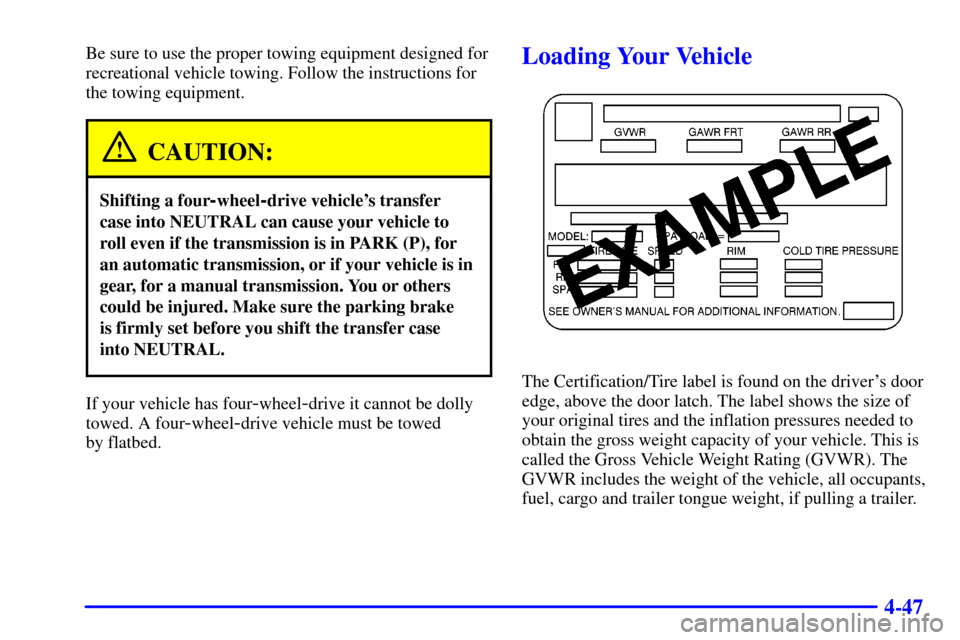
The Certification/Tire label is found on the driver's door
edge, above the door latch. The label shows the size of
your original tires and the inflation pressures needed to
obtain the gross weight capacity of your vehicle. This is
called the Gross Vehicle Weight Rating (GVWR). The
GVWR includes the weight of the vehicle, all occupants,
fuel, cargo and trailer tongue weight, if pulling a trailer.
Page 295 of 488
4-50
Towing a Trailer
CAUTION:
If you don't use the correct equipment and drive
properly, you can lose control when you pull a
trailer. For example, if the trailer is too heavy, the
brakes may not work well
-- or even at all. You
and your passengers could be seriously injured.
Pull a trailer only if you have followed all the
steps in this section. Ask your dealer for advice
and information about towing a trailer with
your vehicle.
NOTICE:
Pulling a trailer improperly can damage your
vehicle and result in costly repairs not covered by
your warranty. To pull a trailer correctly, follow
the advice in this part, and see your dealer for
NOTICE: (Continued)
NOTICE: (Continued)
important information about towing a trailer
with your vehicle. Additional rear axle
maintenance is required for a vehicle used to tow
a trailer. See ªScheduled Maintenance Servicesº
in the Index.
To identify what the vehicle trailering capacity is for
your vehicle, you should read the information in
ªWeight of the Trailerº that appears later in this section.
If yours was built with trailering options, as many are,
it's ready for heavier trailers. But trailering is different
than just driving your vehicle by itself. Trailering means
changes in handling, durability and fuel economy.
Successful, safe trailering takes correct equipment, and
it has to be used properly.
That's the reason for this part. In it are many
time
-tested, important trailering tips and safety rules.
Many of these are important for your safety and that of
your passengers. So please read this section carefully
before you pull a trailer.