Page 359 of 488
6-14 Engine Oil Additives
Don't add anything to your oil. The recommended oils
with the starburst symbol are all you will need for good
performance and engine protection.
When to Change Engine Oil
If any one of these is true for you, use the short trip/city
maintenance schedule:
�Most trips are less than 5 miles (8 km). This is
particularly important when outside temperatures are
below freezing.
�Most trips include extensive idling (such as frequent
driving in stop
-and-go traffic).
�You frequently tow a trailer or use a carrier on top of
your vehicle.
�The vehicle is used for delivery service, police, taxi
or other commercial application.Driving under these conditions causes engine oil to
break down sooner. If any one of these is true for your
vehicle, then you need to change your oil and filter
every 3,000 miles (5 000 km) or 3 months
-- whichever
occurs first.
If none of them is true, use the long trip/highway
maintenance schedule. Change the oil and filter every
7,500 miles (12 500 km) or 12 months
-- whichever
occurs first. Driving a vehicle with a fully warmed
engine under highway conditions will cause engine oil
to break down slower.
Page 360 of 488
6-15
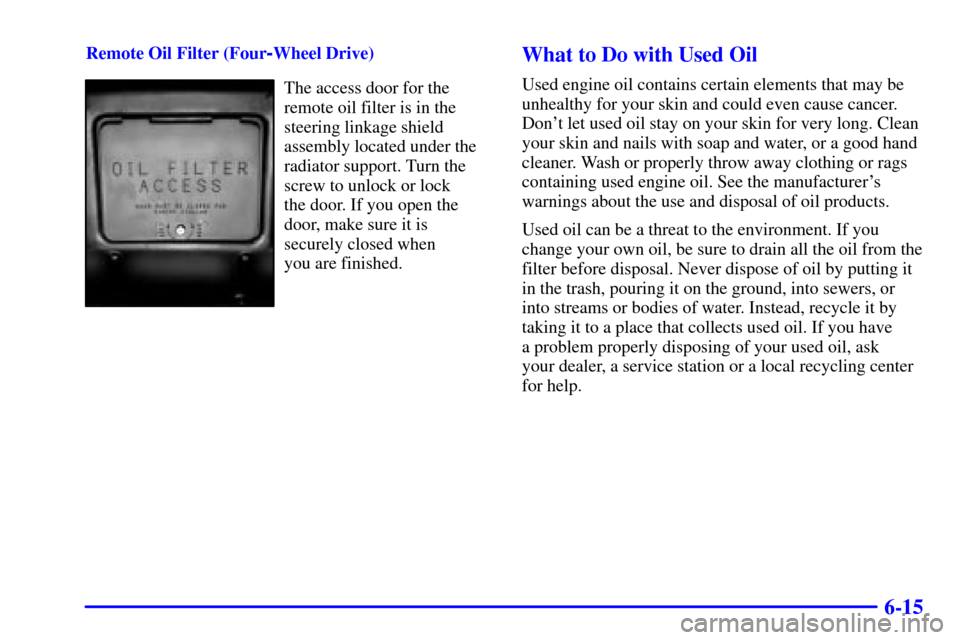
Remote Oil Filter (Four-Wheel Drive)
The access door for the
remote oil filter is in the
steering linkage shield
assembly located under the
radiator support. Turn the
screw to unlock or lock
the door. If you open the
door, make sure it is
securely closed when
you are finished.
What to Do with Used Oil
Used engine oil contains certain elements that may be
unhealthy for your skin and could even cause cancer.
Don't let used oil stay on your skin for very long. Clean
your skin and nails with soap and water, or a good hand
cleaner. Wash or properly throw away clothing or rags
containing used engine oil. See the manufacturer's
warnings about the use and disposal of oil products.
Used oil can be a threat to the environment. If you
change your own oil, be sure to drain all the oil from the
filter before disposal. Never dispose of oil by putting it
in the trash, pouring it on the ground, into sewers, or
into streams or bodies of water. Instead, recycle it by
taking it to a place that collects used oil. If you have
a problem properly disposing of your used oil, ask
your dealer, a service station or a local recycling center
for help.
Page 361 of 488
6-16
Engine Air Cleaner/Filter
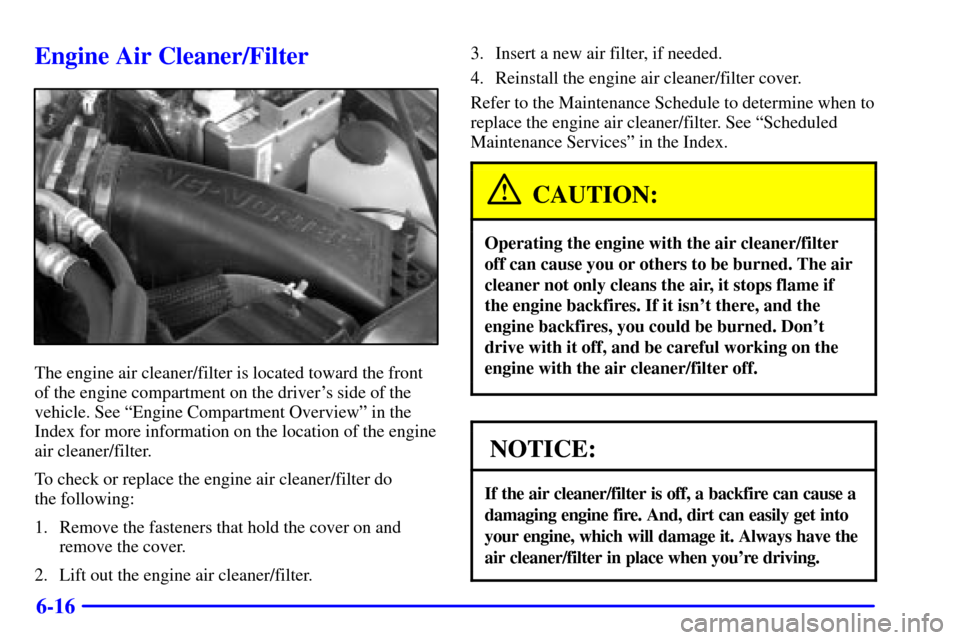
The engine air cleaner/filter is located toward the front
of the engine compartment on the driver's side of the
vehicle. See ªEngine Compartment Overviewº in the
Index for more information on the location of the engine
air cleaner/filter.
To check or replace the engine air cleaner/filter do
the following:
1. Remove the fasteners that hold the cover on and
remove the cover.
2. Lift out the engine air cleaner/filter.3. Insert a new air filter, if needed.
4. Reinstall the engine air cleaner/filter cover.
Refer to the Maintenance Schedule to determine when to
replace the engine air cleaner/filter. See ªScheduled
Maintenance Servicesº in the Index.
CAUTION:
Operating the engine with the air cleaner/filter
off can cause you or others to be burned. The air
cleaner not only cleans the air, it stops flame if
the engine backfires. If it isn't there, and the
engine backfires, you could be burned. Don't
drive with it off, and be careful working on the
engine with the air cleaner/filter off.
NOTICE:
If the air cleaner/filter is off, a backfire can cause a
damaging engine fire. And, dirt can easily get into
your engine, which will damage it. Always have the
air cleaner/filter in place when you're driving.
Page 362 of 488

6-17
Automatic Transmission Fluid
When to Check and Change
A good time to check your automatic transmission fluid
level is when the engine oil is changed.
Change both the fluid and filter every 15,000 miles
(25 000 km) if the vehicle is mainly driven under one or
more of these conditions:
�In heavy city traffic where the outside temperature
regularly reaches 90�F (32�C) or higher.
�In hilly or mountainous terrain.
�When doing frequent trailer towing.
�Uses such as found in taxi, police or delivery service.
If you do not use your vehicle under any of these
conditions, change the fluid and filter every
50,000 miles (83 000 km).
See ªScheduled Maintenance Servicesº in
How to Check
Because this operation can be a little difficult, you may
choose to have this done at the dealership service
department.
If you do it yourself, be sure to follow all the
instructions here, or you could get a false reading
on the dipstick.
NOTICE:
Too much or too little fluid can damage your
transmission. Too much can mean that some of
the fluid could come out and fall on hot engine
parts or exhaust system parts, starting a fire. Too
little fluid could cause the transmission to
overheat. Be sure to get an accurate reading if
you check your transmission fluid.
Page 365 of 488

6-20 How to Add Fluid
Refer to the Maintenance Schedule to determine what
kind of transmission fluid to use. See ªRecommended
Fluids and Lubricantsº in
Add fluid only after checking the transmission fluid
while it is hot. (A cold check is used only as a
reference.) If the fluid level is low, add only enough of
the proper fluid to bring the level up to the HOT area for
a hot check. It doesn't take much fluid, generally less
than one pint (0.5 L). Don't overfill.
NOTICE:
We recommend you use only fluid labeled
DEXRON�-III, because fluid with that label is
made especially for your automatic transmission.
Damage caused by fluid other than DEXRON
�-III
is not covered by your new vehicle warranty.
�After adding fluid, recheck the fluid level as
described under ªHow to Check.º
�When the correct fluid level is obtained, push the
dipstick back in all the way; then flip the handle
down to lock the dipstick in place.
Manual Transmission Fluid
When to Check
A good time to have it checked is when the engine oil is
changed. However, the fluid in your manual
transmission doesn't require changing.
How to Check
Because this operation can be a little difficult, you may
choose to have this done at your GM dealership service
department.
If you do it yourself, be sure to follow all the
instructions here, or you could get a false reading.
NOTICE:
Too much or too little fluid can damage your
transmission. Too much can mean that some of
the fluid could come out and fall on hot engine
parts or exhaust system parts, starting a fire. Too
little fluid could cause the transmission to
overheat. Be sure to get an accurate reading if
you check your transmission fluid.
Page 367 of 488
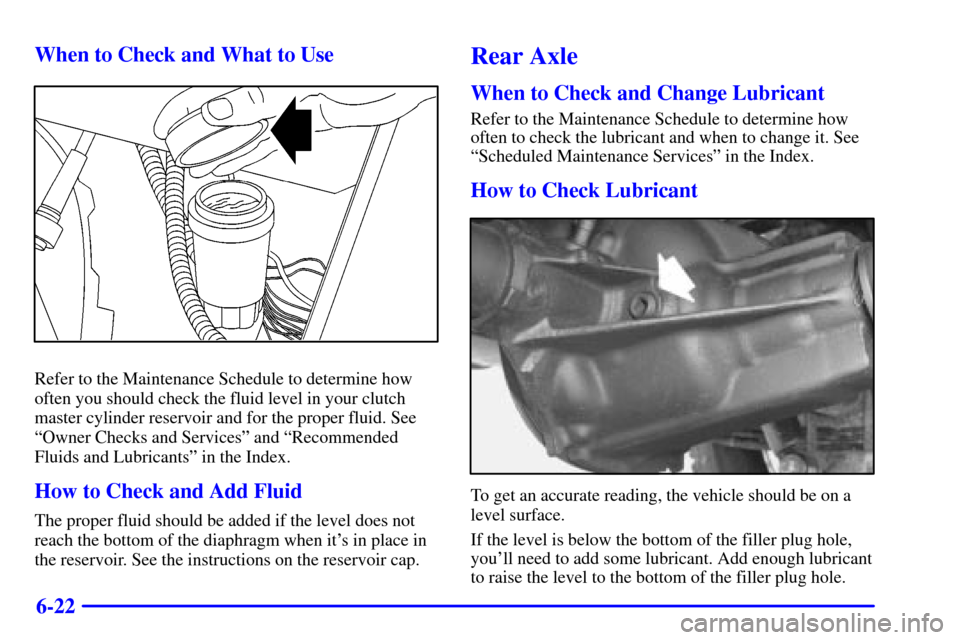
6-22 When to Check and What to Use
Refer to the Maintenance Schedule to determine how
often you should check the fluid level in your clutch
master cylinder reservoir and for the proper fluid. See
ªOwner Checks and Servicesº and ªRecommended
Fluids and Lubricantsº in the Index.
How to Check and Add Fluid
The proper fluid should be added if the level does not
reach the bottom of the diaphragm when it's in place in
the reservoir. See the instructions on the reservoir cap.
Rear Axle
When to Check and Change Lubricant
Refer to the Maintenance Schedule to determine how
often to check the lubricant and when to change it. See
ªScheduled Maintenance Servicesº in the Index.
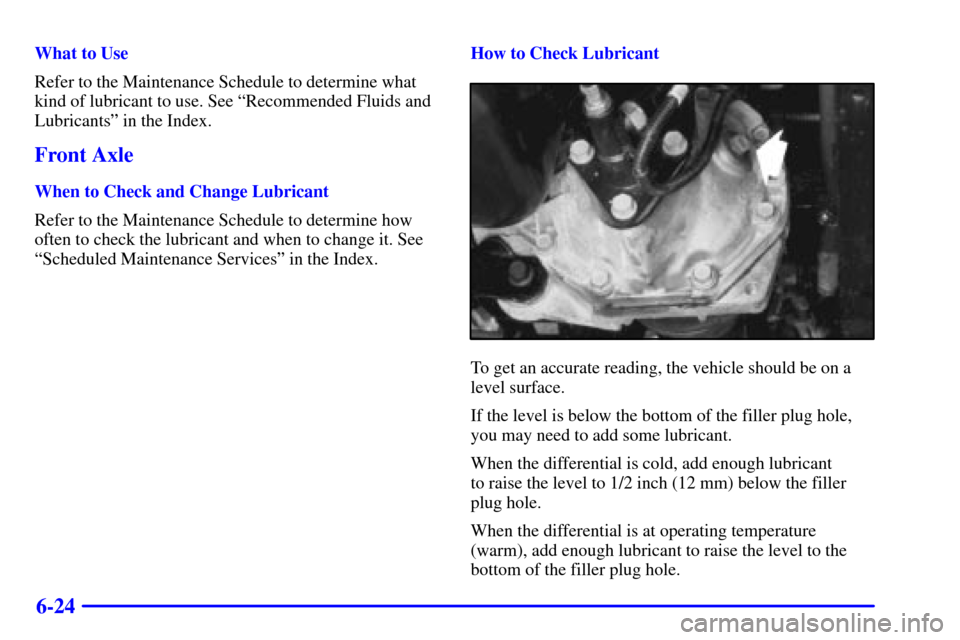
How to Check Lubricant
To get an accurate reading, the vehicle should be on a
level surface.
If the level is below the bottom of the filler plug hole,
you'll need to add some lubricant. Add enough lubricant
to raise the level to the bottom of the filler plug hole.
Page 369 of 488
6-24
What to Use
Refer to the Maintenance Schedule to determine what
kind of lubricant to use. See ªRecommended Fluids and
Lubricantsº in the Index.
Front Axle
When to Check and Change Lubricant
Refer to the Maintenance Schedule to determine how
often to check the lubricant and when to change it. See
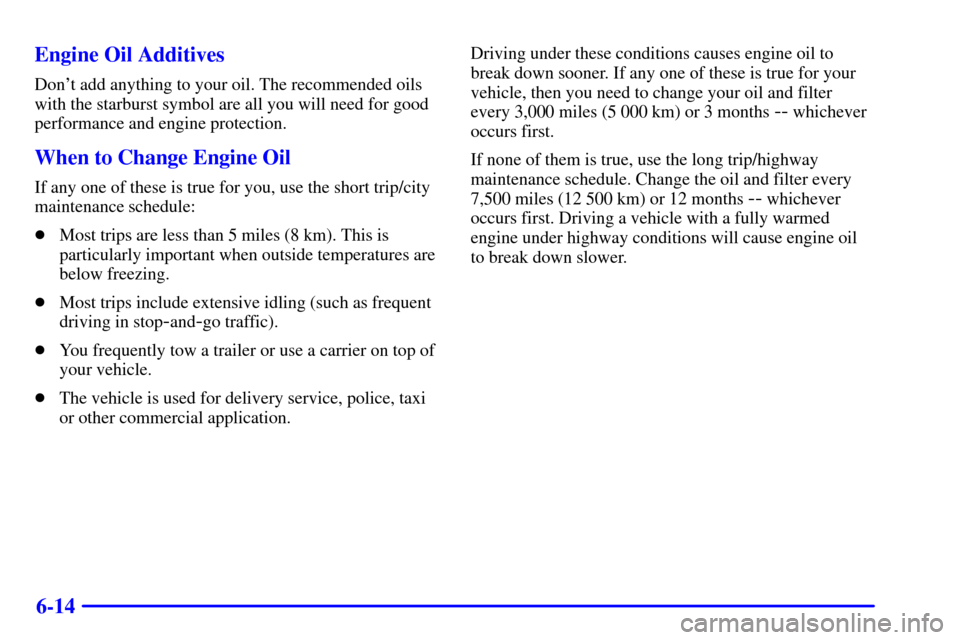
ªScheduled Maintenance Servicesº in the Index.How to Check Lubricant
To get an accurate reading, the vehicle should be on a
level surface.
If the level is below the bottom of the filler plug hole,
you may need to add some lubricant.
When the differential is cold, add enough lubricant
to raise the level to 1/2 inch (12 mm) below the filler
plug hole.
When the differential is at operating temperature
(warm), add enough lubricant to raise the level to the
bottom of the filler plug hole.
Page 379 of 488
6-34
NOTICE:
�Using the wrong fluid can badly damage
brake system parts. For example, just a few
drops of mineral
-based oil, such as engine
oil, in your brake system can damage brake
system parts so badly that they'll have to be
replaced. Don't let someone put in the
wrong kind of fluid.
�If you spill brake fluid on your vehicle's
painted surfaces, the paint finish can be
damaged. Be careful not to spill brake fluid
on your vehicle. If you do, wash it off
immediately. See ªAppearance Careº in
the Index.
Brake Wear
Your vehicle has four-wheel disc brakes.
Disc brake pads have built
-in wear indicators that make a
high
-pitched warning sound when the brake pads are
worn and new pads are needed. The sound may come and
go or be heard all the time your vehicle is moving (except
when you are pushing on the brake pedal firmly).
CAUTION:
The brake wear warning sound means that soon
your brakes won't work well. That could lead to
an accident. When you hear the brake wear
warning sound, have your vehicle serviced.
NOTICE:
Continuing to drive with worn-out brake pads
could result in costly brake repair.