Page 310 of 488
5-2
Hazard Warning Flashers
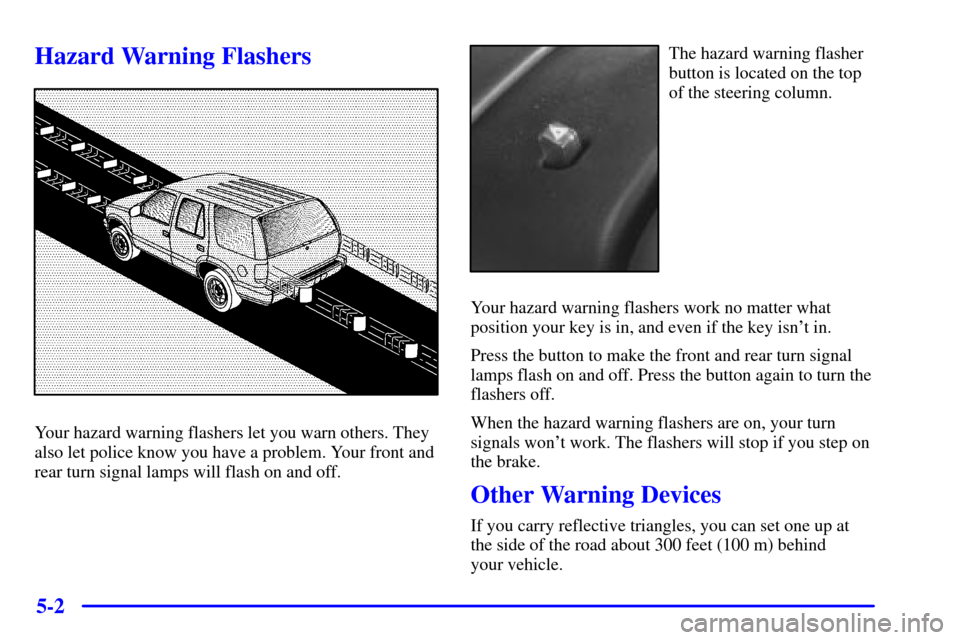
Your hazard warning flashers let you warn others. They
also let police know you have a problem. Your front and
rear turn signal lamps will flash on and off.
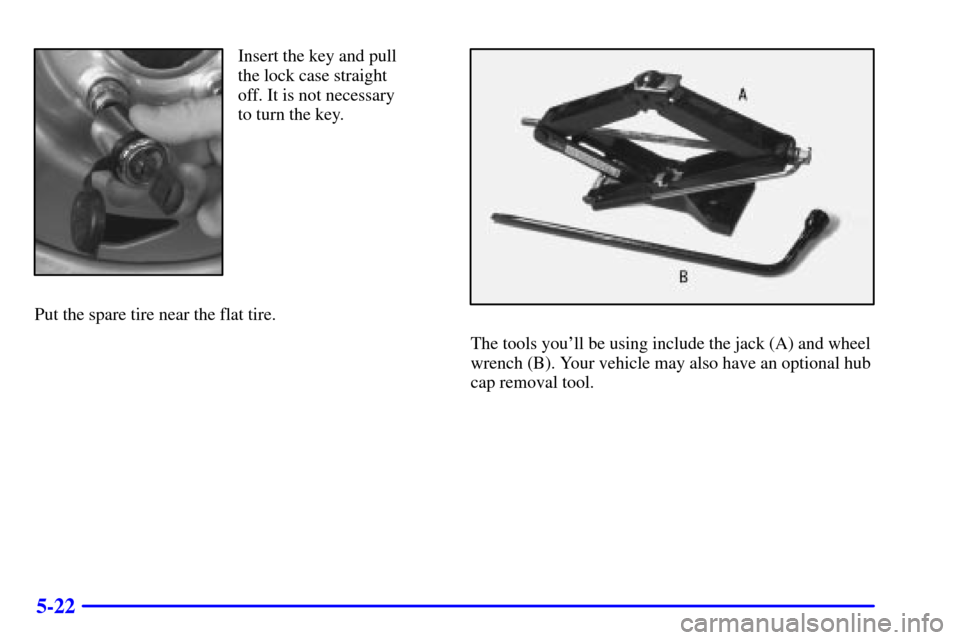
The hazard warning flasher
button is located on the top
of the steering column.
Your hazard warning flashers work no matter what
position your key is in, and even if the key isn't in.
Press the button to make the front and rear turn signal
lamps flash on and off. Press the button again to turn the
flashers off.
When the hazard warning flashers are on, your turn
signals won't work. The flashers will stop if you step on
the brake.
Other Warning Devices
If you carry reflective triangles, you can set one up at
the side of the road about 300 feet (100 m) behind
your vehicle.
Page 330 of 488
5-22
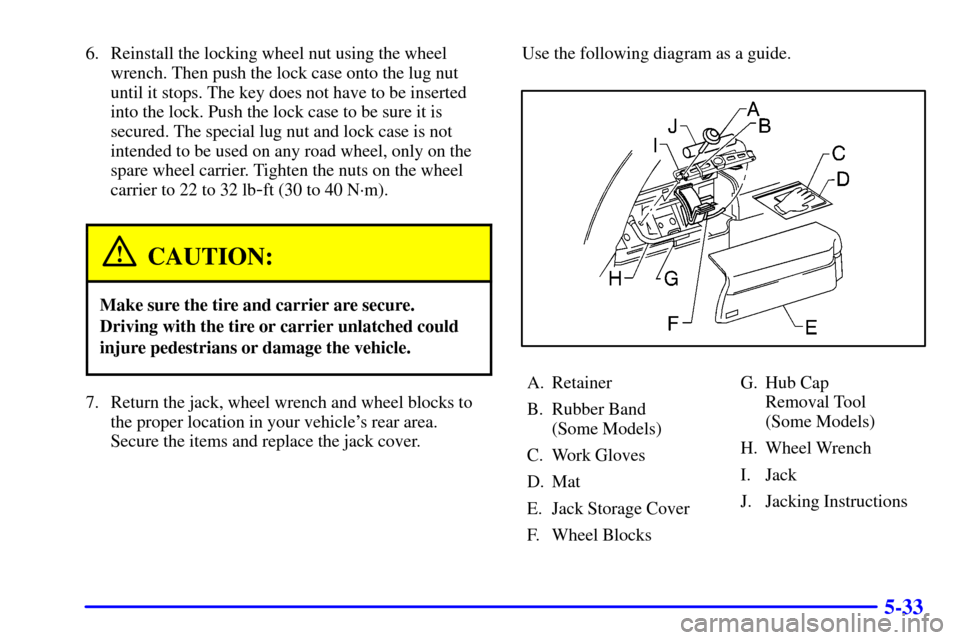
Insert the key and pull
the lock case straight
off. It is not necessary
to turn the key.
Put the spare tire near the flat tire.
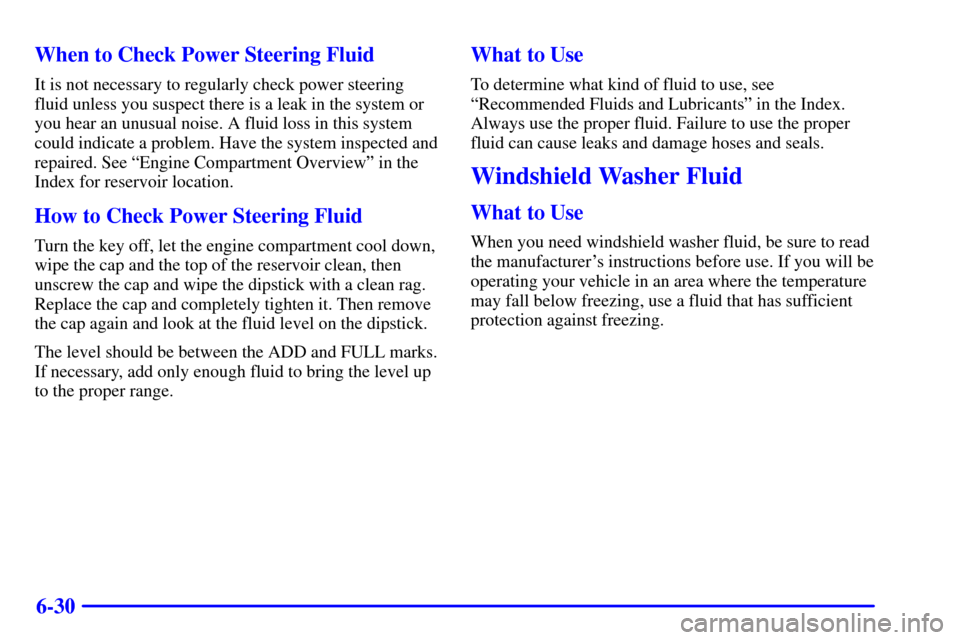
The tools you'll be using include the jack (A) and wheel
wrench (B). Your vehicle may also have an optional hub
cap removal tool.
Page 341 of 488
5-33
6. Reinstall the locking wheel nut using the wheel
wrench. Then push the lock case onto the lug nut
until it stops. The key does not have to be inserted
into the lock. Push the lock case to be sure it is
secured. The special lug nut and lock case is not
intended to be used on any road wheel, only on the
spare wheel carrier. Tighten the nuts on the wheel
carrier to 22 to 32 lb
-ft (30 to 40 N´m).
CAUTION:
Make sure the tire and carrier are secure.
Driving with the tire or carrier unlatched could
injure pedestrians or damage the vehicle.
7. Return the jack, wheel wrench and wheel blocks to
the proper location in your vehicle's rear area.
Secure the items and replace the jack cover.Use the following diagram as a guide.
A. Retainer
B. Rubber Band
(Some Models)
C. Work Gloves
D. Mat
E. Jack Storage Cover
F. Wheel BlocksG. Hub Cap
Removal Tool
(Some Models)
H. Wheel Wrench
I. Jack
J. Jacking Instructions
Page 375 of 488
6-30 When to Check Power Steering Fluid
It is not necessary to regularly check power steering
fluid unless you suspect there is a leak in the system or
you hear an unusual noise. A fluid loss in this system
could indicate a problem. Have the system inspected and
repaired. See ªEngine Compartment Overviewº in the
Index for reservoir location.
How to Check Power Steering Fluid
Turn the key off, let the engine compartment cool down,
wipe the cap and the top of the reservoir clean, then
unscrew the cap and wipe the dipstick with a clean rag.
Replace the cap and completely tighten it. Then remove
the cap again and look at the fluid level on the dipstick.
The level should be between the ADD and FULL marks.
If necessary, add only enough fluid to bring the level up
to the proper range.
What to Use
To determine what kind of fluid to use, see
ªRecommended Fluids and Lubricantsº in the Index.
Always use the proper fluid. Failure to use the proper
fluid can cause leaks and damage hoses and seals.
Windshield Washer Fluid
What to Use
When you need windshield washer fluid, be sure to read
the manufacturer's instructions before use. If you will be
operating your vehicle in an area where the temperature
may fall below freezing, use a fluid that has sufficient
protection against freezing.
Page 464 of 488
7-46
Manual Transmission Check
Check the transmission fluid level; add if needed. See
ªManual Transmission Fluidº in the Index. Check for
leaks. A fluid leak is the only reason for fluid loss. Have
the system inspected and repaired if needed.
Automatic Transmission Check
Check the transmission fluid level; add if needed. See
ªAutomatic Transmission Fluidº in the Index. A fluid
loss may indicate a problem. Check the system and
repair if needed.
Hydraulic Clutch System Check
Check the fluid level in the clutch reservoir. See
ªHydraulic Clutch Fluidº in the Index. A fluid loss in
this system could indicate a problem. Have the system
inspected and repaired at once.At Least Once a Year
Key Lock Cylinders Service
Lubricate the key lock cylinders with the lubricant
specified in Part D.
Body Lubrication Service
Lubricate all hood hinges, hood latch assembly,
secondary latch, pivots, spring anchor, release pawl,
door hinges, fuel door hinge, endgate hinges, outer
tailgate handle pivot points, tailgate hinges, tailgate
mounted spare tire (if equipped), glove box, console
doors, moving seat hardware and folding seat hardware.
Part D tells you what to use. More frequent lubrication
may be required when exposed to a corrosive
environment.
Page 466 of 488
7-48
Automatic Transmission Shift Lock Control
System Check
CAUTION:
When you are doing this check, the vehicle could
move suddenly. If it does, you or others could be
injured. Follow the steps below.
1. Before you start, be sure you have enough room
around the vehicle. It should be parked on a
level surface.
2. Firmly apply the parking brake. See ªParking Brakeº
in the Index if necessary.
Be ready to apply the regular brake immediately if
the vehicle begins to move.3. With the engine off, turn the key to the RUN
position, but don't start the engine. Without applying
the regular brake, try to move the shift lever out of
PARK (P) with normal effort. If the shift lever
moves out of PARK (P), your vehicle needs service.
Ignition Transmission Lock Check
While parked, and with the parking brake set, try to turn
the ignition key to LOCK in each shift lever position.
�With an automatic transmission, the key should turn
to LOCK only when the shift lever is in PARK (P).
�With a manual transmission, the key should turn to
LOCK only when you press the key release button.
On all vehicles, the key should come out only in LOCK.
Page 471 of 488

7-53
USAGEFLUID/LUBRICANT
Manual
TransmissionSynchromesh Transmission Fluid
(GM Part No. 12345349 or
equivalent).
Automatic
TransmissionDEXRON�-III Automatic
Transmission Fluid.
Key Lock
CylindersMulti-Purpose Lubricant,
Superlube� (GM Part
No. 12346241 or equivalent).
Chassis
LubricationChassis Lubricant (GM Part
No. 12377985 or equivalent) or
lubricant meeting requirements
of NLGI # 2, Category LB
or GC
-LB.
Front and Rear
Axle (Standard
Differential)SAE 80W-90 Axle Lubricant (GM
Part No. 1052271 or equivalent).
USAGEFLUID/LUBRICANT
Rear Axle
(Locking
Differential)Axle Lubricant; use only GM Part
No. 1052271. Do not add friction
modifier.
Transfer CaseAUTO-TRAK II Fluid
(GM Part No. 12378508).
Electronic
Transfer CaseDEXRON�-III Automatic
Transmission Fluid.
Automatic
Transfer CaseAUTO-TRAK II Fluid
(GM Part No. 12378508).
Rear Driveline
Center Spline
and Universal
JointsChassis Lubricant (GM Part
No. 12377985 or equivalent) or
lubricant meeting requirements
of NLGI # 2, Category LB
or GC
-LB.
Page 482 of 488
8-6
Chevrolet Roadside Assistance Program
To enhance Chevrolet's strong commitment to customer
satisfaction, Chevrolet is excited to announce the
establishment of the Chevrolet Roadside Assistance
Center. As the owner of a 2002 Chevrolet, membership
in Roadside Assistance is free.Roadside Assistance is available 24 hours a day,
365 days a year, by calling 1
-800-CHEV-USA
(243
-8872). This toll-free number will provide you
over
-the-phone roadside assistance with minor
mechanical problems. If your problem cannot be
resolved over the phone, our advisors have access to
a nationwide network of dealer recommended service
providers. Roadside membership is free; however some
services may incur costs.
Roadside offers two levels of service to the customer,
Basic Care and Courtesy Care:
Roadside Basic Care provides:
�Toll
-free number, 1-800-CHEV-USA (243-8872),
text telephone (TTY) users, call 1
-888-889-2438
�Free towing for warranty repairs
�Basic over
-the-phone technical advice
�Available dealer services at reasonable costs
(i.e., wrecker services, locksmith/key service,
glass repair, etc.)