Page 415 of 488
6-70
Name Usage
A/C Air Conditioning
W/W PMP Not Used
HORN Horn
BTSI Automatic Transmission Shift
Lock Control System
B/U LP Back Up Lamps
IGN B Column Feed, IGN 2, 3, 4
RAP Retained Accessory Power
LD LEV Not Used
OXYSEN Oxygen Sensor
IGN E Engine
MIR/LKS Mirrors, Door Locks
FOG LP Fog Lamps
IGN A Starting and Charging IGN 1
STUD #2 Accessory Feeds, Electric Brake
PARKLP Parking LampsName Usage
LR PRK Left Rear Parking Lamps
IGN C Starter Solenoid,
Fuel Pump, PRNDL
HTDSEAT Heated Seat
HVAC HVAC System
TRCHMSL Trailer Center High Mount
Stop Light
RRDFOG Rear Defogger
TBC Truck Body Computer
CRANK Clutch Switch, NSBU Switch
HAZLP Hazard Lamps
VECHMSL Vehicle Center High
-Mounted
Stop Lamp
HTDMIR Heated Mirror
ATC Transfer Case (Four
-Wheel Drive)
STOPLP Stop Lamps
RR W/W Rear Window Wiper
Page 426 of 488
Short Trip/City Scheduled Maintenance
7-8
The services shown in this schedule up to 100,000 miles
(166 000 km) should be repeated after 100,000 miles
(166 000 km) at the same intervals for the life of
this vehicle. The services shown at 150,000 miles
(240 000 km) should be repeated at the same interval
after 150,000 miles (240 000 km) for the life of
this vehicle.
See ªOwner Checks and Servicesº and ªPeriodic
Maintenance Inspectionsº following.
Footnotes
� The U.S. Environmental Protection Agency or the
California Air Resources Board has determined that the
failure to perform this maintenance item will not nullify
the emission warranty or limit recall liability prior to
the completion of the vehicle's useful life. We, however,
urge that all recommended maintenance services be
performed at the indicated intervals and the
maintenance be recorded.# Lubricate the front suspension, ball joints, steering
linkage, parking brake cable guides, propshaft splines,
universal joints and brake pedal springs.
+ A good time to check your brakes is during tire
rotation. See ªBrake System Inspectionº under
ªPeriodic Maintenance Inspectionsº in Part C of
this schedule.
** Drive axle service. See ªRecommended Fluids and
Lubricantsº in the Index for proper lubricant to use:
�Check fluid level and add fluid as needed. If driving
in dusty areas or when towing a trailer, drain fluid
and refill every 15,000 miles (25 000 km).
�If your vehicle has a locking differential, drain fluid
and refill at first engine oil change.
�More frequent lubrication may be required for
heavy
-duty or off-road use.
Page 449 of 488
Long Trip/Highway Scheduled Maintenance
7-31
The services shown in this schedule up to 100,000 miles
(166 000 km) should be repeated after 100,000 miles
(166 000 km) at the same intervals for the life of
this vehicle. The services shown at 150,000 miles
(240 000 km) should be repeated at the same interval
after 150,000 miles (240 000 km) for the life of
this vehicle.
See ªOwner Checks and Servicesº and ªPeriodic
Maintenance Inspectionsº following.
Footnotes
� The U.S. Environmental Protection Agency or the
California Air Resources Board has determined that the
failure to perform this maintenance item will not nullify
the emission warranty or limit recall liability prior to
the completion of the vehicle's useful life. We, however,
urge that all recommended maintenance services be
performed at the indicated intervals and the
maintenance be recorded.# Lubricate the front suspension, ball joints, steering
linkage, parking brake cable guides, propshaft splines,
universal joints and brake pedal springs.
+ A good time to check your brakes is during tire
rotation. See ªBrake System Inspectionº under
ªPeriodic Maintenance Inspectionsº in Part C of
this schedule.
** Drive axle service. See ªRecommended Fluids and
Lubricantsº in the Index for proper lubricant to use:
�Check fluid level and add fluid as needed.
�If your vehicle has a locking differential, drain fluid
and refill at first engine oil change.
Page 465 of 488
7-47
Starter Switch Check
CAUTION:
When you are doing this check, the vehicle could
move suddenly. If it does, you or others could be
injured. Follow the steps below.
1. Before you start, be sure you have enough room
around the vehicle.
2. Firmly apply both the parking brake and the regular
brake. See ªParking Brakeº in the Index if necessary.
Do not use the accelerator pedal, and be ready to turn
off the engine immediately if it starts.3. On automatic transmission vehicles, try to start the
engine in each gear. The starter should work only in
PARK (P) or NEUTRAL (N). If the starter works in
any other position, your vehicle needs service.
On manual transmission vehicles, put the shift lever
in NEUTRAL (N), push the clutch down halfway
and try to start the engine. The starter should work
only when the clutch is pushed down all the way to
the floor. If the starter works when the clutch isn't
pushed all the way down, your vehicle needs service.
Page 466 of 488
7-48
Automatic Transmission Shift Lock Control
System Check
CAUTION:
When you are doing this check, the vehicle could
move suddenly. If it does, you or others could be
injured. Follow the steps below.
1. Before you start, be sure you have enough room
around the vehicle. It should be parked on a
level surface.
2. Firmly apply the parking brake. See ªParking Brakeº
in the Index if necessary.
Be ready to apply the regular brake immediately if
the vehicle begins to move.3. With the engine off, turn the key to the RUN
position, but don't start the engine. Without applying
the regular brake, try to move the shift lever out of
PARK (P) with normal effort. If the shift lever
moves out of PARK (P), your vehicle needs service.
Ignition Transmission Lock Check
While parked, and with the parking brake set, try to turn
the ignition key to LOCK in each shift lever position.
�With an automatic transmission, the key should turn
to LOCK only when the shift lever is in PARK (P).
�With a manual transmission, the key should turn to
LOCK only when you press the key release button.
On all vehicles, the key should come out only in LOCK.
Page 467 of 488
7-49
Parking Brake and Automatic Transmission
PARK (P) Mechanism Check
CAUTION:
When you are doing this check, your vehicle
could begin to move. You or others could be
injured and property could be damaged. Make
sure there is room in front of your vehicle in case
it begins to roll. Be ready to apply the regular
brake at once should the vehicle begin to move.
Park on a fairly steep hill, with the vehicle facing
downhill. Keeping your foot on the regular brake, set the
parking brake.
�To check the parking brake's holding ability: With
the engine running and transmission in
NEUTRAL (N), slowly remove foot pressure from
the regular brake pedal. Do this until the vehicle is
held by the parking brake only.
�To check the PARK (P) mechanism's holding
ability: With the engine running, shift to PARK (P).
Then release the parking brake followed by the
regular brake.
Underbody Flushing Service
At least every spring, use plain water to flush any
corrosive materials from the underbody. Take care to
clean thoroughly any areas where mud and other debris
can collect.
Page 469 of 488
7-51 Throttle System Inspection
Inspect the throttle system for interference or binding,
and for damaged or missing parts. Replace parts as
needed. Replace any components that have high effort
or excessive wear. Do not lubricate accelerator and
cruise control cables.
Transfer Case and Front Axle
(Four-Wheel Drive) Inspection
Every 12 months or at engine oil change intervals, check
front axle and transfer case and add lubricant when
necessary. A fluid loss could indicate a problem; check
and have it repaired, if needed. Check vent hose at
transfer case for kinks and proper installation. More
frequent lubrication may be required on off
-road use.
Brake System Inspection
Inspect the complete system. Inspect brake lines and
hoses for proper hook
-up, binding, leaks, cracks,
chafing, etc. Inspect disc brake pads for wear and rotors
for surface condition. Inspect other brake parts,
including calipers, parking brake, etc. Check parking
brake adjustment. You may need to have your brakes
inspected more often if your driving habits or conditions
result in frequent braking.
Page 470 of 488
7-52
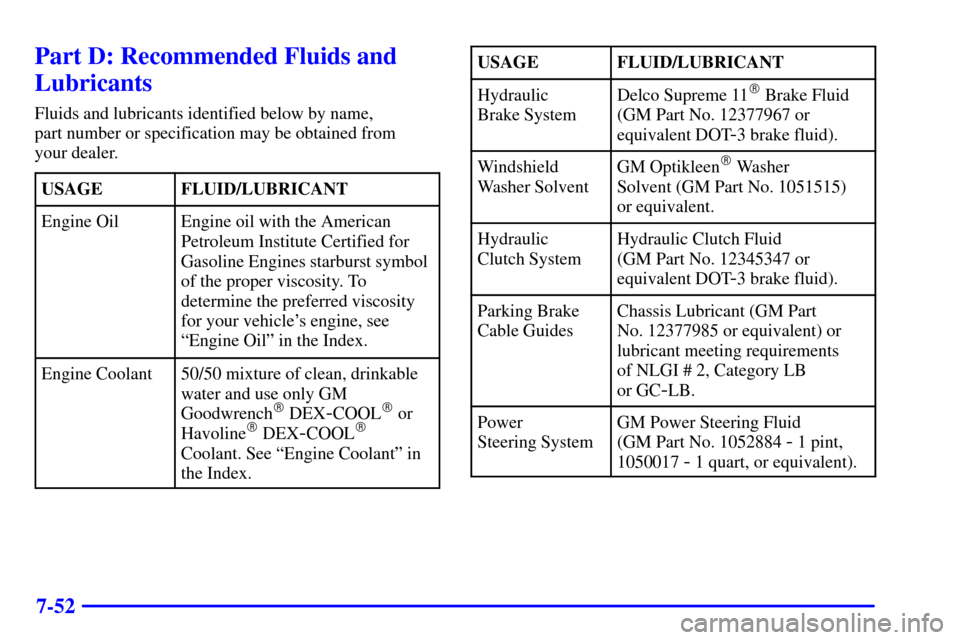
Part D: Recommended Fluids and
Lubricants
Fluids and lubricants identified below by name,
part number or specification may be obtained from
your dealer.
USAGE
FLUID/LUBRICANT
Engine OilEngine oil with the American
Petroleum Institute Certified for
Gasoline Engines starburst symbol
of the proper viscosity. To
determine the preferred viscosity
for your vehicle's engine, see
ªEngine Oilº in the Index.
Engine Coolant50/50 mixture of clean, drinkable
water and use only GM
Goodwrench
� DEX-COOL� or
Havoline� DEX-COOL�
Coolant. See ªEngine Coolantº in
the Index.
USAGEFLUID/LUBRICANT
Hydraulic
Brake SystemDelco Supreme 11� Brake Fluid
(GM Part No. 12377967 or
equivalent DOT
-3 brake fluid).
Windshield
Washer SolventGM Optikleen� Washer
Solvent (GM Part No. 1051515)
or equivalent.
Hydraulic
Clutch SystemHydraulic Clutch Fluid
(GM Part No. 12345347 or
equivalent DOT
-3 brake fluid).
Parking Brake
Cable GuidesChassis Lubricant (GM Part
No. 12377985 or equivalent) or
lubricant meeting requirements
of NLGI # 2, Category LB
or GC
-LB.
Power
Steering SystemGM Power Steering Fluid
(GM Part No. 1052884
- 1 pint,
1050017
- 1 quart, or equivalent).