Page 124 of 488
2-58
Fog Lamps (If Equipped)
Use your fog lamps for better vision in foggy or misty
conditions. Your parking lamps must be on for your fog
lamps to work.
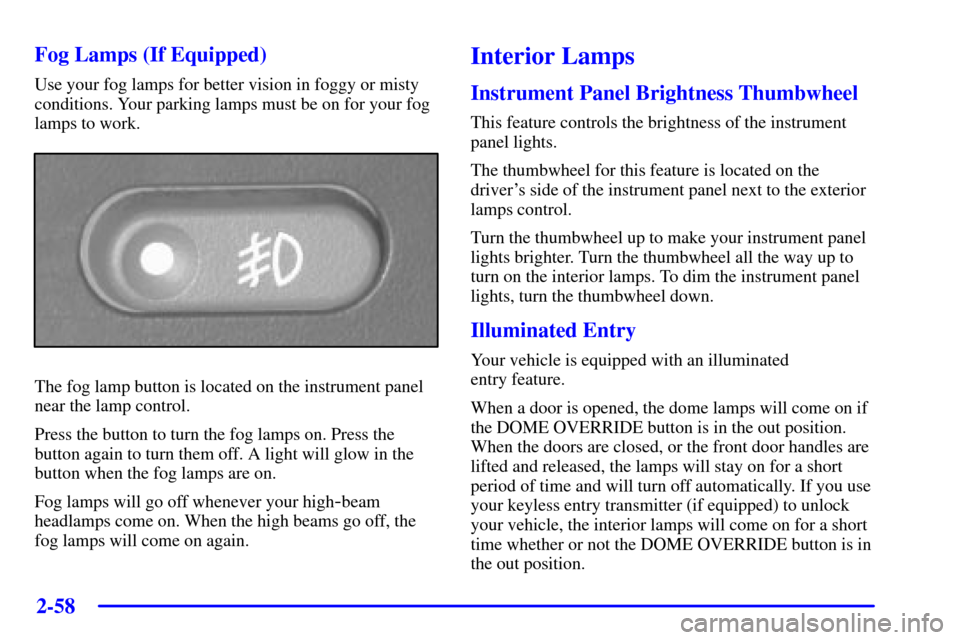
The fog lamp button is located on the instrument panel
near the lamp control.
Press the button to turn the fog lamps on. Press the
button again to turn them off. A light will glow in the
button when the fog lamps are on.
Fog lamps will go off whenever your high
-beam
headlamps come on. When the high beams go off, the
fog lamps will come on again.
Interior Lamps
Instrument Panel Brightness Thumbwheel
This feature controls the brightness of the instrument
panel lights.
The thumbwheel for this feature is located on the
driver's side of the instrument panel next to the exterior
lamps control.
Turn the thumbwheel up to make your instrument panel
lights brighter. Turn the thumbwheel all the way up to
turn on the interior lamps. To dim the instrument panel
lights, turn the thumbwheel down.
Illuminated Entry
Your vehicle is equipped with an illuminated
entry feature.
When a door is opened, the dome lamps will come on if
the DOME OVERRIDE button is in the out position.
When the doors are closed, or the front door handles are
lifted and released, the lamps will stay on for a short
period of time and will turn off automatically. If you use
your keyless entry transmitter (if equipped) to unlock
your vehicle, the interior lamps will come on for a short
time whether or not the DOME OVERRIDE button is in
the out position.
Page 126 of 488
2-60
Battery Run-Down Protection
This feature shuts off the dome, courtesy, vanity,
reading, glove box and underhood lamps if they are left
on for more than 20 minutes when the ignition is off.
This will keep your battery from running down.
If the battery run
-down protection shuts off the interior
lamps, it may be necessary to do one of the following to
return to normal operation:
�Shut off all lamps and close all doors, or
�turn the ignition key to RUN.
Mirrors
Inside Day/Night Rearview Mirror
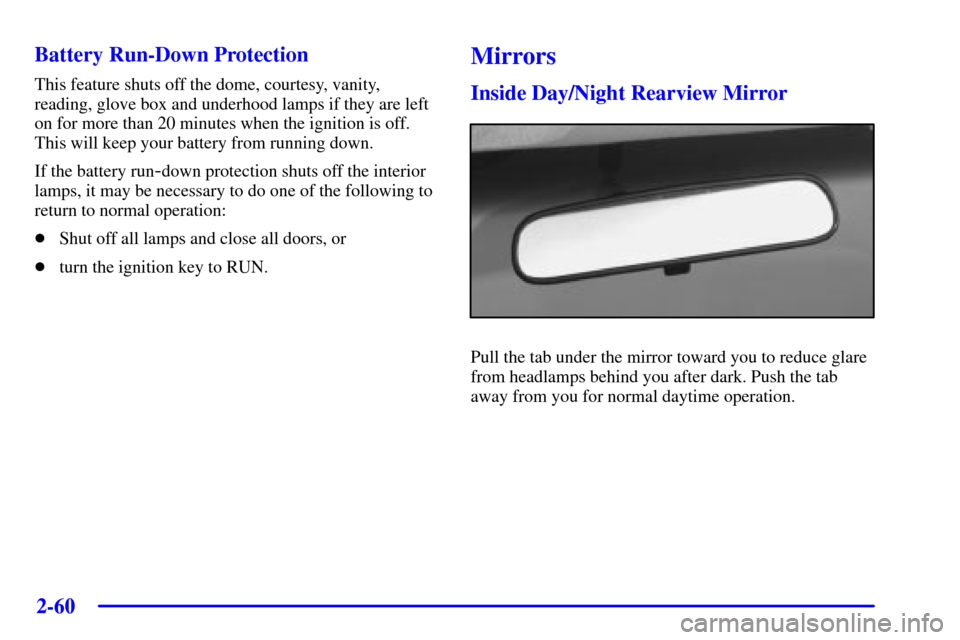
Pull the tab under the mirror toward you to reduce glare
from headlamps behind you after dark. Push the tab
away from you for normal daytime operation.
Page 127 of 488
2-61
Electrochromic Day/Night Inside Rearview
Mirror (If Equipped)
This mirror automatically changes to reduce glare from
headlamps behind you. A photocell on the back of the
mirror senses when it is becoming dark outside. Another
photocell built into the mirror surface senses when
headlamps are behind you.
At night, when the glare is too high, the mirror will
gradually darken to reduce glare (this change may take a
few seconds). The mirror will return to its clear daytime
state when the glare is reduced. The mirror will also
return to its clear daytime state when the vehicle is put
into REVERSE (R).
Press the AUTO button at the base of the mirror to turn
on the automatic feature. The button has an indicator
light to show it is on. Press the OFF button to turn the
automatic feature off.
Page 129 of 488
2-63
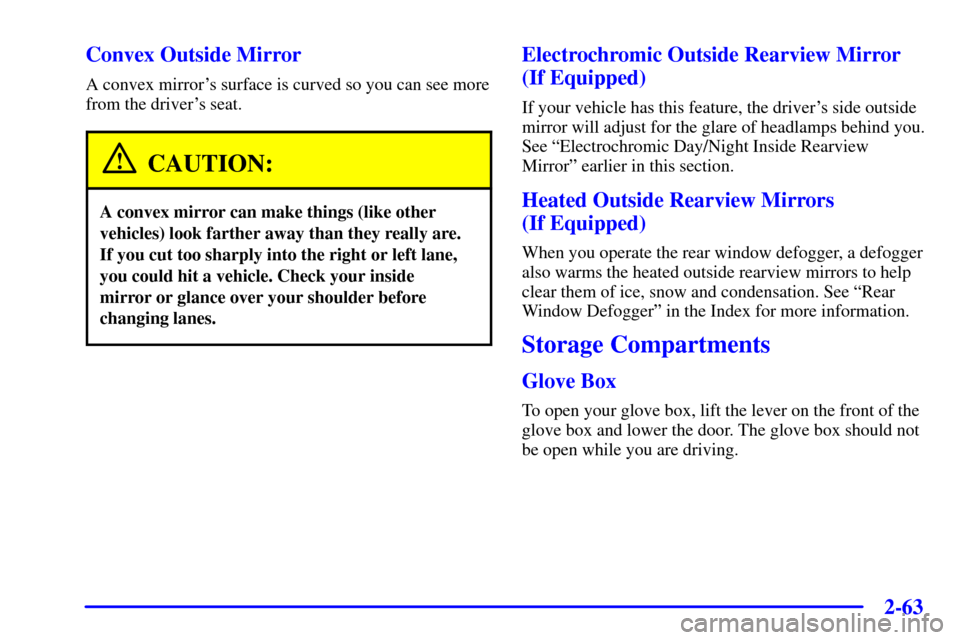
Convex Outside Mirror
A convex mirror's surface is curved so you can see more
from the driver's seat.
CAUTION:
A convex mirror can make things (like other
vehicles) look farther away than they really are.
If you cut too sharply into the right or left lane,
you could hit a vehicle. Check your inside
mirror or glance over your shoulder before
changing lanes.
Electrochromic Outside Rearview Mirror
(If Equipped)
If your vehicle has this feature, the driver's side outside
mirror will adjust for the glare of headlamps behind you.
See ªElectrochromic Day/Night Inside Rearview
Mirrorº earlier in this section.
Heated Outside Rearview Mirrors
(If Equipped)
When you operate the rear window defogger, a defogger
also warms the heated outside rearview mirrors to help
clear them of ice, snow and condensation. See ªRear
Window Defoggerº in the Index for more information.
Storage Compartments
Glove Box
To open your glove box, lift the lever on the front of the
glove box and lower the door. The glove box should not
be open while you are driving.
Page 266 of 488
4-21 Driving Uphill
Once you decide you can safely drive up the hill, you
need to take some special steps.
�Use a low gear and get a firm grip on the
steering wheel.
�Get a smooth start up the hill and try to maintain
your speed. Don't use more power than you need,
because you don't want your wheels to start spinning
or sliding.
�Try to drive straight up the hill if at all possible.
If the path twists and turns, you might want to find
another route.
CAUTION:
Turning or driving across steep hills can be
dangerous. You could lose traction, slide
sideways, and possibly roll over. You could be
seriously injured or killed. When driving up hills,
always try to go straight up.
�Ease up on your speed as you approach the top of
the hill.
�Attach a flag to the vehicle to make you more visible
to approaching traffic on trails or hills.
�Sound the horn as you approach the top of the hill to
let opposing traffic know you're there.
�Use your headlamps even during the day. They make
you more visible to oncoming traffic.
CAUTION:
Driving to the top (crest) of a hill at full speed can
cause an accident. There could be a drop
-off,
embankment, cliff, or even another vehicle. You
could be seriously injured or killed. As you near
the top of a hill, slow down and stay alert.
Page 275 of 488
4-30
Driving at Night
Night driving is more dangerous than day driving.
One reason is that some drivers are likely to be
impaired
-- by alcohol or drugs, with night vision
problems, or by fatigue.Here are some tips on night driving.
�Drive defensively.
�Don't drink and drive.
�Except Vehicles with Electrochromic Day/Night
Inside Rearview Mirror: Adjust your inside
rearview mirror to reduce the glare from headlamps
behind you.
�Since you can't see as well, you may need to
slow down and keep more space between you and
other vehicles.
�Slow down, especially on higher speed roads. Your
headlamps can light up only so much road ahead.
�In remote areas, watch for animals.
�If you're tired, pull off the road in a safe place
and rest.
No one can see as well at night as in the daytime. But as
we get older these differences increase. A 50
-year-old
driver may require at least twice as much light to see the
same thing at night as a 20
-year-old.
Page 276 of 488

4-31
What you do in the daytime can also affect your night
vision. For example, if you spend the day in bright
sunshine you are wise to wear sunglasses. Your eyes will
have less trouble adjusting to night. But if you're
driving, don't wear sunglasses at night. They may cut
down on glare from headlamps, but they also make a lot
of things invisible.
You can be temporarily blinded by approaching
headlamps. It can take a second or two, or even several
seconds, for your eyes to readjust to the dark. When you
are faced with severe glare (as from a driver who
doesn't lower the high beams, or a vehicle with
misaimed headlamps), slow down a little. Avoid staring
directly into the approaching headlamps.Keep your windshield and all the glass on your vehicle
clean
-- inside and out. Glare at night is made much
worse by dirt on the glass. Even the inside of the glass
can build up a film caused by dust. Dirty glass makes
lights dazzle and flash more than clean glass would,
making the pupils of your eyes contract repeatedly.
Remember that your headlamps light up far less of a
roadway when you are in a turn or curve. Keep your
eyes moving; that way, it's easier to pick out dimly
lighted objects. Just as your headlamps should be
checked regularly for proper aim, so should your eyes
be examined regularly. Some drivers suffer from night
blindness
-- the inability to see in dim light -- and
aren't even aware of it.
Page 288 of 488
4-43
CAUTION:
Snow can trap exhaust gases under your vehicle.
This can cause deadly CO (carbon monoxide) gas
to get inside. CO could overcome you and kill
you. You can't see it or smell it, so you might not
know it is in your vehicle. Clear away snow from
around the base of your vehicle, especially any
that is blocking your exhaust pipe. And check
around again from time to time to be sure snow
doesn't collect there.
Open a window just a little on the side of the
vehicle that's away from the wind. This will help
keep CO out.
Run your engine only as long as you must. This saves
fuel. When you run the engine, make it go a little faster
than just idle. That is, push the accelerator slightly. This
uses less fuel for the heat that you get and it keeps the
battery charged. You will need a well
-charged battery to
restart the vehicle, and possibly for signaling later on
with your headlamps. Let the heater run for a while.Then, shut the engine off and close the window almost
all the way to preserve the heat. Start the engine again
and repeat this only when you feel really uncomfortable
from the cold. But do it as little as possible. Preserve the
fuel as long as you can. To help keep warm, you can get
out of the vehicle and do some fairly vigorous exercises
every half hour or so until help comes.
Recreational Vehicle Towing
Recreational vehicle towing means towing your vehicle
behind another vehicle
-- such as behind a motorhome.
The two most common types of recreational vehicle
towing are known as ªdinghy towingº (towing your
vehicle with all four wheels on the ground) and ªdolly
towingº (towing your vehicle with two wheels on
the ground and two wheels up on a device known
as a ªdollyº).
With the proper preparation and equipment, many
vehicles can be towed in these ways. See ªDinghy
Towingº and ªDolly Towing,º following.