Page 328 of 488

5-20 Removing the Spare Tire and Tools
The jacking equipment you'll need is stored along the
driver's side inner rear quarter panel. In some cases, you
may have to remove the spare tire in order to reach the
jack. Your vehicle is also equipped with work gloves
and a plastic ground mat to assist in the changing of a
flat tire.
The following instructions explain how to remove the
spare tire, depending on where it is mounted on your
vehicle. See ªSpare Tireº or ªCompact Spare Tireº later
in this section for more information about the spare.
1. To remove your jack
cover, pull up on the
latch(es) on the cover.
Remove the wheel
blocks, jack and
wheel wrench.
NOTICE:
Never remove or restow a tire from/to a stowage
position under the vehicle while the vehicle is
supported by a jack. Always tighten the tire
fully against the underside of the vehicle
when restowing.
2. To remove the
underbody
-mounted
spare, insert the chisel
end of the wheel
wrench, on an angle,
into the hoist shaft hole
in the rear bumper. Be
sure the chisel end of the
wheel wrench connects
into the hoist shaft.
Page 330 of 488
5-22
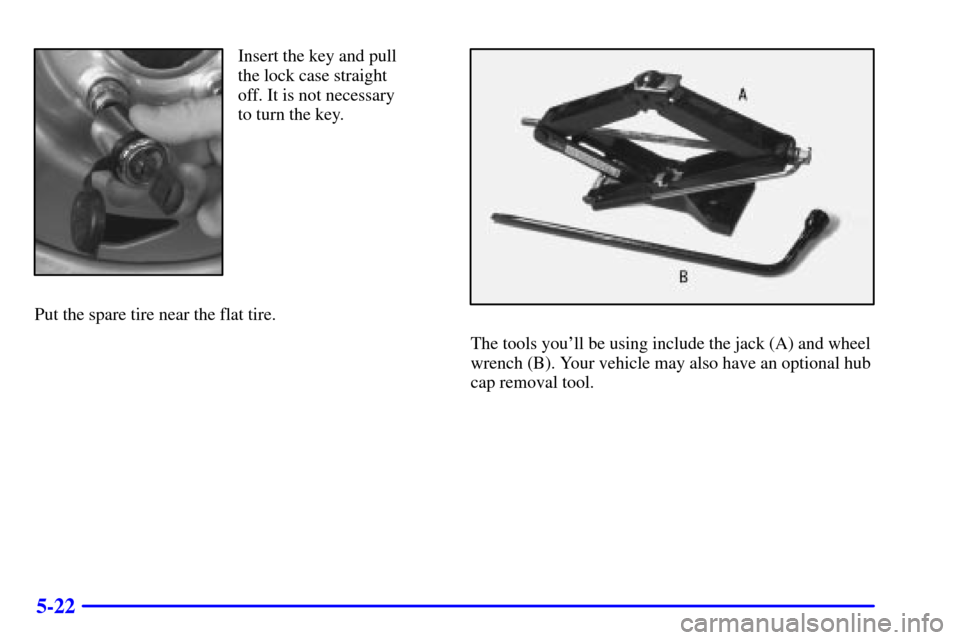
Insert the key and pull
the lock case straight
off. It is not necessary
to turn the key.
Put the spare tire near the flat tire.
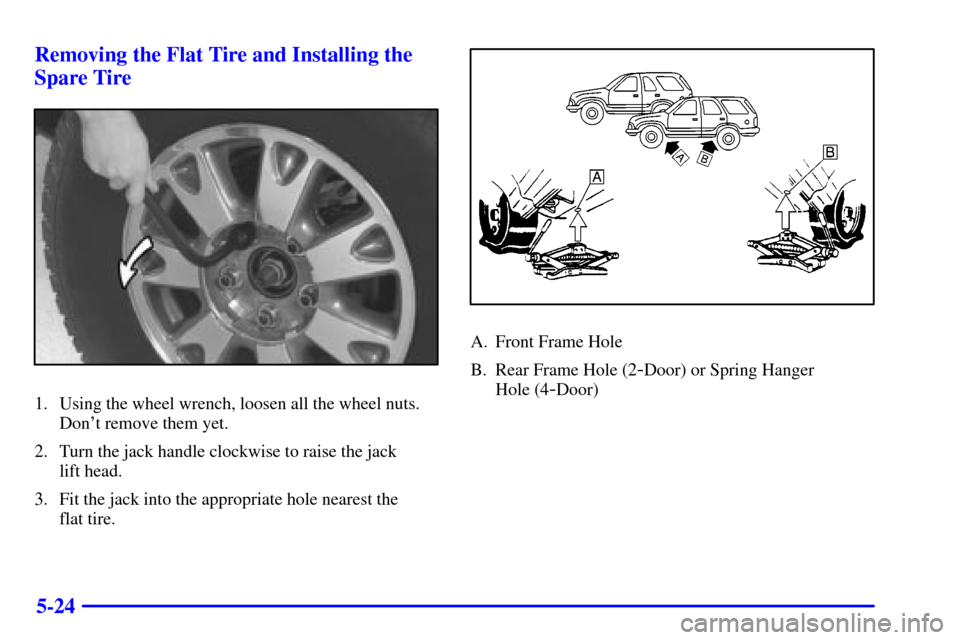
The tools you'll be using include the jack (A) and wheel
wrench (B). Your vehicle may also have an optional hub
cap removal tool.
Page 332 of 488
5-24 Removing the Flat Tire and Installing the
Spare Tire
1. Using the wheel wrench, loosen all the wheel nuts.
Don't remove them yet.
2. Turn the jack handle clockwise to raise the jack
lift head.
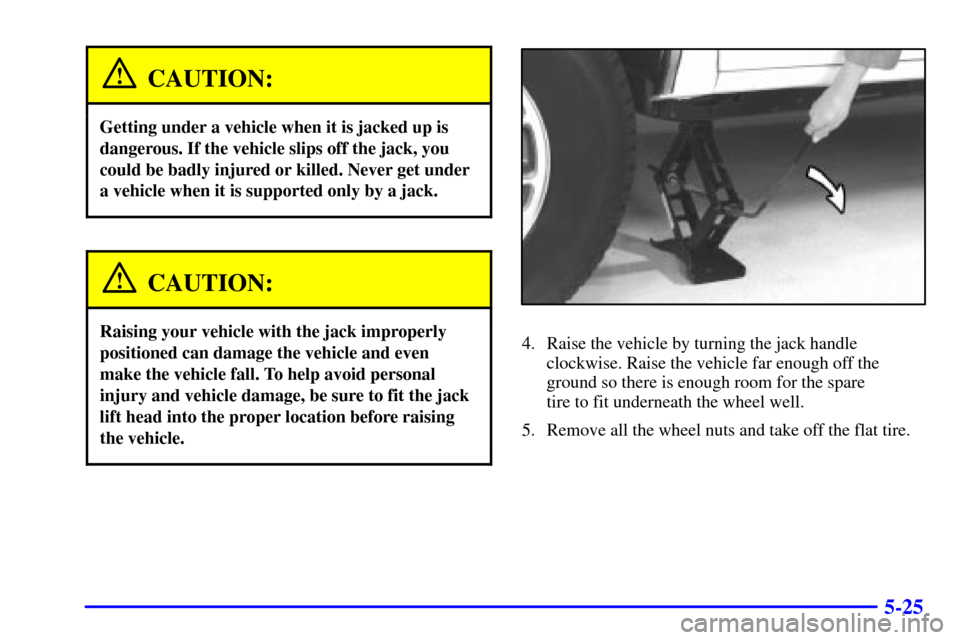
3. Fit the jack into the appropriate hole nearest the
flat tire.
A. Front Frame Hole
B. Rear Frame Hole (2
-Door) or Spring Hanger
Hole (4
-Door)
Page 333 of 488
5-25
CAUTION:
Getting under a vehicle when it is jacked up is
dangerous. If the vehicle slips off the jack, you
could be badly injured or killed. Never get under
a vehicle when it is supported only by a jack.
CAUTION:
Raising your vehicle with the jack improperly
positioned can damage the vehicle and even
make the vehicle fall. To help avoid personal
injury and vehicle damage, be sure to fit the jack
lift head into the proper location before raising
the vehicle.4. Raise the vehicle by turning the jack handle
clockwise. Raise the vehicle far enough off the
ground so there is enough room for the spare
tire to fit underneath the wheel well.
5. Remove all the wheel nuts and take off the flat tire.
Page 338 of 488
5-30 Storing a Flat or Spare Tire and Tools
CAUTION:
Storing a jack, a tire or other equipment in the
passenger compartment of the vehicle could
cause injury. In a sudden stop or collision, loose
equipment could strike someone. Store all these
in the proper place.
NOTICE:
An aluminum wheel with a flat tire should always
be stored under the vehicle with the hoist.
However, storing it that way for an extended
period could damage the wheel. To avoid this,
have the wheel repaired as soon as possible.
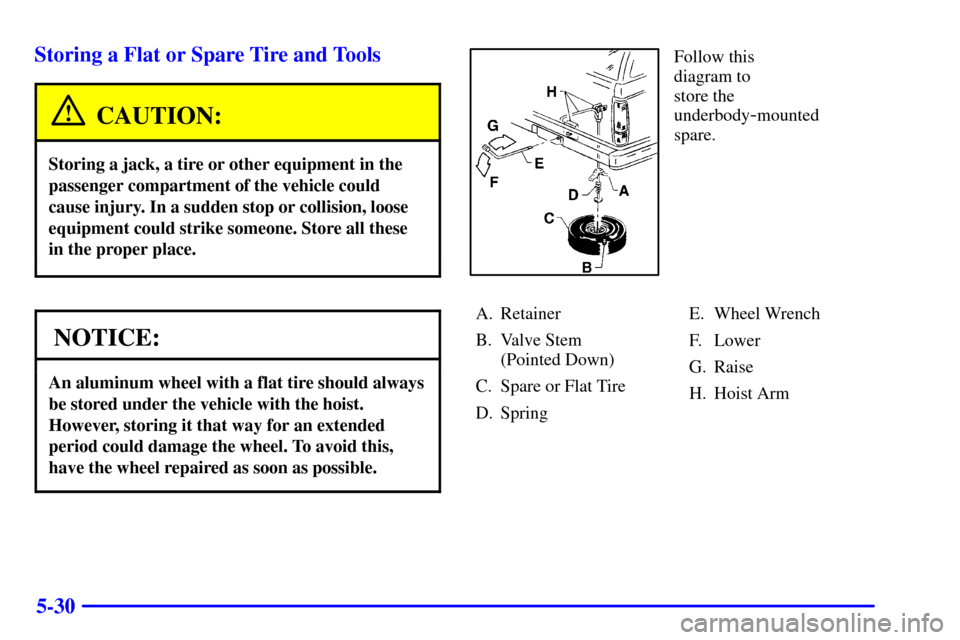
Follow this
diagram to
store the
underbody
-mounted
spare.
A. Retainer
B. Valve Stem
(Pointed Down)
C. Spare or Flat Tire
D. SpringE. Wheel Wrench
F. Lower
G. Raise
H. Hoist Arm
Page 340 of 488
5-32
Follow this diagram for the inside-mounted spare.
A. Spare or Flat Tire
B. Retainer
C. Nut
D. Wheel Carrier
E. HookFollow this diagram for the rear
-mounted spare.
A. Wheel Carrier
B. Spare or Flat Tire
C. Wheel Nut and Locking Nut Cylinder
Page 342 of 488

5-34
Spare Tire
Your vehicle, when new, had a fully inflated spare tire.
A spare tire, whether compact
-size or full-size, may lose
air over time, so check its inflation pressure regularly.
See ªInflation
-Tire Pressureº and ªLoading Your
Vehicleº in the Index, for information regarding proper
tire inflation and loading your vehicle. For instruction
on how to remove, install or store a spare tire, see
ªChanging a Flat Tireº in the Index.
After installing the spare tire on your vehicle, you
should stop as soon as possible and make sure the spare
is correctly inflated. Have the damaged or flat road tire
repaired or replaced as soon as you can and installed
back onto your vehicle. This way, a spare tire will be
available in case you need it again.
Don't mix tires and wheels of different sizes,
because they won't fit. Keep your spare tire and its
wheel together.
If your vehicle has the Xtreme� Sport Appearance
Package (RPO V4A), the spare tire is smaller than your
vehicle's original road tires, so don't include the spare in
the tire rotation.
Compact Spare Tire (If Equipped)
The compact spare tire is a temporary replacement tire
made to perform at speeds up to 65 mph (105 km/h) and
for distances up to 3,000 miles (5 000 km). With the
compact spare installed, you can finish your trip and
then have the damaged or flat road tire repaired or
replaced. Of course, it's best to repair or replace the
damaged road tire as soon as you can. Your compact
spare tire will last longer and be in good shape in case
you need it again.
The compact spare may lose air after a time, so check
the inflation pressure regularly. After installing the
compact spare on your vehicle, stop as soon as
possible and make sure it's correctly inflated. It should
be 60 psi (420 kPa).
Don't use your compact spare on other vehicles and
don't mix your compact spare tire or wheel with other
wheels or tires, they won't fit. Keep your compact spare
and its wheel together. Don't include the compact spare
in your tire rotation.
Page 390 of 488
6-45
Tires
Your new vehicle comes with high-quality tires made by
a leading tire manufacturer. If you ever have questions
about your tire warranty and where to obtain service, see
your GM Warranty booklet for details.
CAUTION:
Poorly maintained and improperly used tires
are dangerous.
�Overloading your tires can cause
overheating as a result of too much friction.
You could have an air
-out and a serious
accident. See ªLoading Your Vehicleº in
the Index.
CAUTION: (Continued)
CAUTION: (Continued)
�Underinflated tires pose the same danger as
overloaded tires. The resulting accident
could cause serious injury. Check all tires
frequently to maintain the recommended
pressure. Tire pressure should be checked
when your tires are cold.
�Overinflated tires are more likely to be
cut, punctured or broken by a sudden
impact
-- such as when you hit a pothole.
Keep tires at the recommended pressure.
�Worn, old tires can cause accidents. If your
tread is badly worn, or if your tires have
been damaged, replace them.