2002 CHEVROLET AVEO lock
[x] Cancel search: lockPage 1539 of 5127
Torque Lock
If you are parking on a hill and you do not shift your
transaxle into PARK (P) properly, the weight of the
vehicle may put too much force on the parking pawl in
the transaxle. You may find it difficult to pull the shift
lever out of PARK (P). This is called “torque lock.”
To prevent torque lock, set the parking brake and then
shift into PARK (P) properly before you leave the
driver’s seat. To find out how, seeShifting Into Park (P)
(Automatic Transaxle) on page 2-29.
When you are ready to drive, move the shift lever out of
PARK (P)beforeyou release the parking brake.
If torque lock does occur, you may need to have another
vehicle push yours a little uphill to take some of the
pressure from the parking pawl in the transaxle, so you
can pull the shift lever out of PARK (P).
Shifting Out of Park (P)
(Automatic Transaxle)
Your automatic transaxle vehicle has an automatic
transaxle shift lock control system. You have to fully apply
your regular brakes before you can shift from PARK (P)
when the ignition is turned to ON. SeeAutomatic
Transaxle Operation on page 2-22.
If you cannot shift out of PARK (P) while holding the
brake pedal down, try this:
1. Set the parking brake.
2. Turn the ignition off and remove the key.
3. Remove the cover over the shift-lock release slot
by prying it off using a small, flat object, like a
screwdriver. The shift-lock release slot is located at
the top of the shift lever.
2-30
Page 1540 of 5127
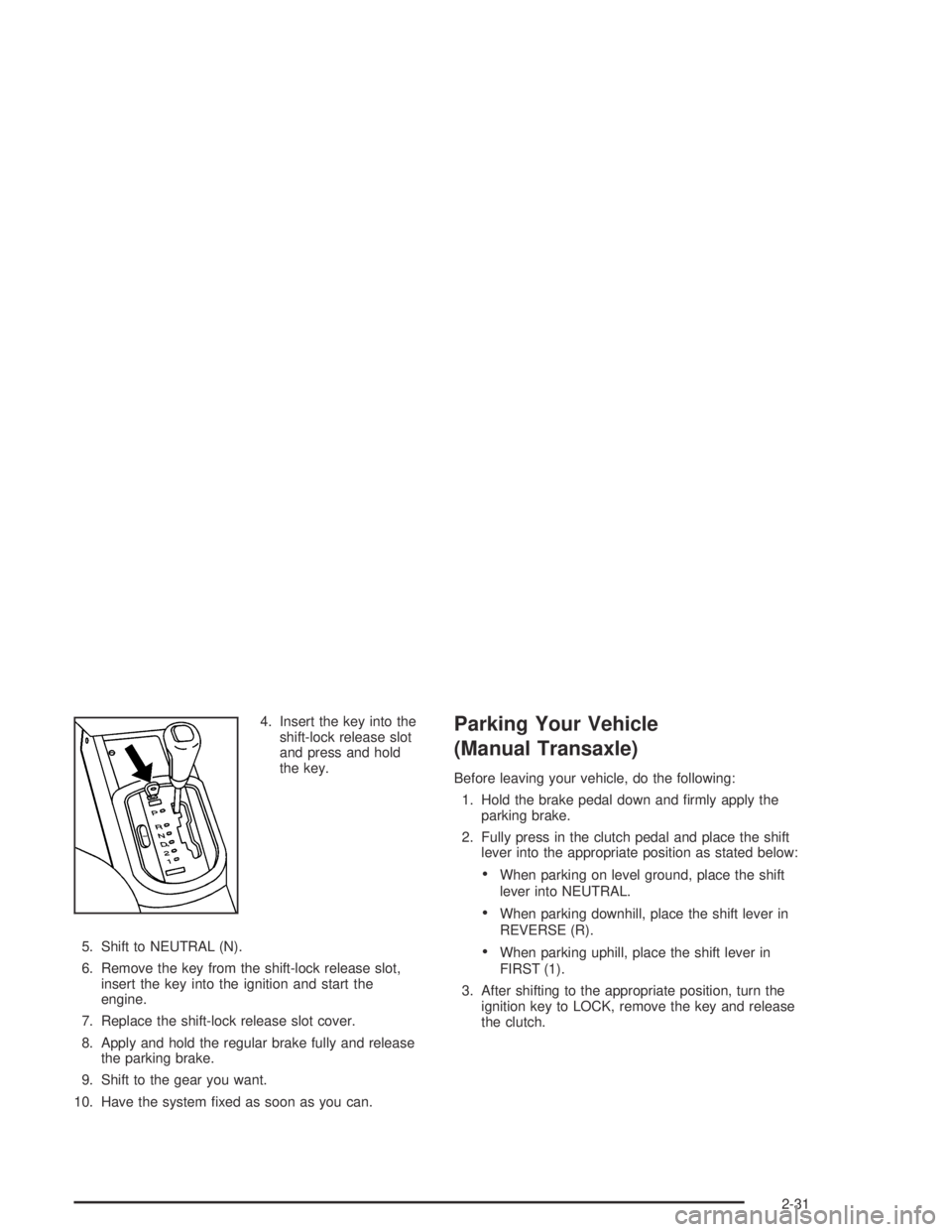
4. Insert the key into the
shift-lock release slot
and press and hold
the key.
5. Shift to NEUTRAL (N).
6. Remove the key from the shift-lock release slot,
insert the key into the ignition and start the
engine.
7. Replace the shift-lock release slot cover.
8. Apply and hold the regular brake fully and release
the parking brake.
9. Shift to the gear you want.
10. Have the system fixed as soon as you can.Parking Your Vehicle
(Manual Transaxle)
Before leaving your vehicle, do the following:
1. Hold the brake pedal down and firmly apply the
parking brake.
2. Fully press in the clutch pedal and place the shift
lever into the appropriate position as stated below:
•When parking on level ground, place the shift
lever into NEUTRAL.
•When parking downhill, place the shift lever in
REVERSE (R).
•When parking uphill, place the shift lever in
FIRST (1).
3. After shifting to the appropriate position, turn the
ignition key to LOCK, remove the key and release
the clutch.
2-31
Page 1548 of 5127
Instrument Panel Overview...............................3-2
Hazard Warning Flashers................................3-3
Other Warning Devices...................................3-4
Horn.............................................................3-4
Tilt Wheel.....................................................3-4
Turn Signal/Multifunction Lever.........................3-5
Windshield Wiper Lever...................................3-6
Exterior Lamps...............................................3-8
Interior Lamps..............................................3-10
Accessory Power Outlets...............................3-11
Ashtrays and Cigarette Lighter........................3-12
Climate Controls............................................3-12
Climate Control System.................................3-12
Outlet Adjustment.........................................3-15
Passenger Compartment Air Filter...................3-16
Warning Lights, Gages, and Indicators............3-17
Instrument Panel Cluster................................3-18
Speedometer and Odometer...........................3-19
Tachometer.................................................3-19
Safety Belt Reminder Tone............................3-20
Brake System Warning Light..........................3-20
Engine Coolant Temperature Gage..................3-21Highbeam On Light.......................................3-22
Fuel Gage...................................................3-22
Low Fuel Warning Light.................................3-23
Secondary Information Center (SIC).................3-24
Clock..........................................................3-25
Safety Belt Reminder Light.............................3-25
Air Bag Readiness Light................................3-26
Charging System Light..................................3-27
Anti-Lock Brake System Warning Light.............3-27
Hold Mode Light...........................................3-28
Malfunction Indicator Lamp.............................3-28
Oil Pressure Light.........................................3-32
Fog Lamp Light............................................3-32
Daytime Running Lamps Indicator Light...........3-33
Door Ajar Light.............................................3-33
Audio System(s).............................................3-34
AM-FM Radio...............................................3-34
Radio with CD..............................................3-36
Theft-Deterrent Feature..................................3-43
Radio Reception...........................................3-43
Care of Your CDs.........................................3-44
Care of Your CD Player................................3-44
Backglass Antenna.......................................3-44
Section 3 Instrument Panel
3-1
Page 1550 of 5127
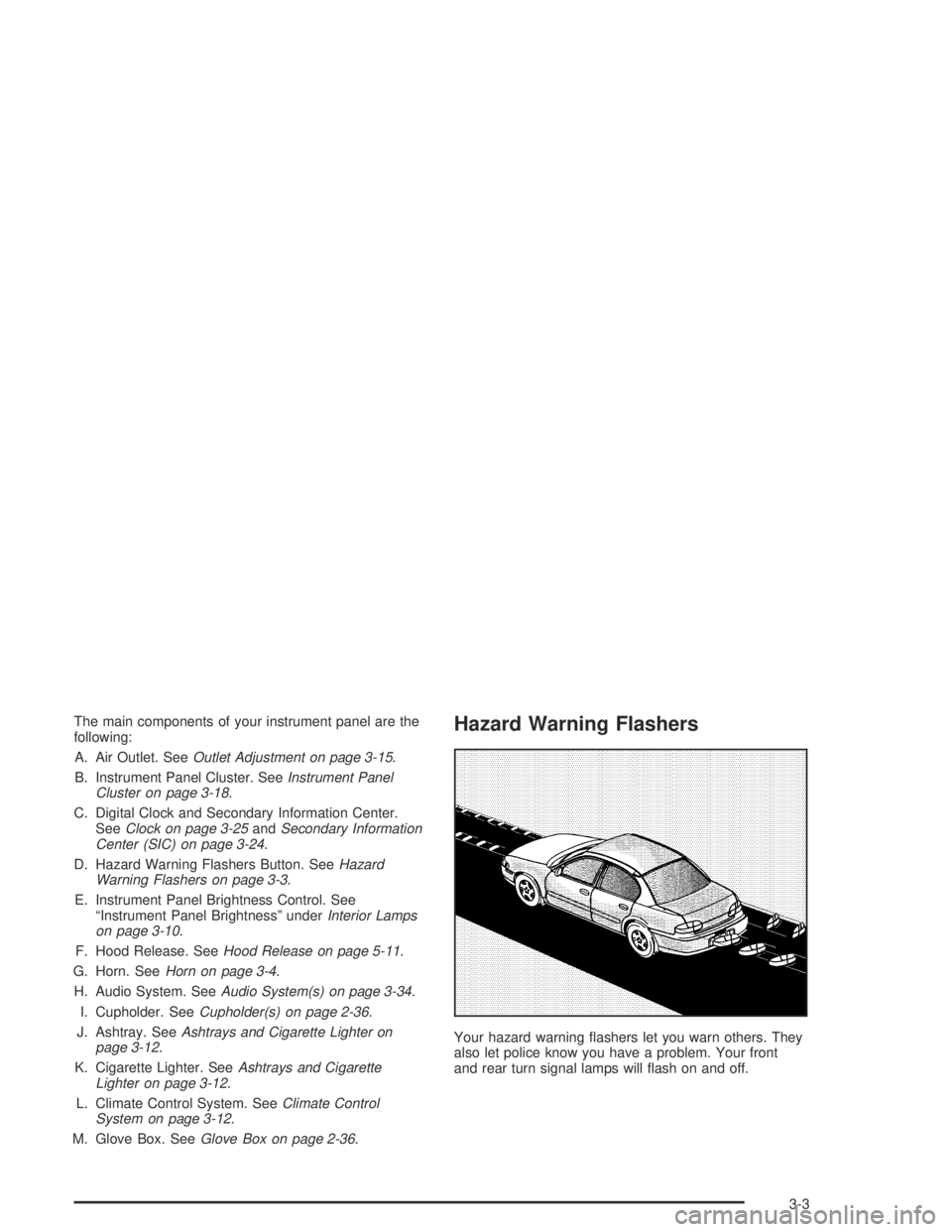
The main components of your instrument panel are the
following:
A. Air Outlet. SeeOutlet Adjustment on page 3-15.
B. Instrument Panel Cluster. SeeInstrument Panel
Cluster on page 3-18.
C. Digital Clock and Secondary Information Center.
SeeClock on page 3-25andSecondary Information
Center (SIC) on page 3-24.
D. Hazard Warning Flashers Button. SeeHazard
Warning Flashers on page 3-3.
E. Instrument Panel Brightness Control. See
“Instrument Panel Brightness” underInterior Lamps
on page 3-10.
F. Hood Release. SeeHood Release on page 5-11.
G. Horn. SeeHorn on page 3-4.
H. Audio System. SeeAudio System(s) on page 3-34.
I. Cupholder. SeeCupholder(s) on page 2-36.
J. Ashtray. SeeAshtrays and Cigarette Lighter on
page 3-12.
K. Cigarette Lighter. SeeAshtrays and Cigarette
Lighter on page 3-12.
L. Climate Control System. SeeClimate Control
System on page 3-12.
M. Glove Box. SeeGlove Box on page 2-36.Hazard Warning Flashers
Your hazard warning flashers let you warn others. They
also let police know you have a problem. Your front
and rear turn signal lamps will flash on and off.
3-3
Page 1551 of 5127
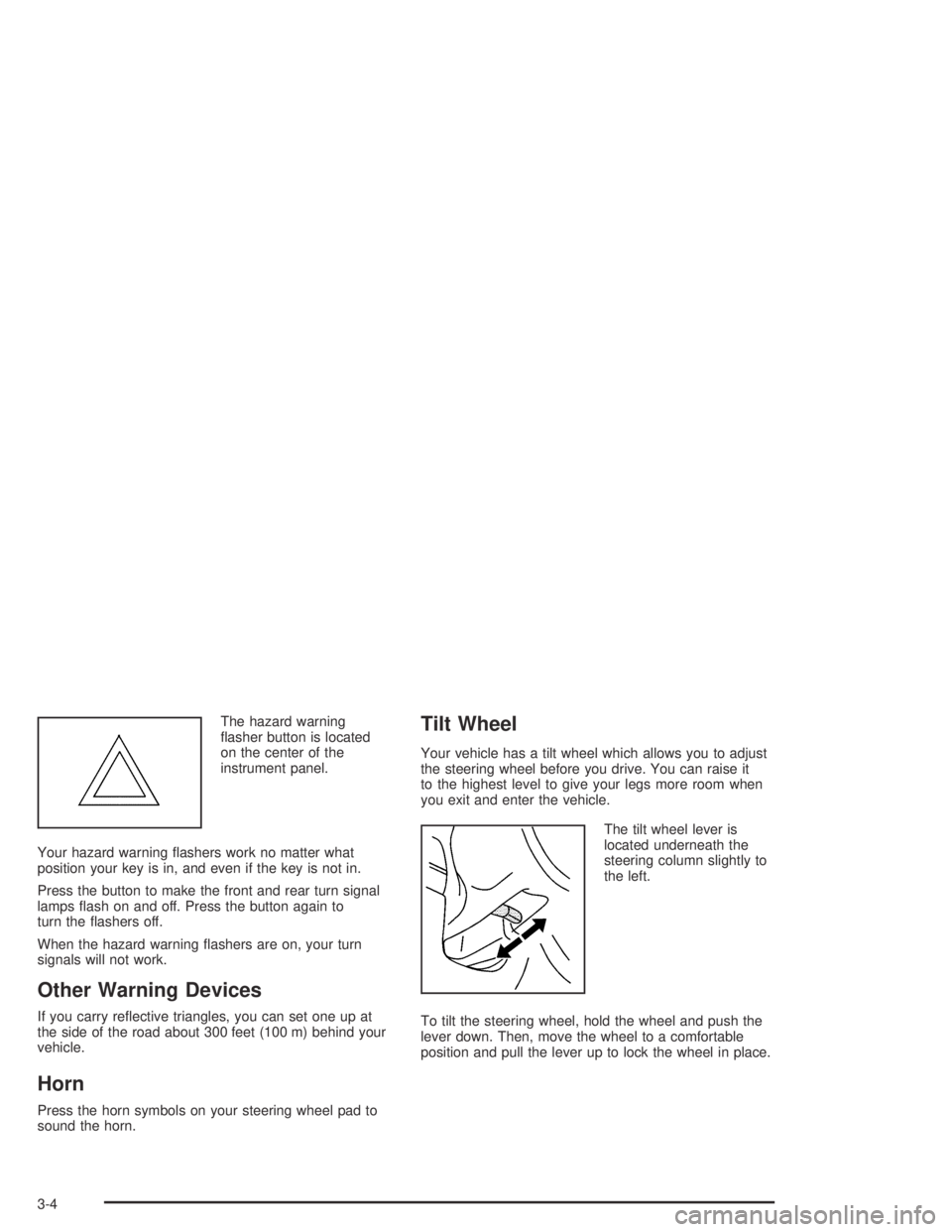
The hazard warning
flasher button is located
on the center of the
instrument panel.
Your hazard warning flashers work no matter what
position your key is in, and even if the key is not in.
Press the button to make the front and rear turn signal
lamps flash on and off. Press the button again to
turn the flashers off.
When the hazard warning flashers are on, your turn
signals will not work.
Other Warning Devices
If you carry reflective triangles, you can set one up at
the side of the road about 300 feet (100 m) behind your
vehicle.
Horn
Press the horn symbols on your steering wheel pad to
sound the horn.
Tilt Wheel
Your vehicle has a tilt wheel which allows you to adjust
the steering wheel before you drive. You can raise it
to the highest level to give your legs more room when
you exit and enter the vehicle.
The tilt wheel lever is
located underneath the
steering column slightly to
the left.
To tilt the steering wheel, hold the wheel and push the
lever down. Then, move the wheel to a comfortable
position and pull the lever up to lock the wheel in place.
3-4
Page 1554 of 5127
INT (Intermittent):Move the lever to this position to
choose a delayed wiping cycle.
OFF:Move the lever to this position to turn off the
windshield wipers.
Misting Function
Move the lever toward the INT position for a single
wiping cycle. Hold it there until the windshield wipers
start; then let go. The windshield wipers will stop
after one wipe. If you want more wipes, hold the band
toward INT longer.
Remember that damaged wiper blades may prevent you
from seeing well enough to drive safely. To avoid
damage, be sure to clear ice and snow from the wiper
blades before using them.
If they are frozen to the windshield, carefully loosen or
thaw them. If your blades do become damaged, get
new blades or blade inserts.
Heavy snow or ice can overload your wiper motor.
A circuit breaker will stop the motor until it cools.
Clear away snow or ice to prevent an overload.
Windshield Washer
To wash your windshield, pull the windshield wiper/
washer lever toward you with the ignition turned to ON.
{CAUTION:
In freezing weather, do not use your washer
until the windshield is warmed. Otherwise the
washer uid can form ice on the windshield,
blocking your vision.
When you release the lever, the washers will stop, but
the wipers will continue to wipe for several cycles and
will either stop or will resume at the speed you were
using before.
Rear Window Washer/Wiper
Your vehicle may have a rear window washer/wiper.
Operate the rear window washer/wiper system by
pushing the windshield wiper/washer lever away from
you. The wiper operates continuously when the lever is
in the first position. Washer fluid sprays onto the rear
window and the wiper operates continuously when
the lever is pushed to the second position.
3-7
Page 1555 of 5127
Exterior Lamps
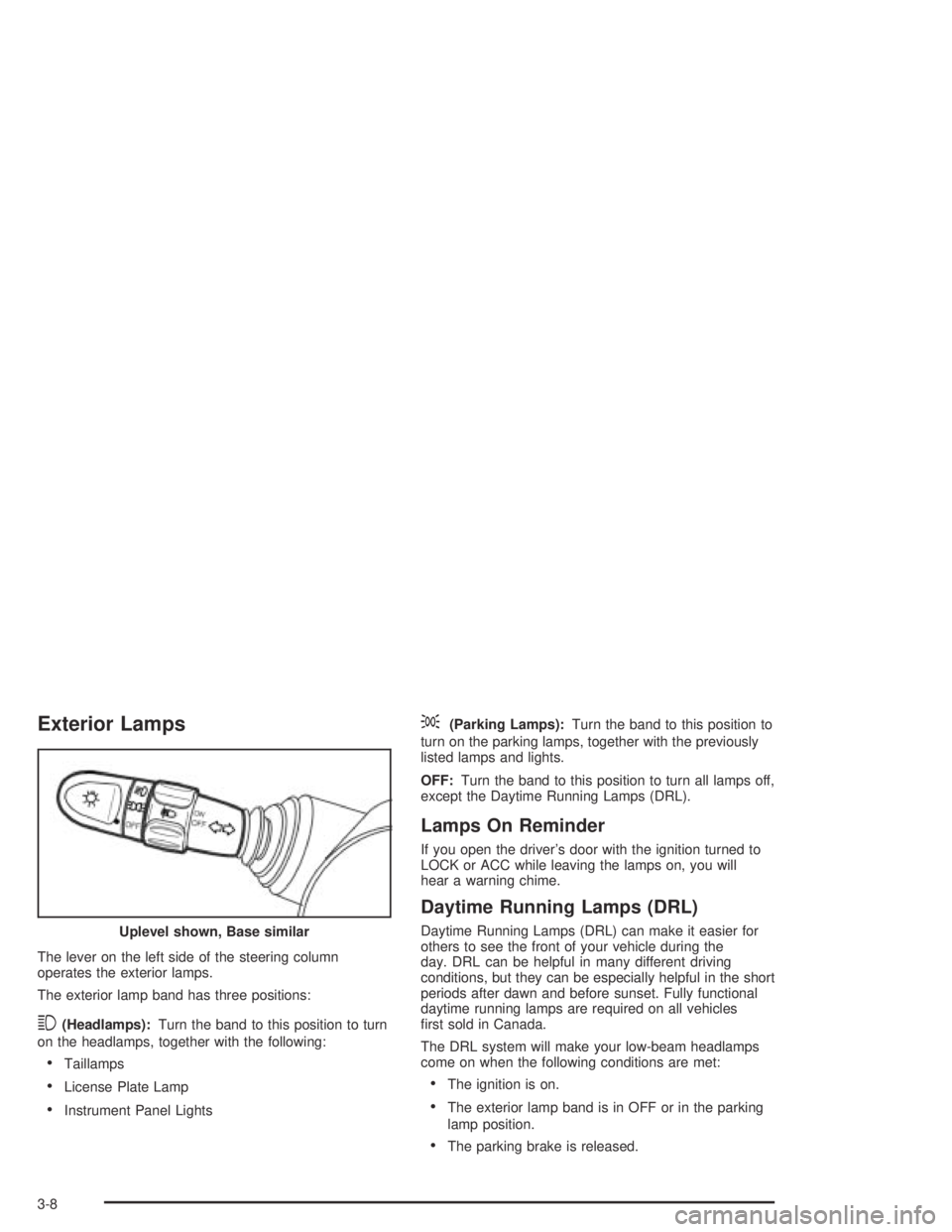
The lever on the left side of the steering column
operates the exterior lamps.
The exterior lamp band has three positions:
3(Headlamps):Turn the band to this position to turn
on the headlamps, together with the following:
•Taillamps
•License Plate Lamp
•Instrument Panel Lights
;(Parking Lamps):Turn the band to this position to
turn on the parking lamps, together with the previously
listed lamps and lights.
OFF:Turn the band to this position to turn all lamps off,
except the Daytime Running Lamps (DRL).
Lamps On Reminder
If you open the driver’s door with the ignition turned to
LOCK or ACC while leaving the lamps on, you will
hear a warning chime.
Daytime Running Lamps (DRL)
Daytime Running Lamps (DRL) can make it easier for
others to see the front of your vehicle during the
day. DRL can be helpful in many different driving
conditions, but they can be especially helpful in the short
periods after dawn and before sunset. Fully functional
daytime running lamps are required on all vehicles
first sold in Canada.
The DRL system will make your low-beam headlamps
come on when the following conditions are met:
•The ignition is on.
•The exterior lamp band is in OFF or in the parking
lamp position.
•The parking brake is released. Uplevel shown, Base similar
3-8
Page 1559 of 5127
Ashtrays and Cigarette Lighter
The ashtray is located at the lower part of the center
instrument panel. To remove the front ashtray for
cleaning, open the ashtray fully, press in the retaining
tab and pull the bin out.
Notice:If you put papers or other ammable items
in the ashtray, hot cigarettes or other smoking
materials could ignite them and possibly damage
your vehicle. Never put ammable items in the
ashtray.
The cigarette lighter is located to the right of the front
ashtray. To use it, turn the ignition to ACC or ON, push
the cigarette lighter in all the way and let go. When it
is ready, it will pop back out by itself.
Notice:Holding a cigarette lighter in while it is
heating will not allow the lighter to back away from
the heating element when it is hot. Damage from
overheating may occur to the lighter or heating
element. Do not hold a cigarette lighter in while it
is heating.
Climate Controls
Climate Control System
With this system you can control the heating, cooling
and ventilation for your vehicle.
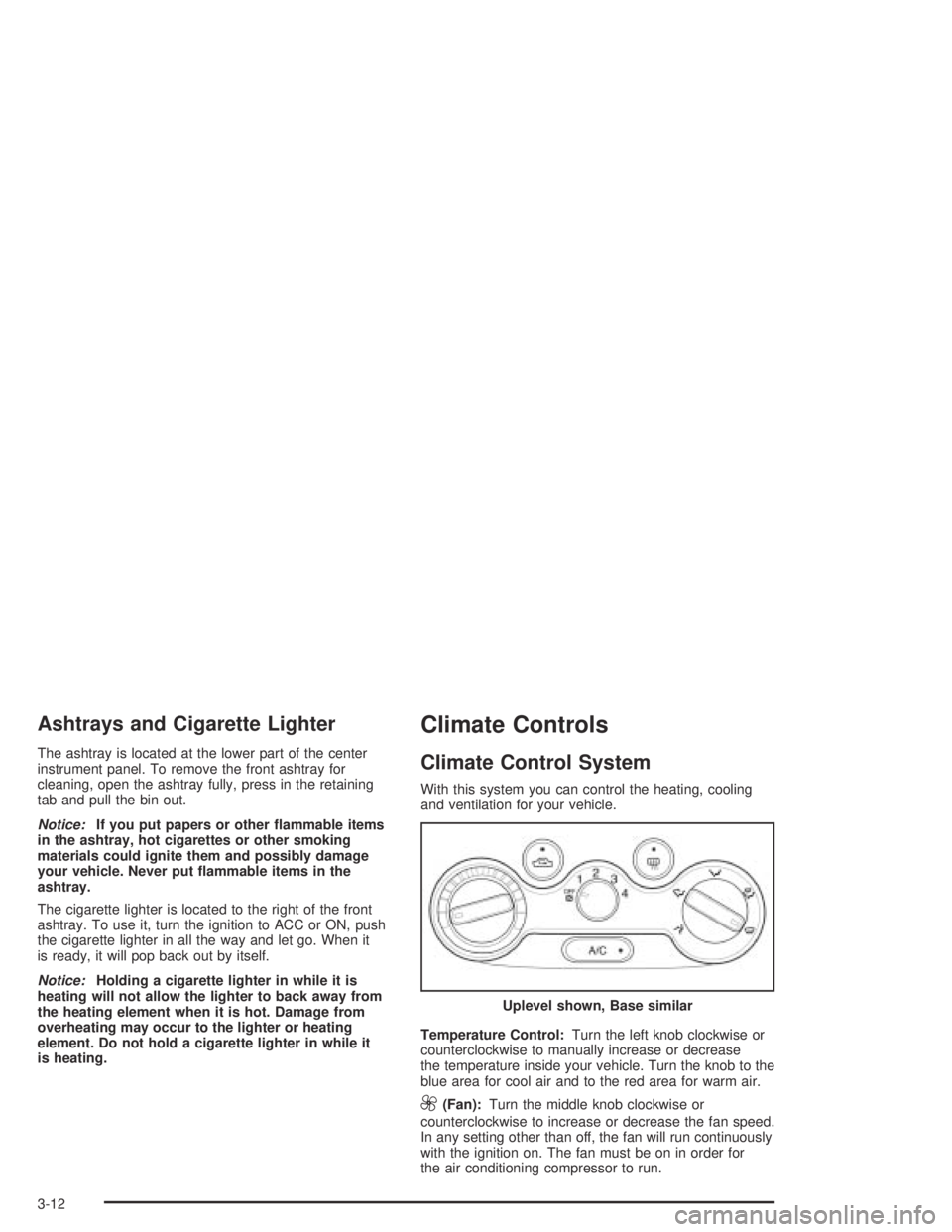
Temperature Control:Turn the left knob clockwise or
counterclockwise to manually increase or decrease
the temperature inside your vehicle. Turn the knob to the
blue area for cool air and to the red area for warm air.
9(Fan):Turn the middle knob clockwise or
counterclockwise to increase or decrease the fan speed.
In any setting other than off, the fan will run continuously
with the ignition on. The fan must be on in order for
the air conditioning compressor to run.Uplevel shown, Base similar
3-12