2002 CHEVROLET AVEO flat tire
[x] Cancel search: flat tirePage 2056 of 5127
Each new wheel should have the same load-carrying
capacity, diameter, width, offset and be mounted
the same way as the one it replaces.
If you need to replace any of your wheels, wheel bolts, or
wheel nuts, replace them only with new GM original
equipment parts. This way, you will be sure to have the
right wheel, wheel bolts, and wheel nuts for your vehicle.
{CAUTION:
Using the wrong replacement wheels, wheel
bolts, or wheel nuts on your vehicle can be
dangerous. It could affect the braking and
handling of your vehicle, make your tires lose
air and make you lose control. You could have
a collision in which you or others could be
injured. Always use the correct wheel, wheel
bolts, and wheel nuts for replacement.
Notice:The wrong wheel can also cause problems
with bearing life, brake cooling, speedometer or
odometer calibration, headlamp aim, bumper height,
vehicle ground clearance, and tire or tire chain
clearance to the body and chassis.
SeeChanging a Flat Tire on page 5-58for more
information.
Used Replacement Wheels
{CAUTION:
Putting a used wheel on your vehicle is
dangerous. You cannot know how it has been
used or how far it has been driven. It could fail
suddenly and cause a crash. If you have to
replace a wheel, use a new GM original
equipment wheel.
Tire Chains
Notice:Use tire chains only where legal and only
when you must. Use only SAE Class “S” type chains
that are the proper size for your tires. Install them
on the front tires and tighten them as tightly as
possible with the ends securely fastened. Drive
slowly and follow the chain manufacturer’s
instructions. If you can hear the chains contacting
your vehicle, stop and retighten them. If the contact
continues, slow down until it stops. Driving too
fast or spinning the wheels with chains on will
damage your vehicle.
5-57
Page 2057 of 5127
If a Tire Goes Flat
It is unusual for a tire to blowout while you are driving,
especially if you maintain your vehicle’s tires properly.
If air goes out of a tire, it is much more likely to leak out
slowly. But if you should ever have a blowout, here
are a few tips about what to expect and what to do:
If a front tire fails, the flat tire will create a drag that pulls
the vehicle toward that side. Take your foot off the
accelerator pedal and grip the steering wheel firmly.
Steer to maintain lane position, and then gently brake to
a stop well out of the traffic lane.
A rear blowout, particularly on a curve, acts much like a
skid and may require the same correction you would
use in a skid. In any rear blowout remove your foot from
the accelerator pedal. Get the vehicle under control
by steering the way you want the vehicle to go. It may
be very bumpy and noisy, but you can still steer. Gently
brake to a stop, well off the road if possible.{CAUTION:
Lifting a vehicle and getting under it to do
maintenance or repairs is dangerous without
the appropriate safety equipment and training.
The jack provided with your vehicle is
designed only for changing a at tire. If it is
used for anything else, you or others could be
badly injured or killed if the vehicle slips off
the jack. Use the jack provided with your
vehicle only for changing a at tire.
If a tire goes flat, the next part shows how to use the
jacking equipment to change a flat tire safely.
Changing a Flat Tire
If a tire goes flat, avoid further tire and wheel damage
by driving slowly to a level place. Turn on your
hazard warning flashers.
5-58
Page 2060 of 5127
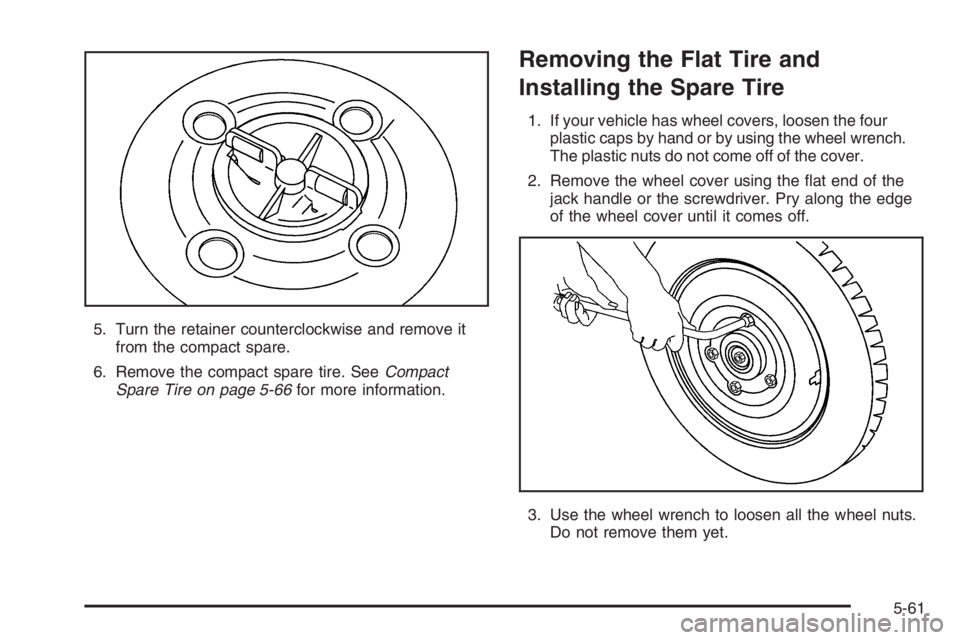
5. Turn the retainer counterclockwise and remove it
from the compact spare.
6. Remove the compact spare tire. SeeCompact
Spare Tire on page 5-66for more information.
Removing the Flat Tire and
Installing the Spare Tire
1. If your vehicle has wheel covers, loosen the four
plastic caps by hand or by using the wheel wrench.
The plastic nuts do not come off of the cover.
2. Remove the wheel cover using the flat end of the
jack handle or the screwdriver. Pry along the edge
of the wheel cover until it comes off.
3. Use the wheel wrench to loosen all the wheel nuts.
Do not remove them yet.
5-61
Page 2064 of 5127
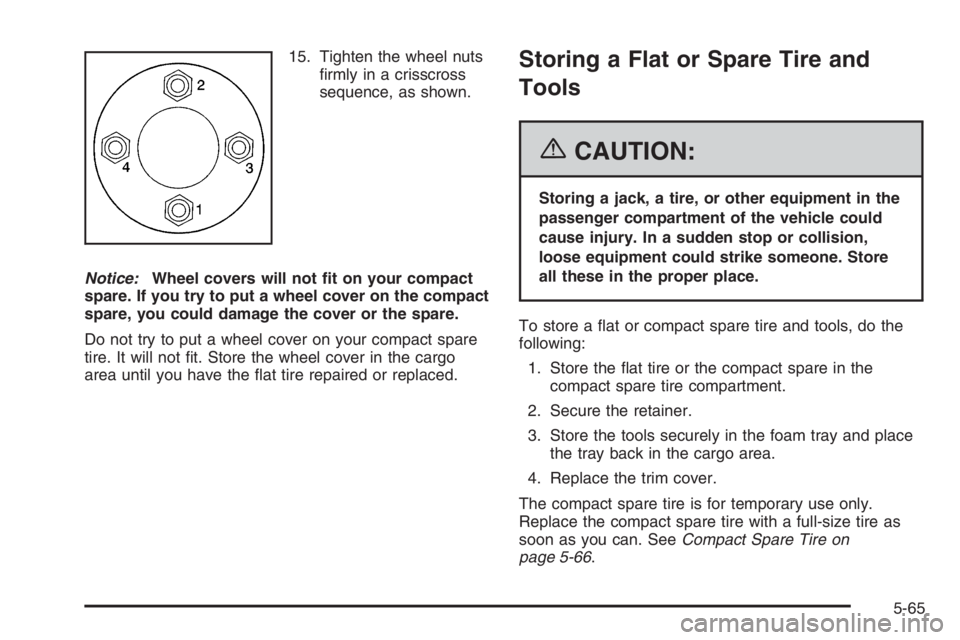
15. Tighten the wheel nuts
firmly in a crisscross
sequence, as shown.
Notice:Wheel covers will not t on your compact
spare. If you try to put a wheel cover on the compact
spare, you could damage the cover or the spare.
Do not try to put a wheel cover on your compact spare
tire. It will not fit. Store the wheel cover in the cargo
area until you have the flat tire repaired or replaced.Storing a Flat or Spare Tire and
Tools
{CAUTION:
Storing a jack, a tire, or other equipment in the
passenger compartment of the vehicle could
cause injury. In a sudden stop or collision,
loose equipment could strike someone. Store
all these in the proper place.
To store a flat or compact spare tire and tools, do the
following:
1. Store the flat tire or the compact spare in the
compact spare tire compartment.
2. Secure the retainer.
3. Store the tools securely in the foam tray and place
the tray back in the cargo area.
4. Replace the trim cover.
The compact spare tire is for temporary use only.
Replace the compact spare tire with a full-size tire as
soon as you can. SeeCompact Spare Tire on
page 5-66.
5-65
Page 2118 of 5127
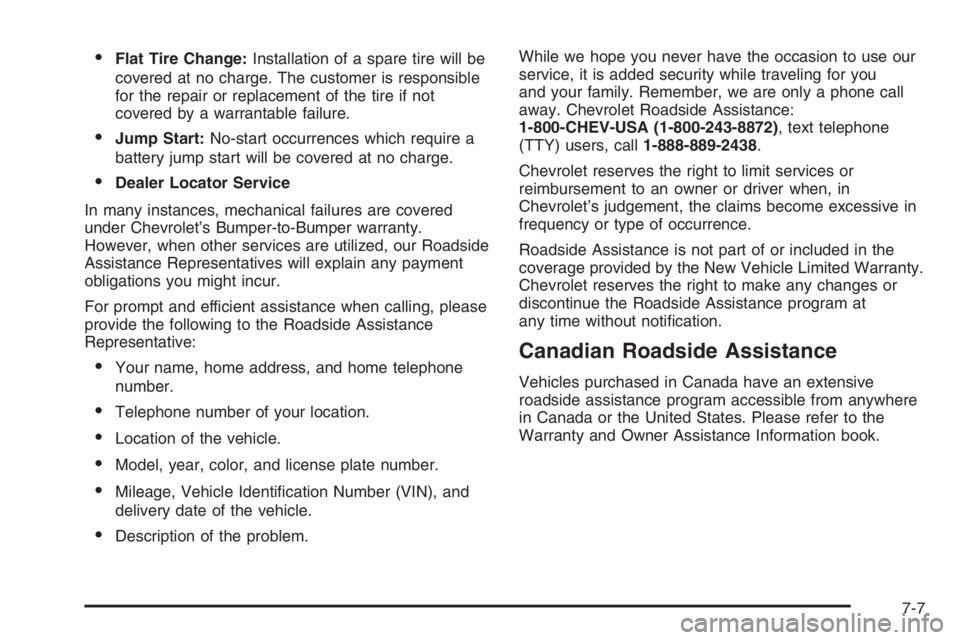
•Flat Tire Change:Installation of a spare tire will be
covered at no charge. The customer is responsible
for the repair or replacement of the tire if not
covered by a warrantable failure.
•Jump Start:No-start occurrences which require a
battery jump start will be covered at no charge.
•Dealer Locator Service
In many instances, mechanical failures are covered
under Chevrolet’s Bumper-to-Bumper warranty.
However, when other services are utilized, our Roadside
Assistance Representatives will explain any payment
obligations you might incur.
For prompt and efficient assistance when calling, please
provide the following to the Roadside Assistance
Representative:
•Your name, home address, and home telephone
number.
•Telephone number of your location.
•Location of the vehicle.
•Model, year, color, and license plate number.
•Mileage, Vehicle Identification Number (VIN), and
delivery date of the vehicle.
•Description of the problem.While we hope you never have the occasion to use our
service, it is added security while traveling for you
and your family. Remember, we are only a phone call
away. Chevrolet Roadside Assistance:
1-800-CHEV-USA (1-800-243-8872), text telephone
(TTY) users, call1-888-889-2438.
Chevrolet reserves the right to limit services or
reimbursement to an owner or driver when, in
Chevrolet’s judgement, the claims become excessive in
frequency or type of occurrence.
Roadside Assistance is not part of or included in the
coverage provided by the New Vehicle Limited Warranty.
Chevrolet reserves the right to make any changes or
discontinue the Roadside Assistance program at
any time without notification.
Canadian Roadside Assistance
Vehicles purchased in Canada have an extensive
roadside assistance program accessible from anywhere
in Canada or the United States. Please refer to the
Warranty and Owner Assistance Information book.
7-7
Page 2131 of 5127
Driver
Position, Safety Belt.....................................1-18
Seat Height Adjuster...................................... 1-3
Driving
At Night.....................................................4-14
City ...........................................................4-17
Defensive..................................................... 4-2
Drunken....................................................... 4-3
Freeway.....................................................4-18
Hill and Mountain Roads..............................4-20
In Rain and on Wet Roads...........................4-15
Rocking Your Vehicle to Get it Out.................4-26
Winter........................................................4-22
E
Electrical System
Add-On Equipment......................................5-74
Engine Compartment Fuse Block...................5-77
Fuses and Circuit Breakers...........................5-75
Headlamp Wiring.........................................5-75
Instrument Panel Fuse Block.........................5-76
Power Windows and Other Power Options......5-75
Windshield Wiper Fuses...............................5-75
Engine
Air Cleaner/Filter.........................................5-17
Battery.......................................................5-35
Check and Service Engine Soon Light............3-34
Coolant......................................................5-22
Coolant Heater............................................2-20Engine (cont.)
Coolant Temperature Gage...........................3-28
Cooling System Inspection............................6-24
Engine Compartment Overview......................5-12
Exhaust.....................................................2-30
Oil .............................................................5-13
Overheating................................................5-24
Starting......................................................2-19
Event Data Recorders (EDR)............................7-10
Extender, Safety Belt.......................................1-29
Exterior Lamps...............................................3-13
F
Filter
Engine Air Cleaner......................................5-17
Finish Damage...............................................5-72
Fixed Mast Antenna........................................3-71
Flashers, Hazard Warning.................................. 3-6
Flash-to-Pass................................................... 3-8
Flat Tire........................................................5-58
Flat Tire, Changing.........................................5-58
Flat Tire, Storing.............................................5-65
Fluid
Automatic Transaxle.....................................5-19
Manual Transaxle........................................5-21
Power Steering...........................................5-30
Windshield Washer......................................5-31
Fog Lamp Light..............................................3-38
Fog Lamps ....................................................3-15
4
Page 2136 of 5127
Q
Questions and Answers About Safety Belts.........1-17
R
Radios..........................................................3-38
AM-FM Radio.............................................3-39
Care of Your CD Player...............................3-71
Care of Your CDs ........................................3-71
Radio with CD............................3-41, 3-45, 3-52
Radio with Six-Disc CD................................3-61
Understanding Reception..............................3-70
Rear Door Security Locks.................................. 2-8
Rear Seat Operation...................................1-6, 1-9
Rear Seat Passengers, Safety Belts..................1-25
Rear Windshield Washer/Wiper.........................3-10
Rearview Mirrors.............................................2-32
Reclining Seatbacks.......................................... 1-3
Recreational Vehicle Towing.............................4-34
Remote Keyless Entry System............................ 2-4
Remote Keyless Entry System, Operation............ 2-5
Removing the Flat Tire and Installing the
Spare Tire..................................................5-61
Removing the Spare Tire and Tools...................5-60
Replacement Bulbs.........................................5-44Reporting Safety Defects
Canadian Government..................................7-14
General Motors...........................................7-15
United States Government............................7-14
Restraint System Check
Checking the Restraint Systems....................1-71
Replacing Restraint System Parts
After a Crash..........................................1-72
Right Front Passenger Position, Safety Belts......1-25
Roadside
Assistance Program....................................... 7-6
Rocking Your Vehicle to Get it Out....................4-26
Running the Engine While Parked.....................2-31
S
Safety Belt
Pretensioners..............................................1-29
Reminder Light............................................3-32
Reminder Tone............................................3-25
Safety Belts
Care of ......................................................5-69
Center Rear Passenger Position....................1-28
Driver Position............................................1-18
How to Wear Safety Belts Properly................1-17
9
Page 2138 of 5127
T
Tachometer....................................................3-25
Taillamps
Turn Signal, Stoplamps and Back-up Lamps....5-43
Theft-Deterrent System....................................2-14
Theft-Deterrent Systems...................................2-14
Immobilizer.................................................2-16
Immobilizer Operation...................................2-16
Tilt Wheel........................................................ 3-6
Tires.............................................................5-45
Aluminum Wheels, Cleaning..........................5-71
Buying New Tires........................................5-54
Chains.......................................................5-57
Changing a Flat Tire....................................5-58
Cleaning....................................................5-71
Compact Spare Tire.....................................5-66
Different Size..............................................5-54
If a Tire Goes Flat.......................................5-58
Inflation - Tire Pressure................................5-51
Inspection and Rotation................................5-52
Installing the Spare Tire................................5-61
Removing the Flat Tire.................................5-61
Removing the Spare Tire and Tools...............5-60
Storing a Flat or Spare Tire and Tools............5-65Tires (cont.)
Tire Sidewall Labeling..................................5-46
Tire Terminology and Definitions....................5-48
Uniform Tire Quality Grading.........................5-55
Wheel Alignment and Tire Balance.................5-56
Wheel Replacement.....................................5-56
When It Is Time for New Tires......................5-53
Towing
Recreational Vehicle.....................................4-34
Towing a Trailer..........................................4-35
Your Vehicle...............................................4-34
Transaxle
Fluid, Automatic...........................................5-19
Fluid, Manual..............................................5-21
Transaxle Operation, Automatic.........................2-21
Transaxle Operation, Manual............................2-25
Trip Odometer................................................3-25
Trunk.............................................................. 2-9
Turn and Lane-Change Signals.......................... 3-7
Turn Signal/Multifunction Lever........................... 3-7
U
Understanding Radio Reception........................3-70
Uniform Tire Quality Grading............................5-55
11