Page 276 of 400
6-16 What to Do with Used Oil
Used engine oil contains certain elements that may be
unhealthy for your skin and could even cause cancer.
Don't let used oil stay on your skin for very long.
Clean your skin and nails with soap and water,
or a good hand cleaner. Wash or properly throw away
clothing or rags containing used engine oil. See the
manufacturer's warnings about the use and disposal
of oil products.
Used oil can be a threat to the environment. If you
change your own oil, be sure to drain all the oil from
the filter before disposal. Never dispose of oil by putting
it in the trash, pouring it on the ground, into sewers,
or into streams or bodies of water. Instead, recycle it
by taking it to a place that collects used oil. If you
have a problem properly disposing of your used oil,
ask your dealer, a service station or a local recycling
center for help.
Engine Cover
Removing the Engine Cover
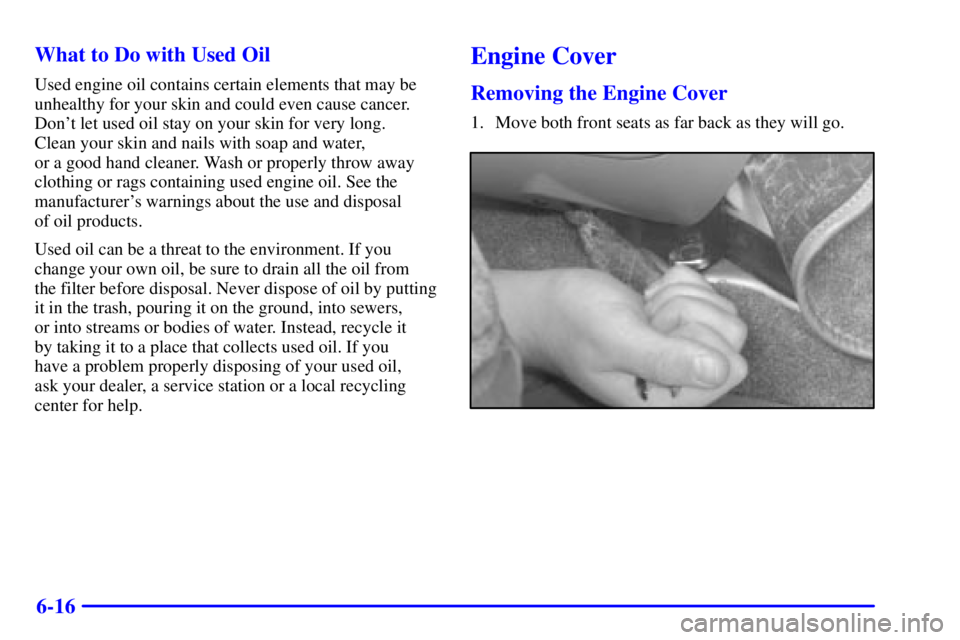
1. Move both front seats as far back as they will go.
Page 282 of 400

6-22
Automatic Transmission Fluid
When to Check and Change
A good time to check your automatic transmission fluid
level is when the engine oil is changed.
Change both the fluid and filter every 15,000 miles
(25 000 km) if the vehicle is mainly driven under one
or more of these conditions:
�In heavy city traffic where the outside temperature
regularly reaches 90�F (32�C) or higher.
�In hilly or mountainous terrain.
�When doing frequent trailer towing.
�Uses such as found in taxi, police or
delivery service.
If you do not use your vehicle under any of
these conditions, change the fluid and filter every
50,000 miles (83 000 km).
See ªScheduled Maintenance Servicesº in the Index.
How to Check
Because this operation can be a little difficult,
you may choose to have this done at the dealership
service department.
If you do it yourself, be sure to follow all the
instructions here, or you could get a false reading
on the dipstick.
NOTICE:
Too much or too little fluid can damage your
transmission. Too much can mean that some of
the fluid could come out and fall on hot engine
parts or exhaust system parts, starting a fire.
Too little fluid could cause the transmission to
overheat. Be sure to get an accurate reading
if you check your transmission fluid.
Page 289 of 400
6-29
Engine Coolant
The cooling system in your vehicle is filled with
DEX
-COOL� engine coolant. This coolant is designed
to remain in your vehicle for 5 years or 150,000 miles
(240 000 km), whichever occurs first, if you add only
DEX
-COOL� extended life coolant.
The following explains your cooling system and how
to add coolant when it is low. If you have a problem
with engine overheating, see ªEngine Overheatingº
in the Index.
A 50/50 mixture of clean, drinkable water and
DEX
-COOL� coolant will:
�Give freezing protection down to
-34�F (-37�C).
�Give boiling protection up to 265�F (129�C).
�Protect against rust and corrosion.
�Help keep the proper engine temperature.
�Let the warning lights and gages work as
they should.
NOTICE:
When adding coolant, it is important that you
use only DEX
-COOL� (silicate-free) coolant.
If coolant other than DEX-COOL is added to
the system, premature engine, heater core or
radiator corrosion may result. In addition, the
engine coolant will require change sooner
-- at
30,000 miles (50 000 km) or 24 months,
whichever occurs first. Damage caused by the
use of coolant other than DEX
-COOL� is not
covered by your new vehicle warranty.
Page 290 of 400

6-30 What to Use
Use a mixture of one-half clean, drinkable water and
one
-half DEX-COOL� coolant which won't damage
aluminum parts. If you use this coolant mixture,
you don't need to add anything else.
CAUTION:
Adding only plain water to your cooling system
can be dangerous. Plain water, or some other
liquid such as alcohol, can boil before the proper
coolant mixture will. Your vehicle's coolant
warning system is set for the proper coolant
mixture. With plain water or the wrong mixture,
your engine could get too hot but you wouldn't
get the overheat warning. Your engine could
catch fire and you or others could be burned.
Use a 50/50 mixture of clean, drinkable water
and DEX
-COOL� coolant.
NOTICE:
If you use an improper coolant mixture, your
engine could overheat and be badly damaged.
The repair cost wouldn't be covered by your
warranty. Too much water in the mixture can
freeze and crack the engine, radiator, heater core
and other parts.
If you have to add coolant more than four times a year,
have your dealer check your cooling system.
NOTICE:
If you use the proper coolant, you don't have to
add extra inhibitors or additives which claim to
improve the system. These can be harmful.
Page 297 of 400
6-37
NOTICE:
�Using the wrong fluid can badly damage
brake system parts. For example, just a few
drops of mineral
-based oil, such as engine
oil, in your brake system can damage brake
system parts so badly that they'll have to
be replaced. Don't let someone put in the
wrong kind of fluid.
�If you spill brake fluid on your vehicle's
painted surfaces, the paint finish can be
damaged. Be careful not to spill brake
fluid on your vehicle. If you do, wash it
off immediately. See ªAppearance Careº
in the Index.
Brake Wear
Your vehicle has front disc brakes and rear drum brakes.
Disc brake pads have built
-in wear indicators that make
a high
-pitched warning sound when the brake pads are
worn and new pads are needed. The sound may come
and go or be heard all the time your vehicle is moving
(except when you are pushing on the brake pedal firmly).
CAUTION:
The brake wear warning sound means that soon
your brakes won't work well. That could lead to
an accident. When you hear the brake wear
warning sound, have your vehicle serviced.
NOTICE:
Continuing to drive with worn-out brake pads
could result in costly brake repair.
Page 333 of 400

6-73
Capacities and Specifications
All capacities are approximate. When adding, be sure
to fill to the appropriate level or as recommended in
this manual. English and metric conversions are given.
See refrigerant charge label under the hood for charge
capacity information and requirements. Please refer to
ªRecommended Fluids and Lubricantsº in the Index
for more information.
Engine Specifications
Engine ªVORTECº 4300 V6 MFI*. . . . . . . . . . . . . .
RPO LU3. . . . . . . . . . . . . . . . . . . . . . . . . . . . . . . . . . .
Firing Order 1
-6-5-4-3-2 . . . . . . . . . . . . . . . . . . . . . .
Horsepower 190 at 4,400 rpm. . . . . . . . . . . . . . . . . . .
*Micro Fuel Injection
Wheel Nut Torque
Base or Optional Wheel 100 lb-ft (140 N´m) . . . . . . .
Tire Pressures See ªLoading Your. . . . . . . . . . . . . . . .
Vehicleº in the Index.
Cooling System Capacities
Quantity
without Rear Heater 13.5 quarts (12.8 L). . . . . . . . . .
Quantity
with Rear Heater 16.5 quarts (15.6 L). . . . . . . . . . . .
Engine Oil with Filter 4.5 quarts (4.3 L). . . . . . . . . .
Fuel Tank 27.0 U.S. gallons (101.8 L). . . . . . . . . . . .
Transmission Fluid
(Drain and Refill) 5.0 quarts (4.7 L). . . . . . . . . . . .
Differential Fluid
Front Axle 2.6 pints (1.2 L). . . . . . . . . . . . . . . . . . .
Rear Axle 3.5 pints (1.7 L). . . . . . . . . . . . . . . . . . .
All capacities are approximate. When adding, be sure
to fill to the appropriate level, as recommended in
this manual. Recheck the fluid level after filling.
See ªRecommended Fluids and Lubricantsº in the
Index for more information.
Page 334 of 400

6-74
Air Conditioning Refrigerant Capacity
If you do your own service work, you'll need the proper
service manual. See ªDoing Your Own Service Workº in
the Index for additional information. It is recommended
that service work on your air conditioning system be
performed by a qualified technician.
Refrigerant Type 134a
Front A/C 2.25 lbs. (1.02 kg). . . . . . . . . . . . . . . . . .
Front and Rear A/C 3.0 lbs. (1.36 kg). . . . . . . . . . . .
Use Refrigerant Oil, R134a Systems
Normal Maintenance
Replacement Parts
Replacement part numbers listed in this section are
based on the latest information available at the time of
printing, and are subject to change. If a part listed in this
manual is not the same as the part used in your vehicle
when it was built, or if you have any questions, please
contact your GM truck dealer.
Engine Oil Filter PF47*. . . . . . . . . . . . . . . . . . . . . . .
Engine Air Cleaner/Filter A1163C*. . . . . . . . . . . . . . .
Positive Crankcase Ventilation
(PCV) Valve CV769C*. . . . . . . . . . . . . . . . . . . . . .
Spark Plugs 41
-932* . . . . . . . . . . . . . . . . . . . . . . . . . .
Spark Plug Gap 0.060 inches (1.52 mm). . . . . . . . . .
Fuel Filter GF481*. . . . . . . . . . . . . . . . . . . . . . . . . . . .
Wiper Blades (Front) Trico 22110158, Pin Type. . . . .
18 inches (45.7 cm) Length
Wiper Blade (Rear) Trico 22154396, Pin Type. . . . .
14 inches (35.5 cm) Length
*ACDelco
� part number
Page 339 of 400

Scheduled Maintenance
7-5
Short Trip/City Definition
Follow the Short Trip/City Scheduled Maintenance if
any one of these conditions is true for your vehicle:
�Most trips are less than 5 miles (8 km). This is
particularly important when outside temperatures are
below freezing.
�Most trips include extensive idling (such as frequent
driving in stop
-and-go traffic).
�You frequently tow a trailer or use a carrier on top of
your vehicle.
�If the vehicle is used for delivery service, police, taxi
or other commercial application.
One of the reasons you should follow this schedule
if you operate your vehicle under any of these
conditions is that these conditions cause engine
oil to break down sooner.
Short Trip/City Intervals
Every 3,000 Miles (5 000 km): Engine Oil and
Filter Change (or 3 months, whichever occurs first).
Chassis Lubrication (or 3 months, whichever occurs
first). Drive Axle Fluid Check.
Every 6,000 Miles (10 000 km): Tire Rotation.
Every 15,000 Miles (25 000 km): Engine Air Cleaner
Filter Inspection, if driving in dusty conditions.
Front Wheel Bearing Repack (2WD only) (or at each
brake relining, whichever occurs first). Automatic
Transmission Service (severe conditions only).
Every 30,000 Miles (50 000 km): Engine Air Cleaner
Filter Replacement. Fuel Filter Replacement.
Every 50,000 Miles (83 000 km): Automatic
Transmission Service (normal conditions).
Transfer Case Fluid Change.
Every 60,000 Miles (100 000 km): Engine Accessory
Drive Belt Inspection.