Page 295 of 400

6-35
Brakes
Brake Fluid
Your brake master cylinder reservoir is filled with
DOT
-3 brake fluid. See ªEngine Compartment
Overviewº in the Index for the location of the reservoir.
There are only two reasons why the brake fluid level in
the reservoir might go down. The first is that the brake
fluid goes down to an acceptable level during normal
brake lining wear. When new linings are put in, the fluid
level goes back up. The other reason is that fluid is leaking out of the brake
system. If it is, you should have your brake system
fixed, since a leak means that sooner or later your brakes
won't work well, or won't work at all.
So, it isn't a good idea to ªtop offº your brake fluid.
Adding brake fluid won't correct a leak. If you add fluid
when your linings are worn, then you'll have too much
fluid when you get new brake linings. You should add
(or remove) brake fluid, as necessary, only when work is
done on the brake hydraulic system.
CAUTION:
If you have too much brake fluid, it can spill on
the engine. The fluid will burn if the engine is hot
enough. You or others could be burned, and your
vehicle could be damaged. Add brake fluid only
when work is done on the brake hydraulic system.
See ªChecking Brake Fluidº in this section.
Refer to the Maintenance Schedule to determine when
to check your brake fluid. See ªPeriodic Maintenance
Inspectionsº in the Index.
Page 298 of 400
6-38
Some driving conditions or climates may cause a brake
squeal when the brakes are first applied or lightly applied.
This does not mean something is wrong with your brakes.
Properly torqued wheel nuts are necessary to help
prevent brake pulsation. When tires are rotated, inspect
brake pads for wear and evenly tighten wheel nuts in the
proper sequence to GM torque specifications.
Your rear drum brakes don't have wear indicators,
but if you ever hear a rear brake rubbing noise, have the
rear brake linings inspected immediately. Also, the rear
brake drums should be removed and inspected each
time the tires are removed for rotation or changing.
When you have the front brake pads replaced,
have the rear brakes inspected, too.
Brake linings should always be replaced as complete
axle sets.
See ªBrake System Inspectionº in Section 7 of this
manual under Part C ªPeriodic Maintenance Inspections.º
Brake Pedal Travel
See your dealer if the brake pedal does not return to
normal height, or if there is a rapid increase in pedal
travel. This could be a sign of brake trouble.
Brake Adjustment
Every time you make a brake stop, your disc brakes
adjust for wear.
If your brake pedal goes down farther than normal, your
rear drum brakes may need adjustment. Adjust them by
backing up and firmly applying the brakes a few times.
Replacing Brake System Parts
The braking system on a vehicle is complex. Its many
parts have to be of top quality and work well together if
the vehicle is to have really good braking. Your vehicle
was designed and tested with top
-quality GM brake parts.
When you replace parts of your braking system
-- for
example, when your brake linings wear down and you
need new ones put in
-- be sure you get new approved
GM replacement parts. If you don't, your brakes may no
longer work properly. For example, if someone puts in
brake linings that are wrong for your vehicle, the balance
between your front and rear brakes can change
-- for the
worse. The braking performance you've come to expect
can change in many other ways if someone puts in the
wrong replacement brake parts.
Page 299 of 400
6-39
Battery
Your new vehicle comes with a maintenance free
ACDelco� battery. When it's time for a new battery,
get one that has the replacement number shown on the
original battery's label. We recommend an ACDelco
battery. See ªEngine Compartment Overviewº in the
Index for battery location.
WARNING: Battery posts, terminals and related
accessories contain lead and lead compounds, chemicals
known to the State of California to cause cancer and
reproductive harm. Wash hands after handling.
Vehicle Storage
If you're not going to drive your vehicle for 25 days
or more, remove the black, negative (
-) cable from
the battery. This will help keep your battery from
running down.
CAUTION:
Batteries have acid that can burn you and gas
that can explode. You can be badly hurt if you
aren't careful. See ªJump Startingº in the Index
for tips on working around a battery without
getting hurt.
Contact your dealer to learn how to prepare your vehicle
for longer storage periods.
Also, for your audio system, see ªTheft
-Deterrent
Featureº in the Index.
Page 306 of 400
6-46
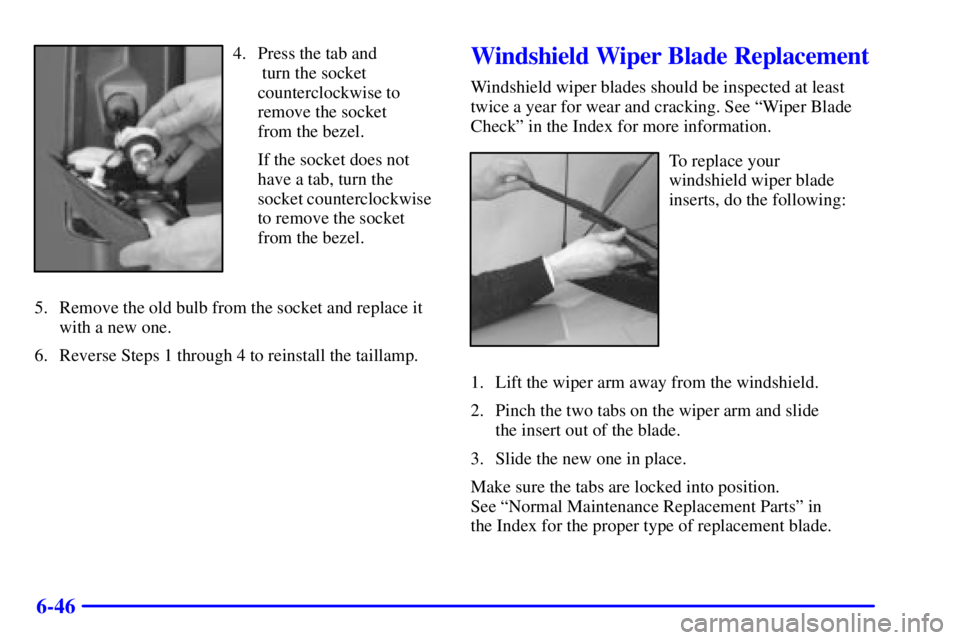
4. Press the tab and
turn the socket
counterclockwise to
remove the socket
from the bezel.
If the socket does not
have a tab, turn the
socket counterclockwise
to remove the socket
from the bezel.
5. Remove the old bulb from the socket and replace it
with a new one.
6. Reverse Steps 1 through 4 to reinstall the taillamp.Windshield Wiper Blade Replacement
Windshield wiper blades should be inspected at least
twice a year for wear and cracking. See ªWiper Blade
Checkº in the Index for more information.
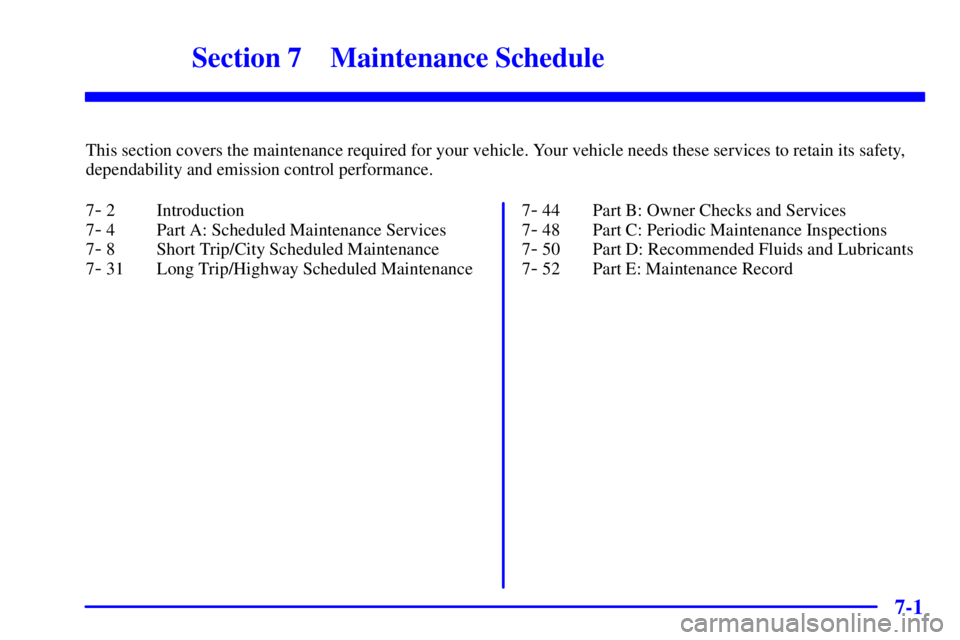
To replace your
windshield wiper blade
inserts, do the following:
1. Lift the wiper arm away from the windshield.
2. Pinch the two tabs on the wiper arm and slide
the insert out of the blade.
3. Slide the new one in place.
Make sure the tabs are locked into position.
See ªNormal Maintenance Replacement Partsº in
the Index for the proper type of replacement blade.
Page 309 of 400
6-49 Tire Inspection and Rotation
Tires should be rotated every 6,000 to 8,000 miles
(10 000 to 13 000 km). Any time you notice unusual
wear, rotate your tires as soon as possible and check
wheel alignment. Also check for damaged tires or wheels.
See ªWhen It's Time for New Tiresº and ªWheel
Replacementº later in this section for more information.
Make sure the spare tire is stored securely. Push, pull, and
then try to rotate or turn the tire. If it moves, use the
ratchet/wheel wrench to tighten the cable. See ªStoring
a Flat or Spare Tire and Toolsº in the Index.
The purpose of regular rotation is to achieve more
uniform wear for all tires on the vehicle. The first rotation
is the most important. See ªScheduled Maintenance
Servicesº in the Index for scheduled rotation intervals.
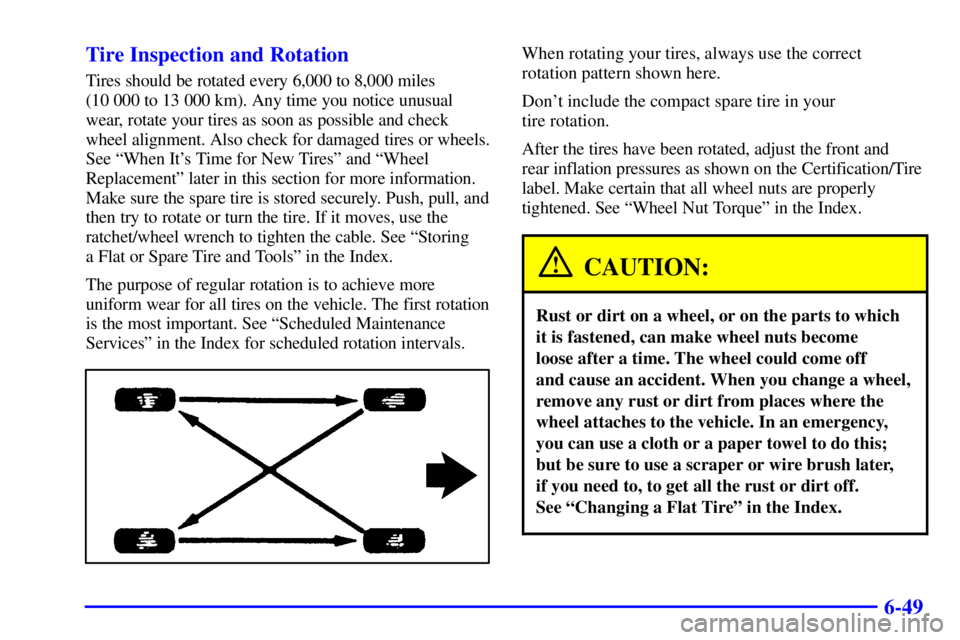
When rotating your tires, always use the correct
rotation pattern shown here.
Don't include the compact spare tire in your
tire rotation.
After the tires have been rotated, adjust the front and
rear inflation pressures as shown on the Certification/Tire
label. Make certain that all wheel nuts are properly
tightened. See ªWheel Nut Torqueº in the Index.
CAUTION:
Rust or dirt on a wheel, or on the parts to which
it is fastened, can make wheel nuts become
loose after a time. The wheel could come off
and cause an accident. When you change a wheel,
remove any rust or dirt from places where the
wheel attaches to the vehicle. In an emergency,
you can use a cloth or a paper towel to do this;
but be sure to use a scraper or wire brush later,
if you need to, to get all the rust or dirt off.
See ªChanging a Flat Tireº in the Index.
Page 323 of 400
6-63
Underbody Maintenance
Chemicals used for ice and snow removal and dust
control can collect on the underbody. If these are
not removed, accelerated corrosion (rust) can occur
on the underbody parts such as fuel lines, frame,
floor pan and exhaust system even though they have
corrosion protection.
At least every spring, flush these materials from the
underbody with plain water. Clean any areas where mud
and other debris can collect. Dirt packed in closed areas
of the frame should be loosened before being flushed.
Your dealer or an underbody car washing system can
do this for you.
Chemical Paint Spotting
Some weather and atmospheric conditions can create a
chemical fallout. Airborne pollutants can fall upon and
attack painted surfaces on your vehicle. This damage
can take two forms: blotchy, ringlet
-shaped
discolorations, and small irregular dark spots etched
into the paint surface.
Although no defect in the paint job causes this,
GM will repair, at no charge to the owner, the surfaces
of new vehicles damaged by this fallout condition
within 12 months or 12,000 miles (20 000 km) of
purchase, whichever occurs first.
Page 334 of 400

6-74
Air Conditioning Refrigerant Capacity
If you do your own service work, you'll need the proper
service manual. See ªDoing Your Own Service Workº in
the Index for additional information. It is recommended
that service work on your air conditioning system be
performed by a qualified technician.
Refrigerant Type 134a
Front A/C 2.25 lbs. (1.02 kg). . . . . . . . . . . . . . . . . .
Front and Rear A/C 3.0 lbs. (1.36 kg). . . . . . . . . . . .
Use Refrigerant Oil, R134a Systems
Normal Maintenance
Replacement Parts
Replacement part numbers listed in this section are
based on the latest information available at the time of
printing, and are subject to change. If a part listed in this
manual is not the same as the part used in your vehicle
when it was built, or if you have any questions, please
contact your GM truck dealer.
Engine Oil Filter PF47*. . . . . . . . . . . . . . . . . . . . . . .
Engine Air Cleaner/Filter A1163C*. . . . . . . . . . . . . . .
Positive Crankcase Ventilation
(PCV) Valve CV769C*. . . . . . . . . . . . . . . . . . . . . .
Spark Plugs 41
-932* . . . . . . . . . . . . . . . . . . . . . . . . . .
Spark Plug Gap 0.060 inches (1.52 mm). . . . . . . . . .
Fuel Filter GF481*. . . . . . . . . . . . . . . . . . . . . . . . . . . .
Wiper Blades (Front) Trico 22110158, Pin Type. . . . .
18 inches (45.7 cm) Length
Wiper Blade (Rear) Trico 22154396, Pin Type. . . . .
14 inches (35.5 cm) Length
*ACDelco
� part number
Page 335 of 400
7-
7-1
Section 7 Maintenance Schedule
This section covers the maintenance required for your vehicle. Your vehicle needs these services to retain its safety,
dependability and emission control performance.
7
- 2 Introduction
7
- 4 Part A: Scheduled Maintenance Services
7
- 8 Short Trip/City Scheduled Maintenance
7
- 31 Long Trip/Highway Scheduled Maintenance7
- 44 Part B: Owner Checks and Services
7
- 48 Part C: Periodic Maintenance Inspections
7
- 50 Part D: Recommended Fluids and Lubricants
7
- 52 Part E: Maintenance Record