Page 45 of 400
1-38
Rear Safety Belt Comfort Guides
for Children and Small Adults
Your vehicle may have rear shoulder belt comfort
guides. This feature will provide added safety belt
comfort for older children who have outgrown booster
seats and for small adults. When installed on a shoulder
belt, the comfort guide better positions the belt away
from the neck and head.
To provide added safety belt comfort for children who
have outgrown child restraints and for smaller adults,
the comfort guides may be installed on the shoulder
belts. Here's how to install a comfort guide and use
the safety belt:
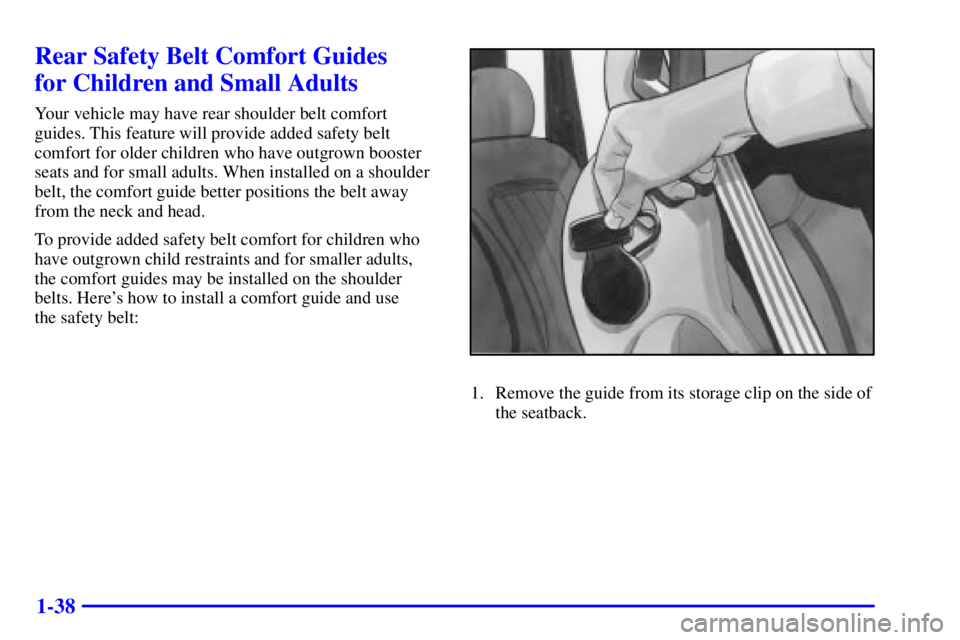
1. Remove the guide from its storage clip on the side of
the seatback.
Page 48 of 400
1-41 Lap Belt
If your vehicle has rear bench seats, someone can sit in
the center positions.
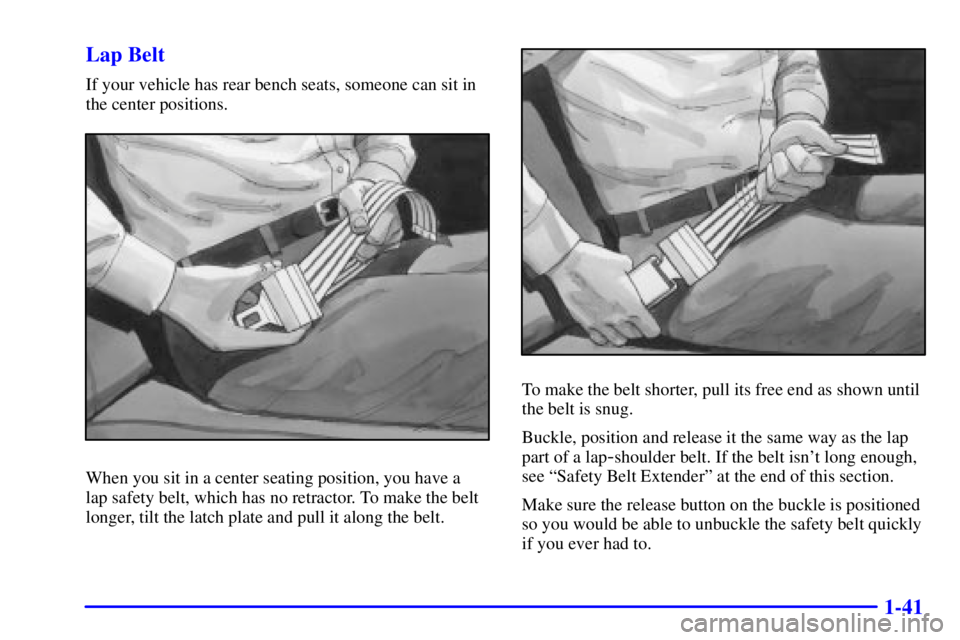
When you sit in a center seating position, you have a
lap safety belt, which has no retractor. To make the belt
longer, tilt the latch plate and pull it along the belt.
To make the belt shorter, pull its free end as shown until
the belt is snug.
Buckle, position and release it the same way as the lap
part of a lap
-shoulder belt. If the belt isn't long enough,
see ªSafety Belt Extenderº at the end of this section.
Make sure the release button on the buckle is positioned
so you would be able to unbuckle the safety belt quickly
if you ever had to.
Page 56 of 400
1-49
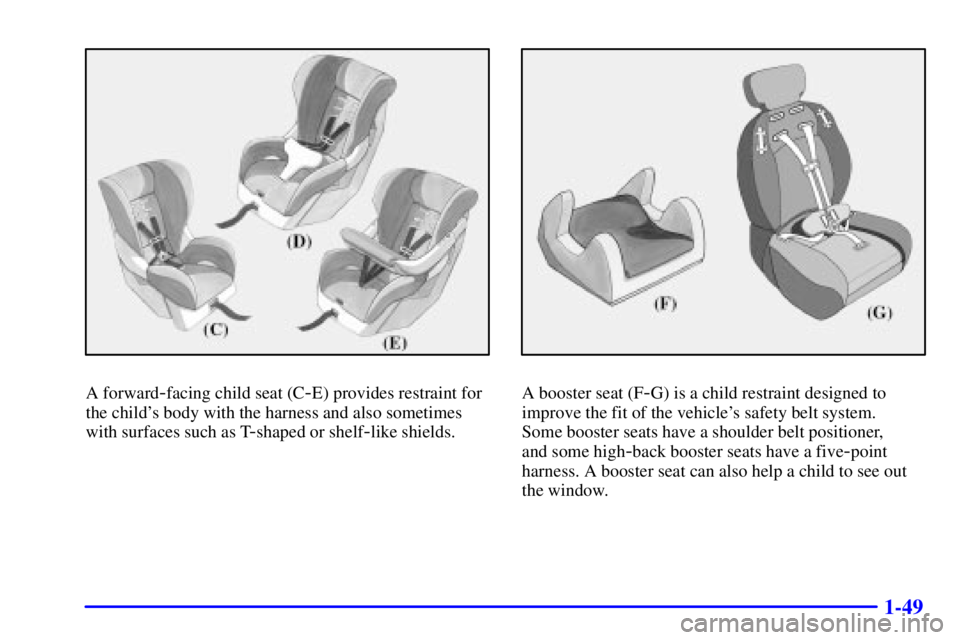
A forward-facing child seat (C-E) provides restraint for
the child's body with the harness and also sometimes
with surfaces such as T
-shaped or shelf-like shields.
A booster seat (F-G) is a child restraint designed to
improve the fit of the vehicle's safety belt system.
Some booster seats have a shoulder belt positioner,
and some high
-back booster seats have a five-point
harness. A booster seat can also help a child to see out
the window.
Page 61 of 400
1-54
If your vehicle is a passenger van with rear seats, it is
recommended that you secure a child restraint with a top
strap only in the outboard positions of the second row.
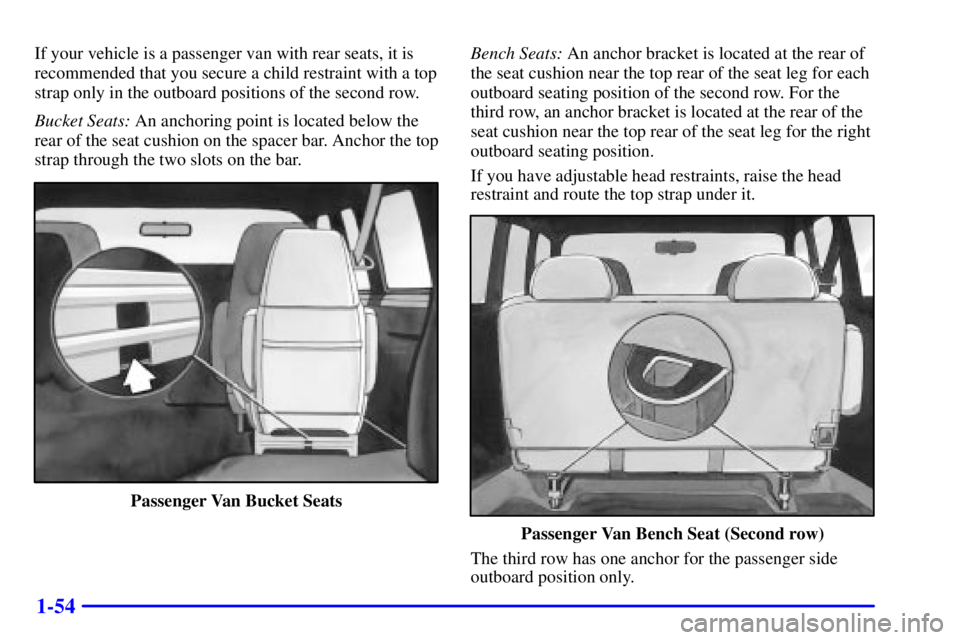
Bucket Seats: An anchoring point is located below the
rear of the seat cushion on the spacer bar. Anchor the top
strap through the two slots on the bar.
Passenger Van Bucket SeatsBench Seats: An anchor bracket is located at the rear of
the seat cushion near the top rear of the seat leg for each
outboard seating position of the second row. For the
third row, an anchor bracket is located at the rear of the
seat cushion near the top rear of the seat leg for the right
outboard seating position.
If you have adjustable head restraints, raise the head
restraint and route the top strap under it.
Passenger Van Bench Seat (Second row)
The third row has one anchor for the passenger side
outboard position only.
Page 67 of 400
1-60
You'll be using the lap-shoulder belt. See the earlier
part about the top strap if the child restraint has one.
Be sure to follow the instructions that came with the
child restraint. Secure the child in the child restraint
when and as the instructions say.
1. Because your vehicle has a right front passenger air
bag, always move the seat as far back as it will go
before securing a forward
-facing child restraint.
See ªSeatsº in the Index.
2. Put the restraint on the seat.
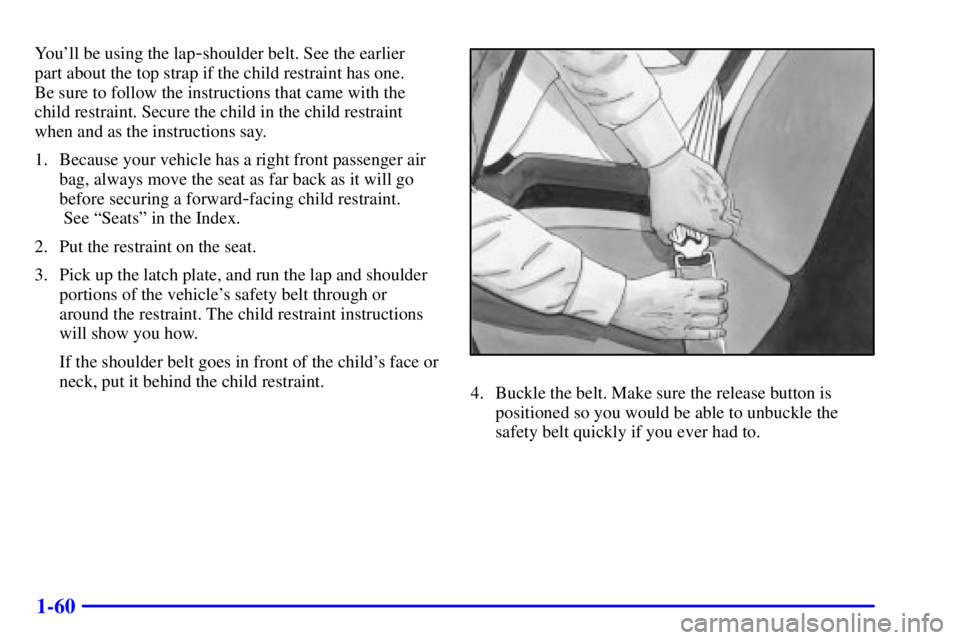
3. Pick up the latch plate, and run the lap and shoulder
portions of the vehicle's safety belt through or
around the restraint. The child restraint instructions
will show you how.
If the shoulder belt goes in front of the child's face or
neck, put it behind the child restraint.
4. Buckle the belt. Make sure the release button is
positioned so you would be able to unbuckle the
safety belt quickly if you ever had to.
Page 69 of 400
1-62
Older Children
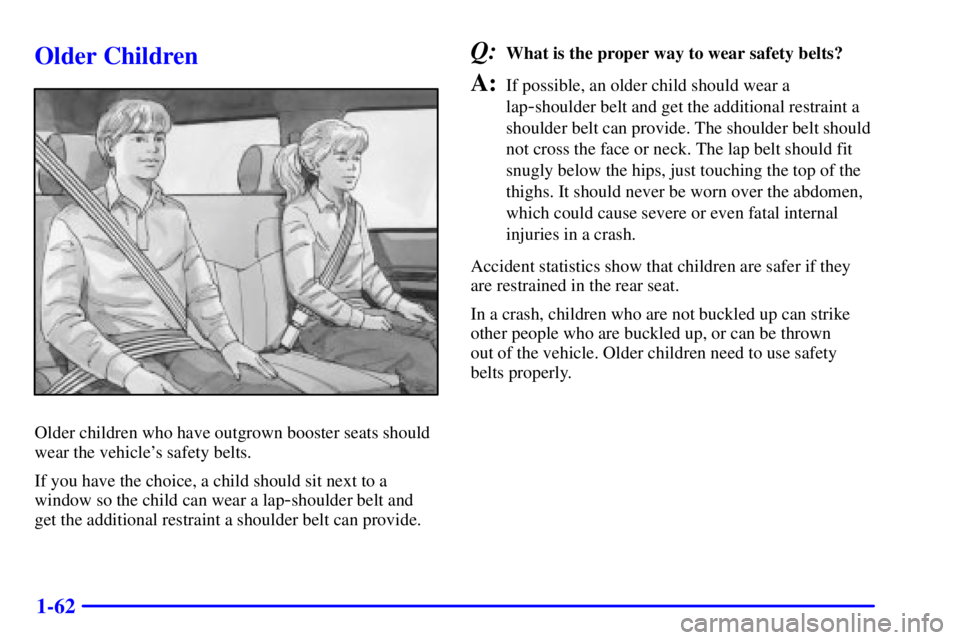
Older children who have outgrown booster seats should
wear the vehicle's safety belts.
If you have the choice, a child should sit next to a
window so the child can wear a lap
-shoulder belt and
get the additional restraint a shoulder belt can provide.
Q:What is the proper way to wear safety belts?
A:If possible, an older child should wear a
lap
-shoulder belt and get the additional restraint a
shoulder belt can provide. The shoulder belt should
not cross the face or neck. The lap belt should fit
snugly below the hips, just touching the top of the
thighs. It should never be worn over the abdomen,
which could cause severe or even fatal internal
injuries in a crash.
Accident statistics show that children are safer if they
are restrained in the rear seat.
In a crash, children who are not buckled up can strike
other people who are buckled up, or can be thrown
out of the vehicle. Older children need to use safety
belts properly.
Page 158 of 400

3-9
When you close a vent, it will increase the flow of air
coming out of any vents that are open.
If you have rear heating or rear air conditioning, you
will have adjustable vents in the rear of the vehicle to
help direct the airflow. The rear air conditioning vents
are located in the headliner at the rear of the vehicle.
The rear heating vents are located next to the second and
third seat on the driver's side of the vehicle, near the
floor. You can move the vents to direct the flow of air,
or close the vents altogether. When you close a vent, it
will increase the flow of air coming out of any vents that
are open.Ventilation Tips
�Keep the hood and front air inlet free of ice, snow or
any other obstruction (such as leaves). The heater
and defroster will work far better, reducing the
chance of fogging the inside of your windows.
�When you enter a vehicle in cold weather, turn the
fan to HI for a few moments before driving off.
This helps clear the intake ducts of snow and
moisture and reduces the chance of fogging the
inside of your windows.
�Keep the air path under the front seats clear of
objects. This helps air to circulate throughout
your vehicle.
Page 214 of 400
4-29
CAUTION:
Do not load your vehicle any heavier than the
GVWR, or either the maximum front or rear
GAWR. If you do, parts on your vehicle can
break, and it can change the way your vehicle
handles. These could cause you to lose control
and crash. Also, overloading can shorten the
life of your vehicle.
Using heavier suspension components to get added
durability might not change your weight ratings. Ask
your dealer to help you load your vehicle the right way.
NOTICE:
Your warranty does not cover parts or
components that fail because of overloading.
If you put things inside of your vehicle -- like suitcases,
tools, packages, or anything else
-- they will go as fast
as the vehicle goes. If you have to stop or turn quickly,
or if there is a crash, they'll keep going.
CAUTION:
Things you put inside your vehicle can strike
and injure people in a sudden stop or turn,
or in a crash.
�Put things in the cargo area of your vehicle.
Try to spread the weight evenly.
�Never stack heavier things, like suitcases,
inside the vehicle so that some of them are
above the tops of the seats.
�Don't leave an unsecured child restraint
in your vehicle.
�When you carry something inside the
vehicle, secure it whenever you can.
�Don't leave a seat folded down unless
you need to.