Page 16 of 400
1-9
Removing the Rear Seats
To remove the rear seats, do the following:
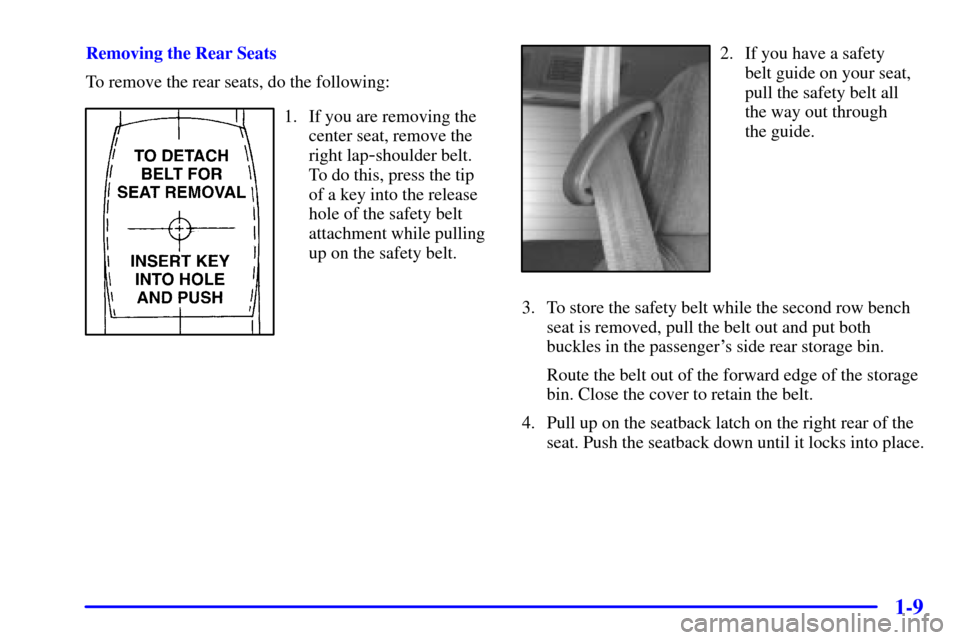
1. If you are removing the
center seat, remove the
right lap
-shoulder belt.
To do this, press the tip
of a key into the release
hole of the safety belt
attachment while pulling
up on the safety belt.
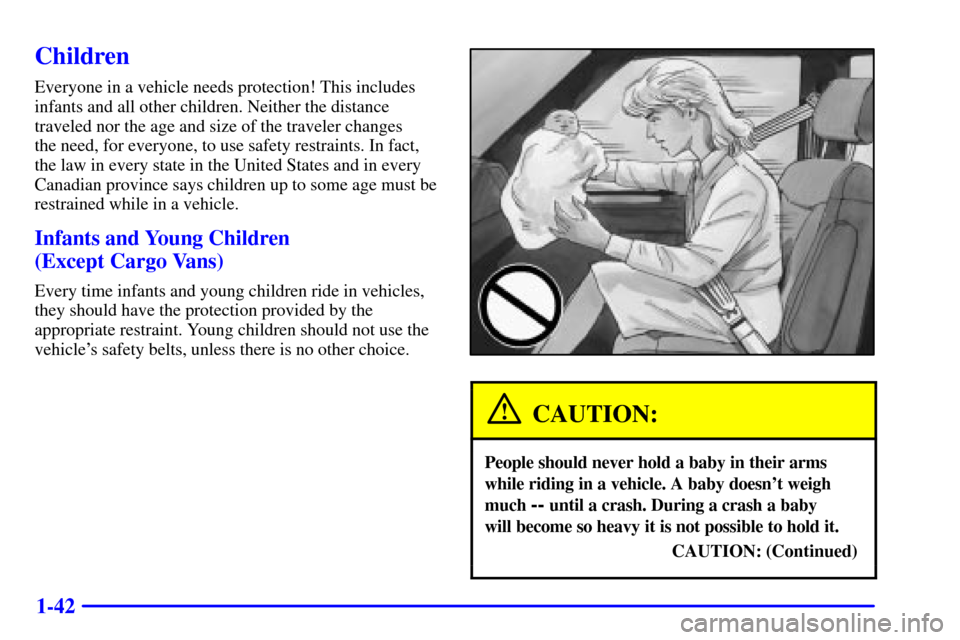
2. If you have a safety
belt guide on your seat,
pull the safety belt all
the way out through
the guide.
3. To store the safety belt while the second row bench
seat is removed, pull the belt out and put both
buckles in the passenger's side rear storage bin.
Route the belt out of the forward edge of the storage
bin. Close the cover to retain the belt.
4. Pull up on the seatback latch on the right rear of the
seat. Push the seatback down until it locks into place.
Page 40 of 400
1-33
�Your vehicle is equipped with a crash sensing and
diagnostic module, which records information about
the air bag system. The module records information
about the readiness of the system, when the system
commands air bag inflation and driver's safety belt
usage at deployment. The module also records speed,
engine rpm, brake and throttle data.
�Let only qualified technicians work on your air bag
system. Improper service can mean that your air
bag system won't work properly. See your dealer
for service.
NOTICE:
If you damage the covering for the driver's or the
right front passenger's air bag, the bag may not
work properly. You may have to replace the air
bag module in the steering wheel or both the air
bag module and the instrument panel for the
right front passenger's air bag. Do not open or
break the air bag coverings.
Servicing Your Air Bag-Equipped Vehicle
Air bags affect how your vehicle should be serviced.
There are parts of the air bag system in several places
around your vehicle. You don't want the system to
inflate while someone is working on your vehicle.
Your dealer and the service manual have information
about servicing your vehicle and the air bag system.
To purchase a service manual, see ªService and Owner
Publicationsº in the Index.
CAUTION:
For up to 10 minutes after the ignition key is
turned off and the battery is disconnected, an
air bag can still inflate during improper service.
You can be injured if you are close to an air bag
when it inflates. Avoid wires wrapped with yellow
tape or yellow connectors. They are probably part
of the air bag system. Be sure to follow proper
service procedures, and make sure the person
performing work for you is qualified to do so.
The air bag system does not need regular maintenance.
Page 49 of 400
1-42
Children
Everyone in a vehicle needs protection! This includes
infants and all other children. Neither the distance
traveled nor the age and size of the traveler changes
the need, for everyone, to use safety restraints. In fact,
the law in every state in the United States and in every
Canadian province says children up to some age must be
restrained while in a vehicle.
Infants and Young Children
(Except Cargo Vans)
Every time infants and young children ride in vehicles,
they should have the protection provided by the
appropriate restraint. Young children should not use the
vehicle's safety belts, unless there is no other choice.
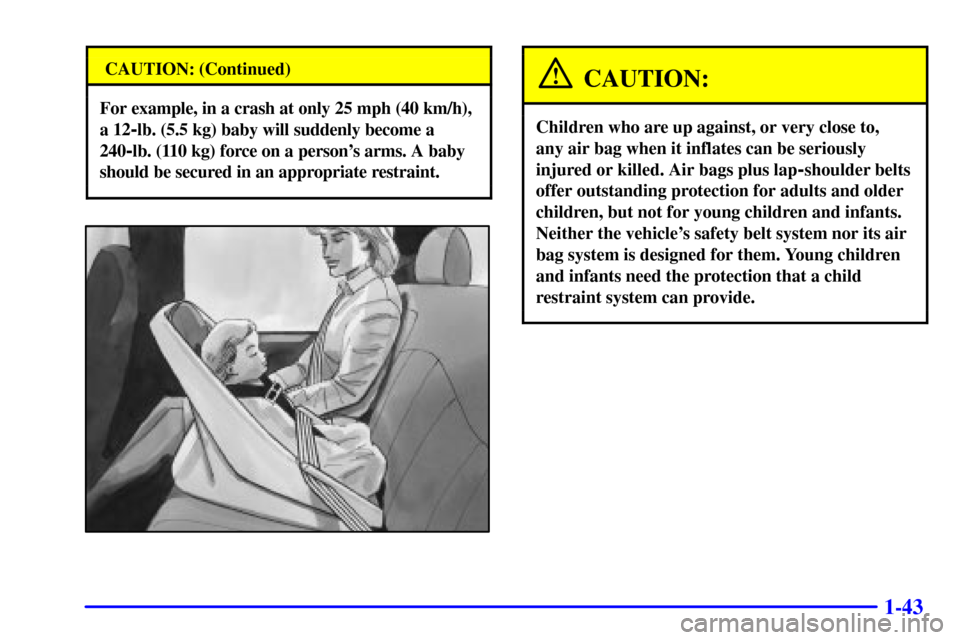
CAUTION:
People should never hold a baby in their arms
while riding in a vehicle. A baby doesn't weigh
much
-- until a crash. During a crash a baby
will become so heavy it is not possible to hold it.
CAUTION: (Continued)
Page 50 of 400
1-43
CAUTION: (Continued)
For example, in a crash at only 25 mph (40 km/h),
a 12
-lb. (5.5 kg) baby will suddenly become a
240
-lb. (110 kg) force on a person's arms. A baby
should be secured in an appropriate restraint.
CAUTION:
Children who are up against, or very close to,
any air bag when it inflates can be seriously
injured or killed. Air bags plus lap
-shoulder belts
offer outstanding protection for adults and older
children, but not for young children and infants.
Neither the vehicle's safety belt system nor its air
bag system is designed for them. Young children
and infants need the protection that a child
restraint system can provide.
Page 54 of 400
1-47
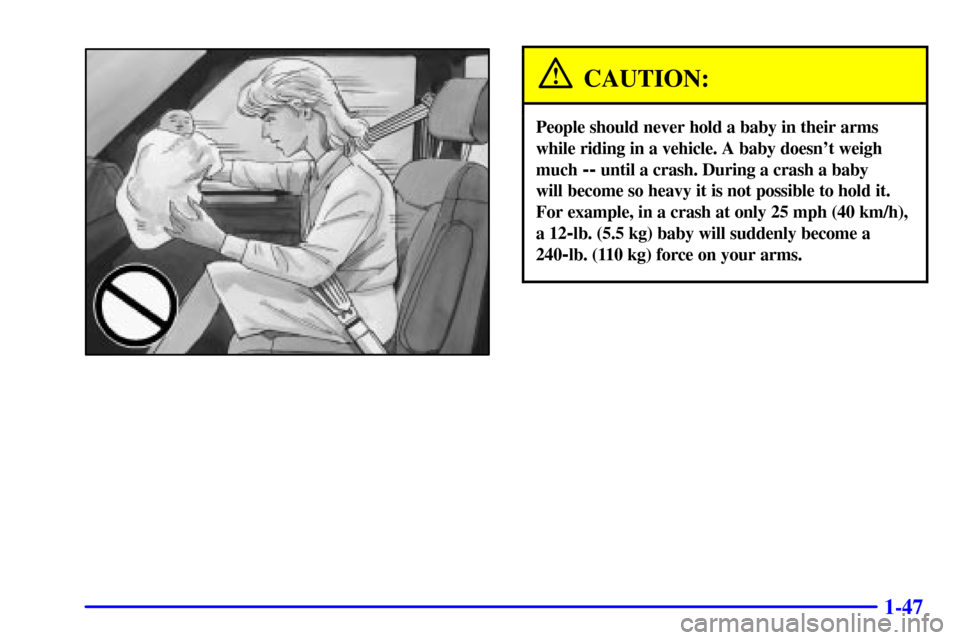
CAUTION:
People should never hold a baby in their arms
while riding in a vehicle. A baby doesn't weigh
much
-- until a crash. During a crash a baby
will become so heavy it is not possible to hold it.
For example, in a crash at only 25 mph (40 km/h),
a 12
-lb. (5.5 kg) baby will suddenly become a
240
-lb. (110 kg) force on your arms.
Page 58 of 400
1-51 Where to Put the Restraint
(Except Cargo Vans)
Accident statistics show that children are safer if they
are restrained in the rear rather than the front seat.
General Motors, therefore, recommends that child
restraints be secured in a rear seat including an infant
riding in a rear
-facing infant seat, a child riding in a
forward
-facing child seat and an older child riding in
a booster seat. Never put a rear
-facing child restraint
in the front passenger seat. Here's why:
CAUTION:
A child in a rear-facing child restraint can be
seriously injured or killed if the right front
passenger's air bag inflates. This is because the
back of the rear
-facing child restraint would be
very close to the inflating air bag. Always secure
a rear
-facing child restraint in a rear seat.
CAUTION: (Continued)
CAUTION: (Continued)
You may secure a forward-facing child restraint
in the right front seat, but before you do, always
move the front passenger seat as far back as it
will go. It's better to secure the child restraint
in a rear seat.
Wherever you install it, be sure to secure the child
restraint properly.
Keep in mind that an unsecured child restraint can move
around in a collision or sudden stop and injure people
in the vehicle. Be sure to properly secure any child
restraint in your vehicle
-- even when no child is in it.
Page 61 of 400
1-54
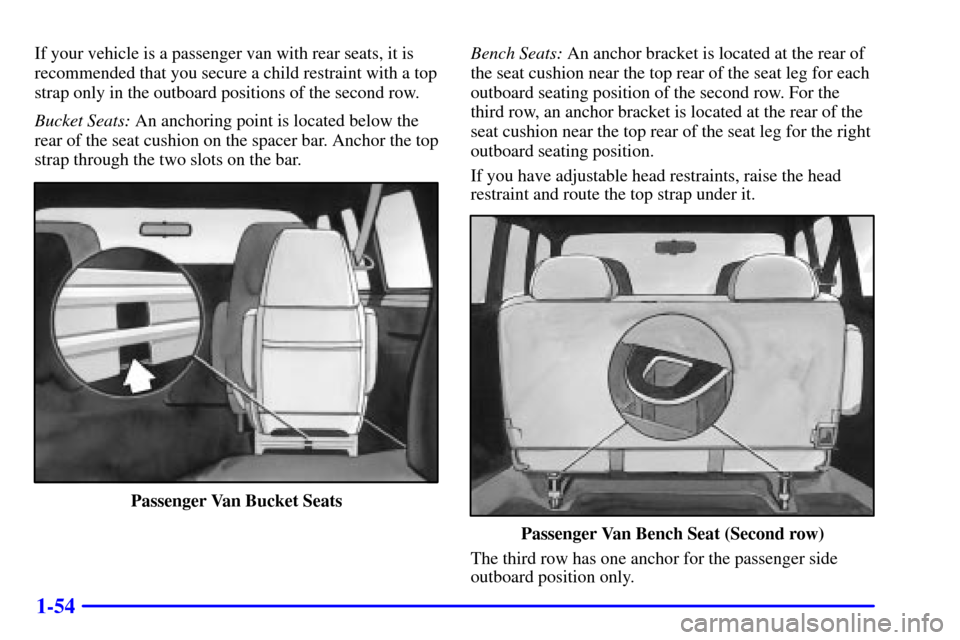
If your vehicle is a passenger van with rear seats, it is
recommended that you secure a child restraint with a top
strap only in the outboard positions of the second row.
Bucket Seats: An anchoring point is located below the
rear of the seat cushion on the spacer bar. Anchor the top
strap through the two slots on the bar.
Passenger Van Bucket SeatsBench Seats: An anchor bracket is located at the rear of
the seat cushion near the top rear of the seat leg for each
outboard seating position of the second row. For the
third row, an anchor bracket is located at the rear of the
seat cushion near the top rear of the seat leg for the right
outboard seating position.
If you have adjustable head restraints, raise the head
restraint and route the top strap under it.
Passenger Van Bench Seat (Second row)
The third row has one anchor for the passenger side
outboard position only.
Page 82 of 400
2-9 Power Door Locks (If Equipped)
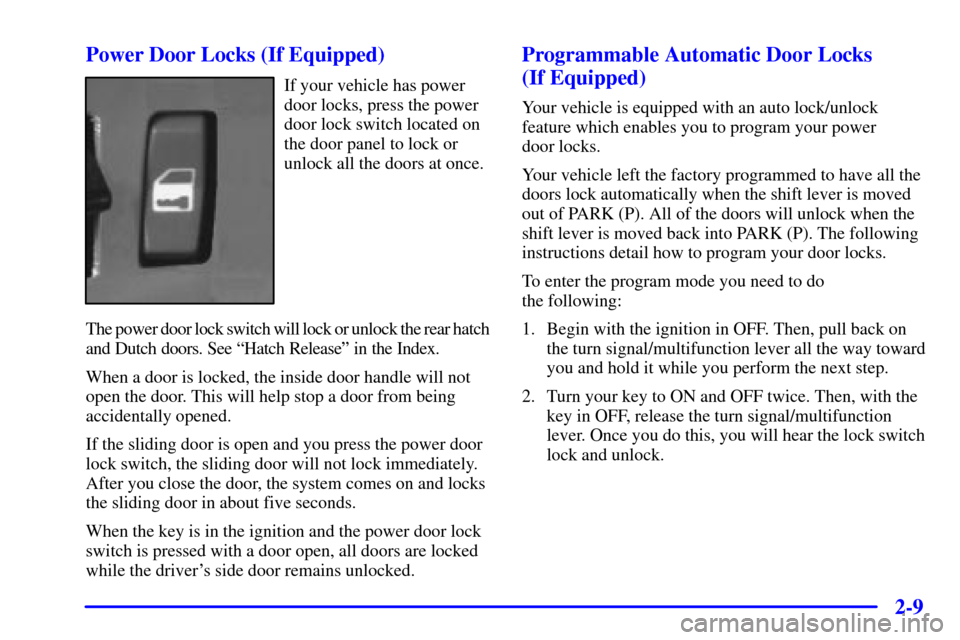
If your vehicle has power
door locks, press the power
door lock switch located on
the door panel to lock or
unlock all the doors at once.
The power door lock switch will lock or unlock the rear hatch
and Dutch doors. See ªHatch Releaseº in the Index.
When a door is locked, the inside door handle will not
open the door. This will help stop a door from being
accidentally opened.
If the sliding door is open and you press the power door
lock switch, the sliding door will not lock immediately.
After you close the door, the system comes on and locks
the sliding door in about five seconds.
When the key is in the ignition and the power door lock
switch is pressed with a door open, all doors are locked
while the driver's side door remains unlocked.
Programmable Automatic Door Locks
(If Equipped)
Your vehicle is equipped with an auto lock/unlock
feature which enables you to program your power
door locks.
Your vehicle left the factory programmed to have all the
doors lock automatically when the shift lever is moved
out of PARK (P). All of the doors will unlock when the
shift lever is moved back into PARK (P). The following
instructions detail how to program your door locks.
To enter the program mode you need to do
the following:
1. Begin with the ignition in OFF. Then, pull back on
the turn signal/multifunction lever all the way toward
you and hold it while you perform the next step.
2. Turn your key to ON and OFF twice. Then, with the
key in OFF, release the turn signal/multifunction
lever. Once you do this, you will hear the lock switch
lock and unlock.