Page 292 of 368
6-38
NOTICE:
To make sure your headlamps are aimed
properly, read all the instructions before
beginning. Failure to follow these instructions
could cause damage to headlamp parts.
To check the aim, the vehicle should be properly
prepared as follows:
�The headlamps must be off for one hour prior to
aiming and must remain off during this procedure.
�The vehicle must have all four tires on a perfectly
level surface.
�If necessary, pads may be used on an uneven surface.
�The vehicle should not have any snow, ice or mud
attached to it.
�The vehicle should be fully assembled and all other
work stopped while headlamp aiming is being done.
�There should not be any cargo or loading of the
vehicle, except it should have a full tank of fuel and
one person or 160 lbs. (75 kg) on the driver's seat.
�Close all doors.�Tires should be properly inflated.
�Rock the vehicle to stabilize the suspension.
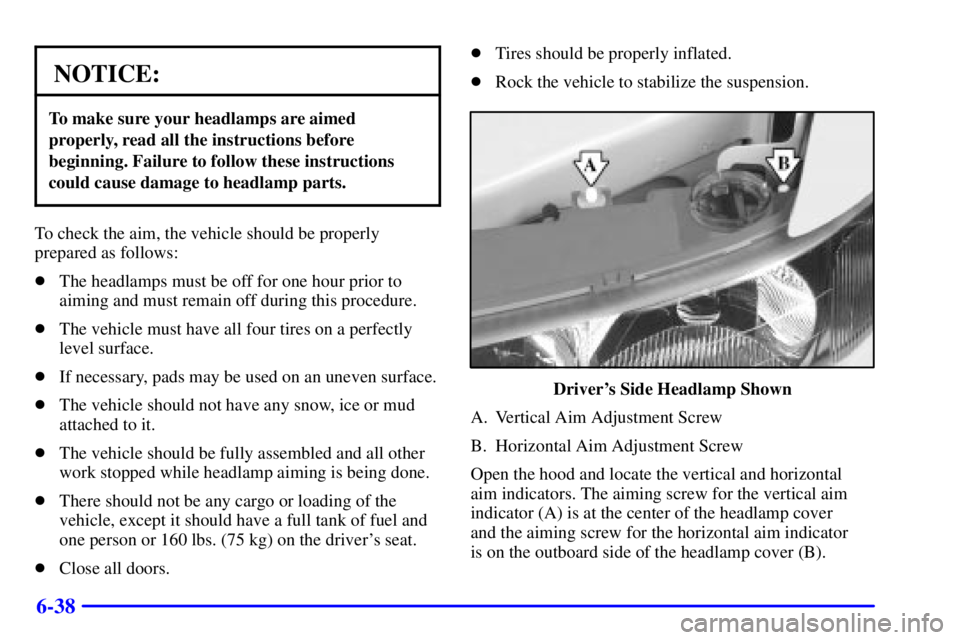
Driver's Side Headlamp Shown
A. Vertical Aim Adjustment Screw
B. Horizontal Aim Adjustment Screw
Open the hood and locate the vertical and horizontal
aim indicators. The aiming screw for the vertical aim
indicator (A) is at the center of the headlamp cover
and the aiming screw for the horizontal aim indicator
is on the outboard side of the headlamp cover (B).
Page 299 of 368
6-45 Inflation -- Tire Pressure
The Tire-Loading Information label, which is on the
inside of the trunk lid, shows the correct inflation
pressures for your tires when they're cold. ªColdº
means your vehicle has been sitting for at least three
hours or driven no more than 1 mile (1.6 km).
NOTICE:
Don't let anyone tell you that underinflation or
overinflation is all right. It's not. If your tires
don't have enough air (underinflation), you
can get the following:
�Too much flexing
�Too much heat
�Tire overloading
�Bad wear
�Bad handling
�Bad fuel economy
NOTICE: (Continued)
NOTICE: (Continued)
If your tires have too much air (overinflation),
you can get the following:
�Unusual wear
�Bad handling
�Rough ride
�Needless damage from road hazards
When to Check
Check your tires once a month or more.
Don't forget your compact spare tire. It should be
at 60 psi (420 kPa).
How to Check
Use a good quality pocket
-type gage to check tire
pressure. You can't tell if your tires are properly inflated
simply by looking at them. Radial tires may look
properly inflated even when they're underinflated.
Be sure to put the valve caps back on the valve stems.
They help prevent leaks by keeping out dirt and moisture.
Page 316 of 368

6-62
Finish Damage
Any stone chips, fractures or deep scratches in the finish
should be repaired right away. Bare metal will corrode
quickly and may develop into a major repair expense.
Minor chips and scratches can be repaired with touch
-up
materials available from your dealer or other service
outlets. Larger areas of finish damage can be corrected
in your dealer's body and paint shop.
Underbody Maintenance
Chemicals used for ice and snow removal and dust
control can collect on the underbody. If these are
not removed, accelerated corrosion (rust) can occur
on the underbody parts such as fuel lines, frame, floor
pan and exhaust system even though they have
corrosion protection.
At least every spring, flush these materials from the
underbody with plain water. Clean any areas where mud
and other debris can collect. Dirt packed in closed areas
of the frame should be loosened before being flushed.
Your dealer or an underbody car washing system can do
this for you.
Chemical Paint Spotting
Some weather and atmospheric conditions can create
a chemical fallout. Airborne pollutants can fall upon
and attack painted surfaces on your vehicle. This
damage can take two forms: blotchy, ringlet
-shaped
discolorations, and small irregular dark spots etched
into the paint surface.
Although no defect in the paint job causes this, Buick
will repair, at no charge to the owner, the surfaces of
new vehicles damaged by this fallout condition within
12 months or 12,000 miles (20 000 km) of purchase,
whichever occurs first.
Page 324 of 368
6-70
Mini Relay Usage
9 Cooling Fan 2
10 Cooling Fan 3
11 Starter Solenoid
12 Cooling Fan 1
13 Ignition Main
14 Air Pump (Optional)
Micro Relay Usage
15 A/C Clutch
16 Horn
17 Fog Lamps
18 Fuel Pump, Speed Control (L67 only)
19 Fuel PumpMini Fuse Usage
20 Air Pump (Optional)
21 Generator
22 ECM
23 A/C Compressor Clutch
24 Cooling Fan
25 Electronic Ignition
26 Transaxle
27 Horn
28 Fuel Injector
29 Oxygen Sensor
30 Engine Emissions
31 Fog Lamps
32 Headlamp (Right)
33 Rear Compartment Release
Page 325 of 368
6-71
Mini Fuse Usage
34 Parking Lamps
35 Fuel Pump
36 Headlamp (Left)
37 Spare
38 Spare
39 Spare
40 Spare
41 Spare
42 Spare
43 Fuse Puller
SYMBOL A/C Compressor Clutch DiodeReplacement Bulbs
Exterior Lamps Bulb Number
Back
-up (Applique) 1156. . . . . . . . . . . . . . . . . . . .
Center High
-Mounted Stop 3155. . . . . . . . . . . . . . .
Front Parking/Turn Signal 4157NAK. . . . . . . . . . .
Headlamp, High Beam 9005. . . . . . . . . . . . . . . . . .
Headlamp, Low Beam 9006. . . . . . . . . . . . . . . . . . .
Stop/Tail/Turn Signal 3057. . . . . . . . . . . . . . . . . . .
Tail (Applique) 194. . . . . . . . . . . . . . . . . . . . . . . . .
For any bulb not listed here contact your dealer.
Page 326 of 368

6-72
Capacities and Specifications
Automatic Transaxle
Pan Removal
and Replacement 7.4 quarts (7.0 L). . . . . . . . . .
After Complete Overhaul 10.0 quarts (9.5 L). . . . . . .
When draining/replacing converter, more fluid will
be needed.
Cooling System
Including Reservoir11.7 quarts (11.0 L) . . . . . . . . .
Engine Oil with Filter4.5 quarts (4.3 L) . . . . . . . . .
Wheel Nut Torque100 lb
-ft (140 N´m) . . . . . . . . . .
Fuel Tank17.0 U.S. gallons (64.0 L) . . . . . . . . . . . .
All capacities are approximate. When adding, be sure to
fill to the approximate level, as recommended in this
manual. See ªFluids and Lubricantsº in the Index.
Engine Specifications
Type 3800 V6 (VIN Engine Code K). . . . . . . . . . . . .
3800 Supercharged V6 (VIN Engine Code 1)
Displacement 231 CID. . . . . . . . . . . . . . . . . . . . . . . .
Firing Order 1
-6-5-4-3-2 . . . . . . . . . . . . . . . . . . . . . .
Air Conditioning
Refrigerant Capacity
If you do your own service work, you'll need the proper
service manual. See ªDoing Your Own Service Workº in
the Index for additional information. It is recommended
that service work on your air conditioning system be
performed by a qualified technician.
Air Conditioning
Refrigerant R±134a 2.3 lbs. (1.0 kg). . . . . . . . . . . . .
Normal Maintenance
Replacement Parts
Engine Air Cleaner/FilterA1208C* . . . . . . . . . . . . .
Passenger Compartment Air Filter10406026 . . . .
Engine Oil FilterType PF47* . . . . . . . . . . . . . . . . . . .
Spark Plugs
3800 V6 Type 41
-921* . . . . . . . . . . . . . . . . . . . . . . . .
Gap: 0.060 inches (1.52 mm)
3800 Supercharged V6 Type 41
-921* or . . . . . . . . . . .
NGK Type PTR4B
-15
Gap: 0.060 inches (1.52 mm)
Wiper Blade
Type Hook. . . . . . . . . . . . . . . . . . . . . . . . . . . . . . . . . .
Length 22.0 inches (56.0 cm). . . . . . . . . . . . . . . . . . .
*ACDelco
� part number.
Page 330 of 368

7-4
Part A: Scheduled
Maintenance Services
Using Your Maintenance Schedule
We at General Motors want to help you keep your
vehicle in good working condition. But we don't know
exactly how you'll drive it. You may drive very short
distances only a few times a week. Or you may drive
long distances all the time in very hot, dusty weather.
You may use your vehicle in making deliveries.
Or you may drive it to work, to do errands or in many
other ways.
Because of all the different ways people use their
vehicles, maintenance needs vary. You may need more
frequent checks and replacements. So please read the
following and note how you drive. If you have any
questions on how to keep your vehicle in good
condition, see your dealer.This part tells you the maintenance services you should
have done and when you should schedule them. If you
go to your dealer for your service needs, you'll know
that GM
-trained and supported service people will
perform the work using genuine GM parts.
The proper fluids and lubricants to use are listed in
Part D. Make sure whoever services your vehicle
uses these. All parts should be replaced and all
necessary repairs done before you or anyone else
drives the vehicle.
This schedule is for vehicles that:
�carry passengers and cargo within recommended
limits. You will find these limits on your vehicle's
Tire
-Loading Information label. See ªLoading Your
Vehicleº in the Index.
�are driven on reasonable road surfaces within legal
driving limits.
�use the recommended fuel. See ªFuelº in the Index.
Page 332 of 368

Scheduled Maintenance
7-6Engine Oil Scheduled Maintenance
Change engine oil and filter as indicated by the
GM Oil Life System� (or every 12 months,
whichever occurs first). Reset the system.
Your vehicle has a computer system that lets you know
when to change the engine oil and filter. This is based on
engine revolutions and engine temperature, and not on
mileage. Based on driving conditions, the mileage at
which an oil change will be indicated can vary
considerably. For the oil life system to work properly,
you must reset the system every time the oil is changed.When the system has calculated that oil life has been
diminished, it will indicate that an oil change is
necessary. A CHANGE OIL SOON light will come on.
Change your oil as soon as possible within the next
two times you stop for fuel. It is possible that, if you are
driving under the best conditions, the oil life system
may not indicate that an oil change is necessary for over
a year. However, your engine oil and filter must be
changed at least once a year and at this time the system
must be reset. It is also important to check your oil
regularly and keep it at the proper level.
If the system is ever reset accidentally, you must change
your oil at 3,000 miles (5 000 km) since your last oil
change. Remember to reset the oil life system whenever
the oil is changed. See ªOil Life Systemº in the Index
for information on resetting the system.
An Emission Control Service.

