Page 155 of 368

3-7 Heating (Engine Coolant Heater)
If your vehicle has an engine coolant heater, you can use
it to help your system provide warm air faster when it's
cold outside
-- 0�F (-18�C) or lower. An engine
coolant heater warms the coolant your engine and
heating system use to provide heat. See ªEngine
Coolant Heaterº in the Index.
Air Conditioning
On very hot days, open the windows long enough to let
hot, inside air escape. This reduces the time for the
vehicle to cool down.
For a quick cool
-down on very hot days, use MAX
with the temperature levers all the way in the blue area.
If this setting is used for long periods of time, the air in
your vehicle may become too dry.
For normal cooling on hot days, use VENT with the
temperature levers in the blue area. The system will
bring in outside air and cool it.
On cool, but sunny days, the sun may warm your upper
body, but your lower body may not be warm enough.
You can use BI
-LEV and set the temperature levers to a
comfortable setting. The system will bring in outside air
and direct it to your upper body, while sending slightly
warmed air to your lower body. You may notice this
temperature difference more at some times than others.
Defogging and Defrosting
If you have the Dual Comfortemp Climate Control, your
system has two settings for clearing the front and side
windows. To defrost the windows quickly, turn the mode
knob to the defrost setting and turn the temperature knob
all the way in the red area.
For maximum defroster performance, set both
driver and passenger temperature controls to the
warmest setting.
To warm passengers while keeping the windows clear,
use BLEND.
If you have the Dual Automatic Comfortemp Climate
Control, your system has two settings for clearing the front
and side windows. To defrost the windows quickly, press
the FRONT button, set the temperature to 90 �F (32�C),
select high fan speed and turn the DUAL button off. To
warm passengers while keeping the windows clear, push
the AIR FLOW button until WINDSHIELD/FLOOR
appears in the display. Select fan speed for comfort and
windshield clearing performance.
Page 157 of 368
3-9 Ventilation System
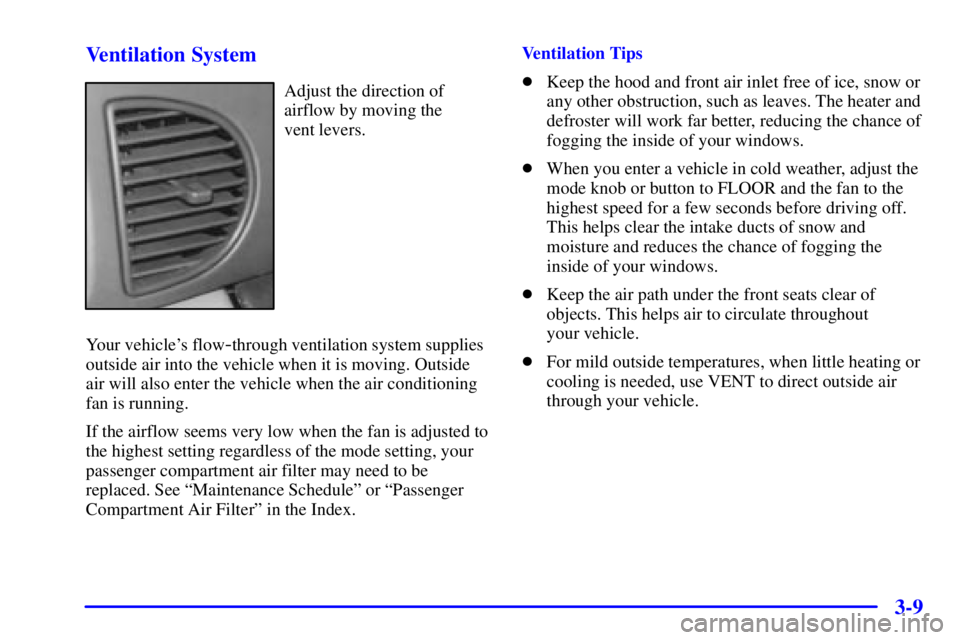
Adjust the direction of
airflow by moving the
vent levers.
Your vehicle's flow
-through ventilation system supplies
outside air into the vehicle when it is moving. Outside
air will also enter the vehicle when the air conditioning
fan is running.
If the airflow seems very low when the fan is adjusted to
the highest setting regardless of the mode setting, your
passenger compartment air filter may need to be
replaced. See ªMaintenance Scheduleº or ªPassenger
Compartment Air Filterº in the Index.Ventilation Tips
�Keep the hood and front air inlet free of ice, snow or
any other obstruction, such as leaves. The heater and
defroster will work far better, reducing the chance of
fogging the inside of your windows.
�When you enter a vehicle in cold weather, adjust the
mode knob or button to FLOOR and the fan to the
highest speed for a few seconds before driving off.
This helps clear the intake ducts of snow and
moisture and reduces the chance of fogging the
inside of your windows.
�Keep the air path under the front seats clear of
objects. This helps air to circulate throughout
your vehicle.
�For mild outside temperatures, when little heating or
cooling is needed, use VENT to direct outside air
through your vehicle.
Page 192 of 368

4-17
A cornering skid and an acceleration skid are best
handled by easing your foot off the accelerator pedal.
If your vehicle starts to slide, ease your foot off the
accelerator pedal and quickly steer the way you want the
vehicle to go. If you start steering quickly enough, your
vehicle may straighten out. Always be ready for a
second skid if it occurs.
Of course, traction is reduced when water, snow, ice,
gravel or other material is on the road. For safety, you'll
want to slow down and adjust your driving to these
conditions. It is important to slow down on slippery
surfaces because stopping distance will be longer and
vehicle control more limited.
While driving on a surface with reduced traction, try
your best to avoid sudden steering, acceleration or
braking (including engine braking by shifting to a lower
gear). Any sudden changes could cause the tires to slide.
You may not realize the surface is slippery until your
vehicle is skidding. Learn to recognize warning
clues
-- such as enough water, ice or packed snow on
the road to make a ªmirrored surfaceº
-- and slow
down when you have any doubt.
Remember: Any anti
-lock brake system (ABS) helps
avoid only the braking skid.
Driving at Night
Night driving is more dangerous than day driving.
One reason is that some drivers are likely to be
impaired
-- by alcohol or drugs, with night vision
problems, or by fatigue.
Page 227 of 368
5-10 Overheated Engine Protection
Operating Mode
This emergency operating mode allows your vehicle to
be driven to a safe place in an emergency situation.
If an overheated engine condition exists, an overheat
protection mode which alternates firing groups of
cylinders helps prevent engine damage. In this mode,
you will notice a significant loss in power and engine
performance. The low coolant light may come on
and the temperature gage will indicate an overheat
condition exists. Driving extended miles (km) and/or
towing a trailer in the overheat protection mode
should be avoided.
NOTICE:
After driving in the overheated engine protection
operating mode, to avoid engine damage, allow
the engine to cool before attempting any repair.
The engine oil will be severely degraded. Repair
the cause of coolant loss, change the oil and reset
the oil life system. See ªEngine Oilº in the Index.
If Steam Is Coming From Your Engine
Page 229 of 368

5-12 If No Steam Is Coming From Your Engine
An overheat warning, along with a low coolant light,
can indicate a serious problem. See ªLow Coolant
Lightº in the Index.
If you get an engine overheat warning with no low
coolant light, but see or hear no steam, the problem may
not be too serious. Sometimes the engine can get a little
too hot when you:
�Climb a long hill on a hot day.
�Stop after high
-speed driving.
�Idle for long periods in traffic.
�Tow a trailer.
If you get the overheat warning with no sign of steam,
try this for a minute or so:
1. If your air conditioner is on, turn it off.
2. Turn on your heater to full hot at the highest fan
speed and open the window as necessary.
3. If you're in a traffic jam, shift to NEUTRAL (N);
otherwise, shift to the highest gear while
driving
-- AUTOMATIC OVERDRIVE (�).If you no longer have the overheat warning, you can
drive. Just to be safe, drive slower for about 10 minutes.
If the warning doesn't come back on, you can
drive normally.
If the warning continues, pull over, stop, and park your
vehicle right away.
If there's still no sign of steam, idle the engine for
three minutes while you're parked. If you still have the
warning, turn off the engine and get everyone out of
the vehicle until it cools down. Also, see ªOverheated
Engine Protection Operating Modeº listed previously in
this section.
You may decide not to lift the hood but to get service
help right away.
Page 255 of 368

6-
6-1
Section 6 Service and Appearance Care
Here you will find information about the care of your vehicle. This section begins with service and fuel information,
and then it shows how to check important fluid and lubricant levels. There is also technical information about your
vehicle, and a part devoted to its appearance care.
6
-2 Service
6
-3 Fuel
6
-5 Fuels in Foreign Countries
6
-6 Filling Your Tank
6
-8 Filling a Portable Fuel Container
6
-8 Checking Things Under the Hood
6
-12 Engine Oil
6
-18 Engine Air Cleaner/Filter
6
-19 Passenger Compartment Air Filter
6
-20 Supercharger Oil
6
-21 Automatic Transaxle Fluid
6
-25 Engine Coolant
6
-29 Power Steering Fluid
6
-30 Windshield Washer Fluid
6
-31 Brakes
6
-35 Battery
6
-36 Bulb Replacement
6
-43 Windshield Wiper Blade Replacement6
-44 Tires
6
-55 Appearance Care
6
-55 Cleaning the Inside of Your Vehicle
6
-58 Cleaning Glass Surfaces
6
-59 Cleaning the Outside of the Windshield and
Wiper Blades
6
-59 Cleaning the Outside of Your Vehicle
6
-61 Cleaning Aluminum or Chrome-Plated
Wheels (If Equipped)
6
-61 Cleaning Tires
6
-63 GM Vehicle Care/Appearance Materials
6
-64 Vehicle Identification Number (VIN)
6
-65 Electrical System
6
-71 Replacement Bulbs
6
-72 Capacities and Specifications
6
-72 Air Conditioning Refrigerant Capacity
6
-72 Normal Maintenance Replacement Parts
Page 258 of 368

6-4 Gasoline Specifications
It is recommended that gasoline meet specifications
which were developed by the American Automobile
Manufacturers Association and endorsed by the
Canadian Vehicle Manufacturers' Association for better
vehicle performance and engine protection. Gasolines
meeting these specifications could provide improved
driveability and emission control system performance
compared to other gasolines.
In Canada, look for
the ªAuto Makers'
Choiceº label on
the pump.
Canada Only
California Fuel
If your vehicle is certified to meet California Emission
Standards (see the underhood emission control label),
it is designed to operate on fuels that meet California
specifications. If this fuel is not available in states
adopting California emissions standards, your vehicle
will operate satisfactorily on fuels meeting federal
specifications, but emission control system performance
may be affected. The malfunction indicator lamp may
turn on (see ªMalfunction Indicator Lampº in the Index)
and your vehicle may fail a smog
-check test. If this
occurs, return to your authorized GM dealer for
diagnosis. If it is determined that the condition is
caused by the type of fuel used, repairs may not be
covered by your warranty.
Page 273 of 368
6-19
NOTICE:
If the air cleaner/filter is off, a backfire can
cause a damaging engine fire. And, dirt can
easily get into your engine, which will damage it.
Always have the air cleaner/filter in place when
you're driving.
Passenger Compartment Air Filter
The passenger compartment air filter is located
underneath your hood below the windshield wiper
arm, on the passenger's side (below the air inlet grille)
of the vehicle.
The filter traps most of the pollen from the air entering
the air conditioning module. Like your engine's air
cleaner/filter, it may need to be changed periodically.
For information on how often to change the passenger
compartment air filter, see ªMaintenance Scheduleº in
the Index.To change the passenger compartment air filter, use the
following steps:
1. Turn off the ignition when the windshield wipers are
in the up position.
2. Raise the hood.
3. Disconnect the windshield washer pump hose from
the fender rail and air inlet grille.
4. Remove the hood weatherstrip from the passenger's
side of the vehicle (peel back halfway to center).
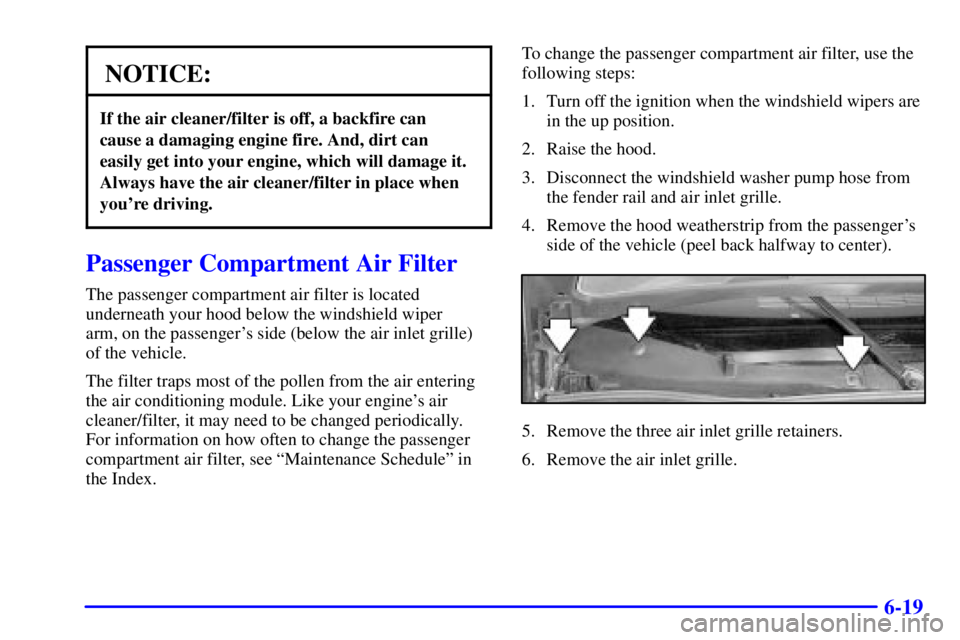
5. Remove the three air inlet grille retainers.
6. Remove the air inlet grille.
