Page 265 of 395

6-
6-1
Section 6 Service and Appearance Care
Here you will find information about the care of your vehicle. This section begins with service and fuel information,
and then it shows how to check important fluid and lubricant levels. There is also technical information about your
vehicle, and a part devoted to its appearance care.
6
-2 Service
6
-3 Fuel
6
-5 Fuels in Foreign Countries
6
-6 Filling Your Tank
6
-8 Filling a Portable Fuel Container
6
-9 Checking Things Under the Hood
6
-12 Engine Oil
6
-17 Engine Air Cleaner/Filter
6
-20 Passenger Compartment Air Filter
6
-20 Supercharger Oil
6
-21 Automatic Transaxle Fluid
6
-25 Engine Coolant
6
-28 Radiator Pressure Cap
6
-28 Power Steering Fluid
6
-29 Windshield Washer Fluid
6
-31 Brakes
6
-34 Battery6
-35 Bulb Replacement
6
-46 Windshield Wiper Blade Replacement
6
-48 Tires
6
-57 Appearance Care
6
-58 Cleaning the Inside of Your Vehicle
6
-62 Cleaning the Outside of Your Vehicle
6
-64 Underbody Maintenance
6
-64 Chemical Paint Spotting
6
-65 GM Vehicle Care/Appearance Materials
6
-66 Vehicle Identification Number (VIN)
6
-66 Service Parts Identification Label
6
-67 Electrical System
6
-73 Removing the Rear Seat Cushion
6
-76 Replacement Bulbs
6
-76 Capacities and Specifications
6
-77 Normal Maintenance Replacement Parts
Page 270 of 395
6-6
Filling Your Tank
CAUTION:
Gasoline vapor is highly flammable. It burns
violently, and that can cause very bad injuries.
Don't smoke if you're near gasoline or refueling
your vehicle. Keep sparks, flames and smoking
materials away from gasoline.
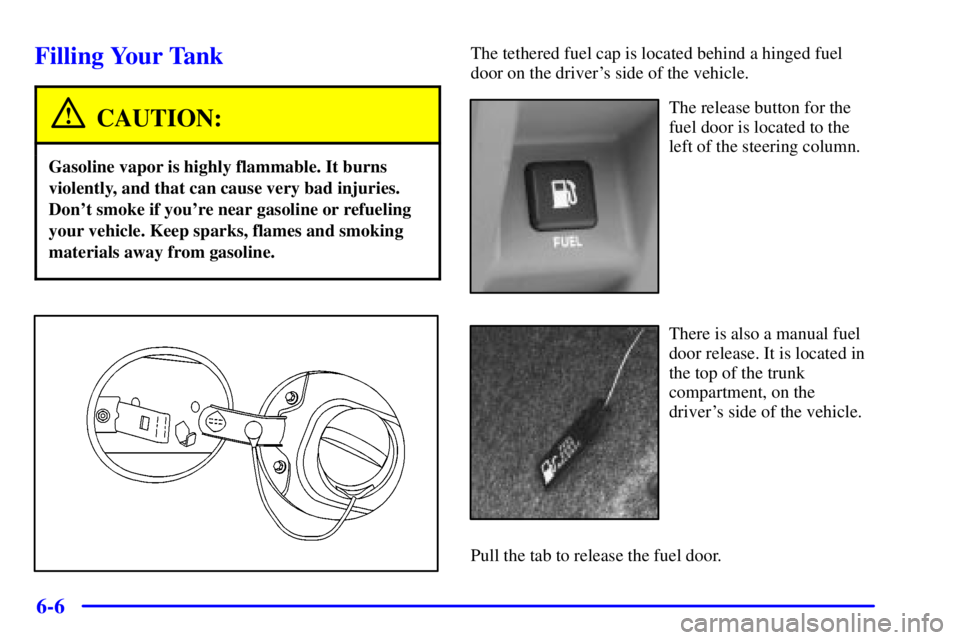
The tethered fuel cap is located behind a hinged fuel
door on the driver's side of the vehicle.
The release button for the
fuel door is located to the
left of the steering column.
There is also a manual fuel
door release. It is located in
the top of the trunk
compartment, on the
driver's side of the vehicle.
Pull the tab to release the fuel door.
Page 292 of 395
6-28
CAUTION:
You can be burned if you spill coolant on hot
engine parts. Coolant contains ethylene glycol,
and it will burn if the engine parts are hot
enough. Don't spill coolant on a hot engine.
Occasionally check the coolant level in the radiator. For
information on how to add coolant to the radiator, see
ªCooling Systemº in the Index.
Radiator Pressure Cap
NOTICE:
Your radiator pressure cap is a 15 psi (105 kPa)
pressure
-type cap and must be tightly installed to
prevent coolant loss and possible engine damage
from overheating. Be sure the arrows on the cap
line up with the overflow tube on the radiator
filler neck.
See ªEngine Compartment Overviewº in the Index for
more information on location.
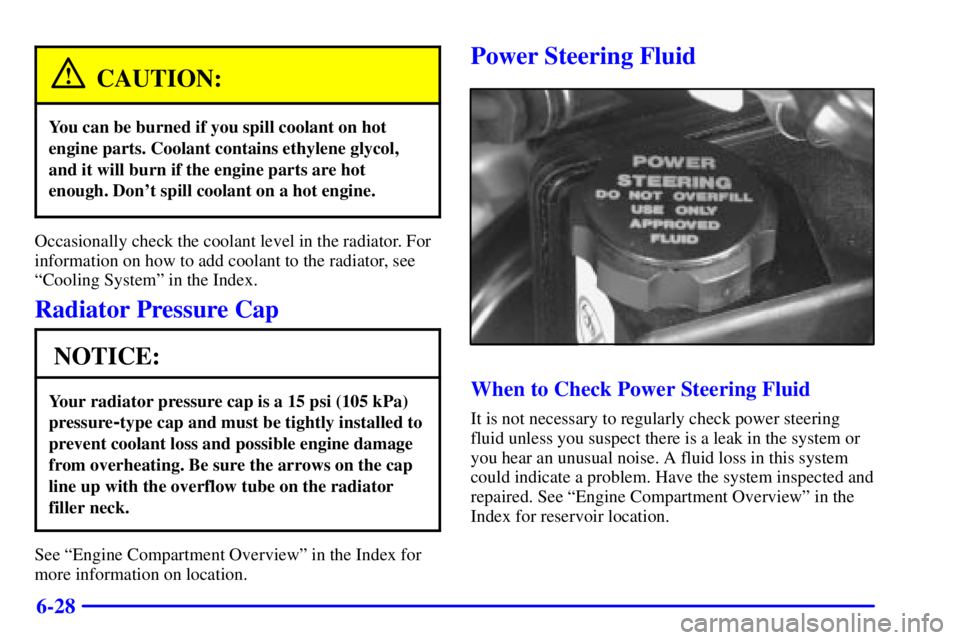
Power Steering Fluid
When to Check Power Steering Fluid
It is not necessary to regularly check power steering
fluid unless you suspect there is a leak in the system or
you hear an unusual noise. A fluid loss in this system
could indicate a problem. Have the system inspected and
repaired. See ªEngine Compartment Overviewº in the
Index for reservoir location.
Page 293 of 395
6-29 How to Check Power Steering Fluid
Turn the key off, let the engine compartment cool down,
wipe the cap and the top of the reservoir clean, then
unscrew the cap and wipe the dipstick with a clean rag.
Replace the cap and completely tighten it. Then remove
the cap again and look at the fluid level on the dipstick.
The level should be at the FULL COLD mark. If
necessary, add only enough fluid to bring the level
up to the mark.
What to Use
To determine what kind of fluid to use, see
ªRecommended Fluids and Lubricantsº in the Index.
Always use the proper fluid. Failure to use the proper
fluid can cause leaks and damage hoses and seals.
Windshield Washer Fluid
What to Use
When you need windshield washer fluid, be sure to read
the manufacturer's instructions before use. If you will be
operating your vehicle in an area where the temperature
may fall below freezing, use a fluid that has sufficient
protection against freezing. See ªEngine Compartment
Overviewº in the Index for reservoir location.
Page 376 of 395

7-35
Part C: Periodic
Maintenance Inspections
Listed in this part are inspections and services which
should be performed at least twice a year (for instance,
each spring and fall). You should let your dealer's
service department or other qualified service center
do these jobs. Make sure any necessary repairs are
completed at once.
Proper procedures to perform these services may be
found in a service manual. See ªService and Owner
Publicationsº in the Index.
Steering, Suspension and Front Drive Axle
Boot and Seal Inspection
Inspect the front and rear suspension and steering
system for damaged, loose or missing parts, signs of
wear or lack of lubrication. Inspect the power steering
lines and hoses for proper hook
-up, binding, leaks,
cracks, chafing, etc. Clean and then inspect the drive
axle boot seals for damage, tears or leakage. Replace
seals if necessary.
Exhaust System Inspection
Inspect the complete exhaust system. Inspect the body
near the exhaust system. Look for broken, damaged,
missing or out
-of-position parts as well as open seams,
holes, loose connections or other conditions which could
cause a heat build
-up in the floor pan or could let
exhaust fumes into the vehicle. See ªEngine Exhaustº
in the Index.
Page 378 of 395

7-37
Part D: Recommended Fluids
and Lubricants
Fluids and lubricants identified below by name,
part number or specification may be obtained from
your dealer.
USAGE
FLUID/LUBRICANT
Engine OilEngine oil with the American
Petroleum Institute Certified for
Gasoline Engines starburst symbol
of the proper viscosity. To
determine the preferred viscosity
for your vehicle's engine, see
ªEngine Oilº in the Index.
Engine Coolant50/50 mixture of clean, drinkable
water and use only GM
Goodwrench
� DEX-COOL� or
Havoline� DEX-COOL�
Coolant. See ªEngine Coolantº in
the Index.
USAGEFLUID/LUBRICANT
Hydraulic
Brake SystemDelco Supreme 11� Brake Fluid
(GM Part No. 12377967 or
equivalent DOT
-3 brake fluid).
Windshield
Washer SolventGM Optikleen� Washer
Solvent (GM Part No. 1051515)
or equivalent.
Parking Brake
Cable GuidesChassis Lubricant (GM Part
No. 12377985 or equivalent) or
lubricant meeting requirements
of NLGI # 2, Category LB
or GC
-LB.
Power
Steering SystemGM Power Steering Fluid
(GM Part No. 1052884
- 1 pint,
1050017
- 1 quart, or equivalent).
Automatic
TransaxleDEXRON�-III Automatic
Transmission Fluid.
Key
Lock CylindersMulti-Purpose Lubricant,
Superlube� (GM Part
No. 12346241 or equivalent).
Page 395 of 395

8-12
SERVICE PUBLICATIONS ORDERING INFORMATION
Service Manuals
Service Manuals have the diagnosis and repair
information on engines, transmission, axle, suspension,
brakes, electrical, steering, body, etc.
RETAIL SELL PRICE: $120.00
Transmission, Transaxle, Transfer Case
Unit Repair Manual
This manual provides information on unit repair
service procedures, adjustments and specifications
for GM transmissions, transaxles and transfer cases.
RETAIL SELL PRICE: $50.00
Service Bulletins
Service Bulletins give technical service information
needed to knowledgeably service General Motors cars
and trucks. Each bulletin contains instructions to assist
in the diagnosis and service of your vehicle.
Owner's Information
Owner publications are written specifically for owners
and intended to provide basic operational information
about the vehicle. The owner's manual will include the
Maintenance Schedule for all models.
In
-Portfolio: Includes a Portfolio, Owner's Manual and
Warranty Booklet.
RETAIL SELL PRICE: $35.00
Without Portfolio: Owner's Manual only.
RETAIL SELL PRICE: $25.00
Current and Past Model Order Forms
Service Publications are available for current and
past model GM vehicles. To request an order form,
please specify year and model name of the vehicle.
ORDER TOLL FREE: 1-800-551-4123 ± Monday-Friday 8:00 AM ± 6:00 PM Eastern TimeVisit Helm, Inc. on the World Wide Web at: www.helminc.com For Credit Card Orders Only (VISA-MasterCard-Discover)
Helm, Incorporated � P.O. Box 07130 � Detroit, MI 48207
Prices are subject to change without notice and without Note to Canadian Customers: All listed prices are quoted in U.S. funds.
incurring obligation. Allow ample time for delivery. Canadian residents are to make checks payable in U.S. funds.