Page 85 of 395

2-22
This device complies with RSS-210 of Industry Canada.
Operation is subject to the following two conditions:
(1) this device may not cause interference, and (2) this
device must accept any interference received, including
interference that may cause undesired operation of
the device.
Changes or modifications to this system by other than
an authorized service facility could void authorization to
use this equipment.
PASS
-Key III uses a radio frequency transponder in the
key that matches a decoder in your vehicle.
When the PASS
-Key III system senses that someone is
using the wrong key, it shuts down the vehicle's starter
and fuel systems. The starter will not work and fuel will
stop being delivered to the engine. Anyone using a
trial
-and-error method to start the vehicle will be
discouraged because of the high number of electrical
key codes.
When trying to start the vehicle if the engine does not
start and the SECURITY light comes on, the key may
have a damaged transponder. Turn the ignition off and
try again.If the engine still does not start, and the key appears to
be undamaged, try another ignition key. At this time,
you may also want to check the fuse (see ªFuses and
Circuit Breakersº in the Index). If the engine still does
not start with the other key, your vehicle needs service.
If your vehicle does start, the first key may be faulty.
See your dealer who can service the PASS
-Key III
to have a new key made.
It is possible for the PASS
-Key III decoder to learn the
transponder value of a new or replacement key. Up to
10 additional keys may be programmed for the vehicle.
This procedure is for learning additional keys only.
Canadian Owners: If you lose or damage your keys,
only a GM dealer can service PASS
-Key III to have new
keys made. To program additional keys you will need
two current driver's keys. You must add a step to the
following procedure. After Step 2 repeat Steps 1 and 2
with the second current driver's key. Then continue
with Step 3.
To program the new key, do the following:
1. Verify that the new key has ªPK3º stamped on it.
2. Insert the current driver's key in the ignition and
start the engine. If the engine will not start, see your
dealer for service.
Page 87 of 395
2-24
Ignition Positions
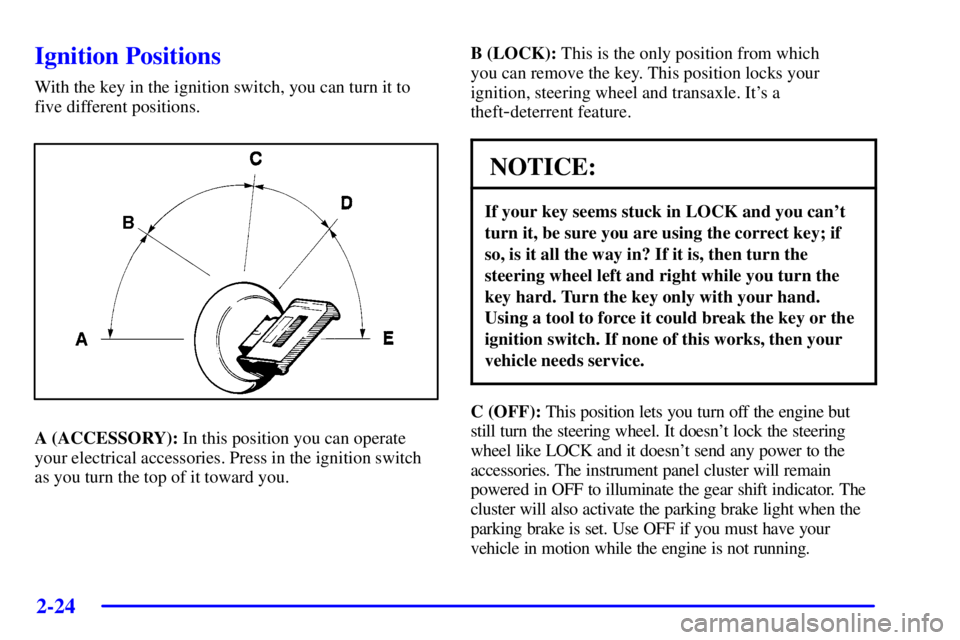
With the key in the ignition switch, you can turn it to
five different positions.
A (ACCESSORY): In this position you can operate
your electrical accessories. Press in the ignition switch
as you turn the top of it toward you.B (LOCK): This is the only position from which
you can remove the key. This position locks your
ignition, steering wheel and transaxle. It's a
theft
-deterrent feature.
NOTICE:
If your key seems stuck in LOCK and you can't
turn it, be sure you are using the correct key; if
so, is it all the way in? If it is, then turn the
steering wheel left and right while you turn the
key hard. Turn the key only with your hand.
Using a tool to force it could break the key or the
ignition switch. If none of this works, then your
vehicle needs service.
C (OFF): This position lets you turn off the engine but
still turn the steering wheel. It doesn't lock the steering
wheel like LOCK and it doesn't send any power to the
accessories. The instrument panel cluster will remain
powered in OFF to illuminate the gear shift indicator. The
cluster will also activate the parking brake light when the
parking brake is set. Use OFF if you must have your
vehicle in motion while the engine is not running.
Page 88 of 395

2-25
D (RUN): This is the position that the switch returns to
after you start your engine and release the ignition key.
This is the position for driving. Even when the engine is
not running, you can use RUN to operate your electrical
accessories and to display some instrument panel
warning lights.
E (START): This position starts your engine. When the
engine starts, release the ignition key. The switch will
return to RUN for normal driving.
Key Reminder Warning
If you leave your key in the ignition, with the engine
off, you will hear a warning chime when you open the
driver's door.
Retained Accessory Power (RAP)
After you turn the ignition off and remove the key,
you will still have power to such accessories as the
radio, sunroof (option) and power windows for up
to 10 minutes. Power is stopped if you open a door.
Starting Your Engine
Move your shift lever to PARK (P) or NEUTRAL (N).
Your engine won't start in any other position
-- that's
a safety feature. To restart when you're already moving,
use NEUTRAL (N) only.
NOTICE:
Don't try to shift to PARK (P) if your vehicle
is moving. If you do, you could damage the
transaxle. Shift to PARK (P) only when your
vehicle is stopped.
1. With your foot off the accelerator pedal, turn your
ignition key to START. When the engine starts, let
go of the key. The idle speed will go down as your
engine gets warm.
Page 91 of 395
2-28
Automatic Transaxle Operation
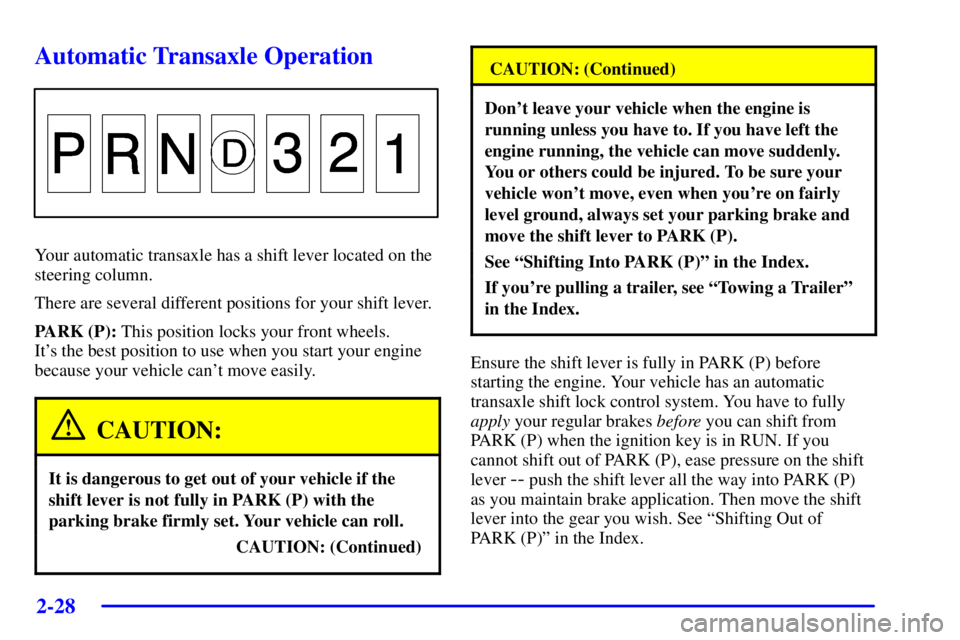
Your automatic transaxle has a shift lever located on the
steering column.
There are several different positions for your shift lever.
PARK (P): This position locks your front wheels.
It's the best position to use when you start your engine
because your vehicle can't move easily.
CAUTION:
It is dangerous to get out of your vehicle if the
shift lever is not fully in PARK (P) with the
parking brake firmly set. Your vehicle can roll.
CAUTION: (Continued)
CAUTION: (Continued)
Don't leave your vehicle when the engine is
running unless you have to. If you have left the
engine running, the vehicle can move suddenly.
You or others could be injured. To be sure your
vehicle won't move, even when you're on fairly
level ground, always set your parking brake and
move the shift lever to PARK (P).
See ªShifting Into PARK (P)º in the Index.
If you're pulling a trailer, see ªTowing a Trailerº
in the Index.
Ensure the shift lever is fully in PARK (P) before
starting the engine. Your vehicle has an automatic
transaxle shift lock control system. You have to fully
apply your regular brakes before you can shift from
PARK (P) when the ignition key is in RUN. If you
cannot shift out of PARK (P), ease pressure on the shift
lever
-- push the shift lever all the way into PARK (P)
as you maintain brake application. Then move the shift
lever into the gear you wish. See ªShifting Out of
PARK (P)º in the Index.
Page 94 of 395

2-31
FIRST (1): This position gives you even more power
(but lower fuel economy) than SECOND (2). You can
use it on very steep hills, or in deep snow or mud.
If the selector lever is put in FIRST (1), the transaxle
won't shift into first gear until the vehicle is going
slowly enough.
NOTICE:
If your front wheels can't rotate, don't try to
drive. This might happen if you were stuck in
very deep sand or mud or were up against a solid
object. You could damage your transaxle.
Also, if you stop when going uphill, don't hold
your vehicle there with only the accelerator
pedal. This could overheat and damage the
transaxle. Use your brakes or shift into PARK (P)
to hold your vehicle in position on a hill.
Parking Brake
This vehicle has a PUSH
TO RELEASE parking
brake pedal. To set the
parking brake, hold the
regular brake pedal down
with your right foot. Push
down the parking brake
pedal with your left foot.
Whether the ignition key is in RUN or OFF, the brake
system warning light stays on while the parking brake
is set.
The parking brake uses the brakes on the rear wheels.
Page 96 of 395
2-33
1. Hold the brake pedal down with your right foot and
set the parking brake.
2. Move the shift lever into PARK (P) as follows:
�Pull the lever toward you.
�Move the lever up as far as it will go.
3. Move the ignition key to LOCK.
4. Remove the ignition key and take it with you. If you
can leave your vehicle with the ignition key in your
hand, your vehicle is in PARK (P).
Page 98 of 395
2-35
Shifting Out of PARK (P)
Your vehicle has an automatic transaxle shift lock
control system. You have to fully apply your regular
brake before you can shift from PARK (P) when the
ignition is in RUN. See ªAutomatic Transaxleº in
the Index.
If you cannot shift out of PARK (P), ease pressure on
the shift lever
-- push the shift lever all the way into
PARK (P) as you maintain brake application. Then
move the shift lever into the gear you want.
If you ever hold the brake pedal down but still can't
shift out of PARK (P), try this:
1. Turn the key to OFF. Open and close the driver's
door to turn off RAP.
2. Apply and hold the brake until the end of Step 4.
3. Shift to NEUTRAL (N).
4. Start the vehicle and then shift to the drive gear
you want.
5. Have the vehicle fixed as soon as you can.
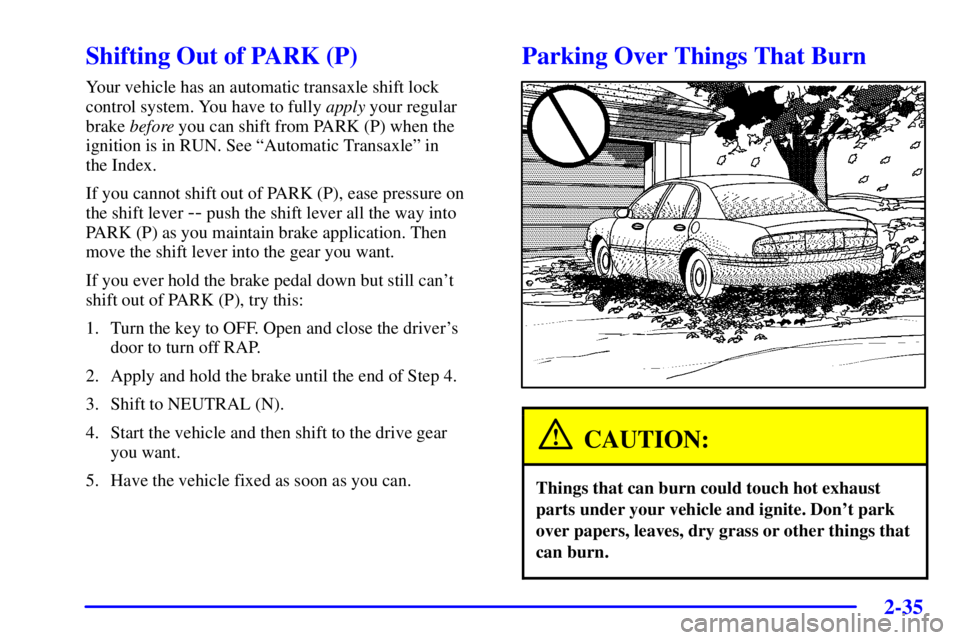
Parking Over Things That Burn
CAUTION:
Things that can burn could touch hot exhaust
parts under your vehicle and ignite. Don't park
over papers, leaves, dry grass or other things that
can burn.
Page 104 of 395

2-41
The windshield wipers also remain in a ªhigh parkº
position (the wipers are stopped on the windshield and
are not in the normal park position), even when the
ignition is turned off.
NOTICE:
Turn the wiper band to OFF to avoid wiper
damage when going through an automatic
car wash.
The MIST and wash cycles operate as normal and are
not affected by the moisture
-sensing function. The
system can be overridden at any time by manually
turning the wiper band to LO or HI speed.
NOTICE:
Do not place stickers or other items on the
exterior glass surface directly in front of the
moisture sensor. Doing this could cause the
moisture sensor to malfunction.
Windshield Washer
At the top of the multifunction lever there is a paddle
with the word PUSH on it. For ªprogrammedº
operation, press and release the paddle. The washer will
provide a measured amount of fluid to the windshield
and the wiper will either stop or return to your original
wiping speed. For ªdemandº operation, press and hold
the paddle for at least two seconds. Release the paddle
when you have enough fluid and the wipers will either
stop or return to your original wiping speed.
CAUTION:
In freezing weather, don't use your washer until
the windshield is warmed. Otherwise the washer
fluid can form ice on the windshield, blocking
your vision.
If your vehicle is equipped with a DIC, a WINDSHIELD
WASHER FLUID LOW message will appear on the
instrument panel cluster when the vehicle is low on
washer fluid.
