Page 95 of 395
2-32
To release the parking brake, hold the regular brake
pedal down and push the parking brake pedal with your
left foot. This will release the parking brake pedal.
When you lift your left foot, the parking brake pedal
will follow it to the release position.
If you try to drive approximately 20 feet (6.1 m) with
the parking brake on, the brake light stays on and
a continuous chime sounds until you release the
parking brake.
NOTICE:
Driving with the parking brake on can cause
your rear brakes to overheat. You may have to
replace them, and you could also damage other
parts of your vehicle.
If you are towing a trailer and are parking on any hill,
see ªTowing a Trailerº in the Index. That part shows
what to do first to keep the trailer from moving.
Shifting Into PARK (P)
CAUTION:
It can be dangerous to get out of your vehicle if
the shift lever is not fully in PARK (P) with the
parking brake firmly set. Your vehicle can roll. If
you have left the engine running, the vehicle can
move suddenly. You or others could be injured.
To be sure your vehicle won't move, even when
you're on fairly level ground, use the steps that
follow. If you're pulling a trailer, see ªTowing a
Trailerº in the Index.
Page 96 of 395
2-33
1. Hold the brake pedal down with your right foot and
set the parking brake.
2. Move the shift lever into PARK (P) as follows:
�Pull the lever toward you.
�Move the lever up as far as it will go.
3. Move the ignition key to LOCK.
4. Remove the ignition key and take it with you. If you
can leave your vehicle with the ignition key in your
hand, your vehicle is in PARK (P).
Page 97 of 395
2-34
Leaving Your Vehicle With the
Engine Running
CAUTION:
It can be dangerous to leave your vehicle with the
engine running. Your vehicle could move
suddenly if the shift lever is not fully in PARK (P)
with the parking brake firmly set. And, if you
leave the vehicle with the engine running, it could
overheat and even catch fire. You or others could
be injured. Don't leave your vehicle with the
engine running unless you have to.
If you have to leave your vehicle with the engine
running, be sure your vehicle is in PARK (P) and your
parking brake is firmly set before you leave it. After
you've moved the shift lever into PARK (P), hold the
regular brake pedal down. Then, see if you can move the
shift lever away from PARK (P) without first pulling it
toward you. If you can, it means that the shift lever
wasn't fully locked into PARK (P).
Torque Lock
If you are parking on a hill and you don't shift your
transaxle into PARK (P) properly, the weight of the
vehicle may put too much force on the parking pawl in
the transaxle. You may find it difficult to pull the shift
lever out of PARK (P). This is called ªtorque lock.º
To prevent torque lock, set the parking brake and
then shift into PARK (P) properly before you leave
the driver's seat. To find out how, see ªShifting Into
PARK (P)º in the Index.
When you are ready to drive, move the shift lever out of
PARK (P) before you release the parking brake.
If torque lock does occur, you may need to have another
vehicle push yours a little uphill to take some of the
pressure from the parking pawl in the transaxle, so you
can pull the shift lever out of PARK (P).
Page 100 of 395
2-37
CAUTION:
It can be dangerous to get out of your vehicle if
the shift lever is not fully in PARK (P) with the
parking brake firmly set. Your vehicle can roll.
Don't leave your vehicle when the engine is
running unless you have to. If you've left the
engine running, the vehicle can move suddenly.
You or others could be injured. To be sure your
vehicle won't move, even when you're on fairly
level ground, always set your parking brake and
move the shift lever to PARK (P).
Follow the proper steps to be sure your vehicle won't
move. See ªShifting Into PARK (P)º in the Index.
If you are parking on a hill and if you're pulling a
trailer, also see ªTowing a Trailerº in the Index.
Horn
Press on the center area of the steering wheel to sound
the horn.
Tilt Wheel
A tilt wheel allows you to adjust the steering wheel
before you drive. You can also raise it to the highest
level to give your legs more room when you exit and
enter the vehicle.
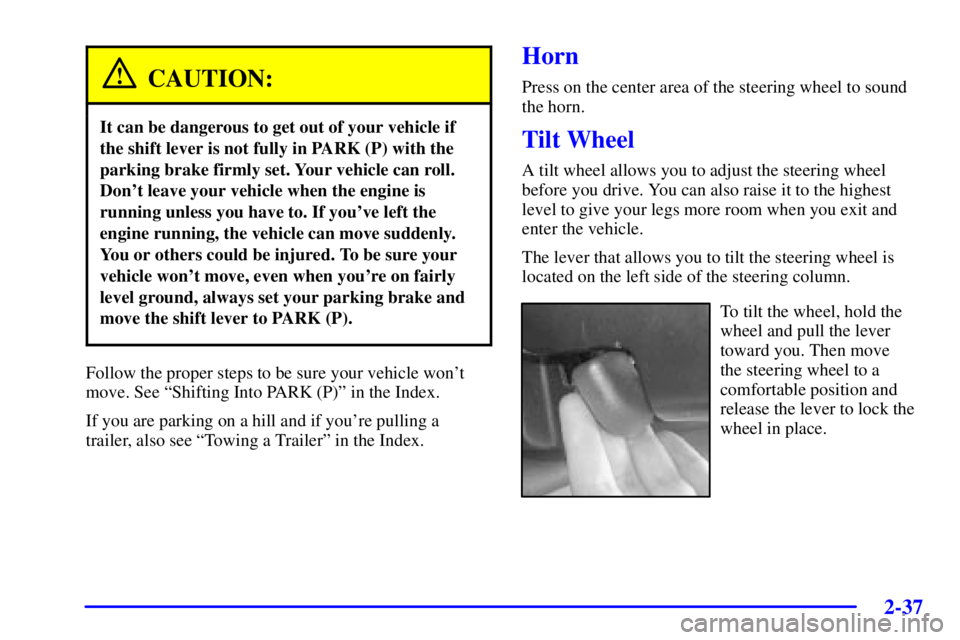
The lever that allows you to tilt the steering wheel is
located on the left side of the steering column.
To tilt the wheel, hold the
wheel and pull the lever
toward you. Then move
the steering wheel to a
comfortable position and
release the lever to lock the
wheel in place.
Page 102 of 395

2-39
As you signal a turn or a lane change, if the arrows flash
at twice the normal rate, this may indicate that a signal
bulb may be burned out and other drivers won't see your
turn signal.
If a bulb is burned out, replace it to help avoid an
accident. If the arrows don't go on at all when you
signal a turn, check the fuse (see ªFuses and Circuit
Breakersº in the Index) and for burned
-out bulbs.
If you have a trailer towing option with added wiring for
the trailer lamps, the signal indicator will flash even if a
turn signal bulb is burned out. Check the front and rear
turn signal lamps regularly to make sure they are
working. You do not need to add a different flasher.
Turn Signal On Chime
If your turn signal is left on for more than 3/4 of a mile
(1.2 km), a chime will sound at each flash of the turn
signal. To turn off the chime, move the turn signal lever
to the off position.
Headlamp High/Low-Beam Changer
To change the headlamps from low beam to high or
high to low, pull the turn signal lever toward you, then
release it.
When the high beams are
on, a light on the instrument
panel cluster will also be on.
If your vehicle is equipped
with HUD, this light
will also appear in the
display area.
Flash-to-Pass Feature
This feature lets you use your high-beam headlamps to
signal a driver in front of you that you want to pass. It
works even if your headlamps are off.
To use it, pull the turn signal lever toward you, but not
so far that you hear a click.
If your headlamps are off or on low beam, your
high
-beam headlamps will turn on. They'll stay on as
long as you hold the lever toward you and the
high
-beam indicator on the instrument panel cluster
comes on. Release the lever to turn the high
-beam
headlamps off.
Page 114 of 395

2-51 Electrochromic Day/Night Rearview Mirror
with Compass (If Equipped)
Your vehicle may have an electrochromic inside
rearview mirror with a compass. Your vehicle's mirror
may also contain OnStar
� controls.
(On/Off): This is the on/off button for mirrors
equipped with OnStar controls.
Pressing the MIRROR button (or the on/off button for
mirrors equipped with OnStar controls) located at the
bottom of the mirror, turns the automatic dimming
feature on or off.
The mirror also includes an eight
-point compass
display in the upper right corner of the mirror face.
When on, the compass automatically calibrates as
the vehicle is driven.
When cleaning the mirror, use a paper towel or similar
material dampened with glass cleaner. Do not spray
glass cleaner directly on the mirror as that may cause
the liquid cleaner to enter the mirror housing.Mirror Operation
To turn on the automatic dimming feature, press
MIRROR (or press and hold the on/off button for
about three seconds for mirrors equipped with OnStar
controls). To turn off automatic dimming, press
MIRROR (or press and hold the on/off button for
about three seconds for mirrors equipped with OnStar
controls) again. The green indicator light will be
illuminated when this feature is active. The automatic
dimming feature will be active each time the vehicle
is started.
Compass Operation
Press COMPASS (or the on/off button for mirrors
equipped with OnStar controls) once to turn the
compass on or off.
When the ignition and the compass feature are on,
the compass will show two character boxes for
approximately two seconds. After two seconds, the
mirror will display the compass heading.
Page 129 of 395
2-66
Sunroof (Option)
The sunroof has both manual and express features for
opening the glass panel and sunshade.
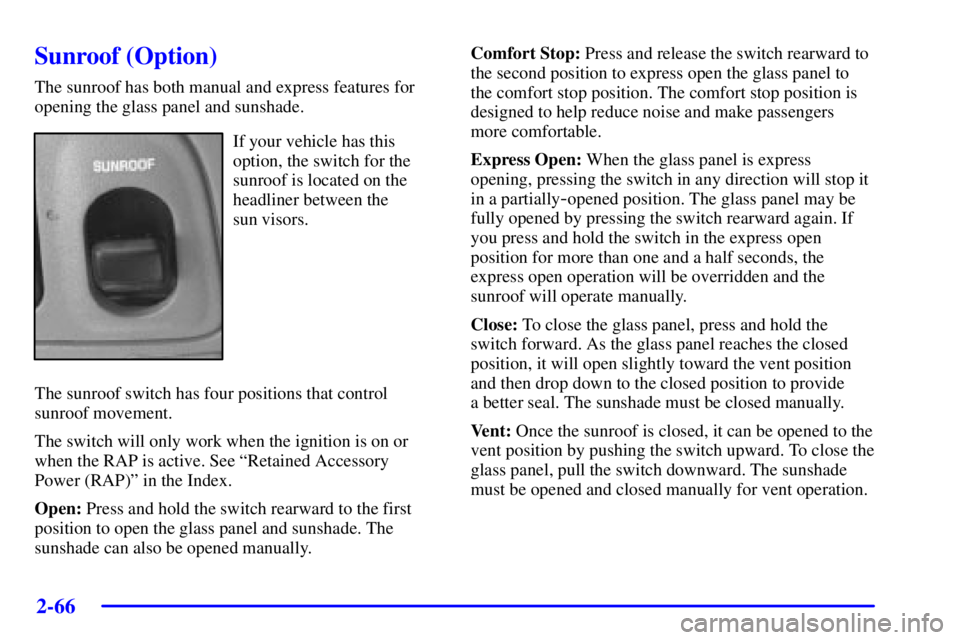
If your vehicle has this
option, the switch for the
sunroof is located on the
headliner between the
sun visors.
The sunroof switch has four positions that control
sunroof movement.
The switch will only work when the ignition is on or
when the RAP is active. See ªRetained Accessory
Power (RAP)º in the Index.
Open: Press and hold the switch rearward to the first
position to open the glass panel and sunshade. The
sunshade can also be opened manually.Comfort Stop: Press and release the switch rearward to
the second position to express open the glass panel to
the comfort stop position. The comfort stop position is
designed to help reduce noise and make passengers
more comfortable.
Express Open: When the glass panel is express
opening, pressing the switch in any direction will stop it
in a partially
-opened position. The glass panel may be
fully opened by pressing the switch rearward again. If
you press and hold the switch in the express open
position for more than one and a half seconds, the
express open operation will be overridden and the
sunroof will operate manually.
Close: To close the glass panel, press and hold the
switch forward. As the glass panel reaches the closed
position, it will open slightly toward the vent position
and then drop down to the closed position to provide
a better seal. The sunshade must be closed manually.
Vent: Once the sunroof is closed, it can be opened to the
vent position by pushing the switch upward. To close the
glass panel, pull the switch downward. The sunshade
must be opened and closed manually for vent operation.
Page 141 of 395
2-78
Brake System Warning Light
Your vehicle's hydraulic brake system is divided into
two parts. If one part isn't working, the other part can
still work and stop you. For good braking, though, you
need both parts working well.
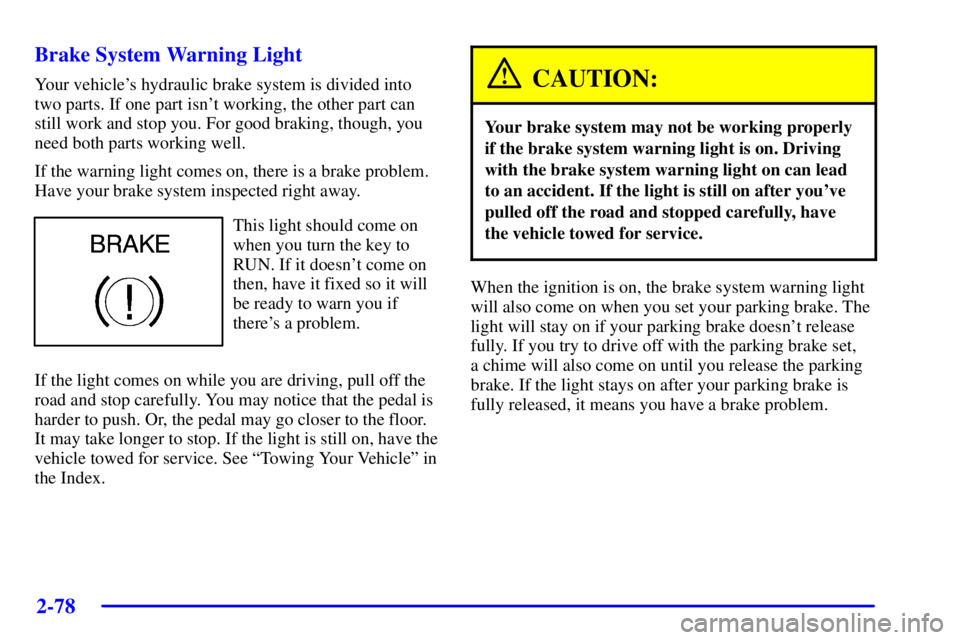
If the warning light comes on, there is a brake problem.
Have your brake system inspected right away.
This light should come on
when you turn the key to
RUN. If it doesn't come on
then, have it fixed so it will
be ready to warn you if
there's a problem.
If the light comes on while you are driving, pull off the
road and stop carefully. You may notice that the pedal is
harder to push. Or, the pedal may go closer to the floor.
It may take longer to stop. If the light is still on, have the
vehicle towed for service. See ªTowing Your Vehicleº in
the Index.
CAUTION:
Your brake system may not be working properly
if the brake system warning light is on. Driving
with the brake system warning light on can lead
to an accident. If the light is still on after you've
pulled off the road and stopped carefully, have
the vehicle towed for service.
When the ignition is on, the brake system warning light
will also come on when you set your parking brake. The
light will stay on if your parking brake doesn't release
fully. If you try to drive off with the parking brake set,
a chime will also come on until you release the parking
brake. If the light stays on after your parking brake is
fully released, it means you have a brake problem.
