3-7
To program a personal choice comfort control setting,
do the following:
1. Choose a climate control setting for the driver and
if desired, for the passenger. See ªDual Automatic
ComforTemp� Climate Controlº and ªPassenger
Climate Controlº earlier in this section.
2. Locate the memory buttons on the driver's door panel.
3. Press a memory button (1 or 2) until you hear two
beeps. The beeps confirm that your selection has
been saved and can now be recalled.
Follow these steps each time you want to change the
stored settings. For more information on the memory
feature, see ªMemory Seat and Mirrorsº in the Index.
Ventilation System
For mild outside temperatures when little heating or
cooling is needed, use VENT in manual mode to direct
outside air through your vehicle. Air will flow through
any of the outlets depending on outside temperatures
and climate control settings.
Your vehicle's flow
-through ventilation system supplies
outside air into the vehicle when it's moving. When the
vehicle is not moving, you can get outside air to flow
through your vehicle by pressing VENT and then using
the AIR FLOW button to select a mode and the FAN
button to select a fan speed.
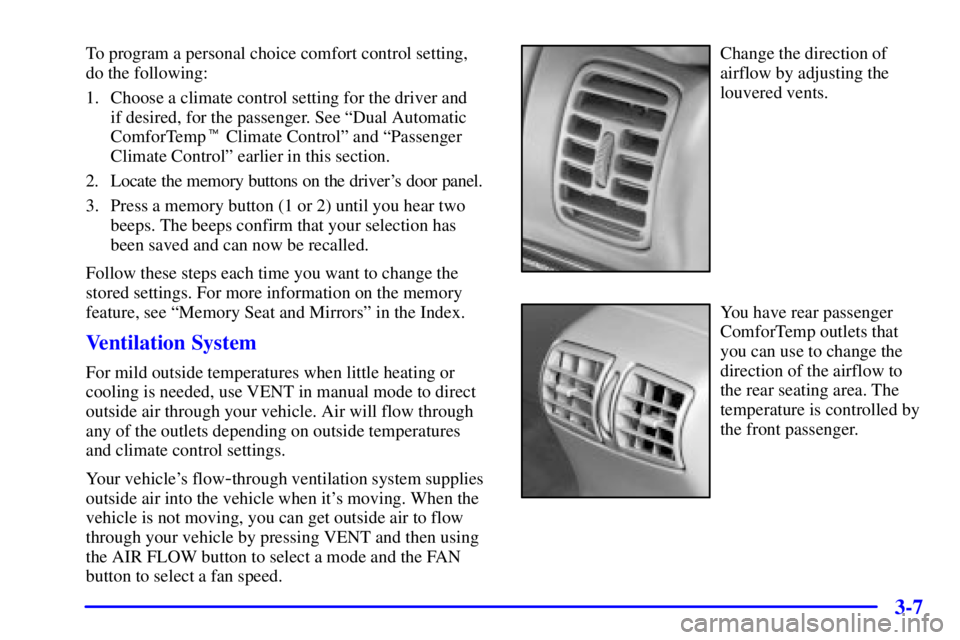
Change the direction of
airflow by adjusting the
louvered vents.
You have rear passenger
ComforTemp outlets that
you can use to change the
direction of the airflow to
the rear seating area. The
temperature is controlled by
the front passenger.
3-8
Ventilation Tips
�Keep the hood and front air inlet free of ice, snow or
any other obstruction such as leaves. The heater and
defroster will work better, reducing the chance of
fogging your windows.
�Keep the air path under the front seats clear of
objects. This helps air to circulate throughout
your vehicle.
Steering Wheel Controls for
Climate Control
You can control the
temperature inside of your
vehicle using the button
located on your steering
wheel. Press the TEMP
up arrow to increase the
temperature and the TEMP
down arrow to decrease
the temperature.
Audio Systems
Your audio system has been designed to operate easily
and give years of listening pleasure. You will get the
most enjoyment out of it if you acquaint yourself with it
first. Find out what your audio system can do and how
to operate all of its controls to be sure you're getting the
most out of the advanced engineering that went into it.
Your vehicle has a feature called Retained Accessory
Power (RAP). With RAP, you can play your audio
system even after the ignition is turned off. See
ªRetained Accessory Powerº in the Index.
Setting the Clock
Press and hold the HRS button until the correct hour
appears. Press and hold the MIN button until the correct
minute appears.
You may set the clock with the ignition off if you
press RECALL first and follow the same procedure
described above.
6-54 Uniform Tire Quality Grading
Quality grades can be found where applicable on the tire
sidewall between tread shoulder and maximum section
width. For example:
Treadwear 200 Traction AA Temperature A
The following information relates to the system
developed by the United States National Highway
Traffic Safety Administration, which grades tires by
treadwear, traction and temperature performance. (This
applies only to vehicles sold in the United States.) The
grades are molded on the sidewalls of most passenger
car tires. The Uniform Tire Quality Grading system does
not apply to deep tread, winter
-type snow tires,
space
-saver or temporary use spare tires, tires with
nominal rim diameters of 10 to 12 inches (25 to 30 cm),
or to some limited
-production tires.
While the tires available on General Motors passenger
cars and light trucks may vary with respect to these
grades, they must also conform to federal safety
requirements and additional General Motors Tire
Performance Criteria (TPC) standards.Treadwear
The treadwear grade is a comparative rating based on
the wear rate of the tire when tested under controlled
conditions on a specified government test course.
For example, a tire graded 150 would wear one and a
half (1 1/2) times as well on the government course
as a tire graded 100. The relative performance of tires
depends upon the actual conditions of their use,
however, and may depart significantly from the norm
due to variations in driving habits, service practices and
differences in road characteristics and climate.
Traction
-- AA, A, B, C
The traction grades, from highest to lowest, are AA, A,
B, and C. Those grades represent the tire's ability to stop
on wet pavement as measured under controlled
conditions on specified government test surfaces of
asphalt and concrete. A tire marked C may have poor
traction performance. Warning: The traction grade
assigned to this tire is based on straight
-ahead braking
traction tests, and does not include acceleration,
cornering, hydroplaning, or peak traction characteristics.