Page 242 of 357
5-24 Removing the Flat Tire and Installing the
Spare Tire
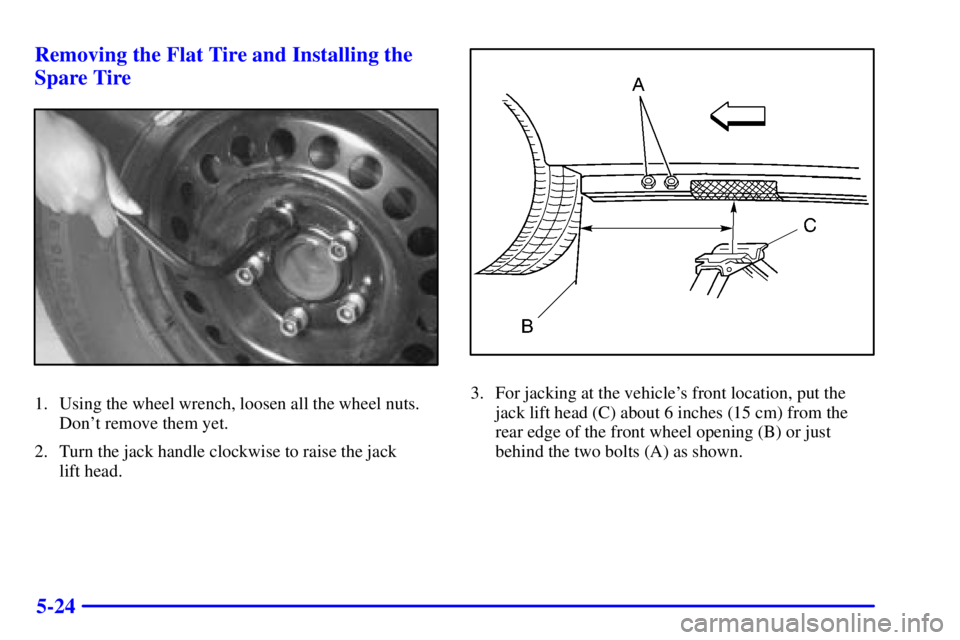
1. Using the wheel wrench, loosen all the wheel nuts.
Don't remove them yet.
2. Turn the jack handle clockwise to raise the jack
lift head.3. For jacking at the vehicle's front location, put the
jack lift head (C) about 6 inches (15 cm) from the
rear edge of the front wheel opening (B) or just
behind the two bolts (A) as shown.
Page 244 of 357
5-26
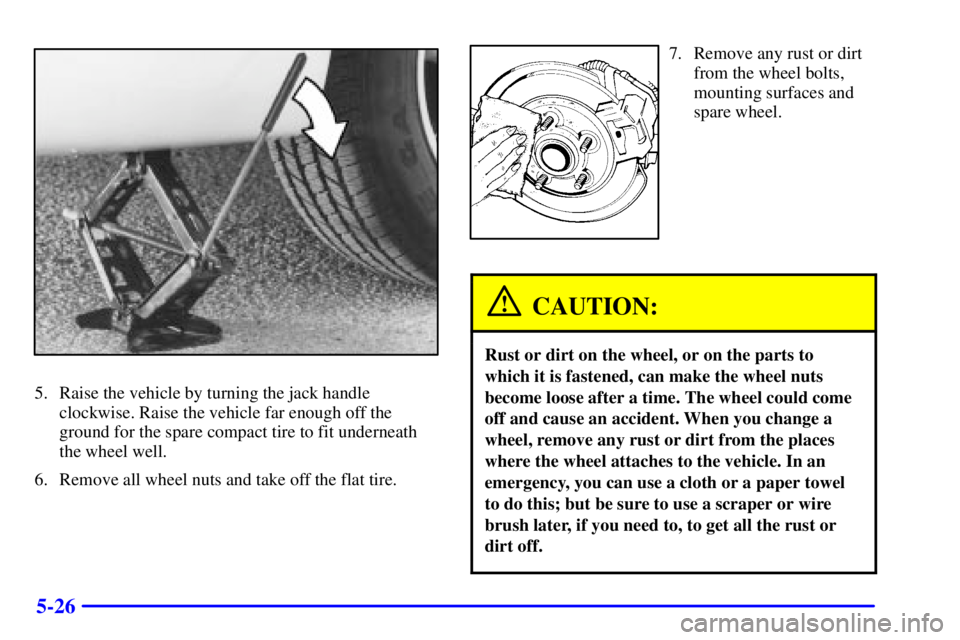
5. Raise the vehicle by turning the jack handle
clockwise. Raise the vehicle far enough off the
ground for the spare compact tire to fit underneath
the wheel well.
6. Remove all wheel nuts and take off the flat tire.
7. Remove any rust or dirt
from the wheel bolts,
mounting surfaces and
spare wheel.
CAUTION:
Rust or dirt on the wheel, or on the parts to
which it is fastened, can make the wheel nuts
become loose after a time. The wheel could come
off and cause an accident. When you change a
wheel, remove any rust or dirt from the places
where the wheel attaches to the vehicle. In an
emergency, you can use a cloth or a paper towel
to do this; but be sure to use a scraper or wire
brush later, if you need to, to get all the rust or
dirt off.
Page 246 of 357
5-28
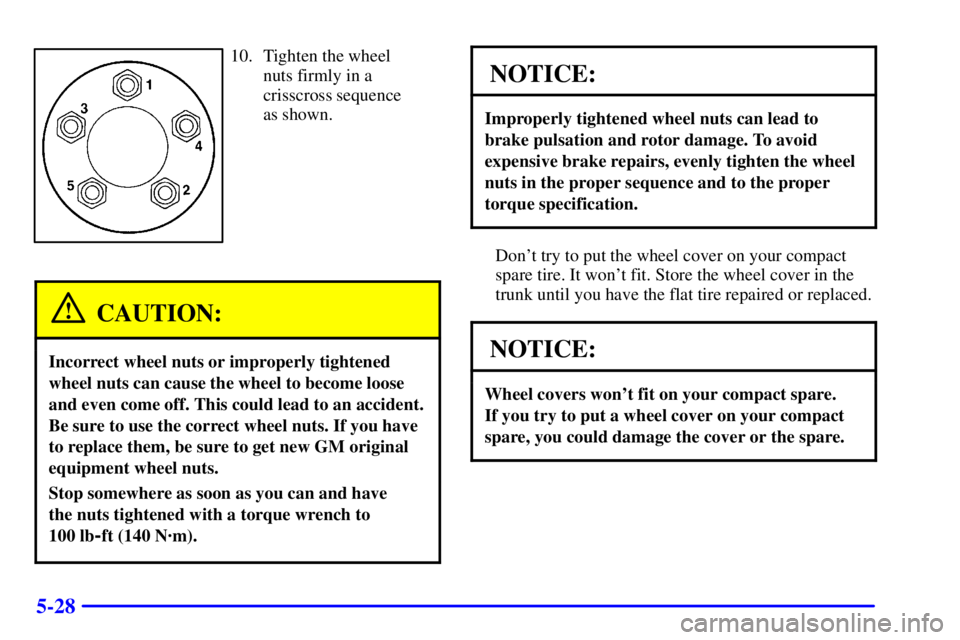
10. Tighten the wheel
nuts firmly in a
crisscross sequence
as shown.
CAUTION:
Incorrect wheel nuts or improperly tightened
wheel nuts can cause the wheel to become loose
and even come off. This could lead to an accident.
Be sure to use the correct wheel nuts. If you have
to replace them, be sure to get new GM original
equipment wheel nuts.
Stop somewhere as soon as you can and have
the nuts tightened with a torque wrench to
100 lb
-ft (140 N´m).
NOTICE:
Improperly tightened wheel nuts can lead to
brake pulsation and rotor damage. To avoid
expensive brake repairs, evenly tighten the wheel
nuts in the proper sequence and to the proper
torque specification.
Don't try to put the wheel cover on your compact
spare tire. It won't fit. Store the wheel cover in the
trunk until you have the flat tire repaired or replaced.
NOTICE:
Wheel covers won't fit on your compact spare.
If you try to put a wheel cover on your compact
spare, you could damage the cover or the spare.
Page 247 of 357
5-29 Storing the Flat Tire and Tools
CAUTION:
Storing a jack, a tire or other equipment in the
passenger compartment of the vehicle could
cause injury. In a sudden stop or collision, loose
equipment could strike someone. Store all these
in the proper place.
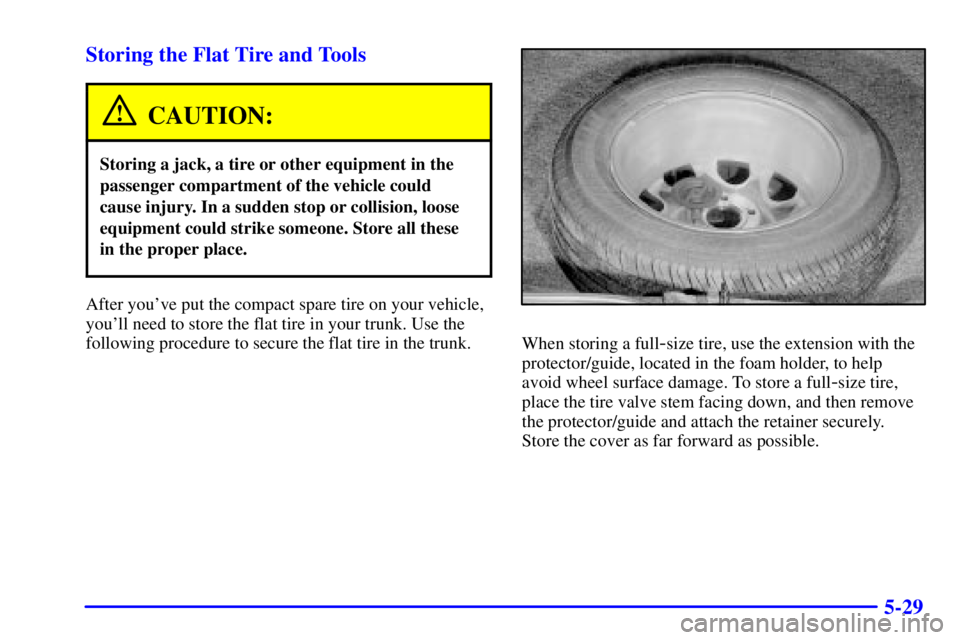
After you've put the compact spare tire on your vehicle,
you'll need to store the flat tire in your trunk. Use the
following procedure to secure the flat tire in the trunk.
When storing a full-size tire, use the extension with the
protector/guide, located in the foam holder, to help
avoid wheel surface damage. To store a full
-size tire,
place the tire valve stem facing down, and then remove
the protector/guide and attach the retainer securely.
Store the cover as far forward as possible.
Page 248 of 357
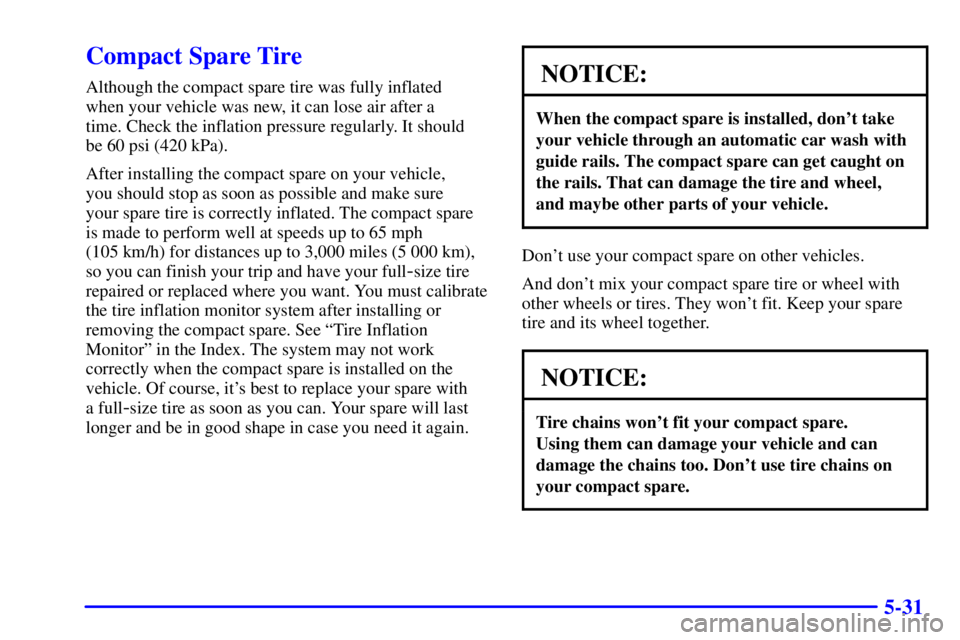
5-30 Storing the Spare Tire and Tools
When storing a compact spare tire in the trunk, put the
protector/guide back in the foam holder.
CAUTION:
Storing a jack, a tire or other equipment in the
passenger compartment of the vehicle could
cause injury. In a sudden stop or collision, loose
equipment could strike someone. Store all these
in the proper place.
The compact spare is for temporary use only. Replace
the compact spare tire with a full
-size tire as soon as you
can. See ªCompact Spare Tireº in the Index. See the
storage instructions label to return your compact spare
to your trunk properly.
Be sure to calibrate your low tire pressure system after
you replace your compact spare tire with a full
-sized
one. See ªLow Tire Inflation Monitorº in the Index.
A. Retainer
B. Cover
C. Compact Spare Tire
D. Nut
E. Jack
F. Wrench
G. Lock Nut Tool
H. Foam Holder
I. Extension and
Protector/Guide
J. Bolt Screw
Page 249 of 357
5-31
Compact Spare Tire
Although the compact spare tire was fully inflated
when your vehicle was new, it can lose air after a
time. Check the inflation pressure regularly. It should
be 60 psi (420 kPa).
After installing the compact spare on your vehicle,
you should stop as soon as possible and make sure
your spare tire is correctly inflated. The compact spare
is made to perform well at speeds up to 65 mph
(105 km/h) for distances up to 3,000 miles (5 000 km),
so you can finish your trip and have your full
-size tire
repaired or replaced where you want. You must calibrate
the tire inflation monitor system after installing or
removing the compact spare. See ªTire Inflation
Monitorº in the Index. The system may not work
correctly when the compact spare is installed on the
vehicle. Of course, it's best to replace your spare with
a full
-size tire as soon as you can. Your spare will last
longer and be in good shape in case you need it again.
NOTICE:
When the compact spare is installed, don't take
your vehicle through an automatic car wash with
guide rails. The compact spare can get caught on
the rails. That can damage the tire and wheel,
and maybe other parts of your vehicle.
Don't use your compact spare on other vehicles.
And don't mix your compact spare tire or wheel with
other wheels or tires. They won't fit. Keep your spare
tire and its wheel together.
NOTICE:
Tire chains won't fit your compact spare.
Using them can damage your vehicle and can
damage the chains too. Don't use tire chains on
your compact spare.
Page 285 of 357

6-35
To check the aim, the vehicle should be properly
prepared as follows:
�The headlamps must be off for one hour prior to
aiming and must remain off during this procedure.
�The vehicle must have all four tires on a perfectly
level surface.
�If necessary, pads may be used on an uneven surface.
�The vehicle should not have any snow, ice or mud
attached to it.
�The vehicle should be fully assembled and all other
work stopped while headlamp aiming is being done.
�There should not be any cargo or loading of the
vehicle, except it should have a full tank of fuel and
one person or 160 lbs. (75 kg) on the driver's seat.
�Close all doors.
�Tires should be properly inflated.
�Rock the vehicle to stabilize the suspension.
Driver's Side Headlamp Shown
A. Vertical Aim Adjustment Screw
B. Horizontal Aim Adjustment Screw
Open the hood and locate the vertical and horizontal
aim indicators. The aiming screw for the vertical aim
indicator (A) is at the center of the headlamp cover and
the aiming screw for the horizontal aim indicator is on
the outboard side of the headlamp cover (B).
Page 291 of 357
6-41
Tires
Your new vehicle comes with high-quality tires made by
a leading tire manufacturer. If you ever have questions
about your tire warranty and where to obtain service, see
your Buick Warranty booklet for details.
CAUTION:
Poorly maintained and improperly used tires
are dangerous.
�Overloading your tires can cause
overheating as a result of too much friction.
You could have an air
-out and a serious
accident. See ªLoading Your Vehicleº in
the Index.
CAUTION: (Continued)
CAUTION: (Continued)
�Underinflated tires pose the same danger
as overloaded tires. The resulting accident
could cause serious injury. Check all tires
frequently to maintain the recommended
pressure. Tire pressure should be checked
when your tires are cold.
�Overinflated tires are more likely to be
cut, punctured or broken by a sudden
impact
-- such as when you hit a pothole.
Keep tires at the recommended pressure.
�Worn, old tires can cause accidents.
If your tread is badly worn, or if your
tires have been damaged, replace them.