Page 284 of 357

6-34
6. Turn the bulb socket one-quarter turn and
remove it from the headlamp assembly.
7. Lift the plastic locking tab on the electrical
connector and pull the connector from the
headlamp bulb socket.
8. Connect the new headlamp bulb to the wiring
harness, making sure the connector tab snaps
into place.
9. Insert the bulb socket into the headlamp assembly.
10. Reverse all steps to reassemble the headlamp
assembly, then check the lamps.
11. Close the hood.Headlamp Aiming
Your vehicle has a headlamp system equipped with
horizontal and vertical aim indicators. The aim has been
pre
-set at the factory and should need no further
adjustment. This is true even though your vertical and
horizontal aim indicators may not fall exactly on the
ª0º (zero) marks on their scales.
If your vehicle is damaged in an accident, the headlamp
aim may be affected. Aim adjustment may be necessary
if it is difficult to see lane markers (for horizontal aim),
or if oncoming drivers flash their high beams at you
(for vertical aim). If you believe your headlamps need
to be re
-aimed, we recommend that you take it to
your dealer for service; however, it is possible for
you to re
-aim your headlamps as described in the
following procedure.
NOTICE:
To make sure your headlamps are aimed
properly, read all the instructions before
beginning. Failure to follow these instructions
could cause damage to headlamp parts.
Page 286 of 357
6-36
Passenger's Side Headlamp Shown
A. Horizontal Aim Adjustment Screw
B. Horizontal Block Index Plate
C. Vertical Aiming Level
Start with the horizontal aim. The adjustment screws can
be turned with an E8 Torx
� socket.Once the horizontal aim is adjusted, then adjust the
vertical aim.
1. Turn the horizontal aiming screw until the indicator
is lined up with zero.
2. Turn the vertical aiming screw until the level bubble
is lined up with zero.
Front Parking and Turn Signal Lamps
1. Remove the headlamp assembly. Refer to the
removal procedure earlier in this section.
2. Remove the rubber bulb access cover.
3. Twist the sidemarker lamp socket, located on
the outboard side of the headlamp assembly,
counterclockwise from the headlamp assembly.
4. Holding the base of the bulb, pull the old bulb
from the socket.
5. Push the new bulb into the socket.
6. Reverse Steps 1 through 3 to reinstall the
lamp assembly.
Page 287 of 357
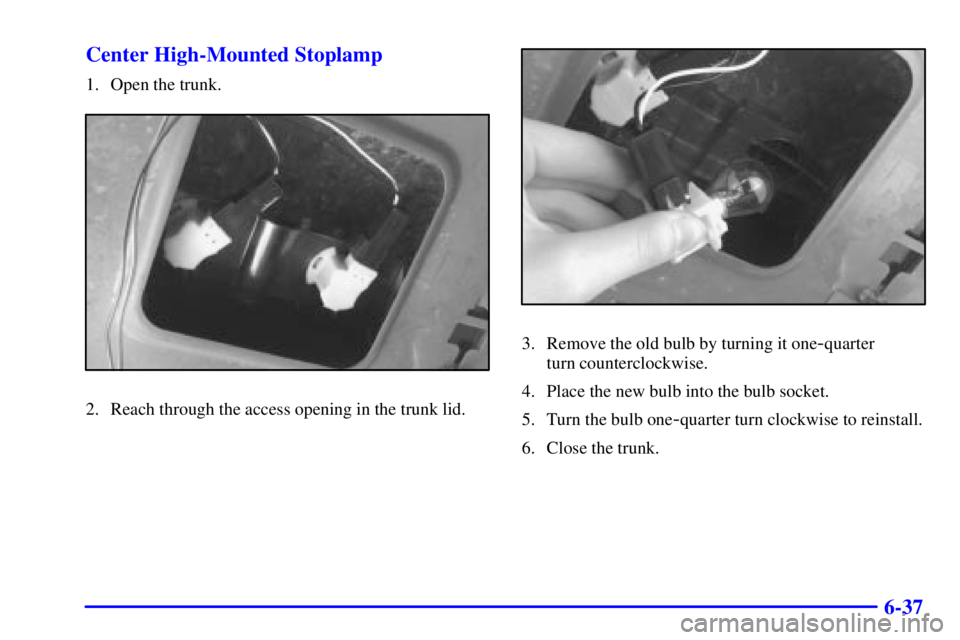
6-37 Center High-Mounted Stoplamp
1. Open the trunk.
2. Reach through the access opening in the trunk lid.
3. Remove the old bulb by turning it one-quarter
turn counterclockwise.
4. Place the new bulb into the bulb socket.
5. Turn the bulb one
-quarter turn clockwise to reinstall.
6. Close the trunk.
Page 288 of 357
6-38 Tail/Stop/Turn Signal Lamps
1. Open the trunk.
2. If your vehicle is equipped with a convenience net,
remove it.
3. Remove the plastic wing nuts (A).
There is one wing nut located on the outside of
the carpet. The other two are located underneath
the carpet.
4. Pull the taillamp housing (B) away from the body of
the vehicle.
5. Squeeze the tab on the socket and turn the
socket counterclockwise.
6. Pull out the socket.
7. Pull the old bulb out of the socket. (There are two
bulbs on each taillamp.)
8. Push in a new bulb.
9. Reverse these steps to reinstall the lamp assembly.
Page 294 of 357

6-44
To reset (calibrate) the system:
1. Turn the ignition to RUN.
2. Locate the red RESET button inside of your
instrument panel fuse block.
The fuse block is located under the cover labeled
FUSES, which is at the end of the instrument panel on
the passenger's side of the vehicle. The RESET button
is the first button in the top row of the fuse block.
3. Press and hold the RESET button for about
five seconds.
The LOW TIRE light will come on and flash three
times. Then it will go off. If the light doesn't go off,
see your dealer for service.
The system completes the calibration process during driving.
The system normally takes 15 to 20 minutes of driving in
each of three speed ranges to ªlearnº tire pressures. The
speed ranges are 15 to 40 mph (25 to 65 km/h), 40 to
65 mph (65 to 105 km/h) and above 65 mph (105 km/h).
When learning is complete, the system will alert you after
two to eight minutes if a tire is 12 psi (83 kPa) different
from the other three tires. Detection thresholds may be
higher and detection times may be longer on rough roads,
curves and at high speeds. The system is not capable of
detection at speeds greater than 70 mph (110 km/h).Tire Inspection and Rotation
Tires should be rotated every 6,000 to 8,000 miles
(10 000 to 13 000 km). Any time you notice unusual
wear, rotate your tires as soon as possible and check
wheel alignment. Also check for damaged tires or wheels.
See ªWhen It's Time for New Tiresº and ªWheel
Replacementº later in this section for more information.
The purpose of regular rotation is to achieve more
uniform wear for all tires on the vehicle. The first
rotation is the most important. See ªScheduled
Maintenance Servicesº in the Index for scheduled
rotation intervals.
When rotating your tires, always use the correct rotation
pattern shown here.
Page 310 of 357

6-60
Electrical System
Add-On Electrical Equipment
NOTICE:
Don't add anything electrical to your vehicle
unless you check with your dealer first. Some
electrical equipment can damage your vehicle
and the damage wouldn't be covered by your
warranty. Some add
-on electrical equipment
can keep other components from working as
they should.
Your vehicle has an air bag system. Before attempting to
add anything electrical to your vehicle, see ªServicing
Your Air Bag
-Equipped Vehicleº in the Index.
Headlamp Wiring
The headlamp wiring is protected by a circuit breaker in
the underhood fuse block. An electrical overload will
cause the lamps to go on and off, or in some cases to
remain off. If this happens, have your headlamp system
checked right away.
Windshield Wipers
The windshield wiper motor is protected by a circuit
breaker and a fuse. If the motor overheats due to heavy
snow, etc., the wiper will stop until the motor cools.
If the overload is caused by some electrical problem,
have it fixed.
Power Windows and Other Power Options
Circuit breakers in the instrument panel fuse block
protect the power windows and other power accessories.
When the current load is too heavy, the circuit breaker
opens and closes, protecting the circuit until the problem
is fixed.
Page 311 of 357
6-61 Fuses and Circuit Breakers
The wiring circuits in your vehicle are protected from
short circuits by a combination of fuses, circuit breakers
and in the wiring of the fuse block itself. This greatly
reduces the chance of fires caused by electrical problems.
Look at the silver
-colored band inside the fuse. If the
band is broken or melted, replace the fuse. Be sure you
replace a bad fuse with a new one of the identical size
and rating.
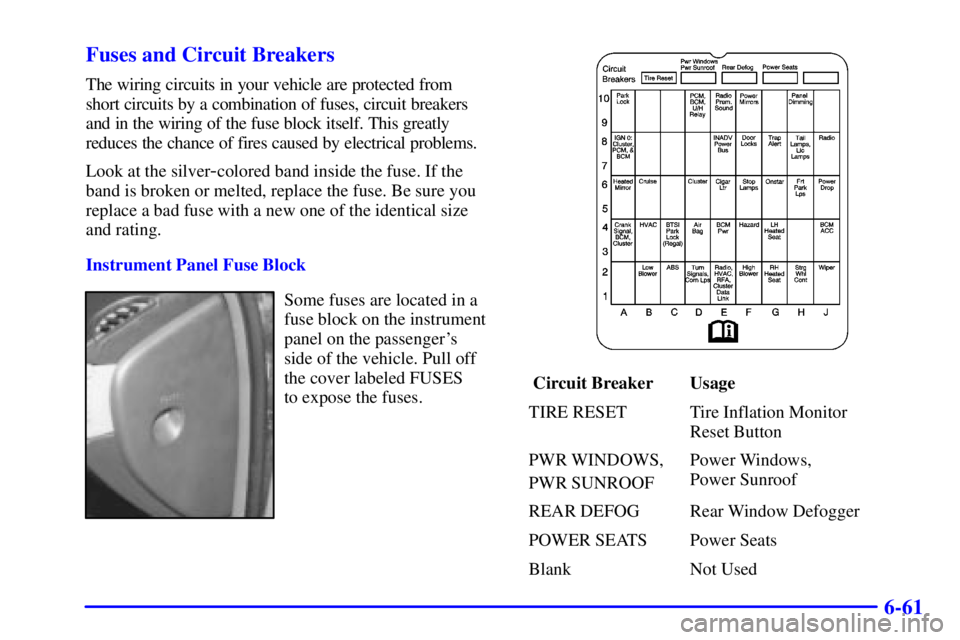
Instrument Panel Fuse Block
Some fuses are located in a
fuse block on the instrument
panel on the passenger's
side of the vehicle. Pull off
the cover labeled FUSES
to expose the fuses.
Circuit Breaker Usage
TIRE RESET Tire Inflation Monitor
Reset Button
PWR WINDOWS,
PWR SUNROOFPower Windows,
Power Sunroof
REAR DEFOG Rear Window Defogger
POWER SEATS Power Seats
Blank Not Used
Page 312 of 357
6-62
Fuse Usage
PARK LOCK Ignition Key Solenoid
Blank Not Used
Blank Not Used
PCM, BCM,
U/H RELAYIgnition Signal: Hot in Run and
Start, Powertrain Control
Module, Body Control Module,
Underhood Relay
RADIO
PREM. SOUNDRemote Radio Premium Sound
POWER MIRRORS Power Mirrors
Blank Not Used
PANEL DIMMING Panel Dimming
Blank Not Used
IGN 0, CLUSTER,
PCM, BCMIgnition Signal: Hot in Run,
Unlock and Start, Cluster,
Powertrain Control Module,
Body Control ModuleFuse Usage
Blank Not Used
Blank Not Used
Blank Not Used
INADV
POWER BUSRetained Accessory Power
DOOR LOCKS Door Locks
TRAP ALERT Trap Alert�
TAIL LAMPS,
LIC LAMPSTaillamps, License Lamps
RADIO Radio
HEATED MIRROR Heated Mirrors
CRUISE Cruise Control
Blank Not Used
CLUSTER Instrument Panel Cluster
CIGAR LTR Cigarette Lighter,
Auxiliary Power Connection
(Power Drop)