2002 BMW Z8 wheel
[x] Cancel search: wheelPage 45 of 174

45n
IndexDataTechnologyRepairsCar careControlsOverview
For maximum safety when adjusting the
seating position, please observe the
following:
Never try to adjust your seat while
driving the vehicle. The seat could
respond with un unexpected move-
ment, and the ensuing loss of vehicle
control could lead to an accident.
Be sure that the safety belt remains
firmly against your body at all times. In
the event of a frontal impact, a loose lap
belt could slide over the hips, leading to
abdominal injury. In addition, the safety
belt's restraint effectiveness is reduced
if the belt is worn loosely.
Never ride with the backrest reclined to
an extreme angle (especially important
for the passenger to remember). If you
do so, there is a risk that you will slide
under the safety belt in an accident,
thus reducing the protection provided
by the safety belt.<
Correct sitting postureTo reduce strain on the spinal column,
sit all the way back in the seat and rest
your back fully against the backrest.
The ideal sitting posture is achieved
with your head extending from your
spine in a straight line.
For long-distance driving, you may wish
to increase the backrest tilt-angle
slightly to reduce muscular tension.
You should be able to grasp the
steering wheel at its highest point with
your arms slightly bent.
1 Backward/Forward adjustment
2 Cushion height
3 Backrest angle
Adjust the head restraint manually.
Ensure that the backrest detent is
fully engaged before sliding the
seat to the rear. If the seat is moved back
with the backrest folded forward, the
detents may not engage during subse-
quent attempts to return the backrest to
its upright position. Both the rear of the
backrest and the upholstery in the rear
storage well may sustain damage as a
result. Always ensure that the backrest is
not reclined to an excessively steep
angle when sliding the seat back: failure
to observe this precaution can result in
damage to both the upholstery in the rear
storage well and to the backrest itself.<
520de017
Seat adjustment
Page 47 of 174
47n
IndexDataTechnologyRepairsCar careControlsOverview
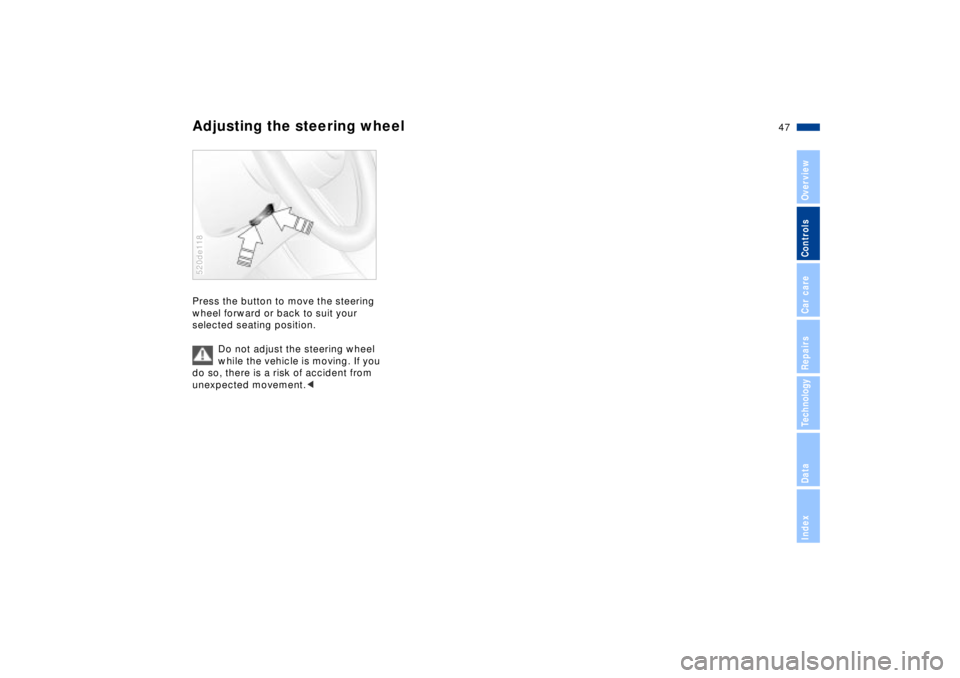
Adjusting the steering wheelPress the button to move the steering
wheel forward or back to suit your
selected seating position.
Do not adjust the steering wheel
while the vehicle is moving. If you
do so, there is a risk of accident from
unexpected movement.<520de118
Page 52 of 174
52n
AirbagsSitting correctly with airbags
Comply with the following instruc-
tions for the airbags, otherwise,
the airbags may not be able to provide
their maximum protection, with
resulting risks to personal safety. All
passengers in the vehicle should be
aware of and comply with this informa-
tion:
The airbag is a supplemental restraint
device; it is not a substitute or replace-
ment for your safety belt, which you
should continue to wear at all times.
When adjusting your seat, assume a
comfortable driving posture allowing
comfortable and secure access to all of
the vehicle's controls. Avoid sitting too
close to the steering wheel.
Always hold the steering wheel by the
rim Ð hands in the "9 o'clock" and
"3 o'clock" positions Ð otherwise, your
hands or arms could be injured if the
airbag is triggered.
Never allow any other passengers,
animals or objects to intrude into the
area between the airbag and the driver
or front passenger.
Do not use the cover panel above the
front passenger airbag as a storage
area.
Do not apply adhesive materials to the
cover panels of the airbags, or cover or
modify them in any other way.
Do not use a rear-facing child seat in
the front passenger seat. If you use a
child-restraint system, carefully read
and comply with the instructions on
page 53.
Be sure that child seats are installed
correctly and with the greatest possible
distance between them and the side
airbag. Do not allow children to lean out
of the child's seat in the direction of the
side trim panels. If they do so, serious
injuries can occur if the airbag is trig-
gered.<
Even when all these guidelines are
observed, there is still a small residual
risk of injury to the face, hands and
arms occurring from airbag deployment
in isolated instances.
The ignition and inflation noise may
cause a mild temporary hearing loss in
extremely sensitive individuals.
You will find the proper airbag safety
precautions on both sun visors and on
the instrument cluster (US models).
For additional information concerning
the airbag system, refer to pages 123
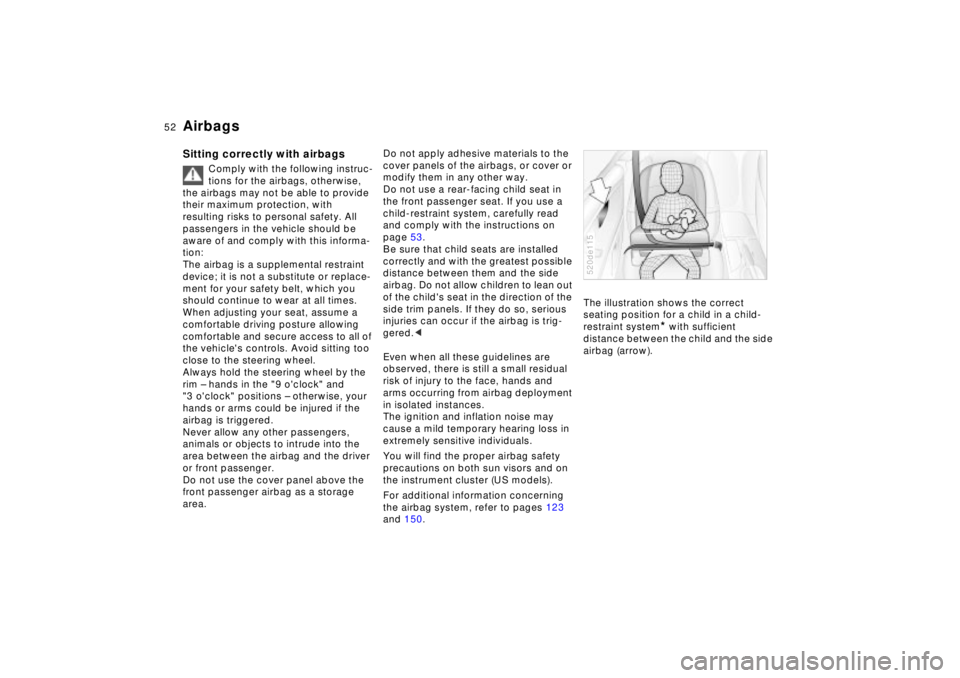
and 150.The illustration shows the correct
seating position for a child in a child-
restraint system
* with sufficient
distance between the child and the side
airbag (arrow).
520de115
Page 55 of 174
55n
IndexDataTechnologyRepairsCar careControlsOverview
Your vehicle is equipped with an elec-
trically powered steering lock mecha-
nism.To activate the electrical power
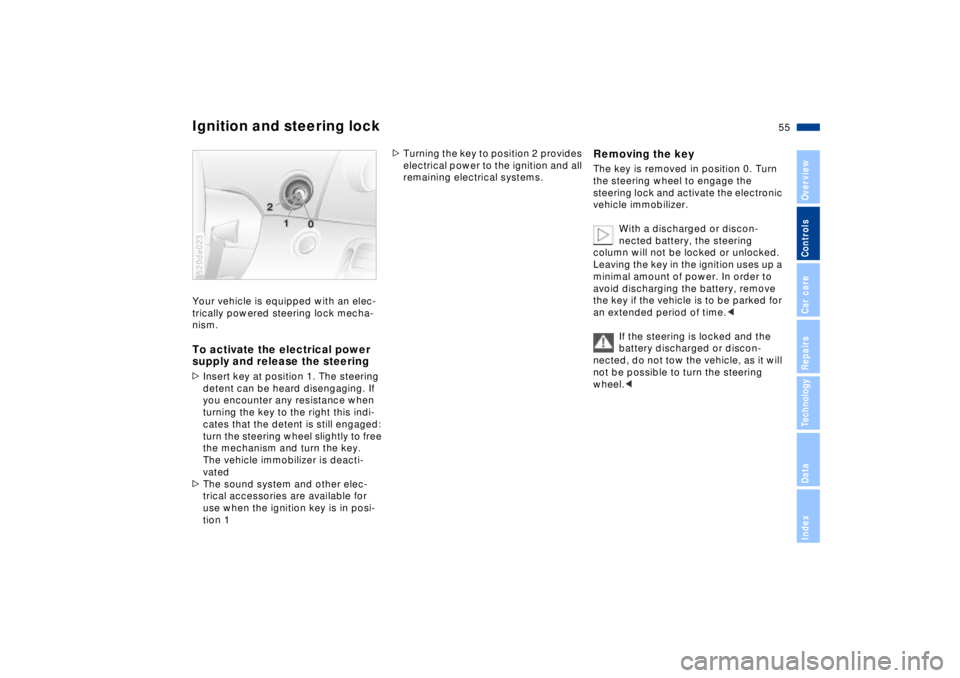
supply and release the steering>Insert key at position 1. The steering
detent can be heard disengaging. If
you encounter any resistance when
turning the key to the right this indi-
cates that the detent is still engaged:
turn the steering wheel slightly to free
the mechanism and turn the key.
The vehicle immobilizer is deacti-
vated
>The sound system and other elec-
trical accessories are available for
use when the ignition key is in posi-
tion 1 520de023
>Turning the key to position 2 provides
electrical power to the ignition and all
remaining electrical systems.
Removing the key The key is removed in position 0. Turn
the steering wheel to engage the
steering lock and activate the electronic
vehicle immobilizer.
With a discharged or discon-
nected battery, the steering
column will not be locked or unlocked.
Leaving the key in the ignition uses up a
minimal amount of power. In order to
avoid discharging the battery, remove
the key if the vehicle is to be parked for
an extended period of time.<
If the steering is locked and the
battery discharged or discon-
nected, do not tow the vehicle, as it will
not be possible to turn the steering
wheel.<
Ignition and steering lock
Page 57 of 174

57n
IndexDataTechnologyRepairsCar careControlsOverview
Switching off the engine Parking brake Turn ignition key to position 1 or 0.
Never remove the ignition key
while the vehicle is rolling. If you
do so, the ignition lock would engage
when the steering wheel is turned.
When you leave the vehicle, always
remove the ignition key and engage the
steering lock.
Always engage the parking brake when
parking on hills and inclined surfaces,
as first gear or reverse may not provide
adequate resistance to rolling.<
The parking brake is primarily designed
to prevent the vehicle from rolling while
parked. It operates on the rear wheels. To engage The lock engages automatically when
you lift the lever, and the indicator lamp
in the instrument cluster comes on
when the ignition key is in position 2.
Refer to page 21.To releasePull up slightly on the lever, press the
button and lower the lever. 520de024
If, in rare circumstances, it should
be necessary to engage the
parking brake while the vehicle is in
motion, do not pull hard on the lever.
Keep your thumb pressed against the
release button while carefully pulling
the lever up to apply moderate pres-
sure.
Excessive pressure can lead to over-
braking and loss of traction (fishtailing)
at the rear axle.
The brake lamps do not come on when
the parking brake is engaged.
Always engage the parking brake when
parking on hills and inclined surfaces,
as selecting first gear or reverse may
not provide adequate resistance to
rolling.<
To avoid corrosion and one-sided
braking, apply the parking brake lightly
from time to time when coasting to a
standstill (at a traffic signal, for
instance), provided that it is safe to do
so.
Page 65 of 174

65n
IndexDataTechnologyRepairsCar careControlsOverview
The conceptDSC maintains vehicle stability even in
critical driving situations.
DSC maintains optimal, predictable
response while maximizing traction
when you accelerate from a standing
start or speed up while already
underway. The system recognizes any
tendency for the vehicle to assume an
instable attitude such as oversteer and
understeer, and counteracts this
tendency with a combination of gradu-
ated reductions in engine torque and
braking intervention at individually
selected wheels. DSC provides optimal
stability Ð within the limits defined by
the laws of physics.
The system automatically assumes
operational status each time the engine
is started.
Indicator lamp
The indicator lamp in the instru-
ment cluster goes out shortly
after you switch on the ignition.
Refer to page 22.
The indicator lamp flashes:
The system is actively regulating drive
torque and braking force.
The indicator lamp does not go out
after the engine is started, or it comes
on during normal driving and stays on:
There is a system malfunction or the
system was deactivated with the
button. You can continue to drive the
vehicle normally, but without DSC.
Please respond to any suspected
defects by referring the problem to your
BMW center.
To deactivate the systemPress the button, the indicator lamp
comes on and stays on.
When DSC is deactivated, you are
operating the vehicle in the conven-
tional drive mode.
In the following rare circumstances, it
may be effective to deactivate the DSC
for a short period of time:
>When rocking the vehicle or starting
off in deep snow or on loose
surfaces.
To maintain vehicle stability,
always drive with the system
switched on when possible.<520de035
Dynamic Stability Control (DSC)
Page 67 of 174
67n
IndexDataTechnologyRepairsCar careControlsOverview
Dynamic Performance Flat Tire MonitorSport mode recognitionActivating:
In ignition position 2, press the button.
The indicator lamp will come on.
Deactivating:
Whenever the indicator lamp is on, it
will go out if you press the button again.
The conceptThe Flat Tire Monitor keeps track of the
inflation pressures in all four wheels as
you drive. The system provides an alert
whenever the inflation pressure has
dropped significantly in one of the tires.
To initialize the Flat Tire Monitor with
the correct inflation pressures, start by
ensuring that all of the vehicle's tires
are inflated to the pressures specified
in the inflation pressure table on
page 27. Now you can activate the
system.
The indicator lamp within the
instrument cluster flashes to
alert you to substantial pres-
sure loss in any of the tires.
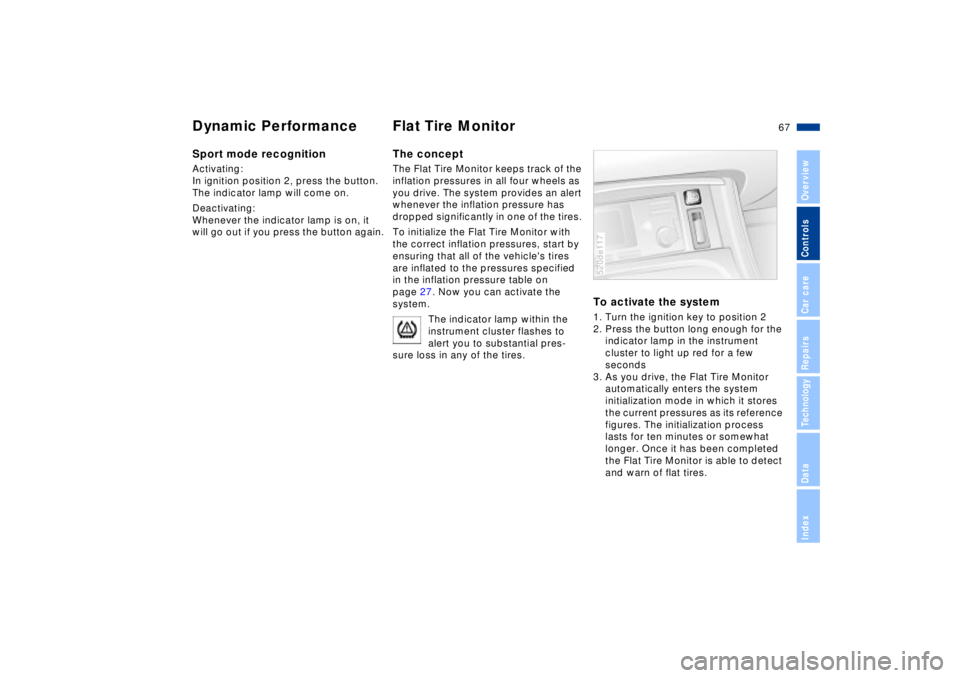
To activate the system1. Turn the ignition key to position 2
2. Press the button long enough for the
indicator lamp in the instrument
cluster to light up red for a few
seconds
3. As you drive, the Flat Tire Monitor
automatically enters the system
initialization mode in which it stores
the current pressures as its reference
figures. The initialization process
lasts for ten minutes or somewhat
longer. Once it has been completed
the Flat Tire Monitor is able to detect
and warn of flat tires.520de117
Page 68 of 174

68n
Flat Tire MonitorRepeat this process after any changes
in tire inflation pressure, tire rotation or
replacement.
Do not reactivate the system after peri-
odic corrections of inflation pressures
to maintain them at the levels stored
during an earlier initialization process. In the event of a flat tireThe red indicator lamp will flash in the
event of a flat tire.
A supplementary gong is also heard.
Carefully reduce speed to less than
50 mph (80 km/h), avoiding any hard
braking or steering maneuvers while
doing so.
For additional details, refer to
page 137.
The Flat Tire Monitor cannot alert
you to severe and sudden tire
damage caused by external factors.
Another factor which the Flat Tire
Monitor does not recognize is the
balanced and very gradual pressure
loss that takes place in all tires over an
extended period of time.<
Check tire pressure on a regular
basis and correct it as required.
Refer to page 26.
Do not activate the system when driving
on snow chains or when operating the
vehicle on a closed racing circuit. False
alarms and undetected pressure loss
are both possible under these condi-
tions.
In certain circumstances, there could
be a delayed detection of any loss in
inflation pressure while driving on
snow-covered or slippery road
surfaces.
Performance-oriented driving (slip at
the drive wheels, high levels of lateral
acceleration) can also delay the
appearance of status reports in the Flat
Tire Monitor's display panel.<
System interferenceThe red indicator lamp in the instrument
cluster will stay on for as long as there
is a malfunction.
The indicator lamp will come on if the
system malfunctions.
Please contact your BMW center for
additional information.