2002 BMW Z8 brake light
[x] Cancel search: brake lightPage 91 of 174

91n
IndexDataTechnologyRepairsCar careControlsOverview
Disc brakesDriving notesWhen driving in heavy rain and on wet
roads it is advisable to apply light pres-
sure to the brake pedal every few miles.
Monitor traffic conditions to ensure that
this maneuver does not pose a hazard
to you or to other road users. The heat
generated in this braking process helps
dry the pads and rotors
Maximum braking force is obtained
while the wheels are not locked, but
rather when they are still barely turning
immediately prior to locking. ABS main-
tains this state automatically. If the ABS
fails, you should revert to the staggered
braking technique (refer to page 93).
When descending steep hills and
extended grades, downshift to a gear
that will allow you to continue safely
with only a minimal amount of braking.
By minimizing the loads placed on the
brake system, this strategy helps
ensure that optimal brake system
response will remain available at all
times.
You can enhance the engine's braking
effect by downshifting, into first gear, if
necessary. Even if engine braking fails to slow the
vehicle sufficiently, you should still
make every effort to avoid prolonged
braking with continuous application of
low to moderate pressure at the pedal.
It is better to decelerate the vehicle by
applying a higher level of force at the
pedal (watch following traffic!) and then
subsequently pausing to allow the
brakes to cool briefly before starting on
your next braking cycle. By protecting
brake system components against
overheating, the cooling phases
afforded by this staggered, or intermit-
tent braking technique help maintain
consistent availability of optimal braking
response when it is needed.
Do not coast with the clutch pedal
depressed, the gear-shift lever in
neutral, or, above all, with the engine
off; otherwise, the engine will provide
no braking effect if the transmission is
in neutral, and there is no braking or
steering power assist if the engine is
not running. Never allow floor mats,
carpets or any other objects to obstruct
the accelerator, clutch or brake pedals
and pose a safety hazard by reducing
their available travel range.<
Page 114 of 174
114n
Coolant Brake fluidAdding coolant To guard against the possibility of
scalding injuries, always wait until the
engine cools (temperature gauge
needle in blue sector) before
unscrewing the cap on the expansion
tank.
1. Turn the cap slightly counterclock-
wise in order to allow accumulated
pressure to escape. Then open
2. Slowly add coolant until the correct
level is reached Ð do not overfill.
The coolant is a mixture of water and
extended-duty antifreeze with corrosion
inhibitor. Always maintain the
prescribed all-season 50:50 mixture
ratio for year-round protection against
internal corrosion. No other additives
are required.
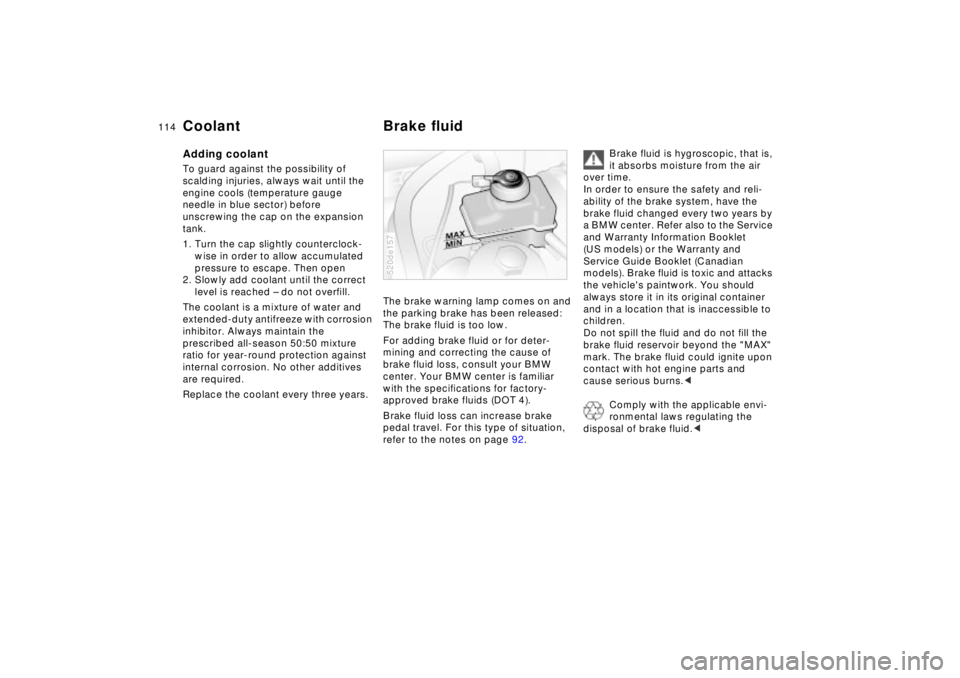
Replace the coolant every three years.The brake warning lamp comes on and
the parking brake has been released:
The brake fluid is too low.
For adding brake fluid or for deter-
mining and correcting the cause of
brake fluid loss, consult your BMW
center. Your BMW center is familiar
with the specifications for factory-
approved brake fluids (DOT 4).
Brake fluid loss can increase brake
pedal travel. For this type of situation,
refer to the notes on page 92.
520de157
Brake fluid is hygroscopic, that is,
it absorbs moisture from the air
over time.
In order to ensure the safety and reli-
ability of the brake system, have the
brake fluid changed every two years by
a BMW center. Refer also to the Service
and Warranty Information Booklet
(US models) or the Warranty and
Service Guide Booklet (Canadian
models). Brake fluid is toxic and attacks
the vehicle's paintwork. You should
always store it in its original container
and in a location that is inaccessible to
children.
Do not spill the fluid and do not fill the
brake fluid reservoir beyond the "MAX"
mark. The brake fluid could ignite upon
contact with hot engine parts and
cause serious burns.<
Comply with the applicable envi-
ronmental laws regulating the
disposal of brake fluid.<
Page 117 of 174

117n
IndexDataTechnologyRepairsCar careControlsOverview
Washing your vehicle You can have your new BMW washed
in an automatic car wash. Car-wash
systems that do not employ brushes
are preferable.
Wipe away tough dirt and loosen and
remove dead insects before washing
the vehicle.
In order to avoid spots, do not wash the
vehicle when the hood is warm, or
during or immediately after exposure to
strong sunlight.
In order to protect your convertible top,
do not use washing programs featuring
wax application on your vehicle. The
small amount of beading wax always
used in automatic car washes will not
harm the convertible top.
When using an automatic car wash, be
sure that
>the car-wash system is suited for the
dimensions of your vehicle
>no damage will occur on vehicles
with attached body accessories (such
as spoilers or antennas). Consult the
car-wash operator if necessary>the wheels and tires of your vehicle
cannot be damaged by the convey-
ance devices of the car-wash system
>the vehicle is cleaned with minimum
brush pressure, and that ample water
is available for washing and rinsing.
Parts of the vehicle which are inacces-
sible to the automatic washer Ð such as
door sills, door and hood edges, etc. Ð
should be cleaned by hand.
In the winter months, it is especially
important to ensure that the vehicle is
washed on a regular basis. Large quan-
tities of dirt and road salt are difficult to
remove, and they also cause damage to
the vehicle.
If spray wands or high-pressure
washers are used, be sure to
maintain an adequate distance between
the spray source and the vehicle's
surface. Inadequate distance and
excessive pressure can damage or
weaken the finish, making it more
susceptible to further damage. In addi-
tion, moisture could penetrate to
vehicle components, leading to long-
term damage.<
When cleaning the headlamps,
please observe the following:
>Do not clean by wiping with a dry
cloth. Never use abrasives or strong
solvents to clean the covers
>Remove dirt and contamination (such
as insects) by soaking with BMW Car
Shampoo and then rinsing with plenty
of water
>Always use a deicer spray to remove
accumulated ice and snow Ð never
use a scraper.<
After washing the vehicle, apply
the brakes briefly to dry them.
Braking efficiency might otherwise be
reduced by the moisture and the brake
rotors could also be corroded.<
Caring for your vehicle
Page 131 of 174

131n
IndexDataTechnologyRepairsCar careControlsOverview
Lamps and bulbs The lamps and bulbs make essential
contributions to the safety of your
vehicle. Therefore, comply fully with the
following instructions during bulb
replacement. If you are not familiar with
any of the procedures, consult your
BMW center.
Do not touch the glass portion of a
new bulb with your bare hands
since even small amounts of impurities
burn into the surface and reduce the
service life of the bulb. Use a clean
cloth, paper napkin, or a similar mate-
rial, or hold the bulb by its metallic
base.<
A replacement bulb set is available from
your BMW center.
Whenever working on the elec-
trical system, switch off the elec-
trical accessory you are working on or
disconnect the cable from the negative
terminal of the battery. Failure to do this
could result in short circuits.
To prevent injuries and damage,
comply with any instructions provided
by the bulb manufacturer.<
When cleaning the headlamps,
please observe the following:
>Do not wipe dry (scratches). Never
use abrasives or strong solvents to
clean the covers
>Remove dirt and contamination (such
as insects) by soaking with BMW Car
Shampoo and then rinsing with plenty
of water
>Always use a deicer spray to remove
accumulated ice and snow Ð never
use a scraper.<
Xenon lamps
The main headlamps for your BMW
Z8 roadster have been designed using
xenon-light technology. The service life
of these bulbs is very long and the
probability of a failure is very low,
provided that they are not switched on
and off an unusual number of times.
Should a lamp ever fail, however,
please contact your BMW center for
assistance.
The xenon-light unit operates at
extremely high voltages; contact
with the unit's electrical components
can be fatal. We therefore urge you to
refer all service and repairs, including
bulb changes, to qualified professional
technicians.<
Neon lampsThe front turn signal indicators (side
marker lamps), the rear turn signal indi-
cators, the rear and brake lamps, as
well as the high-mounted brake lamp
are of neon-light technology. The
service life for these lamps is very high
and the likelihood of failure very
minimal.
Should a lamp ever fail, however,
please contact your BMW center for
assistance.
Page 147 of 174

147n
IndexDataTechnologyRepairsCar careControlsOverview
Towing the vehicle
Avoid "off-center" towing. Be sure
that the tow rope is pulled tightly
when the towing vehicle begins to
move.<
The towed vehicle should always
be the lighter of the two vehicles.
If this is not the case, it is no longer
possible to control vehicle response.<
Tow-startingFor instructions on jump-starting, refer
to page 145.
Never attempt to use your vehicle to
push another vehicle, since damage to
the energy-absorbing bumpers could
result.
Towing a vehicle1. Put the shift lever in neutral
2. Towing speed:
Max. 45 mph (70 km/h)
3. Towing distance:
Max. 95 miles (150 km)
4. Leave the ignition key in position 1 to
ensure that the brake lamps, turn
signals, horn and windshield wipers
remain operative, and to prevent the
steering lock detent from engaging
5. Switch on the hazard warning system
(comply with country-specific regula-
tions).
Find some means of identifying the
vehicle in tow, e. g. place a sign or
warning triangle in the rear window.
Make sure that the ignition key
remains in position 1 even when
the electrical system has failed to
prevent the steering lock from
engaging. The steering and brakes are
without power assist when the engine is
not running. This means that increased
effort is required for steering and
braking.<
Towing with a commercial tow
truck>Do not tow with sling-type equipment
>Use a wheel lift or flatbed equipment
>Please comply with applicable towing
laws.
Never allow passengers to ride in
a towed vehicle for any reason.<520us014
Page 166 of 174

Everything from A to Z
A
ABS (Antilock Brake System) 21, 88
Accessories 6
Activated charcoal filter 75
Add brake fluid 114t
engine coolant 114t
engine oil 111t
washer fluid 110, 161
Adjust seats 45
steering wheel 47
temperature 74
washer nozzles 110t
Adjustment setting configuration 49
Air conditioner 72
Air distribution 74
Air outlets 72
Air pressure 99
Air supply 74
Airbags 21, 51 , 123 , 150
Alarm system 38
Antenna 94
Antifreeze 113
radiator 92
Antifreeze/corrosion protection 92
Antilock Brake System (ABS) 21, 88 Anti-theft alarm system
38
Anti-theft protection 32
Approved gross vehicle weight 160
Aquaplaning 99
Ashtray 81
Attach vehicle vacuum cleaner 82
Automatic car washes 117
Automatic headlamp washers 60
Automatic windshield washer 60
Avoiding a false alarm 39t
Axle weights 160
B
Backrest
adjusting 45
unlock 46
Backup lamps 58
bulb replacement 133t
Battery 138, 162
add distilled water 138t
capacity 162
charge current 20
charging 139t
discharged 145t
recycling 140t
removing and
installing 139t Belts
50
Beverage holder 80
Blower 74
BMW High Performance Synthetic Oil 112
Bore 158
Brake hydraulic system 20, 92
Brake system faults 92t
fluid 114t
pads 22, 92
refer also to ABS, DBC and
Disc brakes
Break-in procedure 86
Bulbs and lamps 131tC
California Proposition 65
Warning 125
Can holder 80
Car Memory 49
Car phone 81, 94
Car radio 64, 95
reception 95, 151
refer also to the radio
Owner's Manual
Car wash 117
Care exterior 119
for the vehicle finish 120
interior 121 Catalytic converter
87
CBC (Cornering Brake Control) 21, 89
CD player, refer to the radio Owner's Manual
Cellular phone 94
refer also to separate
Owner's Manual
Central locking system 32
key 36
Changing a wheel 137t
Changing the oil filter 161
Changing tires 137t
Checking air pressure 26t
Checking engine oil level 111t
Child restraint systems 54
Child seat safety 54
Child seats 53
Child-restraint systems 53
Cigarette lighter 82
Clean headlamps 60
Clock 64
Cockpit 16
Code, refer to the radio
Owner's Manual
Combination switch, turn signal indicator/headlamp
flasher 59
Compartments 79
for stowing items 78
Compression 158
Page 167 of 174

Everything from A to Z
167n
IndexDataTechnologyRepairsCar careControlsOverview
Connector for Onboard
Diagnostic126
Consumption display62
Controls16
Convertible top41
closing in event of
electrical
malfunction143t
manual operation143t
Coolant113, 161
Coolant temperature
gauge63
Copyright4
Cornering Brake Control
(CBC)21, 89
Cruise control61
Curb weight160
Current check indicator20DDashboard16
Data
dimensions159
engine158
technical158
weights160
Daytime driving lamps69
DBC (Dynamic Brake
Control)90
Deactivating the tilt alarm
sensor and interior motion
sensor34Deep water87
Defrosting the
windows60, 75
Difficult steering20, 94
Dimensions159
Dipstick111
Disc brakes90
Displacement158
Display lighting69
Displays18
Disposal
engine oil113
used batteries140t
Door keys30
Door warning lamp, bulb
replacement134t
Doors
emergency
actuation32t
mirrors48
remote control33
unlocking and locking32
DOT Quality Grades100
Draft-free ventilation75
Drink holder78, 80
Drive belts162
Driving in winter92
Driving notes87
DSC (Dynamic Stability
Control)22, 65, 152
Dynamic Brake Control
(DBC)90Dynamic Performance
Control66
Dynamic Stability Control
(DSC)22, 65, 152
EElectric defrosting of
mirrors48
Electric power seats45
Electric power windows40
Electrical equipment
failure140t
Electrical failure
convertible top143t
doors32t
fuel filler door142t
luggage
compartment142t
passenger-side
door143t
Electrical system162
Electronic vehicle
immobilizer31
Emergency operation
convertible top143t
doors32t
fuel filler door142t
luggage
compartment142t
passenger-side
door143tEmergency release from
luggage compartment's
interior38
Engine
coolant113, 161
data158
output158
speed158
starting56
switching off57
Engine compartment108
Engine oil111
add111t
consumption111
filling capacity161
filter change161
pressure indicator
lamp20
quality112
specifications112
viscosity112
Engine oil level
check111
Equipment
options and accessories5
Exit lamps, bulb
replacement134
Exterior finish119
Exterior mirrors48
Page 168 of 174

Everything from A to ZFFailure to start146t
Fault in ABS89
Filler cap cover25
Filling capacities161
Filling the washer
reservoir161
First-aid kit24
Fittings, tow-starting and
towing146t
Flashlight79
Flat tire137t
Flat Tire Monitor67
Fog lamp, bulb
replacement133t
"Follow me home"
lamps49, 69
Footbrake90
Footwell lamps71
bulb replacement134t
Front seat adjustment45
Frost protection,
radiator113
Fuel26
gauge62
indicator62
quality26
Fuel filler door
manual release after
electrical fault142tFuel injection system158
Fuel tank capacity161
Fuses140
GGasoline26
quality26
Glove compartment78
bulb replacement135t
Gross vehicle weight160HHand lamp79
Handbrake57
Hands-free system81
Hardtop96
Hazard warning
flashers24t
Hazard warning
triangle24t
Head restraint46
Headlamp covers,
care117t, 131t
Headlamp flasher70
Headlamp washer
system60, 110, 161
Headlamps70
Headlight glare in rearview
mirror48
Heated mirrors48
Heated seats77
Heating and ventilation72Heating, rapid77
Heavy loads83
Height159
High beams23, 58, 70
Holder for beverage
cans80
Hood release105t
Horn17
Hydraulic system88, 92
IIdentification, tires102
Ignition keys30
Ignition lock55
Imprint4
Incoming-air mode74
Indicator lamps20
Inflation pressure26t, 99
monitoring67
INSPECTION63
Instrument cluster18
Instrument panel lighting69
Instruments18
Interaxle tire rotation101
Interface socket for Onboard
Diagnostic126
Interference
cellular phone94
radio reception95
Interior lamps34, 71
bulb replacement135t
remote control34Interior motion sensor39
deactivating34
Interior rearview mirror with
automatic
dimmer48, 154
Intermittent mode of wiper
system59
JJump-starting145KKey Memory49
Key with remote control30
Keys30LLamps and bulbs131t
Leather care122
Length159
License plate lamp, bulb
replacement133t
Light switch69
Light-alloy wheels104
Lighter82
LIGHTS ON warning69
Loading83
Lock deicer92
Louvers72
Low beam headlamps69