2002 BMW Z8 air condition
[x] Cancel search: air conditionPage 74 of 174

74n
Heating and ventilation/Air conditionerAir supply
You can select blower speeds
from 1 to 4. The higher the
setting, the greater the
amount of heat and air supply.
In position 0, the blower, heating and
air conditioner are switched off.
Temperature
In order to increase the inte-
rior temperature, turn to the
right. For rapid heating, turn
completely to the right. Then
select an interior temperature that is
comfortable for you.
Air distribution
You can direct the airflow onto
the windows , toward the
upper body and into the
footwell . You can also
make all intermediate settings. The
"6 o'clock" setting is recommended for
normal conditions (refer also to the
illustration and overview on page 72).
Recirculated-air mode
If there are unpleasant odors
in the incoming air, you can
temporarily block the air
supply. The system then recir-
culates the air already within the
vehicle.
If condensation starts to form on
window surfaces during operation
in the recirculated-air mode, switch this
mode off and increase the air supply as
required, or press the button for
"Defrosting windows and removing
condensation".<
Incoming-air mode
Recommended when driving
with the convertible top down.
The degree to which the
passenger compartment is
heated depends on temperature selec-
tion and air distribution.
Air conditioner/Incoming-air
mode
The air is cooled and dehu-
midified and Ð depending on
the temperature setting Ð
warmed again when the air
conditioner is switched on.
Depending on the weather, the wind-
shield may fog over briefly when the
engine is started.
Use the button to switch the air condi-
tioner off at outside temperatures
below approx. 41 7(5 6). This will
help to prevent condensation from
forming on window surfaces.
If the windows fog over after switching
the air conditioner off, switch it back
on.
Air conditioner/Recirculated-air
mode
You may find it useful to acti-
vate both systems to cool the
vehicle more rapidly after it
has been parked with the top
up on a hot day. This setting provides
the coldest possible airflow from the
vent outlets (with temperature selection
switch turned all the way to the left).
Page 75 of 174
75n
IndexDataTechnologyRepairsCar careControlsOverview
Heating and ventilation/Air conditioner
If condensation starts to form on
window surfaces during operation
in the recirculated-air mode, switch this
mode off and increase the air supply as
required, or press the button for
"Defrosting windows and removing
condensation".<
Defrost windows and remove
condensation
This operation quickly
removes ice and condensa-
tion from the windshield and
the side windows.
Rear window defroster
Whenever the hardtop is on,
the indicator lamp lights up
when the rear window
defroster is turned on. The rear window
defroster switches off automatically.
Refer to page 60.
The indicator lamp is always
active, however the rear window
defroster will not work if the hardtop is
not in place.<
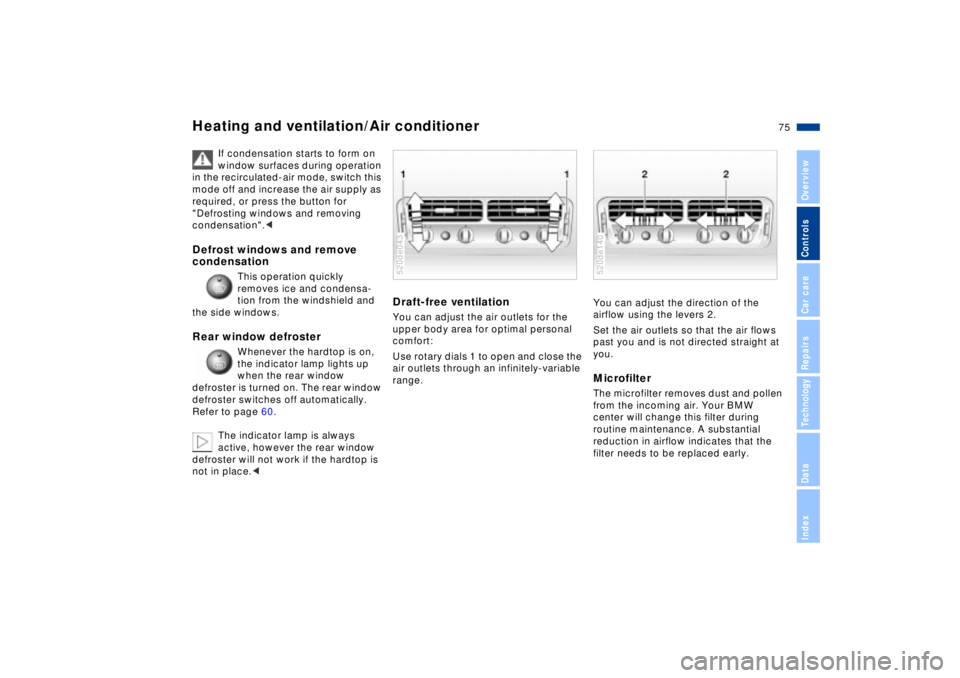
Draft-free ventilation You can adjust the air outlets for the
upper body area for optimal personal
comfort:
Use rotary dials 1 to open and close the
air outlets through an infinitely-variable
range.520de043
You can adjust the direction of the
airflow using the levers 2.
Set the air outlets so that the air flows
past you and is not directed straight at
you.MicrofilterThe microfilter removes dust and pollen
from the incoming air. Your BMW
center will change this filter during
routine maintenance. A substantial
reduction in airflow indicates that the
filter needs to be replaced early.520de140
Page 76 of 174
76n
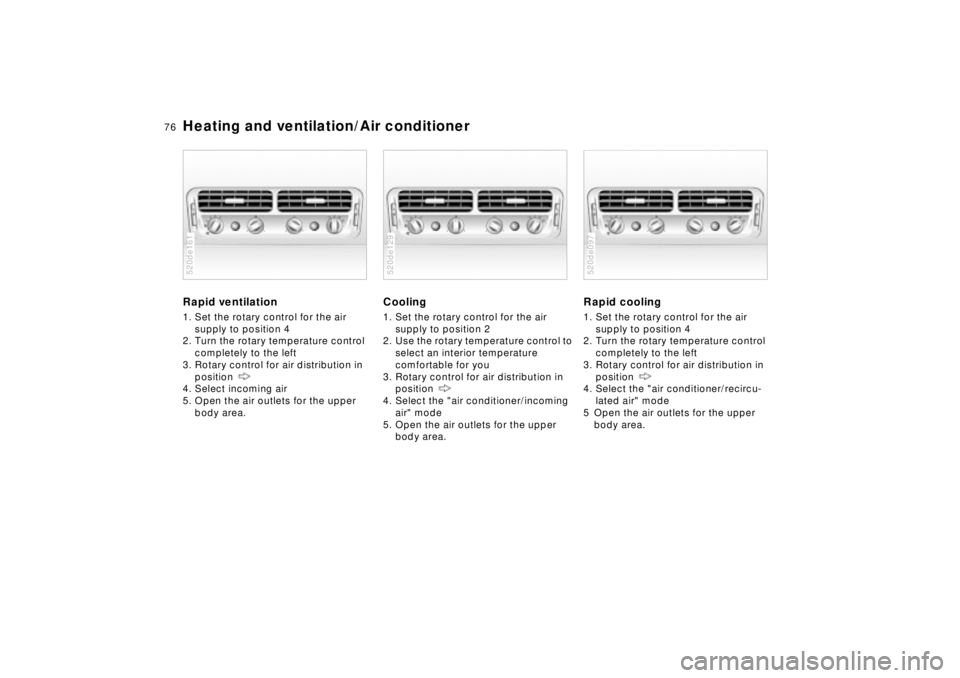
Heating and ventilation/Air conditionerRapid ventilation1. Set the rotary control for the air
supply to position 4
2. Turn the rotary temperature control
completely to the left
3. Rotary control for air distribution in
position
4. Select incoming air
5. Open the air outlets for the upper
body area.520de161
Cooling1. Set the rotary control for the air
supply to position 2
2. Use the rotary temperature control to
select an interior temperature
comfortable for you
3. Rotary control for air distribution in
position
4. Select the "air conditioner/incoming
air" mode
5. Open the air outlets for the upper
body area. 520de129
Rapid cooling1. Set the rotary control for the air
supply to position 4
2. Turn the rotary temperature control
completely to the left
3. Rotary control for air distribution in
position
4. Select the "air conditioner/recircu-
lated air" mode
5 Open the air outlets for the upper
body area.520de097
Page 77 of 174
77n
IndexDataTechnologyRepairsCar careControlsOverview
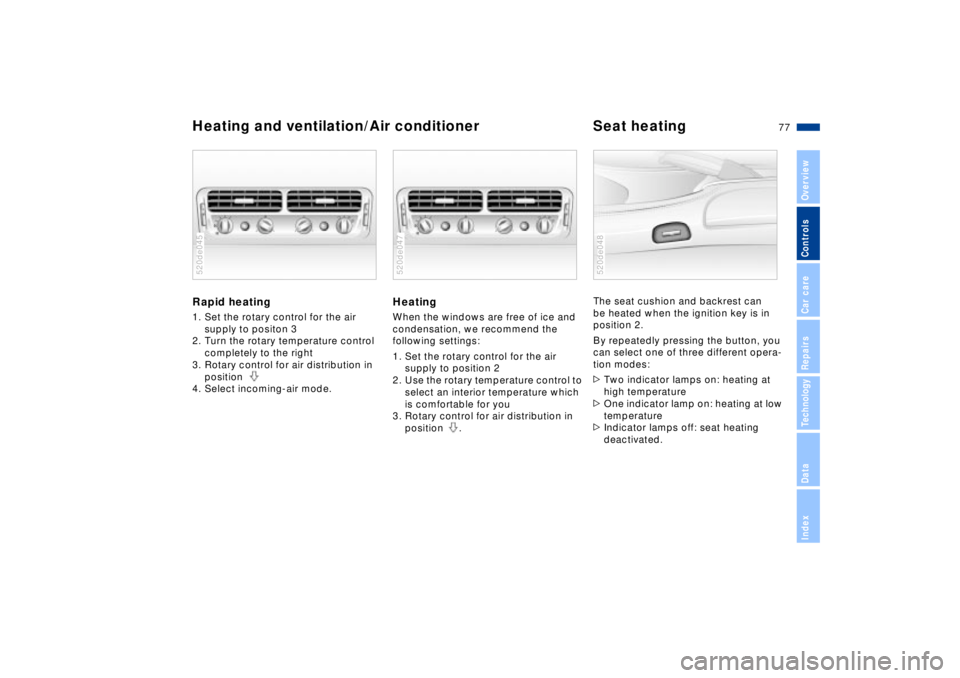
Heating and ventilation/Air conditioner Seat heatingRapid heating 1. Set the rotary control for the air
supply to positon 3
2. Turn the rotary temperature control
completely to the right
3. Rotary control for air distribution in
position
4. Select incoming-air mode.520de045
HeatingWhen the windows are free of ice and
condensation, we recommend the
following settings:
1. Set the rotary control for the air
supply to position 2
2. Use the rotary temperature control to
select an interior temperature which
is comfortable for you
3. Rotary control for air distribution in
position .520de047
The seat cushion and backrest can
be heated when the ignition key is in
position 2.
By repeatedly pressing the button, you
can select one of three different opera-
tion modes:
>Two indicator lamps on: heating at
high temperature
>One indicator lamp on: heating at low
temperature
>Indicator lamps off: seat heating
deactivated.520de048
Page 85 of 174

Overview
Controls and features
Operation, care
and maintenance
Owner service procedures
Technical data
Index Advanced technology
85n
IndexDataTechnologyRepairsCar careControlsOverview
Car care Special operating instructions:
Break-in procedures86
Driving notes87
Catalytic converter87
Antilock Brake System (ABS)88
Dynamic Brake Control
(DBC)90
Disc brakes90
Brake system92
Winter operation92
Power steering94
Cellular phone94
Car radio reception95
Wind deflector95
Hardtop96
Wheels and tires:
Tire inflation pressure99
Tire condition99
Tire replacement100
Tire rotation101
Wheel and tire
combinations102
Special features of winter
tires103
Snow chains103
Approved wheel and tire
specifications104Under the hood:
Hood105
Engine compartment108
Washer fluids110
Washer nozzles110
Engine oil111
Coolant113
Brake fluid114
Vehicle Identification
Number115
Maintenance and care:
The BMW Maintenance
System116
Caring for your vehicle117
Airbags123
Vehicle storage124
Laws and regulations:
Technical modifications125
California Proposition 65
Warning125
OBD interface socket126
Page 90 of 174

90n
Dynamic Brake Control (DBC) Disc brakesIf you step on the brake rapidly, this
system automatically produces maxi-
mum braking force boost and thus
helps to achieve the shortest-possible
braking distance during "panic stops."
All of the benfits of the ABS system are
exploited under these circumstances.
Do not reduce the pressure on the
brake pedal during the brake applica-
tion. When the brake pedal is released,
the DBC is deactivated.
In the event of a malfunction,
the yellow brake warning lamp
comes on. Normal braking effi-
ciency and ABS are still fully
available. Have the system
checked and repaired at your
BMW center as soon as possible.
For your safetyNot even DBC can suspend the laws of
physics. The consequences of brake
applications with inadequate clear-
ances for safety between vehicles,
excessive speed or if aquaplaning
occurs are always the responsibility of
the driver. You should never allow the
added safety provided by DBC to
mislead you into taking risks of any
kind.Disc brakes furnish optimal decelera-
tion and braking control and greater
fade resistance under heavy use.
When the vehicle is driven only occa-
sionally, during extended periods when
the vehicle is not used at all, or in oper-
ating conditions where brake applica-
tions are less frequent, there is an
increased tendency for corrosion of the
rotors and accumulation of contamina-
tion on the brake pads. This occurs
because the minimal pressure which
must be exerted by the pads to clean
the disc brakes by brake applications is
not achieved.
If the brake rotors are corroded, they
will tend to respond to braking with a
pulsating effect that even extended
brake applications will fail to cure.
For your own safety: use only
brake pads BMW has approved
for your specific vehicle model. BMW
cannot evaluate non-approved brake
pads to determine if they are suited for
use, and therefore cannot ensure the
operating safety of the vehicle if they
are installed.<
Page 91 of 174

91n
IndexDataTechnologyRepairsCar careControlsOverview
Disc brakesDriving notesWhen driving in heavy rain and on wet
roads it is advisable to apply light pres-
sure to the brake pedal every few miles.
Monitor traffic conditions to ensure that
this maneuver does not pose a hazard
to you or to other road users. The heat
generated in this braking process helps
dry the pads and rotors
Maximum braking force is obtained
while the wheels are not locked, but
rather when they are still barely turning
immediately prior to locking. ABS main-
tains this state automatically. If the ABS
fails, you should revert to the staggered
braking technique (refer to page 93).
When descending steep hills and
extended grades, downshift to a gear
that will allow you to continue safely
with only a minimal amount of braking.
By minimizing the loads placed on the
brake system, this strategy helps
ensure that optimal brake system
response will remain available at all
times.
You can enhance the engine's braking
effect by downshifting, into first gear, if
necessary. Even if engine braking fails to slow the
vehicle sufficiently, you should still
make every effort to avoid prolonged
braking with continuous application of
low to moderate pressure at the pedal.
It is better to decelerate the vehicle by
applying a higher level of force at the
pedal (watch following traffic!) and then
subsequently pausing to allow the
brakes to cool briefly before starting on
your next braking cycle. By protecting
brake system components against
overheating, the cooling phases
afforded by this staggered, or intermit-
tent braking technique help maintain
consistent availability of optimal braking
response when it is needed.
Do not coast with the clutch pedal
depressed, the gear-shift lever in
neutral, or, above all, with the engine
off; otherwise, the engine will provide
no braking effect if the transmission is
in neutral, and there is no braking or
steering power assist if the engine is
not running. Never allow floor mats,
carpets or any other objects to obstruct
the accelerator, clutch or brake pedals
and pose a safety hazard by reducing
their available travel range.<
Page 93 of 174

93n
IndexDataTechnologyRepairsCar careControlsOverview
Winter operationRubber seals and componentsTo prevent the weather-stripping from
freezing, apply a spray-on rubber treat-
ment or silicone spray to the door, hood
and luggage compartment lid seals.
A full range of car-care products is
available from your BMW center.
on rear tires, complying with the manu-
facturer's safety precautions. Do not
exceed a maximum speed of 30 mph
(50 km/h) while the snow chains are
mounted and refrain from activating the
Flat Tire Monitor, as the snow chains
could trigger false alarms and/or
prevent the system from detecting
actual pressure loss.
Starting off When starting off in deep snow or when
"rocking" the vehicle to free it, it may be
advisable to temporarily deactivate the
DSC. Refer to page 65.
To maintain vehicle stability,
always drive with the system
switched on whenever possible.<
Driving on low-traction road
surfaces Do not activate the Sport mode (refer to
page 66). Use smooth, gentle pressure
to control the accelerator pedal. Avoid
excessive engine speeds and upshift
early. Downshift well in advance when
approaching uphill or downhill grades.
Maintain an adequate distance
between yourself and the vehicle
ahead. BrakesWinter road conditions substantially
reduce the amount of traction available
between the tires and the road surface.
The resulting increases in braking
distance are considerable and should
be kept in mind at all times.
ABS is intended to prevent the wheels
from locking during brake applications,
thus helping to maintain vehicle stability
and steering response. If the ABS does not respond in a critical
braking situation and the wheels lock,
reduce the pressure on the brake pedal
until the wheels just start to roll again
while still maintaining enough force to
continue braking.
Then increase the pressure, reduce the
pressure when the wheels lock, reapply
pressure etc.
This staggered braking procedure will
reduce braking distances while helping
you maintain steering control.
You can always then attempt to steer
around hazards after you have reduced
pressure on the brake pedal.
Never downshift to exploit engine
braking when driving on slippery
road surfaces, as this could lead to a
loss of traction at the rear wheels,
impairing your ability to control the
vehicle.<
Depress the clutch during hard
braking on road surfaces that
provide only poor or uneven traction.<