2002 BMW Z3 lock
[x] Cancel search: lockPage 144 of 187
144n
Remote controlChanging batteryRenew when the LED no longer lights
up when a button is pressed and it is
not possible to lock the vehicle using
the remote key.
Install only a battery of the specification
(CR 2016) indicated in the battery
compartment and make sure that the
battery is installed in the correct posi-
tion.
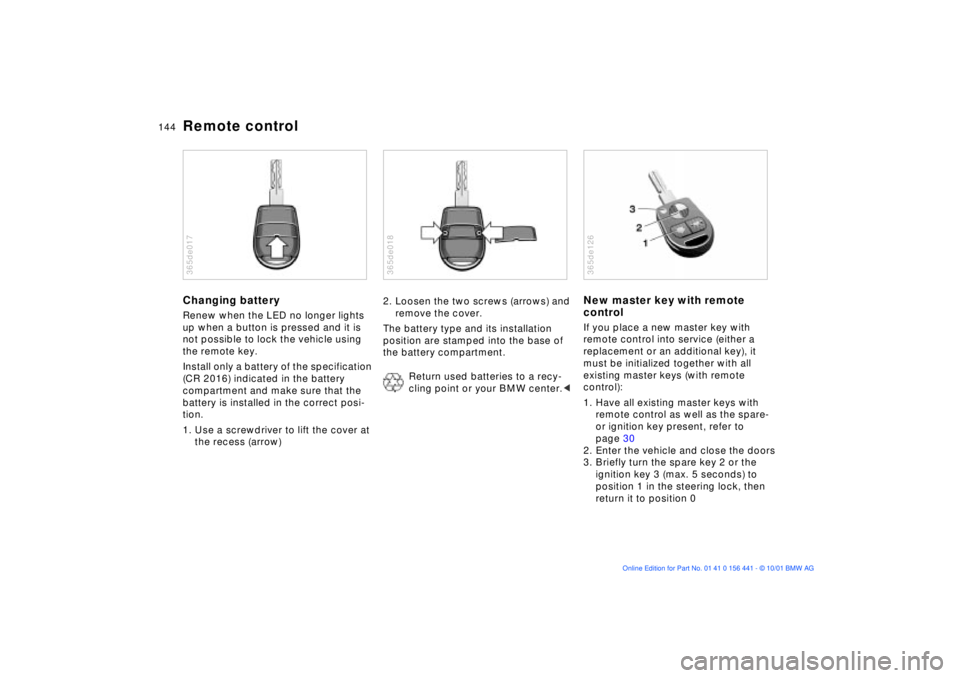
1. Use a screwdriver to lift the cover at
the recess (arrow)365de017
2. Loosen the two screws (arrows) and
remove the cover.
The battery type and its installation
position are stamped into the base of
the battery compartment.
Return used batteries to a recy-
cling point or your BMW center.< 365de018
New master key with remote
controlIf you place a new master key with
remote control into service (either a
replacement or an additional key), it
must be initialized together with all
existing master keys (with remote
control):
1. Have all existing master keys with
remote control as well as the spare-
or ignition key present, refer to
page 30
2. Enter the vehicle and close the doors
3. Briefly turn the spare key 2 or the
ignition key 3 (max. 5 seconds) to
position 1 in the steering lock, then
return it to position 0365de126
Page 145 of 187

145n
IndexDataTechnologyRepairsMaintenanceControlsOverview
Remote control4. Press and hold down button 1 (see
illustration). Maintain pressure on
button 1 while rapidly pressing
button 2 three times in succession
within a period of 10 seconds
5. Release button 1. LED 3 flashes
slowly for a maximum of 10 seconds
6. The central locking system engages
and releases all lock mechanisms in
rapid succession to indicate that the
initialization procedure has been
successfully completed.
If the LED does not flash or if the
central locking system fails to respond,
the initialization procedure will have to
be repeated.
All additional master keys with remote
control for your vehicle (up to a
maximum of four units) must now be
initialized. Make sure that no more than
30 seconds is allowed to elapse
between the individual initialization
procedures. Repeat steps 4 and 5. The
central locking system will respond to
each initialization procedure as
descriped in step 6.
In the event of a system malfunction,
please contact your BMW center, who
can also provide you with replacement
keys.Turn each new master key into
ignition position 2 (ignition
switched on) and back again to allow
the electronic vehicle immobilizer (refer
to page 31) to recognize the new key.
To prevent unauthorized use of the
master key, surrender only the door and
ignition key 3 or the spare key 2 (refer
to page 30) for valet parking, for
instance.<
Page 146 of 187
146n
Wheel change
Safety measures in the event of a
flat tire or a wheel change:
Stop the vehicle on a firm, level surface
as far as possible from the flow of
traffic. Turn on the hazard warning
flashers.
Turn the steering wheel to the straight-
ahead position and engage the steering
lock, engage the parking brake and
shift into 1st or reverse gear (selector
lever in "Park" with automatic transmis-
sion).
All passengers should be outside the
vehicle and well away from your imme-
diate working area (for instance, behind
the guardrail).
If a warning triangle or portable hazard
warning lamp is available, set it up on
the roadside at an appropriate distance
from the rear of the vehicle. Comply
with all safety guidelines and regula-
tions.
Change the wheel only on a level, firm
surface which is not slippery. Avoid
jacking the vehicle on a soft or slippery
support surface (snow, ice, tiles, loose
gravel, etc.), since it could slide side-
ways.
Place the jack on a firm support
surface.
Do not place wooden blocks or similar
objects under the jack. If this is done,
the jack might not be able to reach its
full support capacity because of the
limited height.
Do not lie under the vehicle or start the
engine when the vehicle is supported
by the jack. This creates the risk of fatal
injury.<
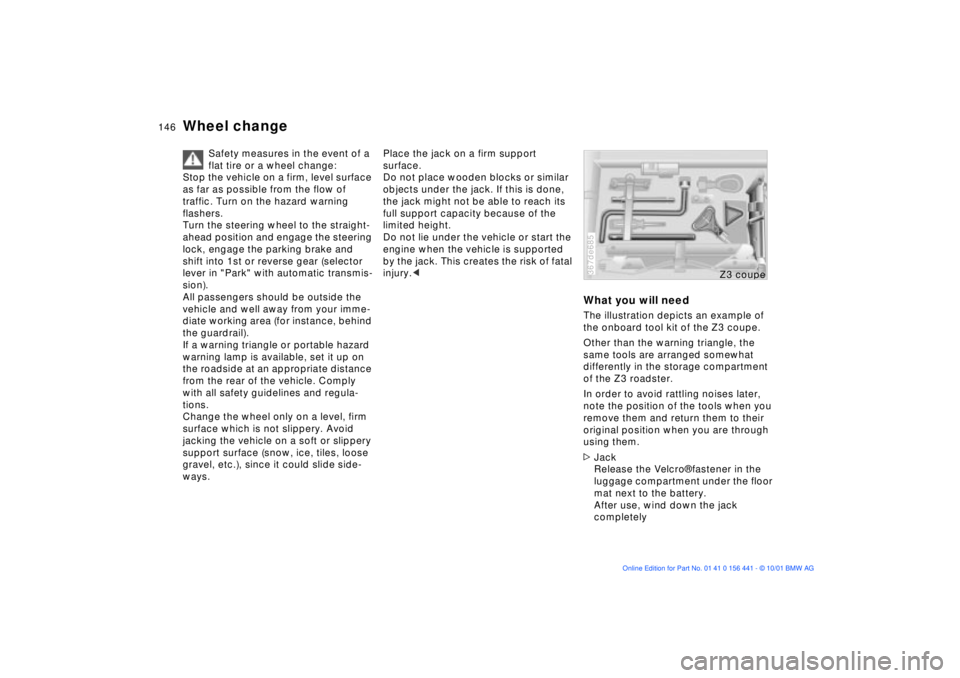
What you will needThe illustration depicts an example of
the onboard tool kit of the Z3 coupe.
Other than the warning triangle, the
same tools are arranged somewhat
differently in the storage compartment
of the Z3 roadster.
In order to avoid rattling noises later,
note the position of the tools when you
remove them and return them to their
original position when you are through
using them.
>Jack
Release the Velcro¨ fastener in the
luggage compartment under the floor
mat next to the battery.
After use, wind down the jack
completely367de685
Z3 coupe
Page 149 of 187
149n
IndexDataTechnologyRepairsMaintenanceControlsOverview
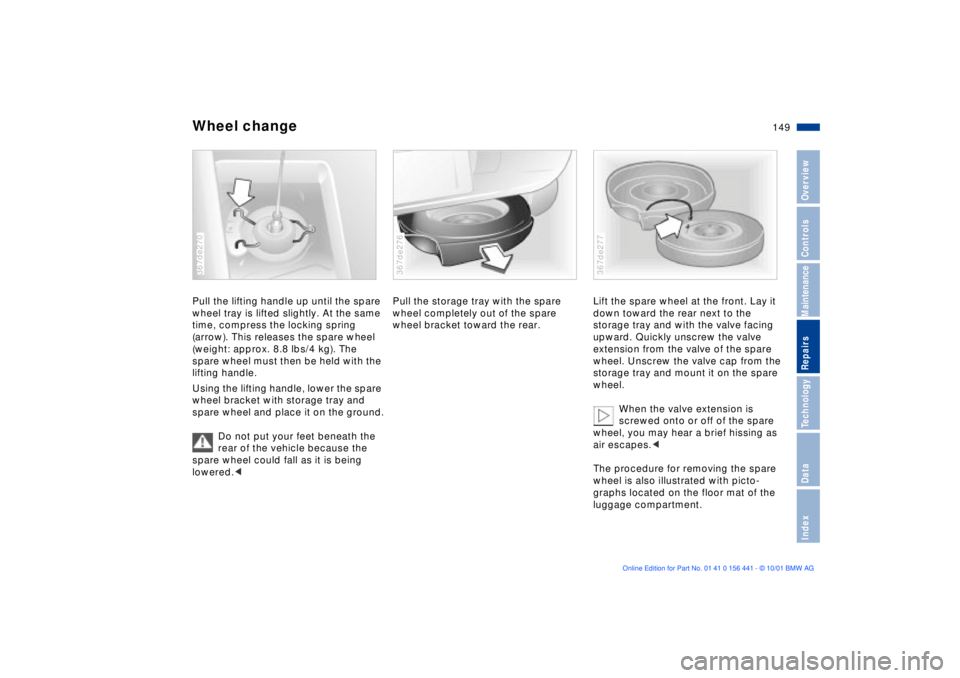
Wheel changePull the lifting handle up until the spare
wheel tray is lifted slightly. At the same
time, compress the locking spring
(arrow). This releases the spare wheel
(weight: approx. 8.8 lbs/4 kg). The
spare wheel must then be held with the
lifting handle.
Using the lifting handle, lower the spare
wheel bracket with storage tray and
spare wheel and place it on the ground.
Do not put your feet beneath the
rear of the vehicle because the
spare wheel could fall as it is being
lowered.< 367de270
Pull the storage tray with the spare
wheel completely out of the spare
wheel bracket toward the rear.367de276
Lift the spare wheel at the front. Lay it
down toward the rear next to the
storage tray and with the valve facing
upward. Quickly unscrew the valve
extension from the valve of the spare
wheel. Unscrew the valve cap from the
storage tray and mount it on the spare
wheel.
When the valve extension is
screwed onto or off of the spare
wheel, you may hear a brief hissing as
air escapes.<
The procedure for removing the spare
wheel is also illustrated with picto-
graphs located on the floor mat of the
luggage compartment.367de277
Page 153 of 187
153n
IndexDataTechnologyRepairsMaintenanceControlsOverview
Battery
Battery posts, terminals and
related accessories contain lead
and lead compounds. Wash hands after
handling.<
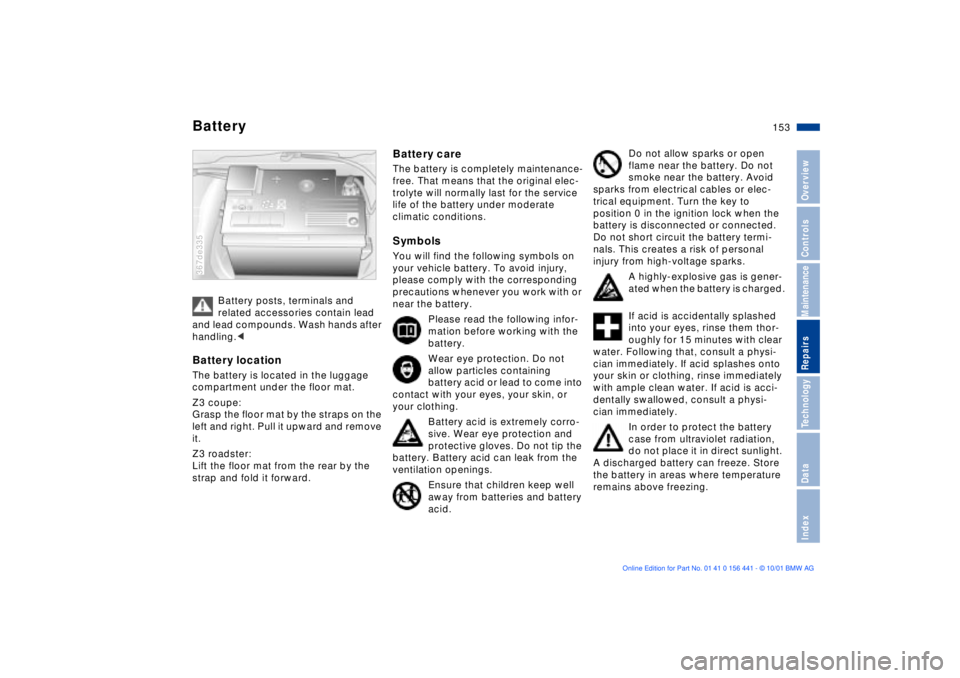
Battery locationThe battery is located in the luggage
compartment under the floor mat.
Z3 coupe:
Grasp the floor mat by the straps on the
left and right. Pull it upward and remove
it.
Z3 roadster:
Lift the floor mat from the rear by the
strap and fold it forward.367de335
Z3 d Z3
Battery careThe battery is completely maintenance-
free. That means that the original elec-
trolyte will normally last for the service
life of the battery under moderate
climatic conditions.SymbolsYou will find the following symbols on
your vehicle battery. To avoid injury,
please comply with the corresponding
precautions whenever you work with or
near the battery.
Please read the following infor-
mation before working with the
battery.
Wear eye protection. Do not
allow particles containing
battery acid or lead to come into
contact with your eyes, your skin, or
your clothing.
Battery acid is extremely corro-
sive. Wear eye protection and
protective gloves. Do not tip the
battery. Battery acid can leak from the
ventilation openings.
Ensure that children keep well
away from batteries and battery
acid.
Do not allow sparks or open
flame near the battery. Do not
smoke near the battery. Avoid
sparks from electrical cables or elec-
trical equipment. Turn the key to
position 0 in the ignition lock when the
battery is disconnected or connected.
Do not short circuit the battery termi-
nals. This creates a risk of personal
injury from high-voltage sparks.
A highly-explosive gas is gener-
ated when the battery is charged.
If acid is accidentally splashed
into your eyes, rinse them thor-
oughly for 15 minutes with clear
water. Following that, consult a physi-
cian immediately. If acid splashes onto
your skin or clothing, rinse immediately
with ample clean water. If acid is acci-
dentally swallowed, consult a physi-
cian immediately.
In order to protect the battery
case from ultraviolet radiation,
do not place it in direct sunlight.
A discharged battery can freeze. Store
the battery in areas where temperature
remains above freezing.
Page 160 of 187
160n
Towing the vehicle
The towed vehicle should always
be the lighter of the two vehicles.
If this is not the case, it will not be
possible to control vehicle handling.<
Tow-startingIt is not possible to start the engine of a
vehicle with an automatic transmission
by towing or pushing the vehicle.
For instructions on jump-starting, refer
to page 158.
Never attempt to use your vehicle to
push another vehicle. This could result
in damage to the energy-absorbing
bumpers.
Towing a vehicle with automatic
transmission1. Place the selector lever in
position "N"
2. Towing speed:
max. 45 mph (70 km/h)
3. Towing distance:
max. 95 miles (150 km)
4. Leave the ignition key in position 1 to
ensure that brake lamps, turn signal
indicators, horn and windshield
wipers remain operative, and to
prevent the steering lock from
engaging
5. Switch on the hazard-warning
flashers (observe applicable legal
regulations).
Find some means of identifying the
vehicle in tow. Place a sign or warning
triangle in the rear window, for
instance.
Even when the electrical system
has failed, make sure that the igni-
tion key remains in position 1 to prevent
the steering lock from engaging.
The steering and brakes are without
power assist when the engine is off.
This means that increased effort is
required for steering and braking.<
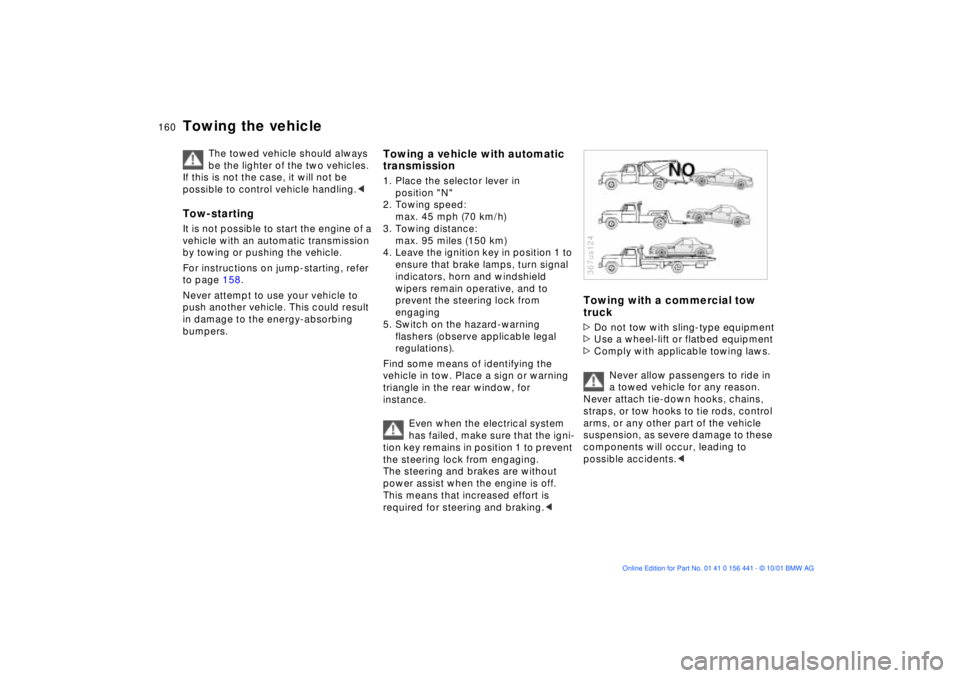
Towing with a commercial tow
truck>Do not tow with sling-type equipment
>Use a wheel-lift or flatbed equipment
>Comply with applicable towing laws.
Never allow passengers to ride in
a towed vehicle for any reason.
Never attach tie-down hooks, chains,
straps, or tow hooks to tie rods, control
arms, or any other part of the vehicle
suspension, as severe damage to these
components will occur, leading to
possible accidents.< 367us124
Page 178 of 187

Everything from A to ZAABS (Antilock Brake
System)101
Accessories6
Adaptive Transmission
Control (ATC)62, 164
ADB (Automatic Differential
Braking)74
Adding
brake fluid126t
engine coolant126t
engine oil123t
washer fluid122t
Additional storage areas90
Adjusting
backrest50
mirrors50, 51
seat49
washer nozzles122t
Air conditioner84
Air distribution82, 86
Air outlets80, 84
ventilation85
Air supply82, 86
Air vents80, 84
Airbags21, 54, 164
important safety
notices130
sitting correctly55Antenna107
Antifreeze126
Antifreeze protection,
radiator105, 125
Antilock Brake System
(ABS)101
Anti-theft system32
Approved gross vehicle
weight172
Approved wheel and tire
specifications116
Aquaplaning99, 111
ASC+T (Automatic Stability
Control plus
Traction)73, 165
Ashtray91
ATC (Adaptive Transmission
Control)62, 164
Automatic cruise control67
Automatic Differential
Braking (ADB)74
Automatic rear window
washer65
Automatic Stability Control
plus Traction
(ASC+T)73, 165
Automatic transmission with
Steptronic62
gear indicator68Automatic windshield
washer122
Average fuel
consumption72
Average speed72
BBackrest, adjusting50
Backup lamps61
bulb replace-
ment139t, 140t
Battery153, 174
capacity174
charge condition154
charging154
discharged158
disposal154t
removal and
installation155
Battery change, keys143
Battery charge indicator
lamp20
Battery safety terminal155
Beverage holder91
BMW High Performance
Synthetic Oil124
Brake fluid126
disposal127tBrake hydraulic system20
Brake lamps, bulb replace-
ment139t, 140t
Brake pads22, 104
Brake system103, 104
brake fluid126
fluid level104
winter road
conditions105
Brakes, malfunctions104
Break-in procedure98
Bulb replacement137t
CCalifornia Proposition
65 Warning132
Capacities173
Car jack146t
Car keys30
Car radio
reception107, 166
refer also to the separate
Owner's Manual
Car wash systems, refer to
the "Caring for your
vehicle" manual
From A to Z
Page 179 of 187

Everything from A to Z
179n
IndexDataTechnologyRepairsMaintenanceControlsOverview
Care of paintwork, refer to
the "Caring for your
vehicle" manual
Care of upholstery materials,
refer to the "Caring for your
vehicle" manual
Cargo loading94
Caring for the vehicle finish,
refer to the "Caring for your
vehicle" manual
Catalytic converter100
CBC (Cornering Brake
Control)102
Cellular phone107
refer also to the separate
Owner's Manual
Center (high-mount) brake
lamp141
Central locking system32
Changing a wheel146t
Charge condition of the
battery154t
Charging the battery154t
Chassis number127
Checking oil level123t
Checking tire
pressure26t, 110
Child seat56
Child-restraint device56Child-restraint system56
installation57
Z3 coupe with tether
strap57
Cigarette lighter92
Cleaning the headlamps66
Cleaning the rear
window66
Cleaning the windshield65
Clock70
Cockpit16
Coin box91
Cold start59
Compartments90
Computer70
refer also to the "Owner's
Manual for Onboard
Computer"
Connecting a car vacuum
cleaner92
Controls, cockpit16
Convertible top
electrical
malfunction157t
manual operation157t
operation40, 44
weather protection44
Coolant105, 126Coolant temperature69
Coolant, antifreeze
protection105
Copyright4
Cornering Brake Control
(CBC)102
Cover, convertible
top41, 46
Cruise control67
Cruising range72
Cup holder, refer to
beverage holder91
Curb weight172
DDashboard16
Data link connector for
Onboard Diagnostics133
Daytime driving lamps76
DBC (Dynamic Brake
Control)103
Deep water99
Defrost windows and
remove
condensation83, 88
Defrosting
rear window66
mirrors51Difficult steering106t
Digital clock70
Dimensions171
Dipstick, engine oil123
Disc brakes103
Displacement170
Display lighting76
Displays18
Disposal
batteries154t
brake fluid127t
coolant125t
engine oil125t
Door key30
Doors
electrical
malfunction32t
manual operation32t
operating with the remote
control33
unlocking and locking32
DOT Quality Grades,
tires111
Drive belts174
Driving notes99
Driving through water99