Page 29 of 187
Overview
Controls and features
Operation, maintenance
Owner service procedures
Technical data
Index Advanced technology
29n
IndexDataTechnologyRepairsMaintenanceControlsOverview
Turn signals/High beams64
Washer/Wiper system65
Rear window defroster66
Cruise control67
Everything under control:
Odometer68
Tachometer68
Fuel gauge68
Coolant temperature gauge69
Service Interval Display69
Clock70
Computer70
Technology for safety
and convenience:
Automatic Stability Control
plus Traction (ASC+T)73
Dynamic Stability Control
(DSC)74
Lamps:
Parking lamps/Low beams76
Fog lamps76
Interior lamps77
Reading lamps78
Controlling the climate
for pleasant driving:
Heating and ventilation80
Heating and ventilation/
Air conditioner84
Seat heating89Cabin convenience:
Glove compartment90
Storage compartments90
Storage boxes90
Beverage holder91
Ashtray91
Cigarette lighter92
Loading and transporting
cargo:
coupe:
Roll-up cover93
Partition net93
Cargo loading94
Roof-mounted luggage
rack95
Page 31 of 187
31n
IndexDataTechnologyRepairsMaintenanceControlsOverview
Electronic vehicle immobilizerThe key to securityThe electronic vehicle immobilization
unit increases the anti-theft protection
of your BMW Ð you do not have to
adjust or activate anything. This elec-
tronic immobilization system is
designed to reduce the susceptibility of
the vehicle to theft by making it impos-
sible to start the engine using any
means other than the special keys
furnished with the vehicle.
Your BMW center can cancel the elec-
tronic system authorization for indi-
vidual keys (in the event a key is lost,
for instance). A deactivated key can no
longer be used to start the engine.
How the electronics workAt the heart of this system is an elec-
tronic chip which is integrated into the
key. The lock mechanism itself is actu-
ally a dual-function device, simulta-
neously serving as a communications
interface designed to allow the security
system to maintain a continuous stream
of variable, vehicle-specific signals with
the electronic circuitry in the key. The
system will not release the ignition, fuel
injection and starter unless it recog-
nizes an "authorized" key.
Force applied to the key can
damage the integrated electronic
circuitry. A damaged key can no longer
be used to start the engine.<
Page 32 of 187
32n
Central locking system Opening and closing Ð from the outsideThe conceptThe central locking system becomes
operational when the doors are closed.
The system simultaneously engages
and releases the locks on the
>doors
>luggage compartment
>fuel filler door.
The central locking system can be
operated
>from outside via the door locks, the
luggage compartment lock as well as
via the remote control
*
>from inside via the safety lock
buttons (locks doors only).
The anti-theft system is automatically
activated whenever you activate the
central locking system from outside the
vehicle. It prevents the doors from
being unlocked with the lock buttons or
release handles.
The central locking system unlocks
automatically in the event of an acci-
dent. In addition, the hazard warning
flashers and interior lamps come on.
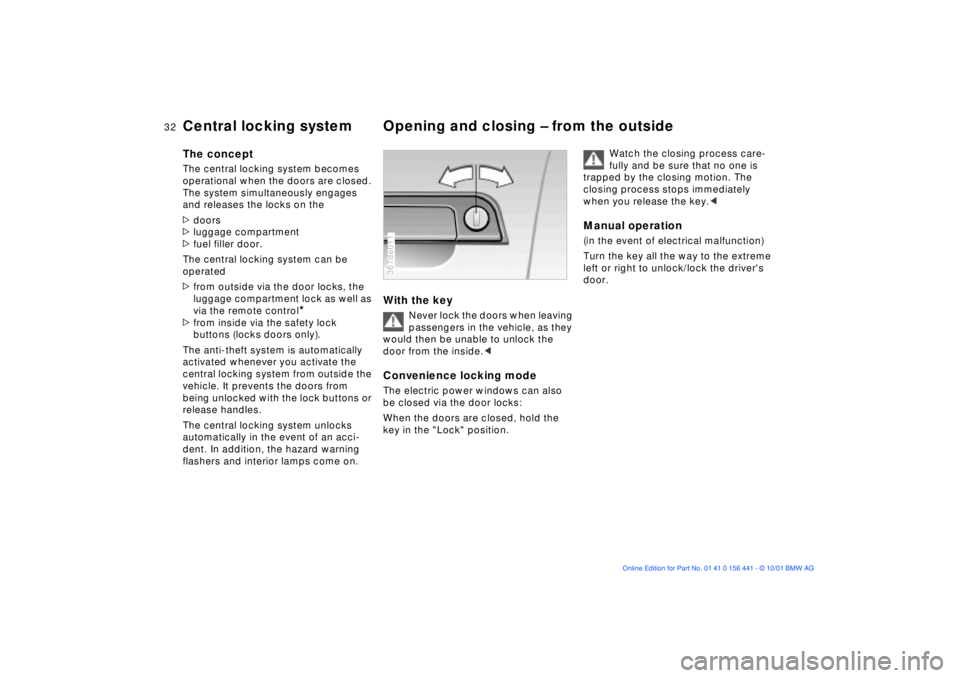
With the key
Never lock the doors when leaving
passengers in the vehicle, as they
would then be unable to unlock the
door from the inside.<
Convenience locking modeThe electric power windows can also
be closed via the door locks:
When the doors are closed, hold the
key in the "Lock" position.367de011
Watch the closing process care-
fully and be sure that no one is
trapped by the closing motion. The
closing process stops immediately
when you release the key.<
Manual operation(in the event of electrical malfunction)
Turn the key all the way to the extreme
left or right to unlock/lock the driver's
door.
Page 36 of 187
36n
Opening and closing Ð from the inside Luggage compartment lidTo unlock and open the doors>Pull the release handle of a door
twice: the initial pull unlocks the door,
and the second opens it.To lock the doorsWhen the safety lock button of any door
is pressed down, the doors and
luggage compartment are locked. The
anti-theft system is not activated.
The fuel filler door also remains
unlocked to allow refueling.
To avoid being accidentally locked out
of the vehicle:
>The vehicle cannot be locked with
the lock button when the driver's
door is open
>The lock button on the passenger's
door only operates the central
locking system if both doors are
closed.Since passengers or animals
remaining in the vehicle might be
able to lock the doors from the inside,
always take the vehicle keys with you
so that the vehicle can be opened again
from the outside at any time.<
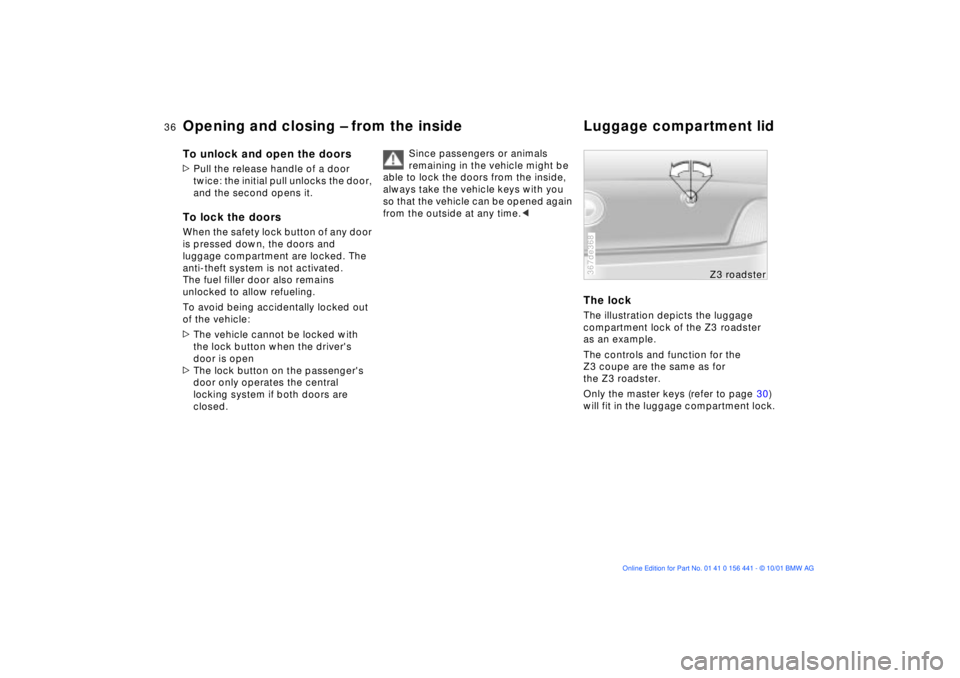
The lockThe illustration depicts the luggage
compartment lock of the Z3 roadster
as an example.
The controls and function for the
Z3 coupe are the same as for
the Z3 roadster.
Only the master keys (refer to page 30)
will fit in the luggage compartment lock.367de368
Z3 roadster
Page 68 of 187

68n
1 OdometerYou can activate the displays shown in
the illustration with the ignition key in
position 0 by pressing the button in the
instrument cluster (arrow).2 Trip odometer/Gear indicator
for automatic transmission with
Steptronic
*
Trip odometer:
To reset the trip odometer to zero,
press the button (arrow) with the igni-
tion key in position 1 or higher.
Gear indicator:
>S for Sport Program
>M1 to M5 for manual mode.367us710
Never allow the engine to operate with
the needle in the red overspeed sector
of the gauge.
To protect the engine, the engine-
management system automatically
interrupts the fuel supply in this range;
you will notice a loss of power.367de005
When you switch on the ignition, the
indicator lamp comes on briefly to
confirm that the system is operational.
Once the indicator lamp stays on
continuously, there are still approx.
2.1 gallons (8 liters) of fuel in the fuel
tank.
Tank capacity: page 173.
If the tilt of the vehicle varies (extended
driving in mountainous areas, for
example), the needle may fluctuate
slightly.
Please refuel early, since driving
to the last drop of fuel can result in
damage to the engine and/or catalytic
converter.< 367us006
Odometer Tachometer Fuel gauge
Page 70 of 187
70n
Clock Computer
*
You can correct the time by pressing
the buttons (arrows) with a sharp object
such as a ball-point pen.
Set the clock forward by pressing the
right button; set the clock back by
pressing the left button.367de728
Mode selectionYou can call up the computer data in
the display from ignition switch posi-
tion 1 with the turn indicator lever.
Press the button briefly to select the
next display mode.
In addition, you can display the time by
pressing the button.
With the button, the calculations
for average fuel consumption and
speed are reset and begin again.367us041
TimeThe display is provided at ignition key
position 1 or higher. In ignition key
position 0, the time is displayed for
approx. 8 seconds by pressing the
button.
Following a power loss, the clock auto-
matically switches to the setting mode:
the colon flashes. Two dashes are
displayed for entering the hour.367de716
Page 72 of 187
72n
Computer
*
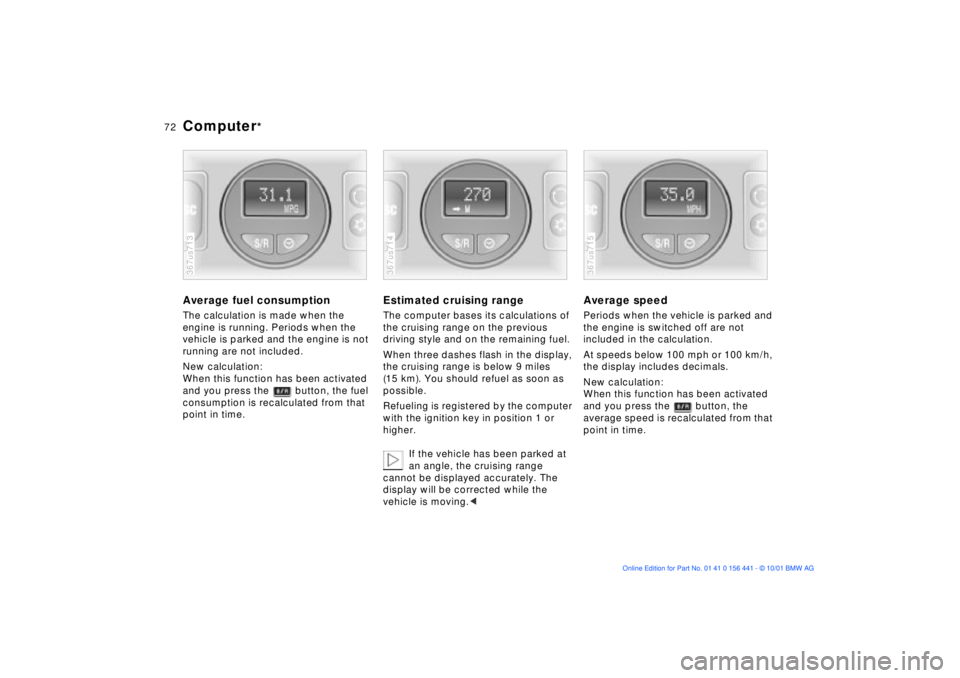
Average fuel consumptionThe calculation is made when the
engine is running. Periods when the
vehicle is parked and the engine is not
running are not included.
New calculation:
When this function has been activated
and you press the button, the fuel
consumption is recalculated from that
point in time.367us713
Estimated cruising rangeThe computer bases its calculations of
the cruising range on the previous
driving style and on the remaining fuel.
When three dashes flash in the display,
the cruising range is below 9 miles
(15 km). You should refuel as soon as
possible.
Refueling is registered by the computer
with the ignition key in position 1 or
higher.
If the vehicle has been parked at
an angle, the cruising range
cannot be displayed accurately. The
display will be corrected while the
vehicle is moving.< 367us714
Average speedPeriods when the vehicle is parked and
the engine is switched off are not
included in the calculation.
At speeds below 100 mph or 100 km/h,
the display includes decimals.
New calculation:
When this function has been activated
and you press the button, the
average speed is recalculated from that
point in time. 367us715
Page 100 of 187

100n
Catalytic converterThe catalytic converter reduces harmful
exhaust emissions.
It is designed for use with unleaded fuel
only.
Even minute quantities of lead would be
enough to permanently damage both
the catalytic converter and the system's
oxygen sensor.
To ensure efficient, trouble-free engine
operation and avoid potential damage:
>Be sure to comply with the scheduled
maintenance requirements
>Fill the fuel tank well before it is
empty
>If the engine runs roughly, shut it off
as soon as possible
>Tow-start the vehicle only when the
engine is cold. Tow-starting when the
engine is warm could cause unburned
fuel to ignite on the way to the cata-
lytic converter, resulting in significant
damage. It is better to start the vehicle
with an outside starting aid>Avoid any other situations in which
the fuel would not be (completely)
burned, for instance:
Frequent or consecutive extended
starting attempts or repeated starting
attempts when the engine fails to
start. (Shutting down and restarting
an engine which is running properly
does not present a problem.) Never
allow the engine to run with any of
the spark plug cables disconnected.Be sure to comply with the
instructions above to prevent
unburned fuel from reaching the cata-
lytic converter. Otherwise, the catalytic
converter could respond by over-
heating, leading to serious damage.
Extreme temperatures occur at the
catalytic converter on this and every
catalyst-equipped vehicle. Heat shields
are installed adjacent to some sections
of the exhaust system. Never remove
these shields; do not apply under-
coating to their surfaces.
When driving, standing while the engine
is idling, or when parking, be careful to
avoid contact between the hot exhaust
system and easily-flammable materials
(hay, dry grass, leaves, etc.). Such
contact could cause a fire, resulting in
personal injuries and property
damage.<

