2002 BMW M6 CONVERTIBLE tow
[x] Cancel search: towPage 133 of 186

133n
OverviewControlsMaintenanceRepairsDataIndex
Information for your safetyThe factory-approved radial tires are
matched to the vehicle and have been
selected to provide optimum safety and
driving comfort.
It is not merely the tire's service life, but
also driving comfort and Ð above all else
Ð driving safety which depend on the
condition of the tires and the mainte-
nance of the specified tire pressure.
Incorrect inflation pressures are a
frequent cause of tire problems
and tire damage. Tire pressure also has
a major effect on your BMW's handling
response. We recommend that you
check the tire pressure Ð remember to
check the spare as well Ð before every
extended trip, as well as at least every
two weeks in normal use (refer to
page 26). Failure to observe these
precautions can result in incorrect tire
pressures, which cause instable
handling response as well as tire
damage, and can ultimately lead to an
accident.<
Tire tread Ð Tire damageInspect your tires frequently for tread
wear, signs of damage and for foreign
objects lodged in the tread. Check the
tread depth.
Tread depth should not be allowed to
go below 0.12 in (3 mm), even though
the legally specified minimum tread
depth is 0.063 in (1.6 mm). Tread wear
indicators (arrow) are embedded in the
base of the tire's tread. Their locations
are indicated by the legend "TWI" Ð
Tread Wear Indicator Ð at various points
on the tire's shoulder. When the tread
reaches a depth of 0.063 in (1.6 mm),
these indicators appear to signal that
the tires have worn to the minimum
legal level. Below 0.12 in (3 mm) tread
depth, there is an increased risk of
aquaplaning, even at relatively 390de331
moderate speeds and with only small
amounts of water on the road.
Do not drive on a deflated (flat)
tire. A flat tire greatly impairs
steering and braking response, and can
lead to complete loss of control over
the vehicle.
Avoid overloading the vehicle so that
the permitted load on the tires is not
exceeded. Overloading leads to over-
heating and causes damage inside the
tires. The ultimate result can assume
the form of a sudden air loss.
Unusual vibrations encountered during
normal vehicle operation can indicate a
flat tire or some other vehicle malfunc-
tion. The type of problem can be
caused by contact with curbs, etc. This
is also true for irregularities in the
vehicle's handling characteristics, such
as a pronounced tendency to pull to the
left or right. Should this occur, respond
by immediately reducing your speed.
Proceed carefully to the nearest BMW
center or professional tire center, or
have the vehicle towed in to have it, its
wheels and tires inspected.
Tire damage (up to and including blow-
outs) can endanger the lives of both the
vehicle occupants and other road
users.<
Tire inflation pressure Tire condition
Page 140 of 186

140n
Engine oilChecking oil level1. Park the vehicle on a level surface
2. Shut the engine off after it has
reached normal operating tempera-
ture
3. After approx. 5 minutes, pull the
dipstick out and wipe it off with a
clean lint-free cloth, paper towel, or
similar material
4. Carefully push the dipstick all the
way into the guide tube and pull it
out again
5. The oil level should be in between
the two marks on the dipstick.
As with fuel economy, oil consumption
is directly influenced by your driving
style and vehicle operating conditions.390de647
The oil volume between the two marks
on the dipstick corresponds to approx.
1.1 US quarts (1 liter). Do not fill beyond
the upper mark on the dipstick. Excess
oil will damage the engine.460de189
Adding engine oilWhile you should wait until the level has
dropped to just above the lower gradu-
ation before adding oil, you should
never allow the oil level to fall below
this marking.
BMW engines are designed to
operate without oil additives; the
use of additives could lead to damage
in some cases. This is also true for the
manual transmission, the automatic
transmission, the differential, and the
power steering system.<
Recommendation: have the oil changed
by your BMW center only.390de626
Page 150 of 186
150n
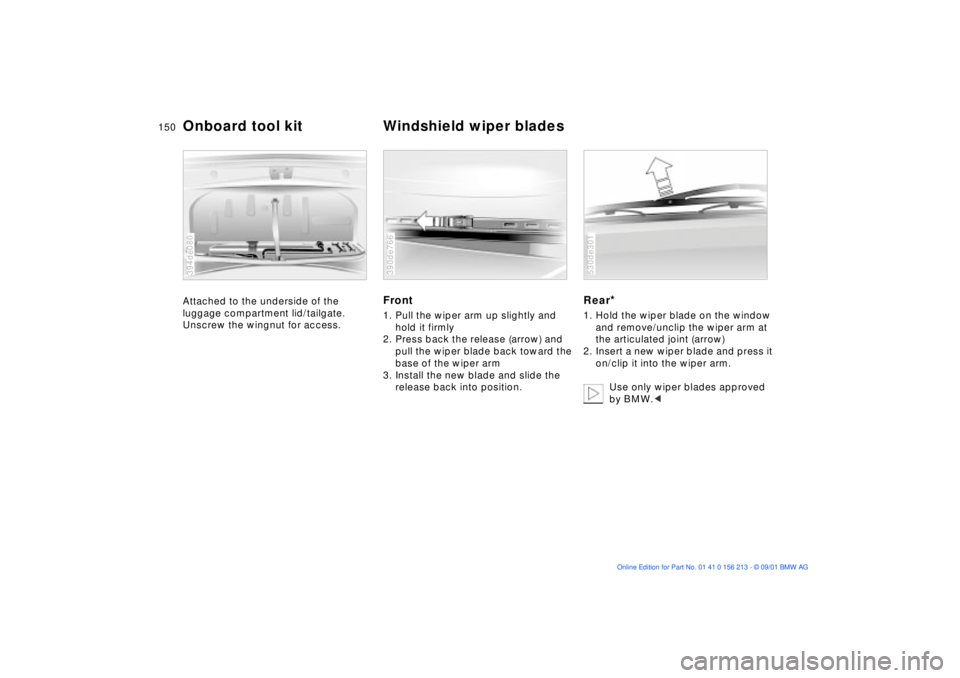
Attached to the underside of the
luggage compartment lid/tailgate.
Unscrew the wingnut for access.
394de080
Front1. Pull the wiper arm up slightly and
hold it firmly
2. Press back the release (arrow) and
pull the wiper blade back toward the
base of the wiper arm
3. Install the new blade and slide the
release back into position.390de766
Rear
*
1. Hold the wiper blade on the window
and remove/unclip the wiper arm at
the articulated joint (arrow)
2. Insert a new wiper blade and press it
on/clip it into the wiper arm.
Use only wiper blades approved
by BMW.< 530de301
Onboard tool kit Windshield wiper blades
Page 153 of 186

153n
OverviewControlsMaintenanceRepairsDataIndex
Lamps and bulbsSide turn signals5 watt bulb
1. Use finger pressure against the rear
end of the lens (arrow) to press it
forward for removal
2. Press gently on the bulb and turn it to
the left to remove it.390de768
Front fog lampsH8 bulb, 35 watt
The bulb is pressurized. There-
fore, wear safety glasses and
protective gloves. Failure to observe
these precautions can result in physical
injury if the bulb breaks.<
1. Using a screwdriver, remove the
mounting clip for the air grill (arrow)
and remove the grill by bringing it
toward the front390de671
2. Loosen both screws (arrows)
3. Take off the cover panel next to the
headlamp
4. Turn the headlamp 903 to the left and
remove it by bringing it toward the
front
5. Disconnect the plug
6. Turn the lamp to the left and remove
it.390de672
Page 163 of 186
163n
OverviewControlsMaintenanceRepairsDataIndex
Jump-starting Towing the vehicle7. Start the support vehicle's engine
and let it run at an increased idling
speed for a few minutes. Start the
engine on the vehicle needing the
jump-start, and allow it to run as
usual. If the first start attempt is not
successful, wait a few minutes
before another attempt in order to
allow the discharged battery to
recharge
8. Before disconnecting the jumper
cables let the engines run for a few
minutes
9. Then disconnect the jumper cables
in reverse sequence.
Depending on the cause of the fault,
have the battery recharged by your
BMW center.
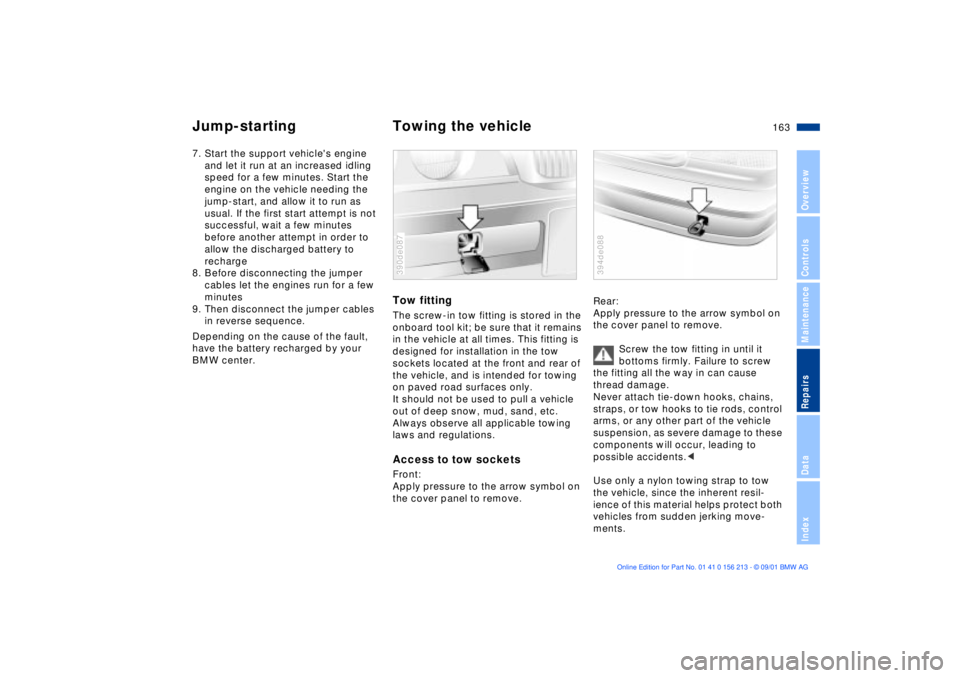
Tow fittingThe screw-in tow fitting is stored in the
onboard tool kit; be sure that it remains
in the vehicle at all times. This fitting is
designed for installation in the tow
sockets located at the front and rear of
the vehicle, and is intended for towing
on paved road surfaces only.
It should not be used to pull a vehicle
out of deep snow, mud, sand, etc.
Always observe all applicable towing
laws and regulations.Access to tow socketsFront:
Apply pressure to the arrow symbol on
the cover panel to remove.390de087
Rear:
Apply pressure to the arrow symbol on
the cover panel to remove.
Screw the tow fitting in until it
bottoms firmly. Failure to screw
the fitting all the way in can cause
thread damage.
Never attach tie-down hooks, chains,
straps, or tow hooks to tie rods, control
arms, or any other part of the vehicle
suspension, as severe damage to these
components will occur, leading to
possible accidents.<
Use only a nylon towing strap to tow
the vehicle, since the inherent resil-
ience of this material helps protect both
vehicles from sudden jerking move-
ments.394de088
Page 164 of 186
164n
Towing the vehicle
The towed vehicle should always
be the lighter of the two vehicles.
If this is not the case, it is no longer
possible to control vehicle response.<
Tow-startingIt is not possible to start the engine of
vehicles equipped with an automatic
transmission by towing or pushing.
For instructions on jump-starting: refer
to page 162.
Never attempt to use your vehicle to
push another vehicle, since damage to
the energy-absorbing bumpers could
result.
Towing a vehicle with automatic
transmission1. Place the selector lever in position N
2. Towing speed:
Max. 45 mph (70 km/h)
3. Towing distance:
Max. 95 miles (150 km)
4. Leave the ignition key in position 1 to
ensure that the brake lamps, turn
signals, horn and windshield wipers
remain operative, and to prevent the
steering lock detent from engaging
5. Switch on the hazard warning
flashers (observe official regulations).
Find some means of identifying the
vehicle in tow, for instance, place a sign
or warning triangle in the rear window.
Make sure that the ignition key
remains in position 1 even when
the electrical system has failed to
prevent the steering lock from
engaging. The steering and brakes are
without power-assist when the engine
is off. This means that increased effort
is required for steering and braking.<
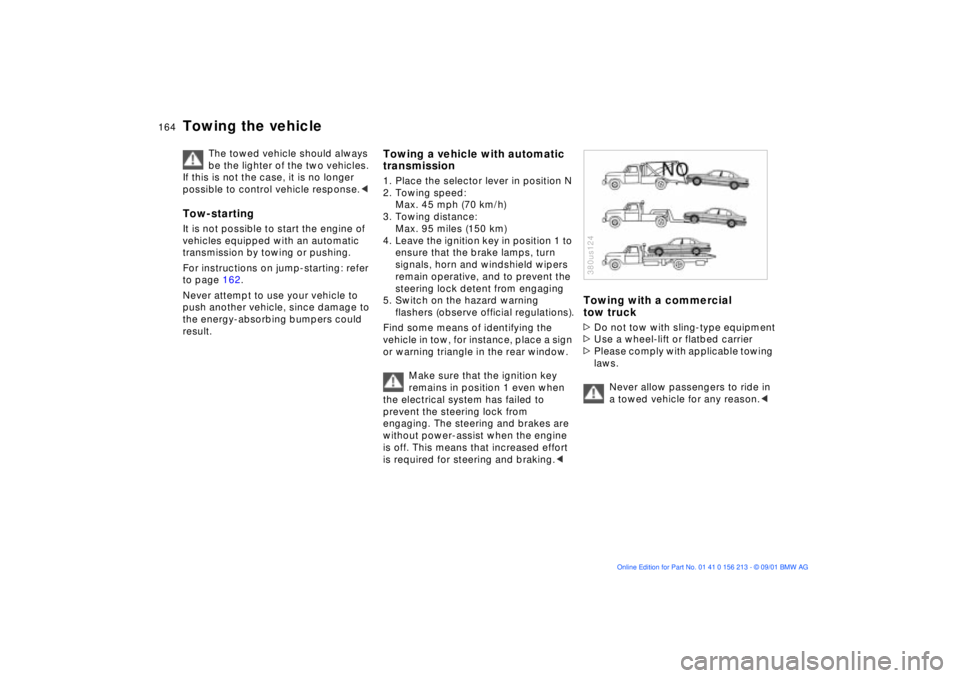
Towing with a commercial
tow truck>Do not tow with sling-type equipment
>Use a wheel-lift or flatbed carrier
>Please comply with applicable towing
laws.
Never allow passengers to ride in
a towed vehicle for any reason.< 380us124
Page 178 of 186

Everything from A to ZDistance from
destination92
Distance warning96
Divided rear-seat
backrest119
Doors
manual operation33
opening and closing34
opening/closing from the
inside34
operation via remote
control34
DOT Quality Grades134
Driving notes131
DSC (Dynamic Stability
Control)21, 97
Dynamic Brake Control
(DBC)20
Dynamic Stability Control
(DSC)21, 97 E
Electric power seat50
Electric power windows44
Electrical malfunction
doors33
fuel filler door24
luggage compartment
lid38
sliding/tilt sunroof47
tailgate39 Elements of operation14
Emergency release of
luggage compartment lid
from luggage
compartment's interior41
Energy control81
Engine compartment138
Engine coolant82, 142
Engine oil140
consumption140
disposal141t
level20
pressure19
specifications141t
viscosity ratings141
Engine specifications168
Estimated time of arrival93
Exterior mirrors57
F
Failure messages83t
Filling the washer
reservoir139t
First-aid kit23
Fittings, tow-starting and
towing163t
Flashlight116 Flat tire133, 157t
Fog lamps102
bulb replacement153t
Follow me home101
Front ashtray117
Front fog lamps102
Front seat adjustment48
Fuel25
gauge81
quality25
specifications25
tank capacity173
Fuel consumption86, 93
average86, 93
indicator81
Fuel filler door24
electrical malfunction24
manual release24
Fuses160
G
Gasoline25
gauge81
quality25
Glass moonroof47
Glove compartment116
Grilles107
Gross vehicle weight171
H
Handbrake68
Hands-free system117
Hazard warning triangle23
Head restraints50
Headlamp covers,
care151t
Headlamp flasher76
Headlight washer
system139
Heated steering wheel56
Heating and
ventilation104, 107
Heating while stopped111
Heavy cargo126
Height adjustment
seats50
steering wheel56
Height of vehicle169
High beams21, 102
bulb replacement151t
High Performance Synthetic
Oils141
High-mount brake lamp155
Holder for canned
beverages117
Hood137
release137t
Horn14
Hydraulic Braking Assistant,
refer to DBC20
Page 182 of 186

Everything from A to ZSummer tires135
Sun blind cover112
Sunroof46
Switching off the engine68
Switch-on times for parked-
car ventilation90
Symbols8 T
Tachometer81
Tail lamps154
bulb replacement154t
Tailgate
manual operation39
manual release39
opening from the
inside40
opening from the
outside39
Technical
modifications10, 145
Telephone hookup117
Temperature display80, 86
Temperature gauge82
Temperature
layering106, 111
Third brake lamp155 Through-loading
system119
Tilt alarm sensor42, 43
avoiding unintentional
alarms44
deactivate35
Tilt function, passenger-side
mirror55
Time
calling up88
changing88
of arrival, estimated93
Timer88
for additional information
refer to the "Owner's
Manual for Onboard
Computer"
Tire
change157t
damage133t
inflation pressure26, 133
pressure
monitoring99, 133
renewal134
tread133
Tire inflation pressure26
Tire Pressure Monitor
(RDC)99
Tire Quality Grading135
Tools150t Torque168
Tow fittings163t
Towing the vehicle163t
Track169
Traction control system,
refer to ASC+T/DSC
Transmission69, 70, 73
Transmitter key32
Transporting children
safely61
Tread depth, tires133
Trip odometer80
Trunk lid
refer to luggage
compartment lid38
Trunk, refer to luggage
compartment42
Turn signal
bulb replacement152t
Turn signal indicator76
Turning circle169
U
Uniform Tire Quality Grading
(UTQR)135
Universal Transmitter113
Use antifreeze,
radiator142t
Used batteries,
disposal160t Used oils, disposal141t
V
Vacuum cleaner, attach118
Valve caps159
Vehicle Memory64
Ventilation104, 106, 111
draft-free106, 111
in the rear106
Ventilation while
parked112
for more information on
ventilation with vehicle
stationary, refer to the
"Owner's Manual for
Onboard Computer"
Viscosity ratings, oils141 W
Warm feet Ð cool
head106, 111
Warning and indicator
lamps19
Warning lamps19t
Warning messages83t
Warning triangle23