2002 BMW M6 CONVERTIBLE stop start
[x] Cancel search: stop startPage 99 of 186

99n
OverviewControlsMaintenanceRepairsDataIndex
Level control system
*
Tire Pressure Monitor (RDC)
*
The warning lamp for the level
control system comes on, or the
message "SELFLEVEL
SUSP.INACT" appears in the Check
Control: there is a malfunction in the
self-level control system.
Stop and inspect the vehicle. If it is
riding significantly lower in the rear than
in the front, or if it is sitting at an incline
(left rear compared to right rear),
consult the nearest BMW center. Drive
with appropriate caution in the mean-
time. The vehicle has reduced ground
clearance or driving comfort is notice-
ably reduced.
Even if the attitude of the vehicle is
normal, you should consult the nearest
BMW center if the warning lamp indi-
cates a system fault.
The conceptRDC monitors the tire pressures at all
four wheels, even when the vehicle is
moving. The system provides an alert
whenever the inflation pressure drops
significantly below the specified pres-
sure in one or more tires.
In order for the system to "learn" the
correct tire inflation pressure, check the
inflation pressure in all tires. Refer to
the table of "Tire inflation pressures"
beginning on page 27 and make any
necessary corrections. Then activate
the system.
This indicator lamp in the instru-
ment cluster or the Check
Control will inform you if the tire
pressure is not correct.
Activate the system1. Turn the ignition key to position 2 (do
not start the engine)
2. Maintain pressure on the button until
the yellow indicator lamp in the
instrument cluster comes on for
several seconds or the message
"SET TIRE PRESSURE" appears in
the Check Control panel
3. After you have driven for a few
minutes, the RDC will import the
current inflation pressure in the tires
as the reference values which the
system will monitor.
You will only have to repeat this proce-
dure if the tire inflation pressure must
be corrected. Otherwise, the RDC func-
tions automatically when the ignition
key is in position 2, and thus operates
whenever the vehicle is driven.390de704
Page 110 of 186
110n
Automatic climate control
*
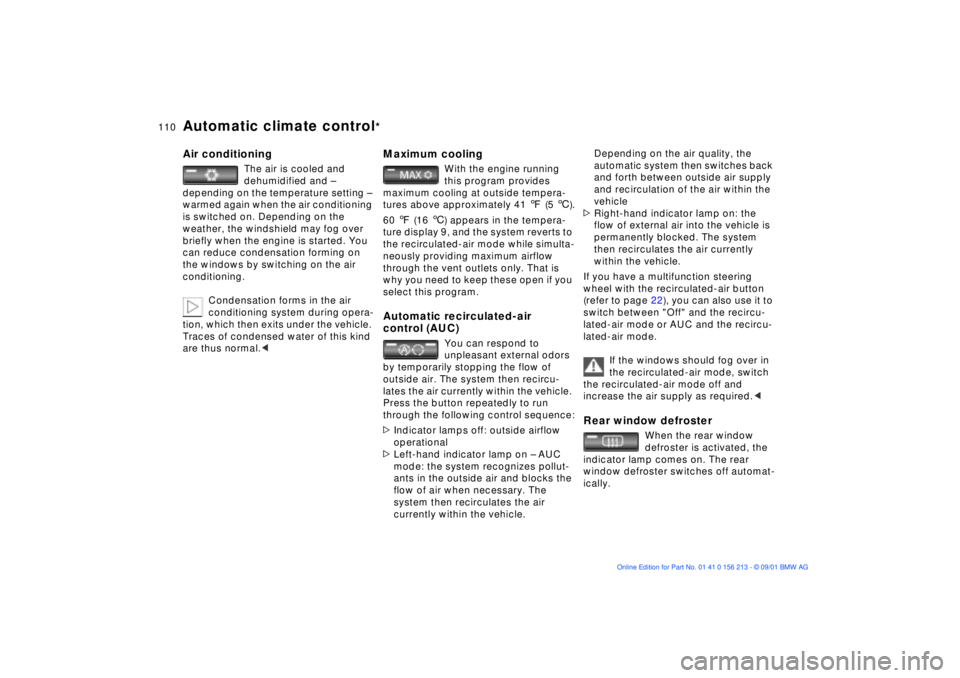
Air conditioning
The air is cooled and
dehumidified and Ð
depending on the temperature setting Ð
warmed again when the air conditioning
is switched on. Depending on the
weather, the windshield may fog over
briefly when the engine is started. You
can reduce condensation forming on
the windows by switching on the air
conditioning.
Condensation forms in the air
conditioning system during opera-
tion, which then exits under the vehicle.
Traces of condensed water of this kind
are thus normal.<
Maximum cooling
With the engine running
this program provides
maximum cooling at outside tempera-
tures above approximately 41 7 (5 6).
60 7 (16 6) appears in the tempera-
ture display 9, and the system reverts to
the recirculated-air mode while simulta-
neously providing maximum airflow
through the vent outlets only. That is
why you need to keep these open if you
select this program.
Automatic recirculated-air
control (AUC)
You can respond to
unpleasant external odors
by temporarily stopping the flow of
outside air. The system then recircu-
lates the air currently within the vehicle.
Press the button repeatedly to run
through the following control sequence:
>Indicator lamps off: outside airflow
operational
>Left-hand indicator lamp on Ð AUC
mode: the system recognizes pollut-
ants in the outside air and blocks the
flow of air when necessary. The
system then recirculates the air
currently within the vehicle.
Depending on the air quality, the
automatic system then switches back
and forth between outside air supply
and recirculation of the air within the
vehicle
>Right-hand indicator lamp on: the
flow of external air into the vehicle is
permanently blocked. The system
then recirculates the air currently
within the vehicle.
If you have a multifunction steering
wheel with the recirculated-air button
(refer to page 22), you can also use it to
switch between "Off" and the recircu-
lated-air mode or AUC and the recircu-
lated-air mode.
If the windows should fog over in
the recirculated-air mode, switch
the recirculated-air mode off and
increase the air supply as required.< Rear window defroster
When the rear window
defroster is activated, the
indicator lamp comes on. The rear
window defroster switches off automat-
ically.
Page 156 of 186
156n
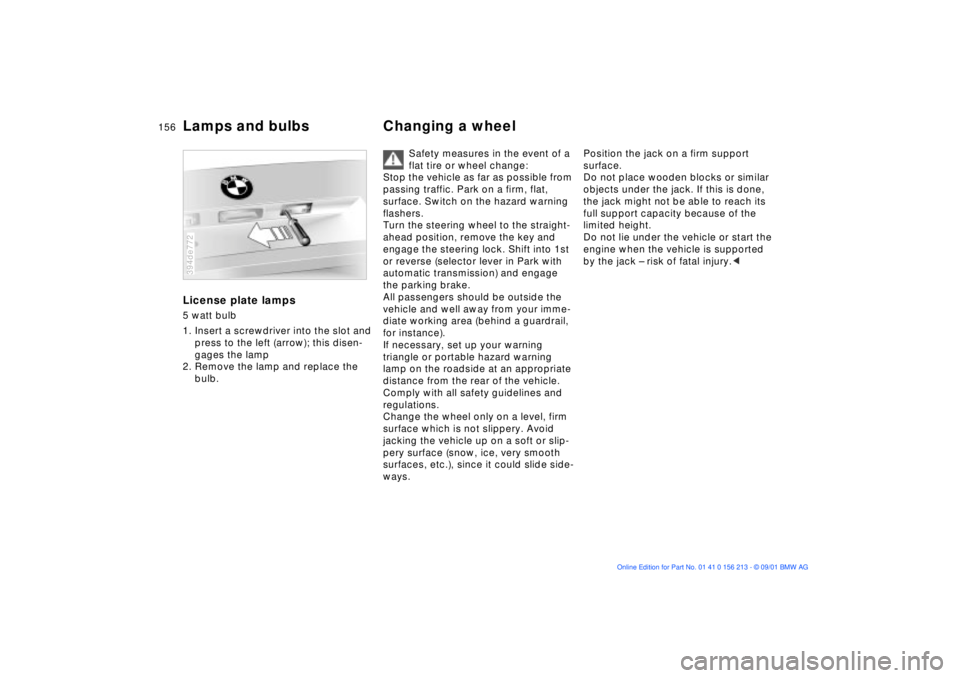
Lamps and bulbs Changing a wheelLicense plate lamps5 watt bulb
1. Insert a screwdriver into the slot and
press to the left (arrow); this disen-
gages the lamp
2. Remove the lamp and replace the
bulb.394de772
Safety measures in the event of a
flat tire or wheel change:
Stop the vehicle as far as possible from
passing traffic. Park on a firm, flat,
surface. Switch on the hazard warning
flashers.
Turn the steering wheel to the straight-
ahead position, remove the key and
engage the steering lock. Shift into 1st
or reverse (selector lever in Park with
automatic transmission) and engage
the parking brake.
All passengers should be outside the
vehicle and well away from your imme-
diate working area (behind a guardrail,
for instance).
If necessary, set up your warning
triangle or portable hazard warning
lamp on the roadside at an appropriate
distance from the rear of the vehicle.
Comply with all safety guidelines and
regulations.
Change the wheel only on a level, firm
surface which is not slippery. Avoid
jacking the vehicle up on a soft or slip-
pery surface (snow, ice, very smooth
surfaces, etc.), since it could slide side-
ways.
Position the jack on a firm support
surface.
Do not place wooden blocks or similar
objects under the jack. If this is done,
the jack might not be able to reach its
full support capacity because of the
limited height.
Do not lie under the vehicle or start the
engine when the vehicle is supported
by the jack Ð risk of fatal injury.<
Page 178 of 186

Everything from A to ZDistance from
destination92
Distance warning96
Divided rear-seat
backrest119
Doors
manual operation33
opening and closing34
opening/closing from the
inside34
operation via remote
control34
DOT Quality Grades134
Driving notes131
DSC (Dynamic Stability
Control)21, 97
Dynamic Brake Control
(DBC)20
Dynamic Stability Control
(DSC)21, 97 E
Electric power seat50
Electric power windows44
Electrical malfunction
doors33
fuel filler door24
luggage compartment
lid38
sliding/tilt sunroof47
tailgate39 Elements of operation14
Emergency release of
luggage compartment lid
from luggage
compartment's interior41
Energy control81
Engine compartment138
Engine coolant82, 142
Engine oil140
consumption140
disposal141t
level20
pressure19
specifications141t
viscosity ratings141
Engine specifications168
Estimated time of arrival93
Exterior mirrors57
F
Failure messages83t
Filling the washer
reservoir139t
First-aid kit23
Fittings, tow-starting and
towing163t
Flashlight116 Flat tire133, 157t
Fog lamps102
bulb replacement153t
Follow me home101
Front ashtray117
Front fog lamps102
Front seat adjustment48
Fuel25
gauge81
quality25
specifications25
tank capacity173
Fuel consumption86, 93
average86, 93
indicator81
Fuel filler door24
electrical malfunction24
manual release24
Fuses160
G
Gasoline25
gauge81
quality25
Glass moonroof47
Glove compartment116
Grilles107
Gross vehicle weight171
H
Handbrake68
Hands-free system117
Hazard warning triangle23
Head restraints50
Headlamp covers,
care151t
Headlamp flasher76
Headlight washer
system139
Heated steering wheel56
Heating and
ventilation104, 107
Heating while stopped111
Heavy cargo126
Height adjustment
seats50
steering wheel56
Height of vehicle169
High beams21, 102
bulb replacement151t
High Performance Synthetic
Oils141
High-mount brake lamp155
Holder for canned
beverages117
Hood137
release137t
Horn14
Hydraulic Braking Assistant,
refer to DBC20
Page 181 of 186
Everything from A to Z
181n
OverviewControlsMaintenanceRepairsDataIndex
Reminder signal (Memo)89
Remote control34
computer95
Removable rear-seat
backrest119
Remove condensation from
windows106, 109
Replacing
fuses160t
lamps and bulbs151t
wiper blades150t
Reporting safety defects11
Reservoir, washer
system139t
Residual heat111
Rims135
Roller sun blind112
Roll-up cover123
Roof load capacity171
Roof-mounted luggage
rack127 S
Safety belts53
Safety defects, reporting11
Safety lock buttons37
Seat belts53
Seats electric power50
manually-adjusted50
memory setting54
Secure the load126
Securing cargo42, 126
Selector lever, automatic
transmission70, 73
Service and Warranty
Information Booklet (US
models)144
Service Interval
Display82, 144
Shiftlock70, 73
Shoulder support51
Side airbags58
Side Impact Head Protection
System58
Side lamps
bulb replacement152t
Side turn signal
bulb replacement153t
Ski bag120
Ski bag in the sport
wagon122
Sliding/tilt sunroof46
manual operation47
with glass moonroof47
Snow chains136 Socket for attaching
electrical appliances118
Spare tire157t
Speaker117
Special characteristics of
winter tires136
Special oil141t
Speed94
Speed limit91
Speed, average86, 94
Speedometer15, 16, 17
sport wagon
anchorages126
compartments in the
luggage
compartment124
cover in the luggage
compartment124
folding down the rear
backrest123
LATCH child-restraint
system64
load-securing
devices126
luggage
compartment123
opening the rear
window40
partition net123 rear window wiper, blade
replacement150t
releasing the tailgate after
an electrical
malfunction39
roll-up cover123
securing a load126
ski bag122
tail lamp assembly, bulb
replacement154t
transporting children
safely64
Standing lamps102
Starting assistance162t
Starting problems67t
Starting the engine67
Steering wheel
heating56
lock66
memory setting54
Steering wheel with
multifunction buttons22
Steptronic73
Stopwatch89
for additional information
refer to the "Owner's
Manual for Onboard
Computer"
Storage compartments116
in the cargo area124